🍊 Diseases of Citrus
Study the important diseases of citrus and learn how symptoms, spread, and management differ across gummosis, scab, canker, and tristeza.
Citrus orchards suffer from several diseases that damage roots, bark, leaves, twigs, and fruits at the same time. This makes disease diagnosis in citrus especially important, because management depends on knowing whether the problem is soil-borne, bacterial, or viral.
Major Citrus Diseases Covered in This Lesson
The original lesson brings together four major citrus disease groups:
- gummosis / foot rot / collar rot
- scab
- canker
- tristeza (quick decline)
Each disease affects different plant parts and spreads in a different way, so the management approach also changes.
Gummosis, Foot Rot, and Collar Rot
Causal organisms: Phytophthora parasitica, P. palmivora, P. citrophthora
This disease usually begins with yellowing of leaves, cracking of bark, and profuse gumming on the trunk region. When infection becomes severe, bark rots, girdling occurs, and the tree may dry up. In advanced cases near the collar region, the disease appears as foot rot or collar rot.
Favorable conditions
- poor drainage
- prolonged contact of trunk with water
- flood irrigation
- heavy soils and waterlogging
Management logic
- plant in well-drained sites
- avoid direct contact of irrigation water with the trunk
- use ring irrigation
- use tolerant or resistant rootstocks where available
- scrape diseased bark and disinfect the area
- drench or spray with suitable anti-oomycete fungicides such as Ridomil MZ or Aliette as noted in the source
In citrus, water management is a disease-management tool. Poor drainage is one of the strongest predisposing factors for gummosis.
Citrus Scab
Causal organism: Elsinoe fawcetti
Scab affects leaves and fruits. Early lesions appear as small semi-translucent dots that later become raised, corky, and scab-like. Distortion of leaves and corky projections on fruits are characteristic signs.
Management logic
- collect and destroy infected leaves, twigs, and fruits
- reduce carry-over inoculum
- use fungicidal protection such as carbendazim-based spray as described in the notes
The practical point here is that citrus scab mainly reduces market quality and young tissue health.
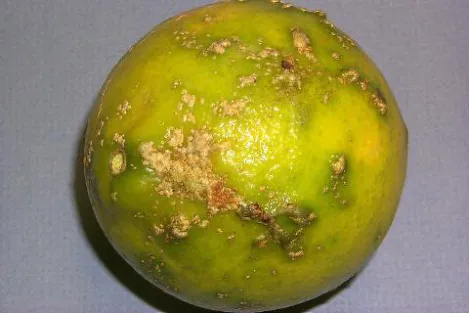
Citrus Canker
Causal organism: Xanthomonas campestris pv. citri
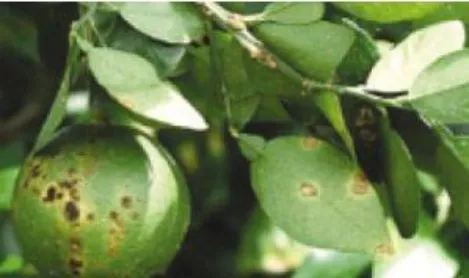
Canker is a bacterial disease that is important because it spreads through splashing rain, wind-driven injury, and wounds created by leaf miner damage.
Characteristic features include:
- circular lesions with yellow halo
- lesions on leaves, twigs, and fruits
- twig girdling in severe infection
- reduction in fruit market value
Favorable conditions
- free moisture
- warm temperature around 20-30 degrees C
- injury on young flush, especially due to leaf miner
Management logic
- prune badly infected twigs before monsoon
- control leaf miner during flush
- use copper-based sprays or antibiotic-supported measures noted in the source
- reduce spread during wet weather
Tristeza or Quick Decline
Causal organism: Citrus tristeza virus (CTV)
Tristeza is a viral disease associated with decline, poor vigor, and collapse in susceptible scion-rootstock combinations. Unlike gummosis or canker, it cannot be managed through fungicide or bactericide logic.
The key management principle is:
- use healthy propagation material
- select tolerant rootstocks
- manage vector transmission where relevant
This disease is a good example of why citrus pathology must be diagnosed accurately before control advice is given.
Summary Cheat Sheet
| Disease | Cause | Main symptom clue | Core management idea |
|---|---|---|---|
| Gummosis / foot rot | Phytophthora spp. | Bark cracking, gumming, collar rot | Drainage + trunk protection + anti-oomycete treatment |
| Scab | Elsinoe fawcetti | Corky raised lesions on leaves and fruit | Sanitation + fungicidal protection |
| Canker | Xanthomonas pv. citri | Haloed lesions on leaves, twigs, fruits | Pruning + copper-based protection + leaf miner control |
| Tristeza | CTV | Quick decline and graft-related susceptibility | Healthy planting stock + tolerant rootstocks |
Lesson Doubts
Ask questions, get expert answers