📈 Diseases of Mango
Diseases of Mango.
This lesson covers the major diseases of mango, their symptoms, pathogen features, spread, and practical management points for exam-focused plant pathology revision.
Anthracnose: Colletotrichum gloeosporioides
Symptoms:
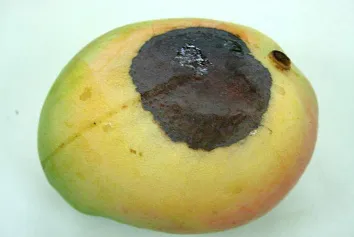
The disease appears on young leaves, stem, inflorescence and fruits. Leaves show oval or
irregular, greyish-brown spots which may coalesce to cover larger area of the leaf. The affected
leaf tissues dry and shred. Leaves on infected petioles droop and fall. On young stem, grey
brown spots develop. These enlarge and cause girdling and drying of the affected area. The
disease appears on young leaves, stem, inflorescence and fruits.
Often, black necrotic areas develop on the twigs from the tip downwards causing a
dieback. In humid weather, minute, black dots develop on the floral organs. The infected flower
parts ultimately shed resulting in partial or complete deblossoming. Latent infections of fruit are
established before harvest. The ripening fruits show typical anthracnose. Black spots appearing
on skin of the affected fruits gradually become sunken and coalesce.
Pathogen
Mycelium septate and coloured. Conidia Single celled, hyaline, small and elongated.
Mode of survival and spread
On dried leaves, defoliated branches mummified flowers and flower brackets. Contact with
diseased fruit during transport and storage. The secondary spread is through airborne conidia.
Favourable conditions
Temperature of 25°C and Relative Humidity 95-97%
Disease cycle
The survival of pathogen in detached diseased twigs and leaves lying on surface of soil
and in diseased twigs attached to the tree. They successfully reproduced the disease by
inoculating leaves, petioles, stems and fruits. The optimum temperature for infection was found
 to be 25˚C. The disease spreads rapidly in the rainy season. Cloudy and misty weather during
flowering favors damage to the infected floral parts.
The pathogen causes severe leaf spotting. The appearance of spots in more concentration
at the stem-end and sometimes in stripes down the sides of the fruits suggested distribution of
spores by rain water over surface of the fruit. The fungus can enter the pores of green fruits. The
latent infection of mature fruits may take place through lenticels. The fungus apparently infects
the fruit while it is green and develops in flesh during ripening.
Management
Spray P. fluorescens (FP 7) at 3 weeks interval commencing from October at 5g/like on flower branches.
5-7 sprays one to be given on flowers and bunches. Before storage, treat with hot water, (50-55°C) for 15 minutes or
dip in Benomyl solution (500ppm) or Thiobendazole (1000ppm) for 5 minutes
Powdery mildew: Oidium mangiferae (Acrosporum mangiferae)
Symptoms
Powdery mildew is one of the most serious diseases of mango affecting almost all the varieties.
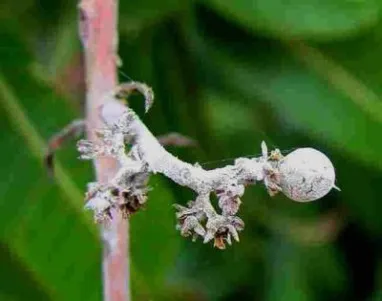
The characteristic symptom of the disease is the white superficial powdery fungal growth on
leaves, stalk of panicles, flowers and young fruits. The affected flowers and fruits drop pre
maturely reducing the crop load considerably or might even prevent the fruit set. Rains or mists
accompanied by cooler nights during flowering are congenial for the disease spread.
Pathogen
Mycelium is ectophytic. Conidiophores short, hyaline and conidia single celled -barrel
shaped, produced in chain. Fungus is odium type.
Mode of survival and spread
Survives as dormant mycelium in affected leaves. Secondary spread by air borne
conidia.
Disease Cycle
Spores blown wind from infected areas readily adhere to hairy, unopened flowers near tip
of the inflorescence and germinate in five to seven hours. Fungus grows rapidly during cloudy
weather accompanied with heavy morning mist. Warm, humid weather and low night
temperatures favour dissemination of the pathogen. Overall disease development is favoured by
high humidity.
Management
Dusting the plants with fine sulphur (250-300 mesh) at the rate of 0.5 kg/tree. The first
application may be soon after flowering, second 15 days later (or) spray with Wettable sulphur
(0.2%), (or) Carbendazim (0.1%),(or) Tridemorph ( 0.1%),(or) Karathane (0.1%).
Mango malformation : Fusarium moliliforme var . subglutinans
Symptoms
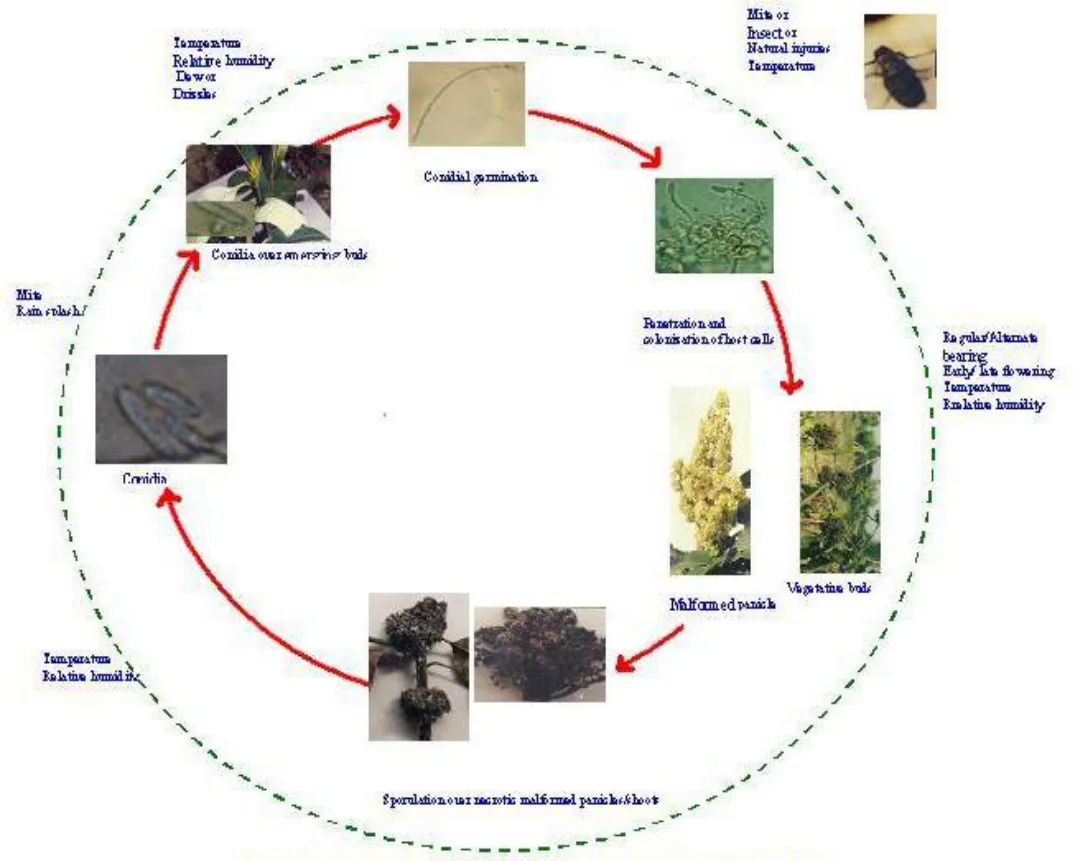
Three types of symptoms: bunchy top
phase, floral malformation and vegetative
malformation. In bunchy top phase in nursery
bunching of thickened small shoots, bearing
stunted giving a bunchy top appearance. In
vegetative malformation, excessive vegetative
branches of limited growth in seedlings. They are swollen with short internodes forming
bunches of various size and the top of the seedlings shows bunchy top appearance. In
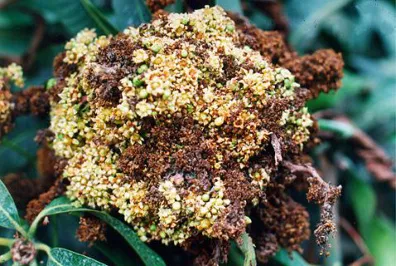
malformation of inflorescens, shows variation in the panicle. Malformed head dries up in black
mass and persist for long time. Secondary branches are transformed into number of small leaves
giving a witches broome appearance.
Pathogen
Micro conidia are one or 2 celled, oval to fusiform and produced from polyphialides.
Macro conidia are rarely produced. They are 2 -3 celled and falcate. Chlamydospores are not
produced.
Mode of spread
Diseased propagatives materials.
Disease Cycle
Management
Diseased plants should be destroyed .Use of disease free planting material. Incidence
reduced by spraying 100-200ppm NAA during October. Pruning of diseased parts along the
basal 15-20 cm apparently healthy portions. This is followed by the spraying of Carbendazim
(0.1%) or Captafol (0.2%).
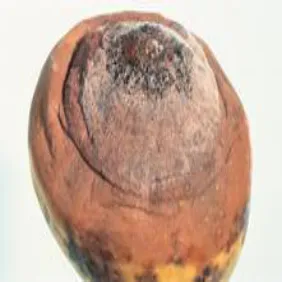
 Stem end rot: Diplodia natalensis
Symptoms
The dark epicarp around the base of the pedicel. In the initial stage the affected area
enlarges to form a circular, black patch. Under humid atmosphere extends rapidly and turns the
whole fruit completely black within two or three days. The pulp becomes brown and somewhat
softer. Dead twigs and bark of the trees, spread by rains
Pathogen
The fungus produces brown to black, globose to sub globose, pyriform, erumpent
pycnidia that are ostiolate. They are 120-155x370-465 micron meter. Two types of conidia are
produced within a pycnidium. One is hyaline, thin walled and unicellular.Tha another one is
thick walled and bicelled with four to six longitudinal striations.
Mode of spread and survival
The fungus persists in infected plant parts which serve as source of inoculum.
Management
Prune and destroy infected twigs and spray Carbendazim or Thiophanate Methyl(0.1%) or Chlorathalonil
(0.2%) as fortnightly interval during rainy season.
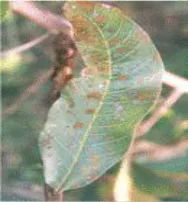
Red-rust: Cephaleuros virescens
Symptoms
Algae attacks foliage and young twigs. Rusty spots appear on leaves, initially as circular,
slightly elevated, coalesce to form irregular spots. The spores mature fall off and leave cream to
white valvet texture on the surface of the leaves .
Pathogen
Cephaleuros virescens after a period of vegetative growth develops its reproductive
structures.Sporangia formed directly on the thallus are sessile and thick walled with orange
pigments. hey are formed singly on the vegetative filaments. When the sporangia are riped the
con tents are converted into Zoospores and liberated through an opening in the wall. The
Zoospores are orange in colour, ovoid and swim actively by means of cilia.
Management
Bordeaux mixture (0.6%) or Copper oxychloride 0.25%
Grey Blight : Pestalotia mangiferae
Symptoms
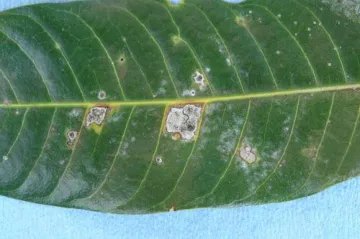
Brown spots develop on the margin and at the tip of the leaf lamina. They increase in
size and become dark brown. Black dots appear on the spots which are acervuli of the fungus.
Survive on mango leaves for over a year. Spreads through wind borne conidia. Heavy infection
is noticed during the monsoon when the temperature is 20-25˚C and high humidity.
Pathogen
Acervuli seen as minute black dots on affected portion. Mycelium is colored and septate.
Conidia five celled middle three cells are colored and the end cells are hyaline Slender 3-5
appendages are produced at the apex of the spore.
Mode of survival and spread
Survive on mango leaves for over a year. Spreads through wind borne conidia.
Favourable conditions
Heavy infection is noticed during the monsoon when the temperature is 20-25˚C and high
humidity.
Management
Remove and destroy infected plant parts. Spraying copper oxychloride 0.25 Mancozeb 0.25%
or Bordeaux mixture 1.0%.
 Sooty mould : Capnodium mangiferae
Symptoms
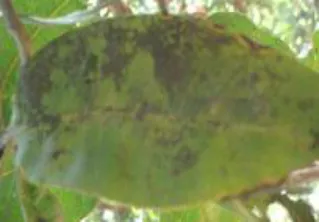
The fungi produce mycelium which is superficial and dark. They row on sugary
secretions of the plant hoppers. Black encrustation is formed which affect the photosynthetic
activity. The fungus grows on the leaf surface on the sugary substances secreted by jassids,
aphids and scale insects.
Favourable conditions
The fungus grows on the leaf surface on the sugary substances secreted by Jassids,Aphids
and scale insects.
Management
Management should be done for insects and sooty moulds simultaneously. Controlling of
insect by spraying systemic insecticides like Monocrotophos or methyl dematon .After that spray
starch solution (1kg Starch/Maida in 5 litres of water. Boiled and dilute to 20 liters) .Starch dries
and forms flake which are removed along with the fungus.
Summary Cheat Sheet
| Focus Area | Key Takeaway |
|---|---|
| Major diseases | Revise causal organisms, hallmark symptoms, and crop stage of attack. |
| Spread and survival | Link each disease with inoculum source, vector, and favorable conditions. |
| Management | Prioritize integrated management: sanitation, resistant varieties, and timely sprays. |
References
1 source • [1]
References
Class notes and standard plant pathology references
Lesson Doubts
Ask questions, get expert answers