📈 Diseases of Banana
Diseases of Banana.
This lesson explains important banana diseases, emphasizing diagnostic symptoms, pathogen biology, disease cycle, and integrated management for field and exam use.
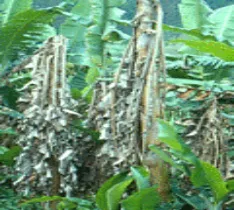
Panama disease : Fusarium oxysporum f. sp cubense
Economic Importance
The first major disease which attacked banana was called Panama disease from the area
where it first became serious. Banana wilt is a soil-borne fungal disease and gets entry in the
plant body through roots and wounds caused by nematodes. It is most serious in poorly drained
soil. Disease spreads through infected suckers.
Symptoms
Yellowing of the lower most leaves starting from margin to midrib of the leaves.
Yellowing extends upwards and finally heart leaf alone remains green for some time and it is
also affected. The leaves break near the base and hang down around pseudostem. Longitudinal
splitting of pseudostem. Discolouration of vascular vessels as red or brown streaks. The fungus
spreads through use of infected rhizomes Continuous cultivation results in build up of inoculum.
Pathogen
Mycelium is septate, hyaline and branched. Fungus produces micro, macro conidia and
also chlamydospores. Micro conidia - Single celled or rarely one septate hyaline elliptical or
oval. Macro conidia - Sickle shaped hyaline, 3-5 septate and tapering at both ends.
Chalamydospores - Thick walled, spherical to oval, hyaline to slightly yellowish in colour.
Mode of spread and survival
The pathogen is soil borne. It survives in soil as chlamydospores for longer periods. The
primary spread of the disease is through infected rhizomes and secondary spread is through
irrigation water. Continuous cultivation results in build up of inoculum.
Management
Avoid growing of susceptible cultivars viz., Rasthali, Monthan, Red banana and
Virupakshi. Grow resistant cultivar Poovan. Since nematode predispose the disease pairing and
prolinage wit Carbofuran granules. Corm injection of 3 ml of 2% Carbendezim injected in the
corm by making a hole to a depth of 10cm with 45 0 angle on 5 th and 7 th month as
mentioned earlier.
Moko disease : Pseudomonas solanacearum / Burkholderia solanacearum
Symptoms
Leaves become yellow and progress upwards. The petiole breaks and leaves hang. When it
is cut open discolouration in vascular region with pale yellow to dark brown colour. The
discolouration is in the central portion of the corm. Internal rot of fruits with dark brown
discoloration. When the pseudostem is cut transversely bacterial ooze can be seen.
Pathogen
It is rod shaped, gram negative bacterium with one polar flagellum.
Mode of spread and survival
The pathogen is soil borne, it survives in susceptible hosts like banana and Heliconia spp.
Management
Eradicate infected plant. Expose soil to direct sunlight. Use of clean planting material.
Fallowing and crop rotation is advisable.Disinfection of pruning of tools. Providing good
drainage.
Tip over or Heart rot: Erwinia carotovora subsp. carotovora
Symptoms
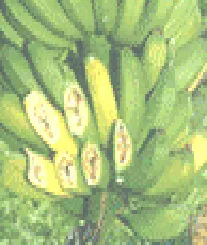
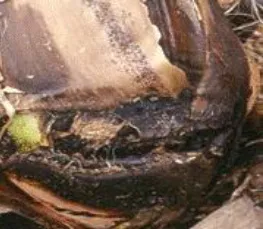 The base of the pseudostem and upper portion of the corm are affected and leads to
rotting. Young 1-3 month old plantation susceptible during summer months.
Management
Plant disease free suckers. Remove infected plants and destroy. Drench with Methoxy
ethyl mercuric chloride (Emisan-6) 0.1 / or Sodium hypohlorite 10% or Bleaching powder 20g
/litre/tree.
Sigatoka disease : Mycosphaerella musicola (Cercospora musae )
Symptoms
On leaves small light yellow or brownish green narrow streaks appear. They enlarge in
size becomes linear, oblong, brown to black spots with dark brown brand and yellow halo.
Black specks of fungal fruitification appear in the affected leaves. Rapid drying and defoliation
of the leaves.
Pathogen
Conidia are elongated, narrow and multi septate and measure 20 – 80 x 2-6micron meter.
Perithecia are dark brown to black and asci are oblong, clavate and measure 28.8- 36.8x8.0-10.8
micron meter. Ascospores are one septate, hyaline, obtuse with upper cell slightly broader.
Disease Cycle
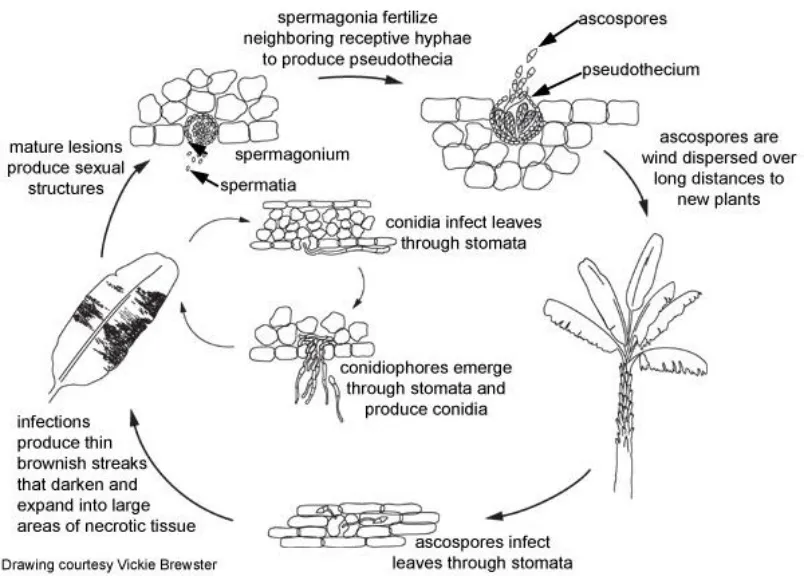
Management
Removal and destruction of the affected leaves. Spray Propiconazole + Carbendazim
0.1% or Chlorothalonil 0.25%. Add wetting agent such as teepol or sandovit added at the rate of
1ml/lit of water.
Cigar end Rot (Verticillium theobromae, Trachsphaera fructigena and Gloeosporium musarum)
Symptoms
A black necrosis spread from the perianth into the tip of immature fingers . The rotted
portion of the banana finger is dry and tends to adhere to fruits (appears similar to the ash of a
cigar).
Pathogen
Conidiophores are usually solitary or in small groups. Conidia are hyaline, oblong to
cylindrical. They are borne at the end of tapering phialides, aggregated into rounded,
mucilaginous translucent heads.
Control:
Removal of pistil and perianth by hand 8-10 days after bunch formation and spraying the
bunch with Dithane M -45 (0.1%) or Topsin M (0.1%) controls the disease effectively.
Minimising bruising; prompt cooling to 14°C; proper sanitation of handling facilities reduce the
incidence in the cold storage.
Anthracnose : Gloeosporium gloeosporioides
Symptoms:
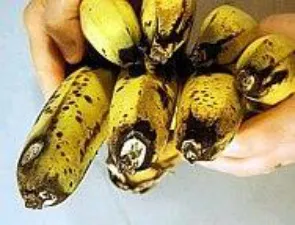
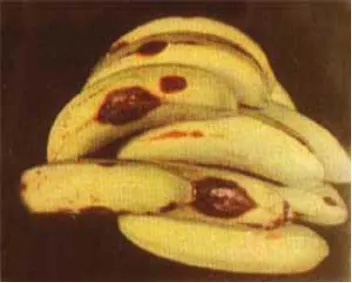 The skin at the distal ends of the fingers turn black shrivels. The fungus produces masses
of conidia which form a pinkish coat. The entire fruit and bunch is affected in severe cases.
Sometimes main stalk of bunch diseased. The bunch becomes black and rotten. Acervuli
produces cylindrical conidiophores, hyaline, septate, branched. Conidia hyaline, non-septate,
oval to elliptical.
Pathogen
Acervuli are usually rounded or sometimes elongated, erumpent. Conidiophores are
cylindrical, tapered towards the apex, hyaline and septate. Conidia are hyaline, aseptate, oval to
ellipitical in shape.
Mode of spread and survival
The spread of the disease is by air borne conidia and numerous insects which frequently
visit banana flowers also spread the disease.
Management
Post harvest dipping of fruits in Carbendazim 400 ppm, or Benomyl 1000 ppm, or
Aureofunginsol 100 ppm.
Freckle or Black Spot: Phyllostictina musarum
Symptoms
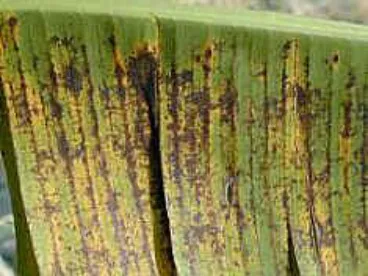
Minute raised dark brown spots appear with black dots in the centre on leaves and fruits.
On the fruits the pathogen is confined to the skin. The fungus produces pycnidium which are
dark. conidiophores simple, short, elongate. Conidia are byline, single celled ovoid. Fungus
survives in infected plant debris. Conidia spread by rain water and wind.
Pathogen
The fungus produces pycnidia and pycnidiospores. Pycnidiospores are needle shape,
hyaline and multi septate.
Management
Spray Copper oxychloride 0.25%. Add wetting agent such as teepol or sandovit added at
the rate of 1ml/lit of water.
Banana bunchy top: Banana bunchy top virus
Economic Importance
The disease is covered by domestic quarantine regulations. Losses were estimated to be
Rs.4 crores every year and 100% loss occurs if infected suckers are planted.
Symptoms
Subsequent leaving show the same symptoms and are dwarfed. Dark broken bands of green
tissues on the veins, leaves and petioles. Plants are extremely stunted. Leaves are reduced in size
marginal chlorosis and curling. Leaves upright and become brittle. Many leaves are crowded at
the top. Branches size will very small. If infected earlier no bunch will be produced. The
disease is transmitted primarily by infected suckers.
Mode of spread
Secondary spread is through the aphid vector Pentalonia nigronervosa
Management
Select suckers from disease free areas. Control vector by spraying methyl demoton 1
ml/l.or Monocrotophos, 2 ml/l.or Phosphomidon 1 ml / lit. or Injection of Monocrotophos 1 ml /
plant (1 ml diluted in 4 ml). Infected plants are destroyed using 4ml of 2, 4, D (50g in 400 ml of
water).
Infectious chlorosis: Cucumber mosaic virus
Economic Importance
Infectious chlorosis or heart rot of banana is caused by Cucumber Mosaic Virus (CMV)
has recently become serious, the disease has been recorded from 20 to 80 per cent in Poovan
cultivar.
Symptoms
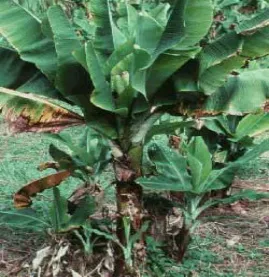
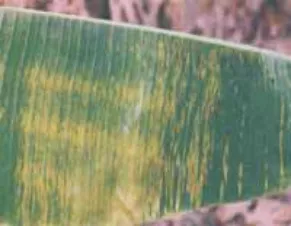
Chlorotic or yellow linear discontinuous streaks on leaves, upward curling of leaves, twisting
and bunching of leaves at the crown, erectness of newly emerged leaves. Sometimes heart rot
symptom also appear. Diseased plants are dwarf, do not produce bunches. The virus spreads
through infected suckers and aphid vectors - Aphis gossypii
Management
Destroy infected plants. Use disease free suckers. Control vector by spraying systemic
insecticide 0.1%
Summary Cheat Sheet
| Focus Area | Key Takeaway |
|---|---|
| Major diseases | Revise causal organisms, hallmark symptoms, and crop stage of attack. |
| Spread and survival | Link each disease with inoculum source, vector, and favorable conditions. |
| Management | Prioritize integrated management: sanitation, resistant varieties, and timely sprays. |
References
1 source • [1]
References
Class notes and standard plant pathology references
Lesson Doubts
Ask questions, get expert answers