📈 Diseases of Potato
Diseases of Potato.
This lesson compiles major potato diseases with emphasis on symptom recognition, epidemiology, and stage-wise disease management.
Late blight of potato: Phytopthora infestans
Symptom :
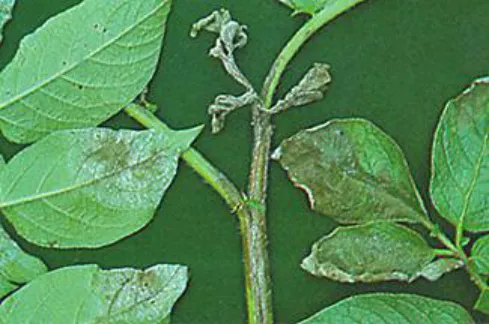
It affects leaves, stems and tubers. Water soaked spots appear on leaves, increase in size,
turn purple brown& finally black colour White growth develops on under surface of leaves. This
spreads to petioles, rachis& stems. It frequently develops at nodes. Stem breaks at these points
and the plant topples over. In tubers, purplish brown spots and spread to the entire surface on
cutting, the affected tuber show rusty brown necrosis spreading from surface to the center.
Pathogen
The mycelium is endophytic, coenocytic and hyaline which are inter cellular with double
club shaped haustoria type. Sporangiophores are hyaline, branched intermediate and thick
walled. Sporangia are thin walled, hyaline, oval or pear shaped with a definite papilla at the apex.
The sporangium may act as a conidium and germinate directly to form a germ tube. Zoospores
are biflagellate possess fine hairs while the other does not.
Mode of spread and survival
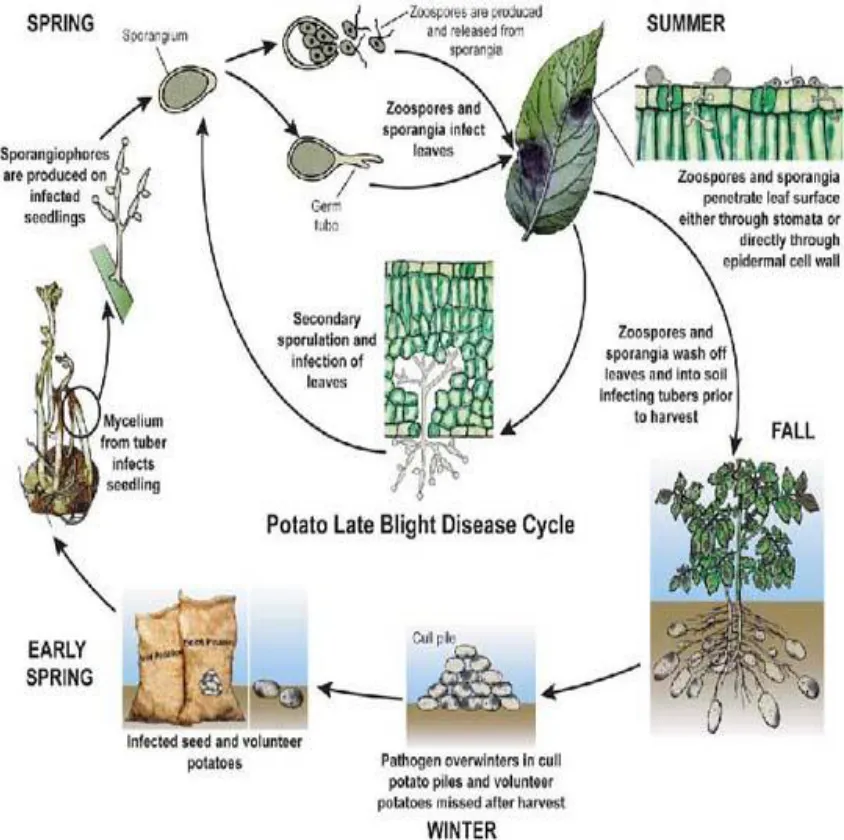
The infected tubers and the infected soil may serve as a source of primary infection. The
diseased tubers are mainly responsible for persistence of the disease from crop to crop. The air
borne infection is caused by the sporangia.
Favourable conditions
RH->90%, Temp.-10-25°C and Night temperature:10°C. Cloudiness on the next day
Rainfall at least 0.1mm, the following day.
Management
A regular spraying and dusting during the growing season give effective control. First
spraying should be given before the commencement of the disease and subsequent should follow
at reqular interval of 10 -15 days. Protective spraying with mancozeb or zineb 0.2 % should be
done to prevent infection of tubers. Destruction of the foliage few days before harvest is
beneficial and this is accomplished by spraying with suitable herbicide. Tuber contamination is
minimized if injuries are avoided at harvest time and storing of visibly infected tubers before
storage. The resistant varities recommended for cultivation are Kufri Naveen, Kufri Jeevan,
Kufri Alenkar, Kufri Khasi Garo and Kufri Moti.
Early blight: Alternaria solani
Symptoms
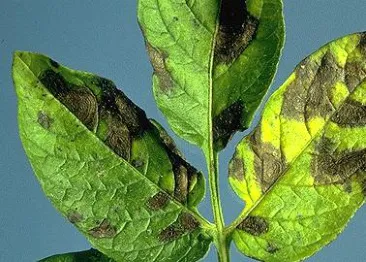 It is present in both hills & plains. Brown-black necrotic spot-angular, oval shape
characterized by concentric rings .Several spot coalesce & spread all over the leaf. Shot holes on
fruits.
Pathogen
Hyphae are light brown or olivaceous which become dark coloured with age. The hyphae
are branched, septate and inter and intra cellular. The coniophores emerge through the stomata or
between the epidermal cells. The conidia are club shaped with a long beak which is often half the
long of the whole conidium. The lower part of the conidium is brown while the neck is colorless.
The body of the conidium is divided by 5 – 10 transverse septa and there may or may not be a
few longitudinal septa.
Favourable condition
Dry warm weather with intermittent rain .Poor vigor. Temperature: 25-30°C. Poorly
manured crop.
Mode of spread and survival
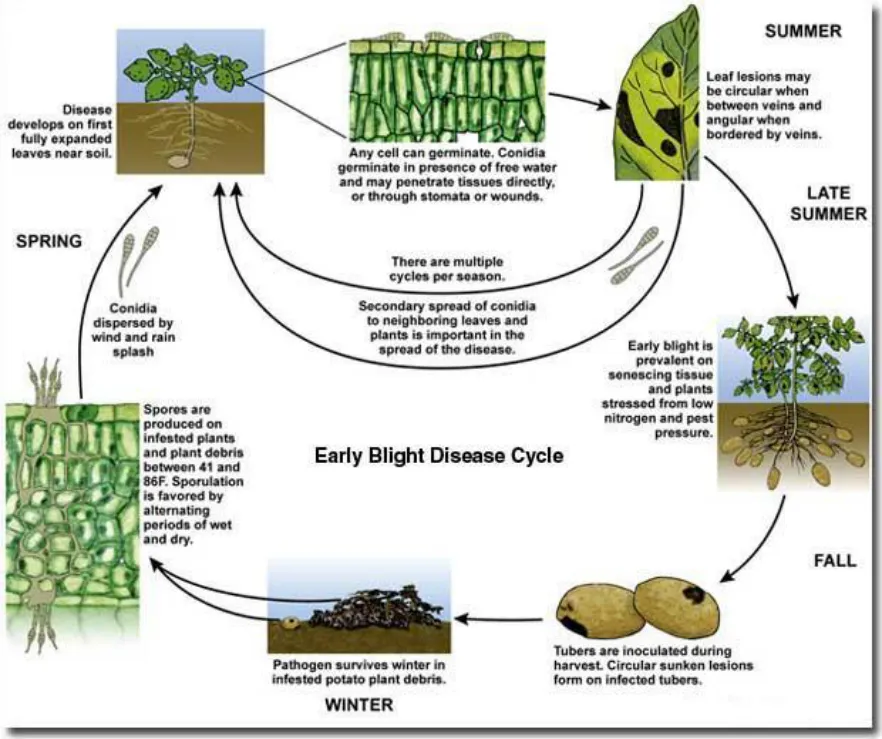
The conidia and the mycelium in the soil or in the debris of the affected plants can remain
viable for more than 17 months. These conidia or the new conidia found on the overwintered
mycelium bring about the primary infection of the succeeding potato crop. Secondary infection is
more important in the spread of the disease. The conidia formed on the spots developed due to
primary infection are disseminated by wind to long distances. The conidia from the affected
plant may also be disseminated to the adjoining plants by rain and insects.
Management
Disease free seed tubers should be used for planting. Removal and destruction of infected
plant debris should be done because the spores lying in the soil are the primary source of
infection. Very early spraying with Zineb or captan 0.2% and repeating it for every 15 – 20 days
gives effective control. The variety Kufri Sindhuri possesses a fair degree of resistance.
Post-harvest tuber rots - Sclerotium rolfsii
Symptoms
Wilting is the initial symptom. Yellowish brown coloured Sclerotia appeared on the
infected tuber. Rotting of the tuber. Milky white and floccose appearance of the tuber.
Pathogen
The mycelium is silky white and floccose. It is comprised of septate and branched
hyphae. The branching take place just below the septum. The cells are large in size. Sclerotia of
the fungus are white to begin with and become clove brown at maturity. They are globose and
smooth surfaced.
Favorable condition
Optimum temperature 30-35ºC. Alternate period of wet and dry soil condition.
Mode of spread and survival
The mycelium and sclerotia of the organisam subsist in the soil and are responsible for
the infection of the crop. The pathogen is disseminated with infected soil, in running water and
on farm implements. Mycelium and sclerotia may also be carried to soil with the seed tubers. In
dry soil scleritia can remain viable for more than two years.
Management
Treating seeds with mercury compounds after harvest reduces tuber rot. Treating the
furrows at planting with PCNB @ 15kg/ ha reduces the disease icidence.Cultural practices like
heavy earthing and irrigation at regular intervals can also check the disease. The disease is low in
the variety Kufri Sindhuri. Among the Indian commercial cultivars, Kufri Bahar, Kufri
Chamatkar, Kufri Jyothi, Kufri muthu and Kufri swarna are resistant. The disease can be
controlled to a certain extent by growing non susceptible crops like corn and sorghum.
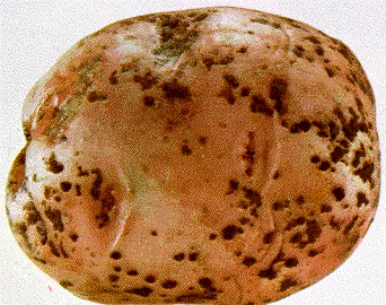
Black scurf- R. solani
Symptoms
Black speck, black speck scab, russet scab on tubers. At the time of sprouting dark brown
colour appear on the eyes. Affected Xylem tissue causes to wilting of plants. Infected tuber
contains russeting of the skin. Hard dry rot with browning on internal tissue. Spongy mass
appear on the infected tuber. Seed tubers are source of spread. Moderately cool, wet weather and
temp 23 °C are the favourable for the development of disease.
Pathogen
The mycelium is hyaline when young and brown at maturity. Hyphae are septate and
branched with a characteristic constriction at their junction with the main hyphae. The branches
arise at a right angle to main axis. Sclerotia are black. A basidium bears four sterimata each with
a basidiospore at the end. The basidiospores are hyaline, elliptical to obovate and thin walled.
They are capable of forming secondary basidiospores.
Mode of spread and survival
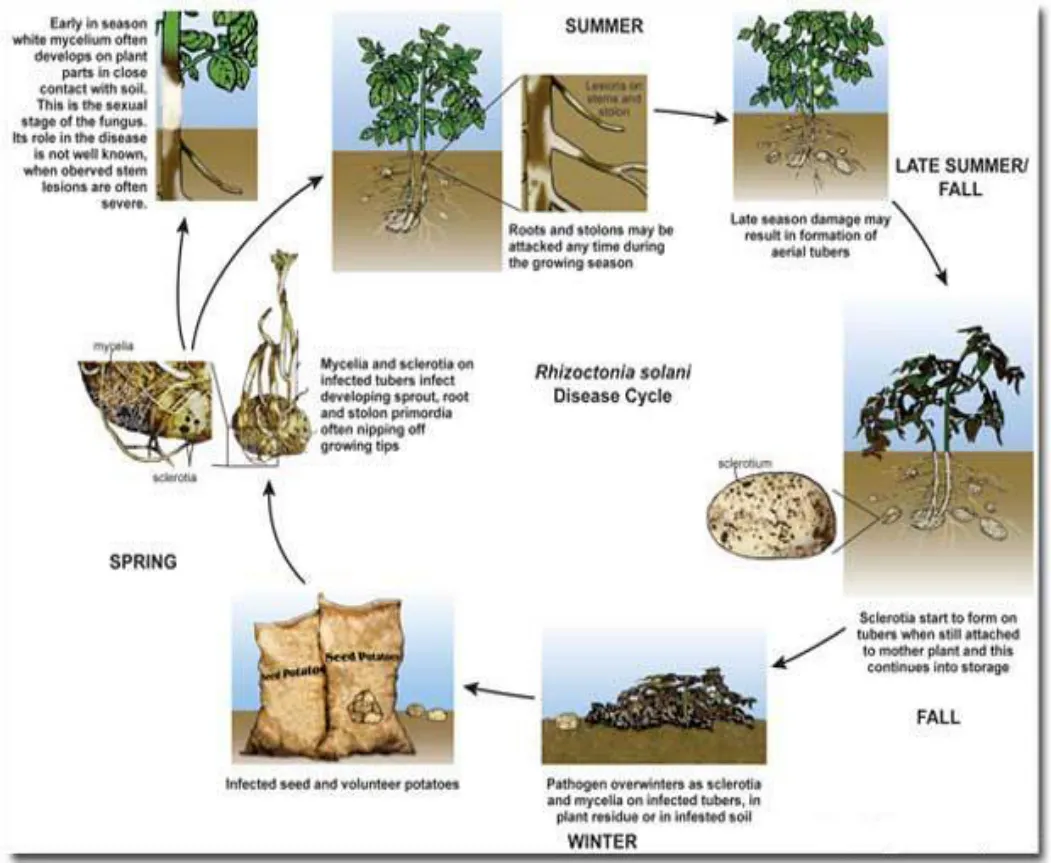
The fungus is capable of leading a saprophytic life on the organic material and can
remain viable in the soil for several years. The sclerotia on the seed tubers is the principal source
 of infection of the subsequent crop raised with these tubers. On return of favourable conditions
the mycelium present in the soil may develop producing new hypae.
Management
Disease free seed tubers alone should be planted. If there is a slight infection of black
scurf that can be controlled by treating seed tubers with mercuric chloride solution for 1.5 hr
with acidulated mercuric chloride solution for 5 min. Treating the soil with pentachloroni
trobenzene at the rate of 70 kg/ ha lowers the incidence of the disease, but it is too expensive and
cumbersome. Well sporulated tubrs may be planted shallow to control disease. The disease
severity is reduced in the land is left fallow for 2 years.
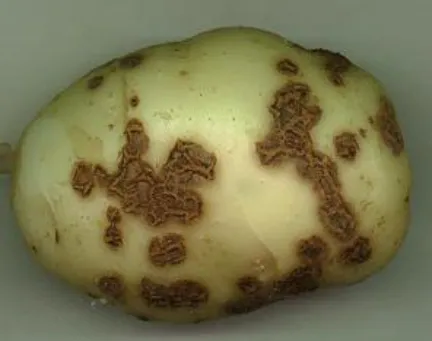
 Common scab or corkey scab – Streptomyces scabies
Symptoms
Corkiness of the tuber periderm is the characteristics symptoms. 1/4 inch into the tuber
surface are russette appearance. Slightly pitted on the infected tuber. Light brown to dark brown
lesion appears on the infected tuber. Affected tissue will attract insects.
Pathogen
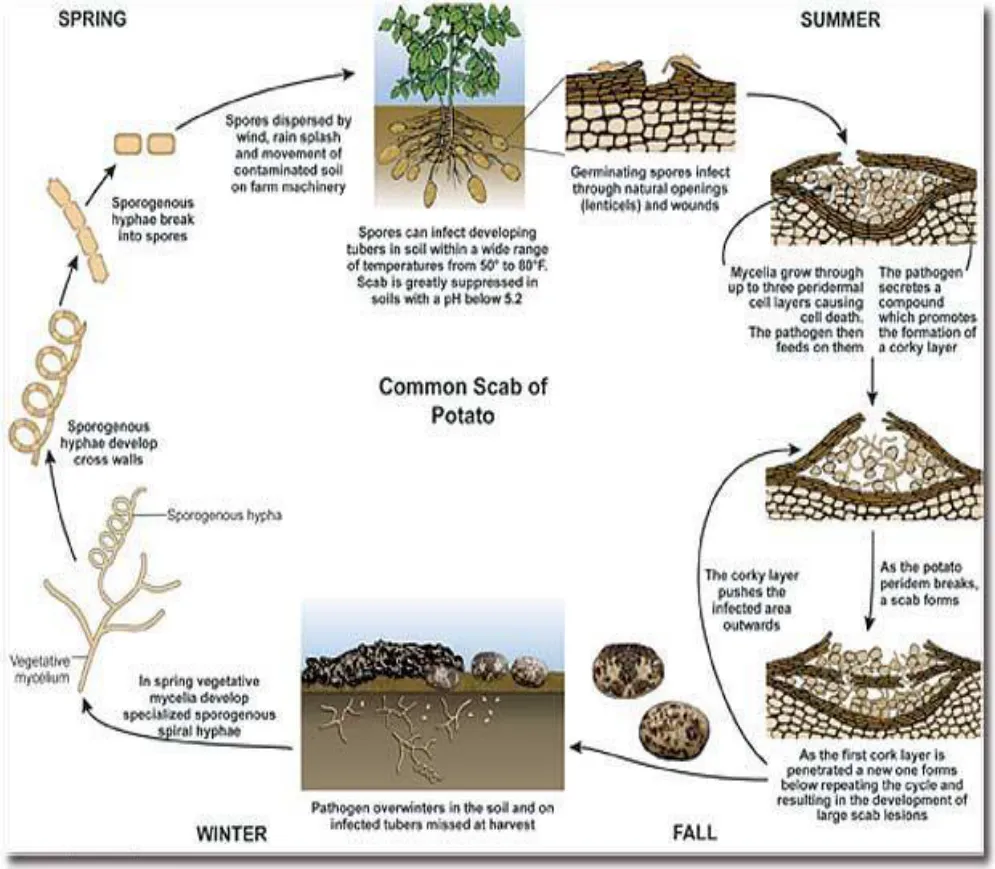
Aerial mycelium in pure culture has of prostrate branched threads. Sporogenous hyphae
are spiral in form. Conidia are produced by the formation of septa at intervals along the hyphae,
which contract to form narrow isthmuses between the cells. Conidia are roughly cylindrical and
hyaline. The conidia can germinate even at higher temperatures. The growth of the organisam is
good in slightly alkaline medium and is checked at pH 5.2.
Mode of spread and survival
It attacks cabbage, carrot, egg plant, onion, radish, spinach and turnip. The causal
organism perpetuates in soil and infects the crop every year. Infected potato tubers serve as the
main source of long distance spread of the disease. The pathogen may survive passage through
digestive tract of animals and hence it may spread with farm yard manure.
Disease Cycle
Management
Only scab free seed potatoes should be planted as this will help in checking the spread of
the inoculum and infection to be subsequent crop. Infection of the seed tubers can be removed by
1.5hrs dip in mercuric chloride 0.1% solution or by 2h dip in 1 part formaldehyde in 240 parts of
water. This disease can be reduced by soil application of PCNB at the time of planting. Four to
six years crop roation with alfalfa satisfactory under irrigated conditions. The disease incidence
can be effectively reduced by green manuring the fields before planting potatoes. Common scab
is severe in alkaline soil and application of alkaline fertilizers like calcium ammonium nitrate
should be avoided.
 Brown rot or Bangle blight - Ralstonia solanacearum
Symptoms
At the time tuber formation wilt is the main characteristic symptom. In leaf symptom
wilt, stunt and yellowing. Browning of xylem tissue. Eye buds are black in colour. Bacteria ooze
coming on infected tuber surface and emits a foul odour.
Pathogen
G –ve, short rod, 1-4 flagella. Colonies are white to brown in colour
Favourable condition
Temp 25to 35ºC, RH above 50 % and PH 6.2-6.6 favours for the development of disease.
Acid soil is not favourable.
Mode of spread and survival
Infected soil and seed tubers form the main source of the primary infection. Brown rot
affected plant parts decay and release masses of bacteria in the soil where these may remain
viable from season to season. The bacteria in the soil are disseminated by wind from one field to
the other. The infection usually occurs through wounds in the root system.
Disease cycle
R. solanacearum is a soilborne and waterborne pathogen; the bacterium can survive and
disperse for various periods of time in infested soil or water, which can form a reservoir source
of inoculum. In potato, the brown rot pathogen is also commonly tuber borne. The bacterium
usually infects potato plants through the roots (through wounds or at the points of emergence of
lateral roots).
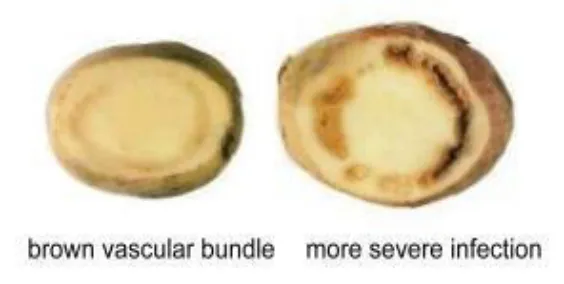
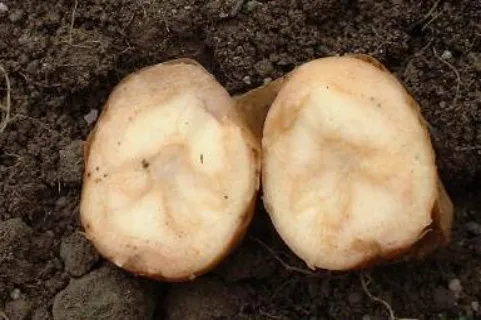
Under favorable conditions, potato plants infected with R. solanacearum may not show
any disease symptoms. In this case, latently infected tubers used for potato seed production may
play a major role in spread of the bacterium from infected potato seed production sites to healthy
potato-growing sites. R. solanacearum can survive for days to years in infected plant material in
soils, infested surface irrigation water, infected weeds, and infected potato washings and sewage.
From these sources of inoculum, bacteria can spread from infested to healthy fields by soil
transfer on machinery, and surface runoff water after irrigation or rainfall. Infected semi-aquatic
weeds may also play a major role in disseminating the pathogen by
releasing bacteria from roots into irrigation water supplies.
Soft rot- Erwinia carotovora subsp caratovora
Symptoms
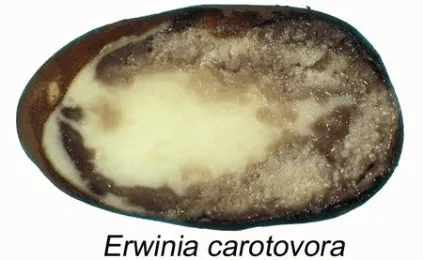
Infection at two phases are black leg and soft rot. Black lesion appear on the base of the plant
.Systemic and browning of infected tubers. Yellow appearance of the plant. Finally the plants
wilt and die. Lenticels (water soaked brown rot). Rot and collapse of tubers. Soft, reddish or
black ring appear on the infected tuber.
Pathogen
It is a gram negative rod shaped bacterium with 1 to 6 peritrichous flagella.
Mode of spread and survival
Infected tubers attract the flies ( Hymelia and Phorlin sp). Spread through immature
contaminated soil and tuber. Optimum temperature 21 to 29 ºC and RH 94%
Management
The pathogen is difficult to control because of long survival both on seed tubers and in soils.
However using disease free seed tubers could minimize the disease incidence. Before planting
the seed tubers are treated with Boric Acid (3% for 30 minutes) and dried in shade. The same
treatment is repeated before the storage of the tubers.
The disease can be reduced by soil application of PCNB (30 kg/ha) at the time of planting.
Following crop rotations with wheat, pea, oats, barley, lupin, soybean, sorghum and bajra checks
the disease development. In plains, treatment of the seed tubers with TBZ + acetic acid + 0.05%
Zinc Sulphate solution or Carbendazim 1% for 15 minutes effectively controls the disease.
Soaking of tubers in Mercuric chloride 0.1% formalin.
Summary Cheat Sheet
| Focus Area | Key Takeaway |
|---|---|
| Major diseases | Revise causal organisms, hallmark symptoms, and crop stage of attack. |
| Spread and survival | Link each disease with inoculum source, vector, and favorable conditions. |
| Management | Prioritize integrated management: sanitation, resistant varieties, and timely sprays. |
References
1 source • [1]
References
Class notes and standard plant pathology references
Lesson Doubts
Ask questions, get expert answers