📈 Diseases of Tomato
Diseases of Tomato.
This lesson on Diseases of Tomato covers major diseases, key symptoms, spread/survival, and management points for exam-focused and field-level understanding.
Damping off: Pythium aphanidermatum
Symptoms
Damping off of tomato occurs in two stages, i.e. the pre-emergence and the post
emergence phase. In the pre-emergence the phase the seedlings are killed just before they reach
the soil surface. The young radical and the plumule are killed and there is complete rotting of the
seedlings. The post-emergence phase is characterized by the infection of the young, juvenile
tissues of the collar at the ground level. The infected tissues become soft and water soaked. The
seedlings topple over or collapse.
Mode of spread and survival
All the causal organisms are soil inhabitants and they build up in soil with the available
hosts. Generally these pathogens have wide host range.
Management
Used raised seed bed. Provide light, but frequent irrigation for better drainage. Drench
with Copper oxychloride 0.2% or Bordeaux mixture 1%. Seed treatment with fungal culture
Trichoderma viride (4 g/kg of seed) or Thiram (3 g/kg of seed) is the only preventive measure to
control the pre-emergence damping off. Spray 0.2% Metalaxyl when there is cloudy weather
Fusarium Wilt: Fusarium oxysporum f. sp. lycopersici
Symptom
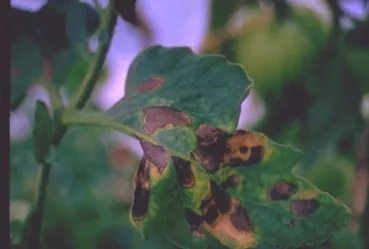
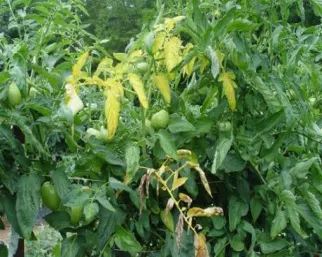 The first symptom of the disease is clearing of the veinlets and chlorosis of the leaves. The
younger leaves may die in succession and the entire may wilt and die in a course of few days.
Soon the petiole and the leaves droop and wilt. In young plants, symptom consists of clearing of
vein let and dropping of petioles. In field, yellowing of the lower leaves first and affected leaflets
wilt and die. The symptoms continue in subsequent leaves. At later stage, browning of vascular
system occurs. Plants become stunted and die.
Pathogen
Mycelium is septate and hyaline. They produce macro and micro conidia. Micro conidia
are one celled, hyaline, ovoid to ellipsoid. Two races of pathogen have been identified.
Mode of spread and survival
The fungus is seed borne and soil borne. The fungus survives in the soil as
chlamydospores or as saprophytically growing mycelium in infected crop debris for more than
10 years. One of the chief methods of its distribution is by seedlings raised in infected soil. Wind
borne spores, surface drainage water and agricultural implements also help in distribution of the
pathogen from field to field.
Management
The affected plants should be removed and destroyed. Spot drench with Carbendazim
(0.1%). Crop rotation with a non-host crop such as cereals.
Early Blight : Alternaria solani
Symptoms
This is a common disease of tomato occurring on the foliage at any stage of the growth.
The fungus attacks the foliage causing characteristic leaf spots and blight. Early blight is first
observed on the plants as small, black lesions mostly on the older foliage. Spots enlarge, and by
the time they are one-fourth inch in diameter or larger, concentric rings in a bull's eye pattern can
be seen in the center of the diseased area. Tissue surrounding the spots may turn yellow.
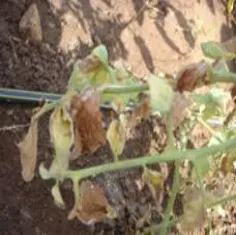 If high temperature and humidity occur at this time, much of the foliage is killed. Lesions
on the stems are similar to those on leaves, sometimes girdling the plant if they occur near the
soil line. Transplants showing infection by the late blight fungus often die when set in the field.
The fungus also infects the fruit, generally through the calyx or stem attachment. Lesions attain
considerable size, usually involving nearly the entire fruit; concentric rings are also present on
the fruit.
Pathogen
Mycelium is septate, branched, light brown which become darker with age.
Conidiophores are dark colored. Conidia are beaked, muriform, dark colored and borne singly.
Mode of spread and survival
The pathogen is spread by wind and rain splashes. Under dry conditions it survives in
infected plant debris in the soil for upto three years and is also seed borne.
Management
Removal and destruction of crop debris. Practicing crop rotation helps to minimize the
disease incidence. Spray the crop with Mancozeb 0.2 % for effective disease control.
Septoria Leaf Spot : Septoria lycopersici
Symptom
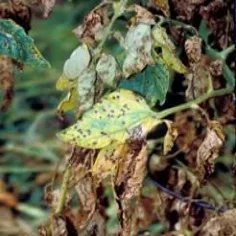
The plant may be attacked at any stage of its growth. The disease is characterized by
numerous, small, grey, circular leaf spots having dark border.
Pathogen
Mycelium is septate, branched, hyaline when young and darkens with age. Pycnidia are
erumpent. Pycnidiospores are filiform, hyaline and septate.
Mode of spread and survival
The pathogen is spread by wind and rain splashes, insects and on the hands and clothings
of tomato pickers. It survives from one season to the next on infested crop debris and also on
 solanaceous weeds. The fungus also survives on or in the seed. Seed stocks contaminated with
spores produce infected seedlings.
Management
Removal and destruction of the affected plant parts. Seed treatment with Thiram or
Dithane M-45 (2 g/kg seed) is useful in checking seed borne infection. In the field spraying with
Mancozeb 0.2 % effectively controls the disease.
Bacterial wilt: Burkholderia solanacearum
Symptom
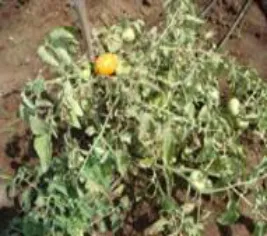
This is one of the most serious diseases of tomato crop. Relatively high soil moisture and soil
temperature favour disease development. Characteristic symptoms of bacterial wilt are the rapid
and complete wilting of normal grown up plants. Lower leaves may drop before wilting.
Pathogen is mostly confined to vascular region; in advantage cases, it may invade the cortex and
pith and cause yellow brown discolouration of tissues. Infected plant parts when cut and
immersed in clear water, a white streak of bacterial ooze is seen coming out from cut ends.
Pathogen
The bacterium is gram negative, rod shaped often occurs in pairs, motile with 1 – 4
flagella. The optimum temperature for growth is 30 - 37˚C.
Mode of spread and survival
The bacterium survives in soil and they spread through irrigation water and by
transplanting of infected seedlings. The bacterium survives for 3 years in fallow and for a
unlimited period in cultivated land. Chilli, egg plant, grount nut, potato and tobacco are
alternative hostswhich help it to survive between tomato crops.
Management
Avoid damage to seedling while transplanting. Apply bleaching powder @ 10kg/ha. Crop
rotations, viz., cowpea-maize-cabbage, okra-cowpea-maize, maize- cowpea-maize and finger
millet-egg plant are reported effective in reducing bacterial wilt of tomato.
Bacterial Leaf Spot : Xanthomonas campestris pv. vesicatoria
Symptom
Moist weather and splattering rains are conducive to disease development. Most outbreaks of
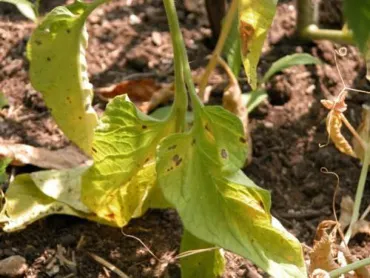
the disease can be traced back to heavy rainstorms that occur in the area. Infected leaves show
small, brown, water soaked, circular spots surrounded with yellowish halo. On older plants the
leaflet infection is mostly on older leaves and may cause serious defoliation.
The most striking symptoms are on the green fruit. Small, water-soaked spots first appear
which later become raised and enlarge until they are one-eighth to one-fourth inch in diameter.
Centers of these lesions become irregular, light brown and slightly sunken with a rough, scabby
surface. Ripe fruits are not susceptible to the disease. Surface of the seed becomes contaminated
with the bacteria, remaining on the seed surface for some time. The organism survives in
alternate hosts, on volunteer tomato plants and on infected plant debris.
Pathogen
The bacterium is gram negative, short rod shaped and has a single, polar flagellum.
Capsules are formed.
Mode of spread and survival
The pathogen survives in the diseased plant debris, volunteer plants. It is seed borne. The
bacterium enters through stomata or injuries and lenticels. Secondary spread through rain
splashes. Disease spreads to new areas through infected seeds and diseased transplants.
Management
Disease-free seed and seedlings should always be used and the crop should be rotated
with non-host crops so as to avoid last years crop residue. Seed treatment with mercuric chloride
(1:1000) is also recommended for control of disease. Spraying with a combination of copper and
organic fungicides in a regular preventative spray program at 5 to 10 day intervals or Spraying
with Agrimycin-100 (100 ppm) thrice at 10 days intervals effectively controls the disease.
Mosaic: Tomato mosaic virus (TMV)
Symptom
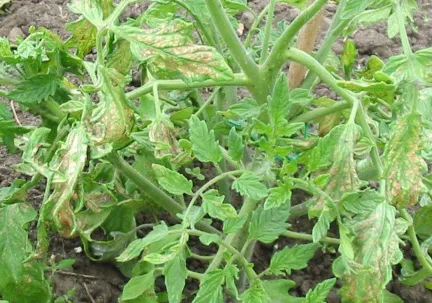
The disease is characterized by light and day green mottling on the leaves often accompanied
by wilting of young leaves in sunny days when plants first become infected. The leaflets of
affected leaves are usually distorted, puckered and smaller than normal. Sometimes the leaflets
become indented resulting in "fern leaf" symptoms. The affected plant appears stunted, pale
green and spindly. The virus is spread by contact with clothes, hand of working labour, touching
of infected plants with healthy ones, plant debris and implements.
Pathogen
Virus paricles are rod shaped, not enveloped, usually straight and thermal inactivation
point is 85 - 90˚C.
Mode of spread and survival
The virus is seed borne and upto 94% of seeds may contain the virus. The virus infection
occurs during transplanting It is readily transmissible. Many solanaceous plants are susceptible
to tomato mosaic virus. The virus is spread easily by man and implements in cultural operations
or by animals and by leaf contact.
Management
Seeds from disease free healthy plants should be selected for sowing. Soaking of the
seeds in a solution of Trisodium Phosphate (90 g/litre of water) a day before sowing helps to
reduce the disease incidence. The seeds should be thoroughly rinsed and dried in shade. In the
nursery all the infected plants should be removed carefully and destroyed. Seedlings with
infected with the viral disease should not be used for transplanting. Crop rotation with crops
other than tobacco, potato, chilli, capsicum, brinjal, etc. should be undertaken.
Leaf curl: Tomato leaf curl virus (ToLCV)
Symptom
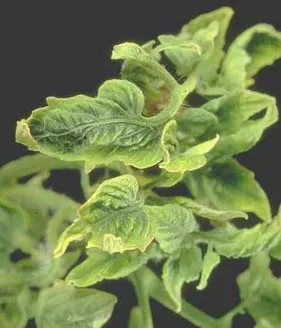
Leaf curl disease is characterized by severe stunting of the plants with downward rolling and
crinkling of the leaves. The newly emerging leaves exhibit slight yellow colouration and later
they also show curling symptoms. Older leaves become leathery and brittle. The nodes and
internodes are significantly reduced in size. The infected plants look pale and produce more
lateral branches giving a bushy appearance. The infected plants remain stunted.
Pathogen
The virus particles are 80nm in diameter.
Mode of spread and survival
It is neither seed nor sap transmissible. But seeds from fresh fruits having infection may
have the virus on the seed coat. The virus is transmitted by white fly, Bemisia tabaci and
grafting. Even a single viruliferous insect is able to transmit the virus.
Management
Keep yellow sticky traps @ 12/ha to monitor the white fly. Raise barrier crops-cereals
around the field. Removal of weed host. Protected nursery in net house or green house. Spray
 Imidachloprid 0.05 % or Dimethoate 0.05% @ 15, 25, 45 days after transplanting to control
vector.
Spotted wilt: Tomato spotted wilt disease (TSWV), Groundnut bud necrosis virus
Symptom
It causes streaking of the leaves, stems and fruits. Numerous small, dark, circular spots
appear on younger leaves. Leaves may have a bronzed appearance and later turn dark brown and
wither. Fruits show numerous spots about one-half inch in diameter with concentric, circular
markings. On ripe fruit, these markings are alternate bands of red and yellow.
Pathogen
It is isometric particles of 70 – 90nm diameter. Thermal inactivation point is 40˚C.
Mode of spread and survival
The spotted wilt virus is transmitted through thrips ( Thrips tabaci, Frankliniella schultzi and
F. occidentalis ).
Management
The affected plants should be removed and destroyed. Alternate or collateral hosts
harboring the virus have to be removed. Raise barrier crops – Sorghum, Maize, Bajra 5-6 rows
around the field before planting tomato. Spray Imidachloprid 0.05% or any systemic insecticide
to control the vector.
Gray Mould: Botrytis cinerea
Symptoms
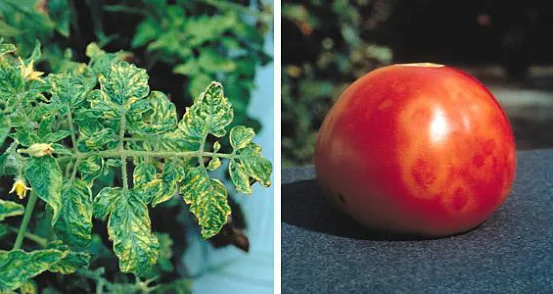
 Lesion - a watery area with a light brown or tan-colored central region. Converted into a soft,
watery mass within a few days. Skin is broken, the grayish mycelium and spore clusters develop
within a few hours. Halo forms around the point of entry -small whitish rings approximately
develop on young green fruit. "Ghost spots" are usually single rings but may be solid white
spots; the center of which contain dark-brown specks.
Pathogen
Mycelium is septate and branched, hyaline but become dark in color upon age.
Conidiophores are branched and bear conidia at the apex. Conidia are continuous or one septate,
oblong and dark.
Mode of spread and survival
High relative humidities are necessary for prolific spore production. Optimum
temperatures for infection are between 65° and 75° F (18° and 24° C), and infection can occur
within 5 hours. High temperatures, above 82° F (28° C), suppress growth and spore production.
Management
Spraying with Bordeaux mixture 1.0 % or mancozeb 0.2% is helpful in reducing the
disease. Resistant varieties like Vetomold may be grown in area’s where disease appears in an
endemic form. Eurocross varities like Antincold, LMRI and Sapsford’s No.1 are resistant.
Early Blight : Alternaria solani
Symptoms
The fruit become infected-through the calyx or stem attachment, either in the green or
ripe stage. Concentric ring present on the fruit surface. Appear leathery and may be covered by a
velvety mass of black spores. Infected fruit frequently drop, and losses of 50% of the immature
fruit may occur.
Pathogen
Mycelium is septate, branched, light brown which become darker with age.
Conidiophores are dark coloured. Conidia are beaked, muriform, dark colored and borne singly.
In each conidium 5 – 10transverse and a few longitudinal septa are present.
Mode of spread and survival
The pathogen is spread by wind and rain splashes. Under dry conditions it survives in
infected plant debris in the soil for upto three years and is also seed borne.
Management
Disease free seeds should be used for sowing. Seeds soaked in thiram 0.2% at 30˚C for
24h gives better protection. Seed treatment with thiram 2g/ kg gives good protection against seed
borne infection. Three sprayings with difolatan 0.2% or mancozeb at fortnightly interval prevent
the spread of the disease. Infected plant debris should be removed. Three year rotation with non
solanaceous crop is recommended.
Bacterial Soft Rot and Hollow Stem: Erwinia carotovora pv. carotovora
Symptoms
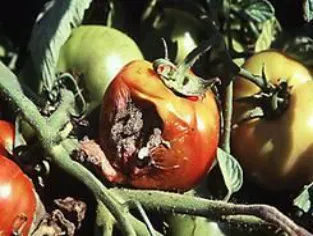
Fruit -soft watery decay of fruit, starting at one or more points, as very small spots.
Enlarge-very rapidly until the entire fruit -soft watery mass. Pathogen liquefies fruit tissue by
breaking down the pectate "glue" that holds plant cells together Leakage-internal collapse
resembling a shriveled water balloon. Bacteria -single-celled - rapidly multiply and spread-in
water. During wet weather and High humidity, Heavy rain fall or irrigation. Warm temperatures
in the 73 - 95 F. range
Phoma Rot: Phoma destructive
Symptoms
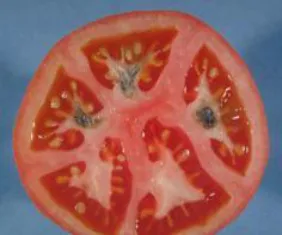
Distinguished from other rots by the black color of this spot .Small, black, pimple-like
eruptions. Specks are the pycnidia or fruiting bodies of the fungus. Moderate temperature and
high humidity.
Pathogen
The ascospores are irregularly arranged in two series. They are ellipsoid with obtuse
ends, hyaline and guttulate. Pycnidia are solitary to gregarious and dark brown. Conidia typically
biguttulate, straight and irregular.
Mode of spread
The pathogen is seed borne.
Management
Seed treatment with organomercurial and spraying the crop with zineb 0.2% gives
adequate protection against the disease.
Summary Cheat Sheet
| Focus Area | Key Takeaway |
|---|---|
| Disease diagnosis | Identify each disease using hallmark symptoms and affected plant part. |
| Spread and survival | Remember seed-, soil-, water-, and vector-borne survival pathways. |
| Management | Use integrated control: sanitation, resistant material, and need-based sprays/drenches. |
References
2 sources • [1] [2]
References
Lesson Doubts
Ask questions, get expert answers