📈 Diseases of Beans
Diseases of Beans.
This lesson on Diseases of Beans covers major diseases, key symptoms, spread/survival, and management points for exam-focused and field-level understanding.
Beans
Anthracnose: Colletotrichum lindemuthianum
Symptoms
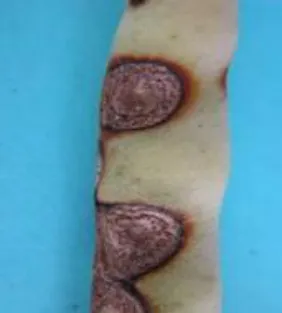
Bean pods with black, sunken lesions or reddish-brown blotches most likely have
anthracnose, a fungal disease caused by Colletotrichum lindemuthianum . Black, sunken lesions
about ½ inch in diameter develop on stems, pods and seedling leaves (cotyledons) but are most
prominent on pods. A salmon colored ooze on lesions and the veins on lower leaf surfaces turns
black. On lima beans, symptoms are sooty- appearing spots on leaves and pods. Anthracnose
develops primarily during the spring and fall when the weather is cool and wet, and not during
our hot, dry summers. Lima beans are particularly susceptible.
Pathogen
Mycelium is branched, septate, hyaline at first and dark colored with age. Acervuli
develop beneath the cuticle. Conidia are borne on short conidiophores. Setae are few, brown and
septate. Conidia are one celled, hyaline and cylindrical with rounded ends or with one end
slightly pointed.
Mode of spread and survival
The fungus is seed borne and can survive from one season to another in debris from
infected plant as well as in diseased seed. The fungus can remain alivein seeds even after the
seeds are dead.
Disease Cycle
The fungus survives the winter primarily in bean seed. Survival in soil or in plant residue
varies greatly, depending on environmental conditions. Moisture is required for development,
spread, and germination of the spores as well as for infection of the plant. A prolonged wet
period is necessary for the fungus to establish its infection. The time from infection to visible
symptoms ranges from 4 to 9 days, depending on the temperature, bean variety, and age of the
tissues. The fungal spores are easily carried to healthy plants in wind-blown rain and by people
and machinery moving through contaminated fields when the plants are wet. Frequent rainy
weather increases disease occurrence and severity.
Management
Prevent this disease by using certified disease-free seed for planting and removing all
plant debris after harvest. Anthracnose can survive in the soil for two years on plant debris or be
brought to the garden on infected seeds. Do not plant bean seeds in an area that had disease for
two to three years. Avoid overhead watering and avoid splashing soil onto the plants when
watering. Fungicide sprays of fixed copper are the only recommended chemical that can be used
on lima beans for anthracnose control.
Bean Root Rots: Rhizoctonia solani, Pythium, Fusarium solani
Symptoms
Many fungi, including Rhizoctonia solani, Pythium species and Fusarium solani, form species
phaseoli, live in the soil and will infect young seedlings or the seeds of bean plants. Seedlings
fail to emerge after planting when the seeds rot in the soil or young seedlings may be stunted.
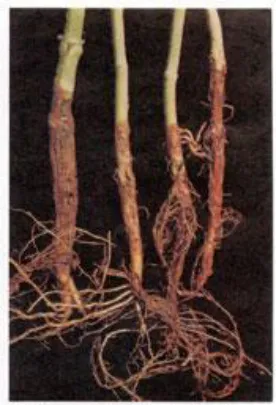 Plants are usually affected slightly above or below the soil line with a watery soft rot. Roots of
the plant usually die and leaves turn yellow.
Management
Do not plant beans in low, poorly drained areas. Plant on raised beds. Plant after the soil
has warmed to 69° F at a 4 inch depth. Reduce disease buildup in the soil by rotating locations in
the garden where you plant bean or pea with other vegetables. Try to avoid injury to the root
system, which often occurs during planting, through cultivation or due to a large population of
nematodes in the soil. Remove crop debris immediately after harvest. Plant seeds previously
treated with captan. Apply chemicals according to directions on the label.
Rust: Uromyces appendiculaters
Symptoms
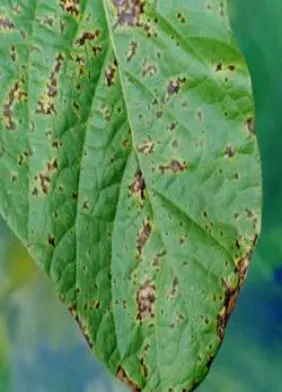
Bean rust is mainly a disease of bean leaves that causes rust-colored spots to form on the
lower leaf surfaces. Severely infected leaves turn yellow, wilt, and then drop off of the plant.
Stems and pods may also be infected. This disease is caused by the fungus Uromyces
appendiculaters . It affects most types of beans under humid conditions.
Pathogen
The fungus is autoecious, thus living its entire life on bean and long cycled rust. Uredia
are brown and powdery. Uredospores are globose or ellipsoid. Spore wall is golden brown. Telia
are formed on uredia and are dark brown or black.Teliospores are globose or broadly ellipsoid,
pedicellate and one celled. Pycnia appear on the yellowish spots on the upper surface of the
leaves.
Mode of spread and survival
The rust fungus is not seed borne, but can be disseminated locally by farm tools, insects,
animals or other moving bodies. However wind is the principal agent for long distance spore
dissemination.
Management
The fungus survives the winter in the soil, on plant debris and even on poles used the
previous year. In gardens where rust has been severe, crop rotation is important. As plants begin
to bloom, sulfur or chlorothalonil can be sprayed weekly on snap and green beans only. Do not
apply chlorothalonil to lima (butter) beans. Wait seven days between spraying and harvest when
using chlorothalonil on beans, and 14 days on Southern peas. Apply chemicals according to
directions on the label.
Bacterial Blight: Xanthomonas campestris pv phaseoli
Symptoms
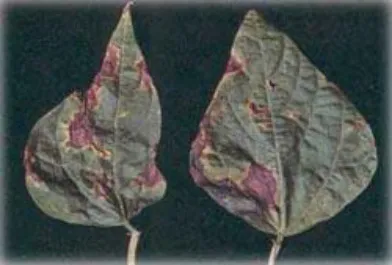
There are two widespread bacterial blights that affect most types of beans, common
blight ( Xanthomonas campestris pv phaseoli ) and halo blight ( Pseudomonas syringae pathovar
phaseolicola). The stems, leaves and fruits of bean plants can be infected by either disease. Rain
and damp weather favor disease development. Halo blight occurs primarily when temperatures
are cool. Light greenish-yellow circles that look like halos form around a brown spot or lesion on
the plant. With age, the lesions may join together as the leaf turns yellow and slowly dies. Stem
lesions appear as long, reddish spots. Leaves infected with common blight turn brown and drop
quickly from the plant. Common blight infected pods do not have the greenish-yellow halo
around the infected spot or lesion. Common blight occurs mostly during warm weather.
Pathogen
The bacteria is gram negative rod, non capsulated and motile with single polar flagellum.
Mode of spread and survival
The pathogen is seed borne and the disease spread through wind splashed rains from
diseased to healthy plants. In new area disease spreads through infected seeds.
Management
Both of these diseases come from infected seeds. The diseases spread readily when
moisture is present. Avoid overhead watering and do not touch plants when the foliage is wet.
The bacteria can live in the soil for two years on plant debris. Do not plant beans in the same
location more frequently than every third year. Buy new seeds each year. Fixed copper can be
applied at ten day intervals. Wait one day between spraying and harvest.
Mosaic Viruses
Symptoms
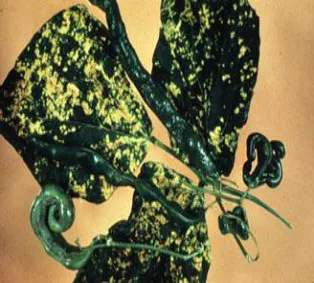
Mosaic viruses in which the leaves show sharply defined patches of unusual coloration
may occur in beans. The causal agents of these symptoms may be nutrient imbalance or
herbicide injury or result from infection by one of several viruses.
Pathogen
Cucumber mosaic virus
Mode of spread and survival
The virus occurs worldwide in many agricultural crops, ornamentals and weeds. Many of
these plants serve as reservoirs for season to season survival of the virus. The virus is transmitted
mechanically with ease as well as in seed and by aphids, especially Myzus persicae and Aphis
gossypii .
Management
There are no recommended chemical controls for these problems. Many of these viruses
are transmitted by aphids and are also transmitted through seed. For this reason it is unwise to
save seeds from year to year.
Powdery Mildew: Erysiphe polygonii
Symptoms
Leaves are covered with patches of a whitish to grayish powdery growth. This disease is
caused by the fungus Erysiphe polygonii . New growth appears contorted, curled or dwarfed and
may turn yellow and drop. Pods are dwarfed and distorted. This is mostly a problem on fall
beans. Powdery mildew is spread by wind and rain.
Pathogen
The mildew pathogen develops mycelial threads between a few cells near the epidermis
and grows root like structures, haustoria that slowly withdraw food from the living plant tissue.
After the fungus covers the upper and sometimes the lower leaf surface with fungus threads, the
threads can produce many short multicellular fungus stalks, each of which bears a few spores
resembling beads in a chain.
Mode of spread and survival
The fungus is capable of attacking different leguminous hosts and survives in conidial or
perithecial form. The conidia are easily carried by wind, rain and insects. The spores are short
lived and usually die in about 2 days if they do not reach a suitable host. When humididity is
high and the leaf surface is dry, the spores germinate readily in few hours and the germ tubes
enter the plant. Some strains produce sexual perithecia with asci which can remain alive from
one season to the next.
Management
Avoid crowding plants by allowing adequate space between rows. On Southern peas,
sulfur can be used. When the disease is first noticed, sprays or dusts of sulfur are recommended
for use on snap and green beans only. Do not use sulfur on young plants. Apply chemicals
according to directions on the label.
Cercospora Leaf Spot: Cercospora sp.
Symptoms
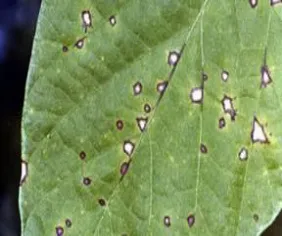 This fungal disease, caused by Cercospora species, occurs primarily on the lower leaves
of plants as irregular, tan spots. Severe infection causes excessive leaf drop and stunting of the
plant. Infection is worse during periods of extended rainfall, high humidity and temperatures
between 75 to 85° F.
Management
Use disease-free seed for planting. Remove all debris in the garden after harvest. Do not
plant beans in the same area for two to three years. There are no resistant varieties or
recommended chemicals for this disease in the home garden.
Watery Soft Rot: Sclerotinia sclerotiorum
Symptoms
Small, soft, watery spots that are caused by the fungus Sclerotinia sclerotiorum occur on
the stems, leaves and pods of beans. These spots enlarge rapidly under cool, moist conditions,
and run together, girdling the stem. Infected pods turn into a soft, watery mass, before dying out
and turning brown. Soon infected areas are covered by a white fungal growth.
Management
Improve air circulation between plants and rows. Too much fertilizer favors heavy vine
growth, creating areas for the disease to develop. There are no recommended chemical controls
for the home garden.
Summary Cheat Sheet
| Focus Area | Key Takeaway |
|---|---|
| Disease diagnosis | Identify each disease using hallmark symptoms and affected plant part. |
| Spread and survival | Remember seed-, soil-, water-, and vector-borne survival pathways. |
| Management | Use integrated control: sanitation, resistant material, and need-based sprays/drenches. |
References
2 sources • [1] [2]
References
Lesson Doubts
Ask questions, get expert answers