📈 Diseases of Onion
Diseases of Onion.
This lesson on Diseases of Onion covers major diseases, key symptoms, spread/survival, and management points for exam-focused and field-level understanding.
Basal Rot: Fusarium oxysporum f.sp. cepae
Symptoms
The leaves turn yellow and then dry up slowly. The affected plant shows drying of leaf
tip downwards. The entire plant shows complete drying of the foliage. The bulb of the affected
plant shows soft rotting and the roots get rotted. There will be a whitish mouldy growth on the
scale. This disease can begin in the field and continue on in storage.
Pathogen
The fungus produces many chlamydospores which are thick walled resting spores and
microconidia which are one celled and thin walled.
Mode of spread and survival
The pathogen is soil borne and the optimum temperatures for development are 28 - 32˚C.
Infection occurs through the root either directly or through wounds.
Management
Growers must follow crop rotation and harvested bulbs must be thoroughly cured to
reduce potential storage losses. Onions are very sensitive to low soil copper levels. In order to
optimize crop production and disease susceptibility, additional soil copper fertility may be
needed especially on mucky and sandy soils. Soil drenching with Copper oxychloride 0.25 %.
Downy mildew: Peronospora destructor
Symptoms
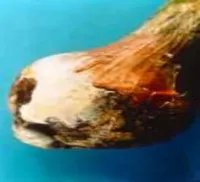
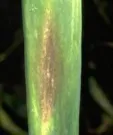
White downy growth appears on the surface of the leaves. Finally the infected leaves are
dried up.
Pathogen
The sporangiophores are non septate, long and swollen at the base.Sporangia are
pyriform to fusiform, attached to the sterigmata by their pointed end. These sporangia germinate
by one or two germ tubes. The coenocytic mycelium is intercellular with filamentous haustoria.
Oogonia are formed in the intercellular spaces.
Mode of spread and survival
The fungus attacks the seed stalks in a seed crop and has been found on and in the seed as
mycelium but true seeds do not help in carry over of the fungus from one season to the next. The
main sources of perennation are the diseased bulbs used for propagating the crop in many areas
and oospores present in diseased crop residues. If infected bulbs are planted, the fungus grows up
with the foliage produces sporangia and these spread the disease to other plants.
Disease Cycle
Dormant Period
It is believed that the DM fungus over winters primarily as mycelium in infected onions
that remain in onion fields or in nearby cull piles. The pathogen also can over winter in perennial
varieties of onion in home gardens. It is suspected that spores of the fungus that persist in the soil
may directly infect the roots of young onion plants. These plants become systemically infected
and serve as focal points for infection in commercial onion fields.
Primary Spread
When favorable environmental conditions occur, the over wintering fungal mycelium in
systemically infected plants produces spores. After dissemination through the air, these spores
infect the leaves of onion plants in commercial fields. Spores are formed at night when high
humidity and temperatures of 4–25˚C occur, with an optimal temperature of 13˚C. The spores
mature early in the morning and are disseminated during the day. Spores remain viable for about
4 days. Germination occurs in free water from 1–28˚C with an optimal range of 7–16˚C. Rain is
not needed for infection if heavy dews occur continuously during the night and morning hours.
Secondary Spread
The mycelium of DM in leaves of infected onion plants in commercial bulb production
fields produces a new crop of spores called conidia in cycles of approximately 11–15 days. As
the upper portions of a leaf are killed, the fungus infects the next lower part of the leaf in each
successive cycle of spore formation. Such cycles can be repeated several times until the leaf may
be completely killed. These repeated cycles of spore formation can result in severe and continued
epidemics of DM if disease favorable environmental conditions persist.
Management
Three spraying with Mancozeb 0.2 % is effective. Spraying should be started 20 days
after transplanting and repeated at 10-12 days interval.
Leaf Blight (Blast) : Botrytis spp .
Symptoms
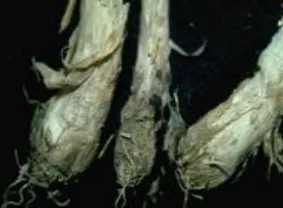
Botrytis is the major disease of onions in cool climate areas. Light infections do not affect
yields but heavy infections causing major yield reductions can occur. Hundreds of white specks
are seen on the foliage. The disease then spreads very rapidly and tops of the entire crop may be
killed.
Pathogen
Botrytis is characterized by its conidiophores which present an appearance of
grapebunch. The conidiophores are tall, erect and branches irregularly or dichotomously. They
are dark and septate. The terminal cells swell to produce sporogenous ampullae. On each
ampulla numerous conidia arise simultaneously on short denticles. The conidia are hyaline or
tinted, aseptate and globose to ovoid.
Disease cycle
Dormant Period
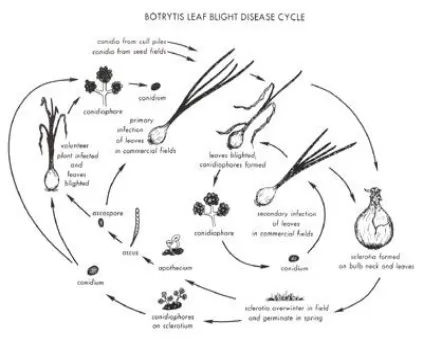
The Botrytis leaf blight pathogen over winters as sclerotic (compact mass of fungi
capable of surviving unfavorable environmental conditions). These are produced on infected
onion bulbs left in cull piles, on mother bulbs stored for seed production, and on bulbs left in the
field. The latter results in volunteer onion plants the following spring. Sclerotic also over winter
directly in the soil and on leaves that persist as debris in commercial onion fields. The sclerotia
are formed on infected leaves and the necks and upper portions of bulbs before or after harvest.
Infected leaves may be raked or washed together and persist as leaf tissue debris in which many
sclerotic can be found. Sclerotic in the soil result from the disintegration and decay of infected
leaves on which sclerotic were formed.
Primary Spread
Sclerotic on onion bulbs in cull piles, on mother bulbs in seed fields, and on volunteer
onion plants in commercial onion fields produce conidia (spores) that infect leaves on sprouted
bulbs and onion plants in commercial fields. Sclerotic on the surface of the soil in commercial
onion fields also produce conidia that can infect the leaves of nearby onion plants. Sclerotia on
leaf debris produce conidia and also ascospores (sexual spores) that infect leaves of onion plants.
Because ascospores are the result of sexual reproduction, they may serve as the source of new
strains of the pathogen that are tolerant to fungicides used to control Botrytis leaf blight. The
ability of sclerotic to germinate and produce conidia repeatedly (up to four times) results in the
production of conidia over an extended period of time. Sclerotic on the bulbs of volunteer onions
produce conidia that infect either leaves of the same plant or those of onion plants in commercial
fields. In the absence of seed fields and cull piles, it is suspected that sclerotic in the soil and
sclerotic on volunteer plants provide the primary source of inoculum for outbreaks of Botrytis
leaf blight in commercial onion fields.
Secondary Spread
The dense, tangled growth of leaves that develop from bulbs in cull piles provides
conditions (little air movement and high relative humidity) that are favorable for subsequent
production of spores on dead leaf tissue. This results in secondary cycles of infection in the cull
piles. Similar secondary cycles occur slightly later in seed fields. Conidia are blown from the
seed fields and cull piles to commercial bulb production fields and the disease cycles continue.
Leaves of onion plants in commercial fields can be infected by conidia that develop from
sclerotic in the soil.
These infected leaves also serve as secondary sources of inoculum once conidia are
produced on the dead leaf tissue. Leaves of volunteer onion plants infected by conidia produced
by sclerotic on the same plant also serve as a secondary source of inoculum. Leaves of onion
plants grown for commercial production are repeatedly infected, and these serve as the source of
inoculum for infecting new leaves throughout the growing season.
Management
Bulb treatment with Captan /Thiram 0.25%. Spraying of Maneb or Mancozeb or
Chlorothalonil. Fungicides may be applied every 5 - 7 days for disease control.
Pythium root rot: Pythium aphanidermatum , P. debaryanum and P. ultimum
Symptoms
This disease causes seed rotting, pre-emergence damping off. The disease appears in
circular patches in the field here and there. All the affected plants get killed. if the disease occurs
prior to seed germination, it causes gappiness. The seeds or seed materials are killed before their
establishment. The disease also occurs after establishment of the crop i.e after 15 to 30 days of
sowing or planting. This stage is called post-emergence damping off. If the disease occurs very
late, it causes stunting of the plant and rotting of the roots.
Pathogen
Pythium aphanidermatum
Epidemiology
The fungus is mainly soil borne. The disease is favoured by ill drained conditions in the
field due to stagnation of water. High soil moisture or continuous rain may favour rapid
development of the disease.
Management
Seed treatment with Thiram or Captan @ 4g/kg. The bulbs may be dipped in Thiram
solution 0.25%. After sprouting, the root region of the plants along the rows should be given a
soil drenching with Copper oxychloride 0.25%.
Smut: Urocystis cepulae
Symptoms
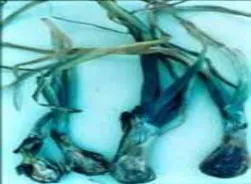
Black smut sori are seen at the base of the leaves and leaf surface. Black powdery mass is
seen after rupturing of sorus wall.
Pathogen
The sori of urocystis cepulae contain dark coloured and powdery spore masses. The
spores are found in permentant balls. Each ball consists of an enveloping cortex of tined, sterile,
bladder like cells with one or two central dark coloured thick walled chlamydospores. The spores
germinate by means of short promycelium while still in the ball.
Mode of spread and survival
The fungus remains viable for 15 years in infected soil by means of spore balls. It persists
in soil as a saprophyte. Onion bulbs and onion transplants are important means of widespread
distribution of the fungus. Implements also help in the spread. Wind borne soil and surface
drainage water are important means of local dissemination.
Management
Seed treatment with Thiram or Captan @ 4g/kg. The bulbs may be dipped in Thiram
solution 0.25%.
White Rot: Sclerotium cepivorum
Symptoms
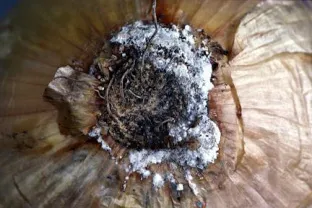
The leaves become yellow and die-back and when the plants are pulled up, roots are found to
be rotten and the base of the bulb covered with a white or grey fungal growth. Later, numerous
small black spherical sclerotia are produced. The bulb of the onion completely rots.
Mode of spread and survival
The disease is worst in warm summers or in the case of winter onions during warm spell
in autumn or spring. Sclerotia persist in soil for eight years. The primary inoculum consists of
spherical small black sclerotia produced in infested fissure of Allium spp. during previous years.
Scelerotia are transported from field to field by flood water.
Disease Cycle
The sclerotia that form on the decaying host will lay dormant until a host plant’s root
exudates stimulate germination, specifically root exudates that are unique to Allium spp. Cool
weather is also needed for germination of sclerotia and hyphal growth. The soil moisture levels
optimal for host root growth are also optimal for sclerotia germination. Mycelium will grow
through the soil, and once it encounters a host root the fungus will form appresoria, structures
whose purpose is to aid in the attachment and penetration of the host.
Mycelium can grow outwards from the roots of one plant to the roots of a neighboring
plant, and it is by this method that the pathogen can move down a planted row. Sclerotia are
formed on the decaying host tissue, and once the host tissue completely decays the sclerotia are
free in soil. If the bulbs survive long enought to be placed into storage, the pathogen may
continue to decay the bulbs if there is high humidity and low temperatures. If the bulbs are
stored dry then the disease may not spread but bulbs infected in the field will continue to decay.
Management
Crop rotation and clean seed are the only effective control. Heavy manuring with organic
manures reduces the disease in the crop. Seed dressing with Benomyl, Carbendazim or
Thiophanate-methyl (100 to 150 g/kg seed) gives effective control.
Purple blotch: Alternaria porri
Symptoms
This disease occurs mainly at the top
of the leaves, the infection starts with
whitish minute dots on the leaves with
irregular chlorotic areas on tip portion of
the leaves. Circular to oblong concentric
black velvety rings appear in the
chlorotic area. The lesions develop
towards the base of the leaf. The spots
join together and spread quickly to the
entire leaf area. The leaves gradually die
from the tip downwards.
Pathogen
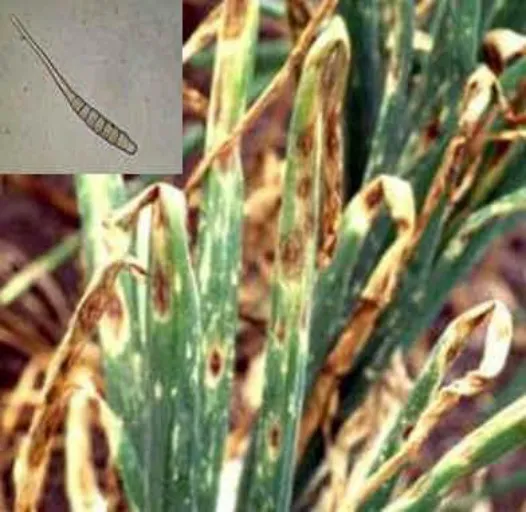 Alternaria porri mycelium is branched, coloured and septate. Conidiophores arise singly
or in groups. They are straight or flexuous, sometimes geniculate.
Management
Disease free bulb should be selected for planting. Seeds should be treated with Thiram @
4 g/kg seed. The field should be well drained. Three foliar sprayings with Copper oxychloride
0.25 % or Chlorothalonil 0.2 % or Zineb 0.2 % or Mancozeb 0.2 %.
Neck Rot :Botrytis allii, B. squamosa and B. cinerea
Symptoms
Symptoms usually appear after harvest, although infections originate in the field. Greatest
epidemic development occurs when cool (50° to 75°F), moist weather prevails for some days
before or during harvest. If the weather remains dry during harvest and curing, losses found in
storage are usually small. Symptoms are first seen as a softening of the tissues around the neck of
the bulb, or more rarely, at a wound. A definite margin separates diseased and healthy tissues.
Infected tissues become sunken, soft, and appear brownish to grayish in color, as if they had
been cooked. These symptoms progress gradually to the base of the bulb. Then the entire bulb
may become mummified. Hard, irregularly shaped kernel-like bodies, sclerotia, may form
between scales, especially at the neck region.
Mode of spread and survival
The fungi that cause neck rot survive the winter on previously infected onion debris in
the soil, in cull piles and refuse dumps, and in trash in storage sheds.
Blue mould rot- _ Penicillium _ sp
Symptoms
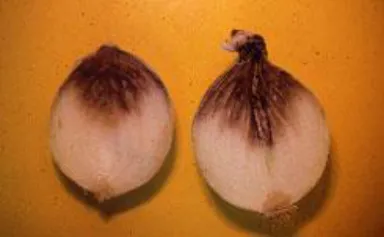
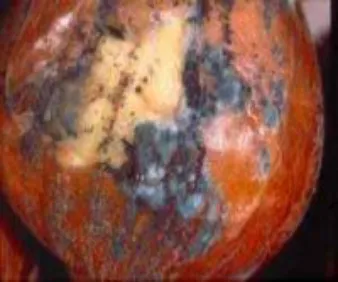
Blue mold generally appears during harvesting and storage. Initial symptoms include water
soaked areas on the outer surface of scales. Later, a green to blue green, powdery mold may
develop on the surface of the lesions. Infected areas of fleshy scales are tan or gray when cut. In
advanced stages, infected bulbs may disintegrate into a watery rot. Many species of Penicillium
can cause blue mold. These fungi are common saprophytes on plant debris and senescent plant
tissue.
Pathogen
Penicillium produces an enormous number of spores on a broom like conidiophore. Some
of these spores are in the air at all times. They can be carried to long distances by wind. In moist
air they germinate readily. Symptoms develop slowly on the bulbs.
Mode of spread and survival
Invasion of onion bulbs and garlic is usually through wounds, bruises, or uncured neck
tissue. Once inside the bulb, the mycelium grows through the fleshy scales, eventually
sporulating profusely on the surface of lesions and wounds. Optimum conditions include
moderate temperatures 70° to 77°F (21° to 25°C) and high relative humidity.
Black mould- Aspergillus niger
Symptoms
Infection usually is through neck tissues as foliage dies down at maturity. Infected bulbs
are discolored black around the neck, and affected scales shrivel. Masses of powdery black
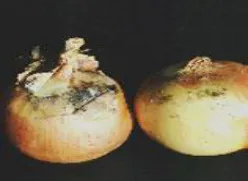 spores generally are arranged as streaks along veins on and between outer dry scales. Infection
may advance from the neck into the central fleshy scales. In advanced disease stages, the entire
bulb surface turns black, and secondary bacterial soft rot may make the bulb soft and mushy. No
external symptoms may be found with some bulbs.
Management
Seeds should be treated with Thiram @ 4 g/kg seed. The field should be well drained.
Three foliar sprayings with Copper oxychloride 0.25 % or Chlorothalonil 0.2 % or Zineb 0.2 %
or Mancozeb 0.2 %. Growers must follow crop rotation and harvested bulbs must be thoroughly
cured to reduce potential storage losses. Soil drenching with Copper oxychloride 0.25 %
Summary Cheat Sheet
| Focus Area | Key Takeaway |
|---|---|
| Disease diagnosis | Identify each disease using hallmark symptoms and affected plant part. |
| Spread and survival | Remember seed-, soil-, water-, and vector-borne survival pathways. |
| Management | Use integrated control: sanitation, resistant material, and need-based sprays/drenches. |
References
2 sources • [1] [2]
References
Lesson Doubts
Ask questions, get expert answers