📈 Diseases of Coconut
Diseases of Coconut.
This lesson on Diseases of Coconut covers major diseases, key symptoms, spread/survival, and management points for exam-focused and field-level understanding.
Coconut
Bud rot
Phytophthora palmivora
Symptoms
Palms of all ages are susceptible to the disease, but it is more severe in young palms of 5
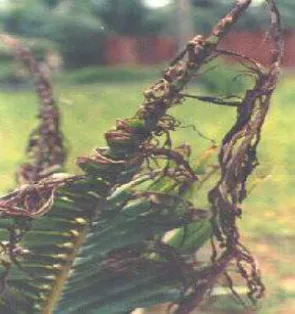
20 years. The first indication of the diseases is seen on the central shoot of the tree (spindle). The
heart leaf shows discolouration which becomes brown instead of yellowish brown. This is
followed by drooping and breading off the heart leaf. With the progress of diseases, more
number of leaves get affected with loss of lusture and turn pale yellow. The entire base of the
crown may be rotten emitting a foul smell. The central shoot comes off easily on slight pulling.
The leaves fall in succession starting from the top of the crown. The leaf falling and
bunch shedding continue until a few outer leaves are left unaffected. But within few months the
infection leads to complete shedding of leaves, within subsequent wilt and death of the tree.
Pathogen
The fungus produces intercellur, non septate, hyaline mycelium. Sporangiophores are
hyaline and simple or branched occasionally. The sporangiophores are hyaline, Thin walled, pear
shaped with a prominent papillae. Sporangia releases reniform, biflagellate zoospores upon
germination. The fungus also produces thick walled, spherical oospores. In addition, thick
walled, yellowish brown chlamydospores are also produced.
Favorable Conditions
 High rainfall, high atmospheric humidity (above 90 per cent), low temperature (18-20˚C)
and wounds caused by tappper and Rhinoceros beetles.
Mode of Spread and Survival
The fungus remains as dormant mycelium in the infected tissues and also survives as
chamydospores and oospores in crop residues in the soil. The diseases spread is mainly through
air-borne sporangia and zoospores. Rainfall also helps in spreading the diseases. Insects and
tappers also help in the spread of the inoculum from diseased trees.
Mangement
Remove and burn badly affected trees which are beyond recovery. If diseases is detected
in early stage, remove the infected tissue thoroughly by cutting the infected spindle along with
two leaves surrounding it and protect the cut portion with Bordeauex paste. Give prophylactic
spray with 1% Bordeaux mixture to all the healthy plams in the vicinity of diseases one and also
before onset of monsoon rains.
Basal Stem Rot (Thanjavur wilt / Bole rot)
Ganoderma lucidum
Symptoms
The trees in the age group of 10-30 years are easily attacked by the pathogen. The fungus
is soil-borne and infects the roots. The most usual symptoms are yellowing, withering and
drooping of the outer fronds which remain hanging around the trunk for several months before
shedding. The younger leaves remain green for sometime and later turn yellowish brown. The
new fronds produced become successively smaller and yellowish in colour which do not unfold
 properly. Soft rot occurs in the bud with a bad newly formed leaves wither away. More often the
spindle is blown off leaving the decapitated stem.
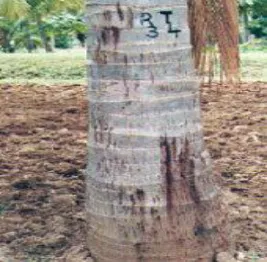
The wilting plants also show bleeding patches near the base of the trunk. A brown
gummy liquid oozes out from the cracks in the tree which slowly result in the death of outer
tissues. As the infection advances, fresh bleeding patches appear above the old once, up to 3-5
meters height. The decay of the basal portion occurs slowly and tree succumbs to the diseases in
2-3 years. In the advanced stages of infection, the fungus produces fruiting body (Bracket) along
the side of the basal trunk. The roots of wilting trees show discoloration and severe rotting.
Pathogen
The fungus produces a semi circular basidiocarp (bracket), which is attached to the tree
with a stalk. The bracket is very big about 10-12 cm diameter and woody. The upper surface is
tough, shining, light to dark brown or almost black with concentric furrows. The lower surface is
white and soft with numerous minute pores. These pores represent the opening of the hymenial
tubes, which are lined with basidia and basidio-spores. Basidiospores are oval, brown and thick
walled.
Favourable Conditions
Trees grown in sandy loam and sandy soils, water logging during severe rains, low soil
moisture content during summer months and damages caused by weevils and beetles.
Mode of Spread and Survival
The fungus is soil-borne and survives in the soil for long time. The primary infection is
through basidiospores in the soil, which attack roots. The irrigation water and rain water also
help in the spread of the fungus.
Management
Remove and burn severely infected trees which are beyond recovery. Isolate the diseased
trees by digging a trench all around to check further spread. Irrigate the palms at least once in a
fortnight during summer months. Apply heavy doses of farm yard manure or compost for green
manure at 50 Kg/tree/year along with 5 kg of neem cake. Drench the soil near the tree with 40
litres of 1 per cent Bordeaux mixture at quarterly interval for thrice a year and repeat after 2-3
years. Apply Aureofunginsol 2g+Copper sulphate 1g in100 ml of water or Tridemorph 2ml/100
ml of water through stem injection or root feeding at quarterly intervals for one year.
Stem bleeding
Theilaviopsis paradoxa
( Ceratocystis paradoxa )
Symptoms
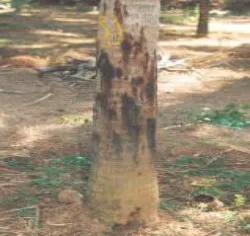
The characteristic symptom is the exudation of reddish brown fluid from the cracks in the
stem. The fluid trickles down to several feet on the stem and the exudates dries up forming a
black crust. The tissues below the cracks turn yellow and decay. As the disease progresses, more
area underneath the bark gets decayed and the bleeding patch extends further up. The vigour of
the tree is affected and nut yield is reduced. The tree is not killed out right but become
uneconomical to maintain. In extreme cases, the trees may become barren and die.
Pathogen
The fungus produces two type of conidia. Macroconidia are produced on conidiophores
singly or in chains. They are spherical and dark green in colour. Microcondinia are produced
endogenously inside the long cells ruptures when mature and release the microcondia in long
chain. Microconidia (endoconidia) are thinwalled, hyaline and cylindrical in form. C. paradoxa
also produces hyaline perithecia with a long neck base is ornamented with knobbed appendages
and ostiole is covered by numerous pale-brown, erect, tapering hyphae. Asci are clavate and
ascospores are hyaline ad ellipsoid.
Favourable Conditions
Copious irrigation or rainfall followed by drought, shallow loamy soils or laterite
 soil with clay or rock layer beneath the soil, poor maintenance of gardens and damages by
Diocalandra and Xyleborus beetles.
Mode of Spread and Survival
The fungus survies in the infected plant debris and soil as perithecia and conidia.
The spread is mainly through wind-borne conidia. The irrigation and rain water also help in the
disease spread. The beetles which feed on the diseased plants also help in transmission.
Management
Maintain the gardens properly with adequate fertilization. Scoop out the diseased tissue
with a portion of healthy tissues, burn the exposed tissue and apply molten coal tar followed by
swabbing Bordeaux paste. When stem bleeding is observed in association with Ganoderma,
follow root feeding or stem injection technique. Irrigate during the summer months.
Root wilt disease (Kerala wilt)
Phytoplasma
Symptoms
Palms of all ages are found infected by the pathogen. The important diagnostic symptom
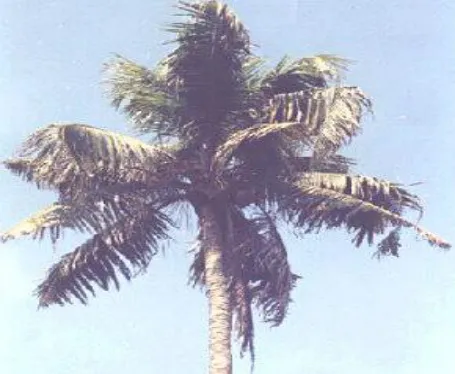
is “flaccidity” of leaves i.e. they curve abnormally inwards, resembling the ribs of mammals.
Yellowing of leaves and marginal necrosis of leaflets are also conspicuously. Wilting of leaves
from middle whorl to outward and shedding of buttons and immature nuts occur. The size of
mature nuts are small with thin kernel. The crown size also gets reduced in advanced stages and
trees remain unproductive.
 The roots show rotting symptoms, which rot from tip backwards. The older roots show
cracks and blotches and cortex turns brownish black resulting in drying in flakes. The root wilt
affected palms become highly susceptible to leaf rot disease caused by Bipolaris halodes.
Occurrence of leaf rot independent of root wilt is very rare. The first symptom is blackening and
shrivelling of the distal ends of leaflets in the central spindle and in some of the young leaves.
Later the affected portion breaks off in bits giving the leaf a fan-like
appearance. This rotting hastens the decline of the palms.
Pathogen
The disease is caused by Phytoplsama which is frequently identified in the phloem tissues
of infected trees.
Favourable Conditons
Sandy and sandy loam soils, severe floods and abundance of lace wing bug
Stephanitis typia.
Mode of Spread and Survival
The severely infected plants serve as primary sources of inoculum. The MLO is
transmitted by the lace wing bug Stephanitis typicuc from diseased to healthy palms.
Management
Remove all severely infected and uneconomic palms and replant with healthy hybrid
seedling like CDO X WCT or WCT X CDO. Remove all the juvenile (young) palms showing
symptoms irrespective of its intensity. Spray the leaves with 0.01 per cent Monocroptophos.
Apply balanced doses of fertilizers (1kg Urea, 1.7kg Super phosphate, 1.7kg Muriate of potash
and 3kg Magnesium sulphate per palm per year in two splits, 1/3 during April-May and 2/3
during September-October for rainfed palms and in 4 splits during January, April, July and
October for irrigated palms).
Apply 50kg of farmyard manure/palm/year. Grow green manure crops n basin and
incorporate at the time of fertilizer application. Control the leaf rot disease by spraying
1%Bordeaux mixture or 0.3% Mancozeb. Irrigate the palm during summer months at the rate of
600-900 litres of water/basin once in 4 to 6 days. Avoid water logging by providing proper
drainage during rainy seasons. Raise crops in the inter space and maintain the milch cows to
recycle the manure and other organic wastes to increase the nut yield in affected gardens.
Grey leaf blight
Pestalotia palmarum
Symptoms
Initially symptoms develop only on the outer whorl of leaves, especially in older leaves.
Minute yellow spots surrounded by a greyish margin appear on the leaflets. Gradually, the centre
of the spots turns to greyish white with dark brown margins with a yellow halo. Many spots
coalesce into irregular grey necrotic patches. Complete drying and shrivelling of the leaf blade
occur giving a blighted or burnt appearance. Large number of globose or ovoid black acervuli
appear on the upper surface of leaves.
Pathogen
The fungus produces conidia inside the acervuli. The acervuli are black in colour,
cushion shaped and sub epidermal and break open to expose conidia and black sterile structures,
setae. The conidiophores are hyaline, short and simple, bear conidia at the tip singly. The conidia
are five celled, the middle three cells are dark coloured, while the end cells are hyaline with 3-5
slender, elongated appendages at the apex of the spore.
Favourable conditions
Ill drained soils, soils with potash deficiency, continuous rainy weather for 4-5 days and
strong winds.
Mode of Spread and Survival
The fungus remains in the infected plant debris in soil. The disease is spread through
wind-borne conidia
Management
Remove and burn the infected, fallen leaves periodically. Apply heavy doses of potash.
Improve the drainage conditions of the soil. Spray the crown with 0.25 per cent copper
oxychloride or 1 per cent Bordeaux mixture before the onset of rains.
Oil palm
Anthracnose: Botryodiplodia palmarum
Symptoms
This disease occurs in the nursery. It is recognized by regular or irregular brown to black
leaf blotches surrounded by yellow haloes, which develop along the margin, centre or tip of the
leaves. It causes heavy seedling loss.
Management
The disease can be controlled by spraying Mancozeb or Captan at the rate of 200 g/100
litres of water. Copper fungicides should not be used because of the extreme susceptibility of oil
palm seedlings to copper burn (scorching).
Diseases of Mulberry and Betel vine
Summary Cheat Sheet
| Focus Area | Key Takeaway |
|---|---|
| Disease diagnosis | Identify each disease using hallmark symptoms and affected plant part. |
| Spread and survival | Remember seed-, soil-, water-, and vector-borne survival pathways. |
| Management | Use integrated control: sanitation, resistant material, and need-based sprays/drenches. |
References
2 sources • [1] [2]
References
Lesson Doubts
Ask questions, get expert answers