📈 Diseases of Mulberry
Diseases of Mulberry.
This lesson on Diseases of Mulberry covers major diseases, key symptoms, spread/survival, and management points for exam-focused and field-level understanding.
Mulberry
Root rot- Macrophomina phaseolina
Symptoms
Sudden wilting, withering of leaves and affected
plants fail to sprout after pruning and dry up completely.
Affected plants can be pulled out easily. Rotting of primary
and secondary roots, rotten roots turn black and roots contain
large number of black sclerotia. Decay of root bark.
Management
Uprooting the infected plant and the stump and root portions are burnt. Application of
Neem cake @ 1 tonne/ha in four split doses. Application of antagonist Bacillus subtilis @ 25
g/plant. Application of antagonist fungus Trichoderma viride @ 25 g/plant. Drenching the soil
with carbendazim @ 10 ml of 1% concentration per plant
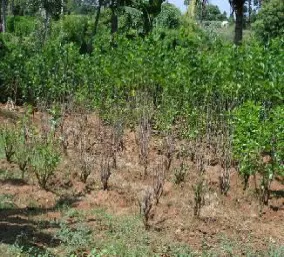
Stem canker- Lasiodiplodia (Botryodiplodia) theobromae
Symptoms
Nursery
Failure of cuttings to sprout. Sudden withering and death of sprouts. Discolouration and
drying of stems and buds above the soil. Rotting and peeling of bark on stem below the soil
surface. Black mycelial threads seen below infected bark and black eruptions on the bark of the
infected stem portion.
Grown-up plants
Greyish brown discolouration of the bark at the cut ends of the stem. Delayed sprouting,
death of buds and sprouts, black eruptions on the bark in the infected region and death of plants.
The above symptoms can be observed a few days after the plants are pruned.
Management
 Planting in winter months is avoided. Pre-treatment of cuttings with carbendazim @ 4g/l
for a period of 12 h. After pruning, the cut surfaces of the stems should be dressed with a
spray/smear of carbendazim @ 4g/l.
Leaf rust - Cerotelium fici
Symptoms
Presence of small, irregular reddish to rusty brown spot on older leaves on lower surface.
Leaves become yellowish and wither off prematurely.
Management
Providing wider spacing. Spraying carbendazim @ 500-625 g/ha
Leaf spot - Cercospora moricola
Symptoms
Brownish circular or irregular leaf spots in the initial stage, enlarge, coalesce and form
shot holes in later stage. Severely affected leaves become yellowish and fall off prematurely.
Management
Spraying carbendazim @ 500-625 g/ha
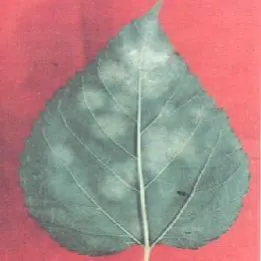
Powdery mildew - Phyllactinia corylea
Symptoms
Initially, white powdery patches on lower surface of leaves
are seen which later cover the entire leaf surface. Later turn black
to brown in colour. Infected leaves turn yellow and fall off. High
humidity (>70%) and low temperature (24-26˚C) favour outbreak
of the disease.
Pathogen
The fungus produces ectophytic mycelium. It gets nutrition from the host through
haustoria sent into the mesophyll tissues. Conidiophores are erect, long and hyaline, which cut
off oval shaped conidia at their tips. Cleistothecia are flat, sphere shaped, papillate and bear asci
inside.
Mode of spread and survival
The fungus spreads through conidia or ascospores.
Management
 Providing wider spacing. Growing resistant varieties like MR1, MR2 and China White
Spraying Carbendazim @ 500-625 g/ha. Releasing yellow lady bird beetles and white spotted
lady bird beetles, since they feed on the mildew fungus.
Bacterial blight- Pseudomonas mori
Symptoms
Numerous irregular water soaked patches on the lower surface of leaf. Leaves become
curled, rotten and turn brownish black in colour. Black longitudinal lesions are seen on the bark
of young shoots. Yellowing and defoliation.
Management
Uprooting and burning. Spraying 0.1 per cent of Streptomycin or Streptocyclin (safe
period is 15 days).
Root knot nematode- Meloidogyne incognita
Symptoms
Growth and yield of plants affected. Stunted plants, marginal necrosis and yellowing of
leaves, necrotic lesions on the root surface. Formation of characteristic knots or galls on the
roots. Wilting of plants.
Management
Deep ploughing in summer. Applying neem cake @ 1000 kg/ha. Applying Carbofuran
3G @ 30 kg/ha/year in four split doses (safe period is 50 days).
Summary Cheat Sheet
| Focus Area | Key Takeaway |
|---|---|
| Disease diagnosis | Identify each disease using hallmark symptoms and affected plant part. |
| Spread and survival | Remember seed-, soil-, water-, and vector-borne survival pathways. |
| Management | Use integrated control: sanitation, resistant material, and need-based sprays/drenches. |
References
2 sources • [1] [2]
References
Lesson Doubts
Ask questions, get expert answers