📈 Diseases of Tea
Diseases of Tea.
This lesson on Diseases of Tea covers major diseases, key symptoms, spread/survival, and management points for exam-focused and field-level understanding.
Blister blight - Exobasidium vexans
Symptoms
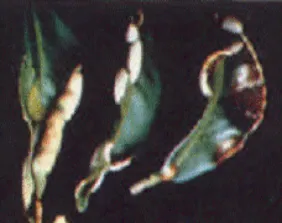
Small pale or pinkish circular spots appear on leaves and attain a size of 2.5 cm diameter.
The spots in the upper surface of the leaf becomes light brown in color and depressed while in
under surface of leaf it bulges farming a blister like swelling. Lower budget portion is covered
with a white powdery growth of fungus. When many spots coursers, curling of leaves will occur.
When it spreads to young succulent stems affected portion are withered. The leaf yield is reduced
vigor of the tea bush is affected.
Pathogen
The mycelium is confined to the blistered areas on the leaves. They are septae and collect
in bundles below the lower epidermis. Later by rupturing the epidermisa continuous layer of
vertical hyphae are projected on the surface of spot. The fungus produces two kind of spores
viz.,the conidia and basidiospores. The conidia are most abundant, borne singly at the tip of long
stalks. Basidia are formed on the surface in large number but never form a continuous
hymenium.
Mode of spread and survival
The fungus completes its life cycle in 11-28 days and several generations of spores are
produced in a season. It produces conidia and basidiospores in the same blister. Spores are air
borne. The perpetuation of the fungus appears to be form the pre existing infected bushes.
Management
Removal and destruction of the affected portion. Spraying with Copper oxychloride 0.25 %
in effective. Spray with 210 g of COC + 210 g nickel chloride/ha at 5 days interval from June –
September and 11 days interval in October – November gives economic control. Spraying with
 systemic insecticides like Atemi 50 SL at 400 ml/ha (or) Baycor (300 EC) at 340 ml/ha a weekly
interval is also effective. Chlorotalonil, Bayleton, tridemorph is also effective. Tridemorph at 340
and 60 ml/ha is satin factory under mild and moderate rainfall condition.
Black rot
Symptoms
Small dark brown irregular spots appear on leaf. They coalesce to produce a dark brown
patch which eventually covers the whole leaf and drop off. Before the leaf turns black the lower
surface assumes a white powdery appearance.
Pathogen
Corticium invisum and C. theae
Mode of spread and Survival
Basidiospores carried by workers. The disease develops rapidly when temperature is high
and air is humid. At the beginning of rainfall they germinate and produce hyphae which start
fresh infection.
Epidemiology
Occur in nursery shaded with Crotalaria. Basidiospores germinate only in wet weather or
when leaves are covered with dew.
Management
Prune in December end, remove the prunings immediately, burn after drying. Collect all
dead and dried leaves. Spray a copper fungide in third week of April.
Red rust: C ephaleurus mycoidea
Symptoms
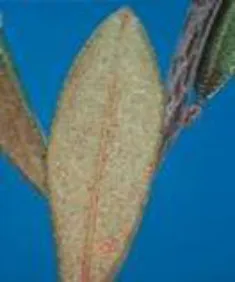
Orange yellow, circular patches appear on upper surface of
leaves. The spots become brown and dry up. When it affects the
given stem it hardens prematurely.
Pathogen
C ephaleurus mycoidea also attacks Tephrosia sp. and
Desmodium gyroides grown as green manure and shade.
Epidemiology
Rainy season is best suited for propagation of algae.
Management
Removal of infected portion and spraying with Copper oxychloride 0.25 %
Black root : Rosellina areuata
Symptoms
The fungus originate from the dead heaped leaves of 5 – 7.5 above the soil level. From
there if spreads to roots region of tea bushes. When bark is removed star like growth of
mycelium can be seen. At the surface of the soil the mycelium surrounds the stem and kills the
bank for the length of 7.5 – 10.0 cm. A swollen ring of tissue is formed round the stem above the
dead patch.
Pathogen
The fungus produces two kinds of fructification, a conidial stage and a perithecial stage.
The conidia are borne on short bristle like stalks. The perithecia are black and spherical. They
bear asci which in turn bear ascospores.
Mode of spread
The disease is spread by wind
Management:
Removal and destruction of infected plant. Clean cultivation with out fallen leaves
Dig a drench around the infected bush to provide sunlight in the drench which prevent the spread
of mycelium.
Summary Cheat Sheet
| Focus Area | Key Takeaway |
|---|---|
| Disease diagnosis | Identify each disease using hallmark symptoms and affected plant part. |
| Spread and survival | Remember seed-, soil-, water-, and vector-borne survival pathways. |
| Management | Use integrated control: sanitation, resistant material, and need-based sprays/drenches. |
References
2 sources • [1] [2]
References
Lesson Doubts
Ask questions, get expert answers