📈 Diseases of Rose
Diseases of Rose.
This lesson on Diseases of Rose covers major diseases, key symptoms, spread/survival, and management points for exam-focused and field-level understanding.
Black spot- Diplocarbon rosae
Economic Importance
Black spot of rose is a serious problem in chill and cold climate of temperate regions. The
disease causes marked reduction in the size and
number of flowers.
Symptoms
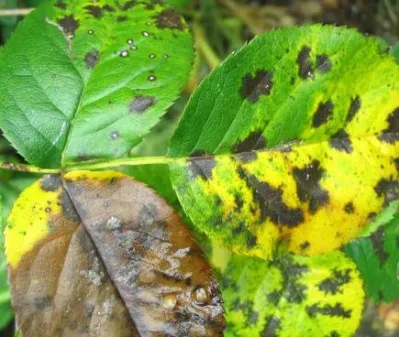
Black lesions with feathery margins
surrounded by yellow tissue are found on the
leaves. Infected leaves drop prematurely.
evident. Plants may be weakened due to
defoliation and reduced flower production may be observed.
Pathogen
The vegetative body of the fungus consists of two parts viz ., the subcuticular mycelium
and the internal mycelium. The fungus produces acervuli on the central part of the tar spots as
blister like projections. Asci are discoid, sub epidermal, erumpent and 84 to 224 micron meter in
diameter. Stroma is thin. Conidiophores are hyaline short and cylindrical. Conidia are hyaline,
two celled, fusiform or allantoid to obclavate, upper end round, base narrow, guttulate, 18 – 25 x
5 – 6 micron meter.
Mode of spread and survival
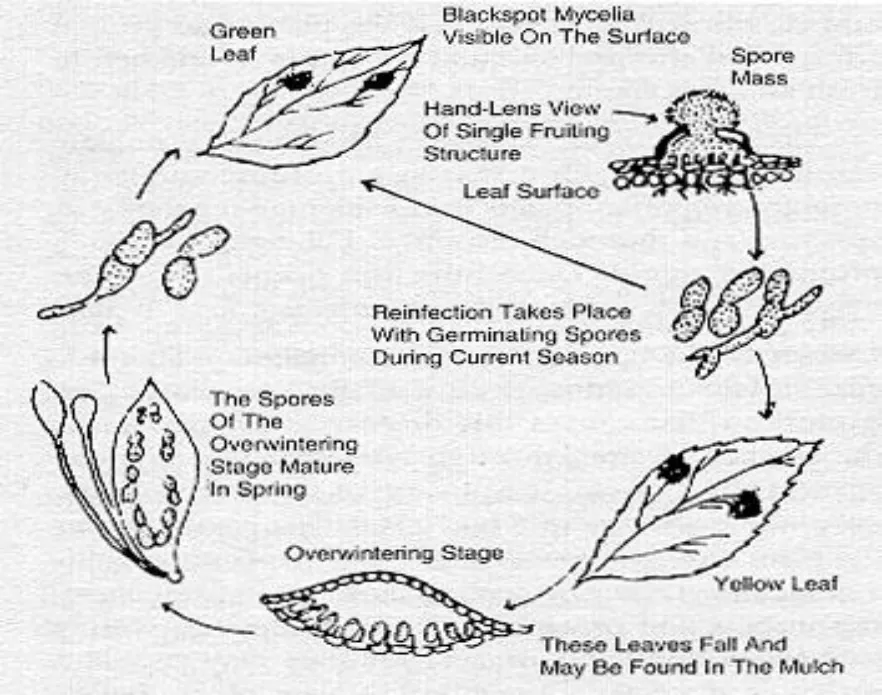
The fungal spores are spread primarily by splashing rain or water. Germination of the
spores and infection occur when free water remains on the leaf surface for a period of 6 hours or
longer. Leaf spots develop within 5 to 10 days.
Disease Cycle
Management
Cultural-Roses should be planted where the sun can quickly dry the night's dew. Space
roses far enough apart for good air circulation Avoid overhead watering and keep foliage as dry
as possible.Remove infected canes and burn diseased leaves. Spraying with Mancozeb (or)
Chlorothalonil 0.2% (or) Benomyl 0.1% or a copper dust .
Powdery mildew – Sphaerotheca pannosa
Economic Importance
It is one of the widely distributed disease of rose. Powdery mildew is prevalent during
Oct – Jan in south India and Dec- Feb in North India.
Symptoms
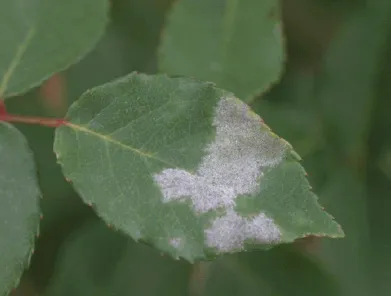
The symptom appears as grayish-white
powdery substance on the surfaces of young
leaves, shoots and buds. Infected leaves may be
distorted, and some leaf drop may occur. Flower
buds may fail to open, and those that do may
produce poor-quality flowers. It can occur almost
anytime during the growing season when
temperatures are mild (70 - 80 °F) and the relative humidity is high at night and low during the
day. It is most severe in shady areas and during cooler periods.
Pathogen
Mycelium is white, septate, ectophytic and sends globose haustoria into the epidermal
cells of the host. Conidiophores are short and erect. Conidia are one celled, oblong, minutely
verrucose with many large fat globules and 22.5 – 29.0 x 12.9 to 14.5 micron meter.
Cleistothecia are formed towards the end of the season on the leaves, petals, stems and thorns.
Cleistothecia are with simple myceloid appendages. Each ascus contains eight ascospores.
Disease Cycle
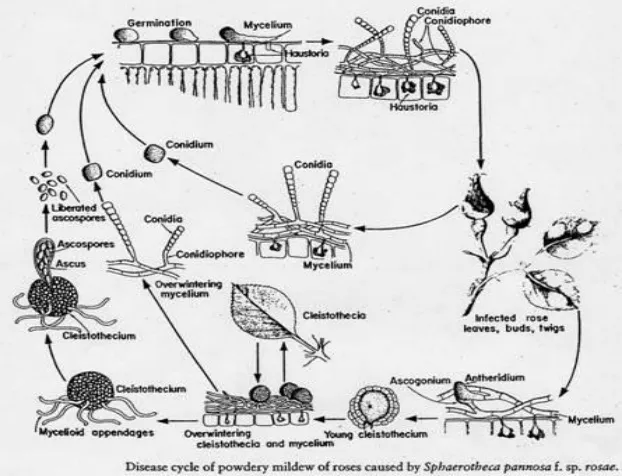
Mode of spread and survival
The fungus over winters as mycelium in dormant buds and shoots which are not entirely
killed. Either conidia or ascospores serve as primary inoculum. The secondary spread is through
wind borne conidia.
Management
Collection and burning of fallen leaves. Spray with Wettable sulphur 0.3% (or) Dinocap
0.07% (or) Carbendazim 0.1% 2-3 sprays at 15 days interval is effective. Sulphur dust at 25
kg/ha. Use of sulphur at higher temperature conditions will be phytotoxic.
Die back – Diplodia rosarum
Economic Importance
In India it was first reported in 1961 from Delhi. Now it occurs in all the rose growing
areas.
Symptoms
twigs. The disease spreads to root and causes complete
killing of the plants.
Pathogen
The fungus produces round, black pycnidia which bear spores. The pycnidiospores are
dark coloured and two celled. Perithecia are immersed in the host tissue and are surrounded by a
pseudostroma. Ascospores are ellipsoidal or fusoid, hyaline, two celled with the septum in or
near the middle.
Mode of spread and survival
The fungus persists in dead twigs and the stalks of the withered blooms.
Management
Pruning should be done so that lesions on the young shoots will be eliminated. Apply
chaubatia pastic in the pruned area. Spray with COC 0.2% (or) Difolatan 0.2% (or)
Chlorothalonil 0.2% (or) Mancozeb 0.2%
Rust – Phragmidum mucronatum
Economic Importance
Rose rust is restricted to higher altitudes. It occurs in Jammu and Kashmir, Himachal
Pradesh, Punjab, Tamil Nadu and Uttar Pradesh. Outbreaks of rust disease was reported from
Udaipur district of Rajasthan in the variety Chaiti Gulab.
Symptoms
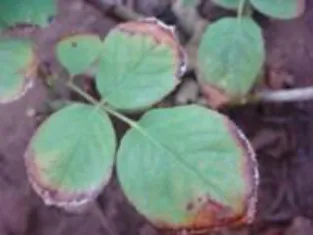
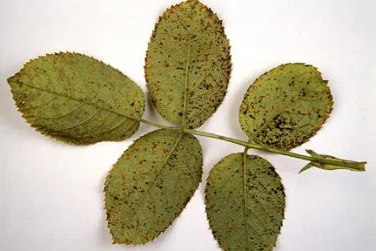
Damage to lemon yellow pustules appear on lower surface of the leaves and stems. Then the
color changes to blackish red. The affected leaves turn yellow deformed and fall prematurely.
Die back symptom also appear due to weakening of the plant.
Pathogen
Phragmidum mucronatum on rosa sp. Aecidiospores are verrucose, orange yellow, 24 –
25 x 18- 21 micron meter.They are surrounded in the aecidium by club shapped paraphyses.
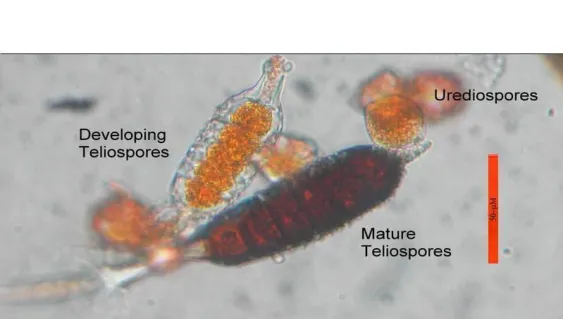
Uredospores are ellipsoid or ovate, echinulate, orange yellow and 21 – 28 x 14 -20 micron meter.
The uredospores are borne on short pedicels and are surrounded by paraphyses. Teleutospores
are dark coloured, cylindrical, 6- 8 celled with a pointed papilla and 65 – 120 x 30 – 40 micron
meter.
Management
Collection and burning of fallen leaves. Spray with Carboxin 0.1% or Wettable sulphur
0.25% or Captan 0.2%
Summary Cheat Sheet
| Focus Area | Key Takeaway |
|---|---|
| Disease diagnosis | Identify each disease using hallmark symptoms and affected plant part. |
| Spread and survival | Remember seed-, soil-, water-, and vector-borne survival pathways. |
| Management | Use integrated control: sanitation, resistant material, and need-based sprays/drenches. |
References
2 sources • [1] [2]
References
Lesson Doubts
Ask questions, get expert answers