📈 Diseases of Jasmine
Diseases of Jasmine.
This lesson on Diseases of Jasmine covers major diseases, key symptoms, spread/survival, and management points for exam-focused and field-level understanding.
Jasmine
Cercospora leaf spot – Cercospora jasminicola
Economic Importance
In India, the disease was first reported in 1946. Now
it’s known to be widely distributed.
Symptoms
Circular to irregular reddish brown spots of 2-8 mm dia
appear on the surface of the leaves. Later the spots become irregular covering larger areas of the
leaves.
Pathogen
Stromata are pale to dark brown, globular, filling stomatal openings. Fascicles are mostly
dense. Conidiophores are pale olivaceous brown, narrow, sparingly septate and straight or
sinuous. It has bluntly rounded tip and are 2 to 4 x 5 to 25 micron meter. Conidia are pale to pale
olivaceous obclavate cylindric, indistinctly septate and straight to mildly curved. Its base is
obconically truncate and tip is subobtuse and 20 to 66 x 2 to 4 micron meter.
Mode of spread and Survival
It attacks all species of Jasminum. The disease spreads through wind borne conidia.
Management
Spraying with Mancozeb 0.25% (or) Carbendazim 0.1%
Alternaria leaf blight – Alternaria jasmine, A. alternate
Symptoms
In the leaves dark brown spots appear. On fumed
condition the spots enlarges covering larges area causing
blighting of leaves. Concentric rings can be seen the lesions.
The disease also affects stem, petiole and flowers.
Mode of spread and Survival
The disease spreads through wind borne conidia.
Epidemiology
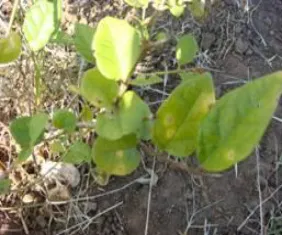
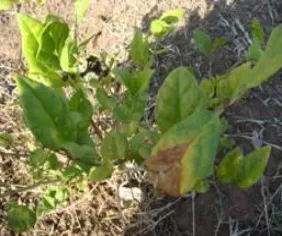 The disease attacks Jathi malli ( J. grandiflorum ) and mullai ( J. auriculatum ). The disease
is severe during winter months (Oct-Dec). In certain areas the disease is noticed even upto
February.
Management
Collection and removal of fallen leaves. Spray with Copper oxychloride 0.25% or Mancozeb
0.25%
Collar rot and Root rot – Sclerotium rolfsii
Symptoms
Plants at all stages are infected. First the older leaves
become yellow followed by younger leaves and finally death
of the plant. In the root black discoloration can be seen. On the
infected tissues and stem surface white strands of mycelia and
mustard like sclerotia are seen.
Management
Soil drenching with Copper oxychloride 0.25%. Heavy application of FYM with
Trichoderma viride
Phyllody – Phytoplasma
Symptoms
Leaves become small malformed and bushy. In the place of flowers green leaf like
malformed flowers are formed.
Mode of spread
The disease is transmitted by grafting and whitefly, Dialeurodes kirkaldii .
Management
Selection of cuttings from healthy plants. Spraying insecticide to control the vector.
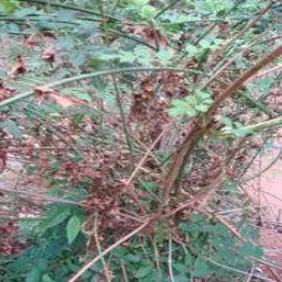
Summary Cheat Sheet
| Focus Area | Key Takeaway |
|---|---|
| Disease diagnosis | Identify each disease using hallmark symptoms and affected plant part. |
| Spread and survival | Remember seed-, soil-, water-, and vector-borne survival pathways. |
| Management | Use integrated control: sanitation, resistant material, and need-based sprays/drenches. |
References
2 sources • [1] [2]
References
Lesson Doubts
Ask questions, get expert answers