🧫 Soil physical properties
Explains soil texture and core physical properties that control water, air, and root behavior.
Soil physical properties determine how soil supports roots, stores water, and supplies air and nutrients to crops. Understanding these properties is essential for soil management decisions in field conditions.
Physical properties (mechanical behaviour) of a soil greatly influence its use and behaviour
towards plant growth. The plant support, root penetration, drainage, aeration, retention of
moisture, and plant nutrients are linked with the physical condition of the soil. Physical
properties also influence the chemical and biological behaviour of soil. The physical properties
of a soil depend on the amount, size, shape, arrangement and mineral composition of its
particles. These properties also depend on organic matter content and pore spaces.
Important physical properties of soils.
-
Soil texture, 2. Soil structure, 3. Surface area, 4. Soil density,
-
Soil porosity, 6.Soil colour, 7.Soil consistence
Soil texture- Textural classes- Particle size distribution
Definition
Soil texture refers to the relative proportion of particles or it is the relative percentage by
weight of the three soil separates viz., sand, silt and clay or simply refers to the size of soil
particles. The proportion of each size group in a given soil (the texture) cannot be easily altered
and it is considered as a basic property of a soil. The soil separates are defined in terms of
diameter in millimeters of the particles Soil particles less than 2 mm in diameter are excluded
from soil textural determinations.
Stones and gravels may influence the use and management of land because of tillage
difficulties but these larger particles make little or no contribution to soil properties such as
WHC and capacity to store plant nutrients and their supply.
Gravels : 2 – 4 mm
Pebbles : 4 – 64 mm
Cobbles : 64 – 256 mm
Boulders : > 256 mm
Particles less than 2 mm is called fine earth, normally considered in chemical and mechanical
analysis.
The components of fine earth: Sand, Silt and Clay (Soil separates. The size limits of these
fractions have been established by various organizations. There are a number of systems of
naming soil separates.
(a) The American system developed by USDA
(b) The English system or British system ( BSI )
(c) The International system (ISSS)
(d) European system
i) USDA
Soil separates Diameter (mm)
Clay < 0.002 mm
Silt 0.002 – 0.05
Very Fine Sand 0.05 – 0.10
Fine Sand 0.10 – 0.25
Medium Sand 0.25 - 0.50
Coarse Sand 0.50 - 1.00
Very Coarse Sand 1.00 – 2.00
ii) BSI
Soil separates Diameter (mm)
Clay < 0.002 mm
Fine Silt 0.002 – 0.01
Medium Silt 0.01 – 0.04
Coarse Silt 0.04 – 0.06
Fine Sand 0.06 - 0.20
Medium Sand 0.20 - 1.00
Coarse Sand 1.00 – 2.00
iii) ISSS
Soil separates Diameter (mm)
Clay < 0.002 mm
Silt 0.002 – 0.02 mm
Fine sand 0.02 – 0.2 mm
Coarse sand 0.2 – 2.0 mm
iv) European System
S.No Soil separates Diameter (mm)
1 Fine clay < 0.0002 mm
2 Medium clay 0.0002 – 0.0006
3 Coarse clay 0.0006 – 0.002
4 Fine silt 0.002 - 0.006
5 Medium silt 0.006 - 0.02
6 Coarse silt 0.02 - 0.06
7 Fine sand 0.06 - 0.20
8 Medium sand 0.20 - 0.60
9 Coarse sand 0. 60 - 2.00
Sand
Usually consists of quartz but may also contain fragments of feldspar, mica and
occasionally heavy minerals viz., zircon, Tourmaline and hornblende.
Has uniform dimensions
Can be represented as spherical
Not necessarily smooth and has jagged surface
Silt
Particle size intermediate between sand and clay
Since the size is smaller, the surface area is more
Coated with clay
Has the physico- chemical properties as that of clay to a limited extent
Sand and Silt forms the SKELETON
Clay
Particle size less than 0.002 mm
Plate like or needle like in shape
Belong to alumino silicate group of minerals
Sometimes considerable concentration of fine particles which does not belong to alumino
silicates. (eg). iron oxide and CaCO
These are secondary minerals derived from primary minerals in the rock
Flesh of the soil
Knowledge on Texture is important. It is a guide to the value of the land .Land use capability and
methods of soil management depends on Texture
Particle size distribution/ determination
The determination of relative distribution of the ultimate or individual soil particles below 2 mm
diameter is called as Particle size analysis or Mechanical analysis
Two steps are involved
i) Separation of all the particles from each other i.e. Complete dispersion into ultimate
particles
ii) Measuring the amount of each group
Separation
| S.No | Aggregating agents | Dispersion method |
|---|---|---|
| 1 | Lime and Oxides of Fe & Al | Dissolving in HCl |
| 2 | Organic matter | Oxidises with H 2O 2 |
| 3 | High concn. of electrolytes ( soluble salts) |
Precipitate and decant or filter with suction |
| 4 | Surface tension | Elimination of air by stirring with water or boiling |
After removing the cementing agents, disperse by adding NaOH
Measurement
Once the soil particles are dispersed into ultimate particles, measurement can be done
i) Coarser fractions - sieving – sieves used in the mechanical analysis corresponds to the
desired particle size separation
For 2 mm, 1 mm and 0.5 mm – sieves with circular holes
For smaller sizes, wire mesh screens are used ( screening)
ii) Finer fractions - by settling in a medium
The settling or the velocity of the fall of particles is influenced by
Viscosity of the medium
Difference in density between the medium and falling particles
Size and shape of object
Stokes' Law
Particle size analysis is based on a simple principle i.e. "when soil particles are suspended in
water they tend to sink. Because there is little variation in the density of most soil particles, their
velocity (V) of settling is proportional to the square of the radius 'r' of each particles.
Thus V = kr
, where k is a constant. This equation is referred to as Stokes' law.
Stokes (1851) was the first to suggest the relationship between the radius of the particles and its
rate of fall in a liquid. He stated that "the velocity of a falling particle is proportional to the
square of the radius and not to its surface. The relation between the diameter of a particle and its
settling velocity is governed by Stokes' Law:
2
V = 2 gr
9 n
( ds - dw )
Where,
V - velocity of settling particle (cm/sec.)
(981 )
g - acceleration due to gravity cm/ sec
ds - density of soil particle (2.65)
dw - density of water (1 )
n - coefficient of viscosity of water (0.0015 at 4oC)
r - radius of spherical particles (cm).
Assumptions and Limitations of Stokes' Law
Particles are rigid and spherical / smooth. This requirement is very difficult to fulfill, because the
particles are not completely smooth over the surface and spherical. It is established that the
particles are not spherical and irregularly shaped such as plate and other shapes.
The particles are large in comparison with the molecules of the liquid so that in comparison with
the particle the medium can be considered as homogenous. Ie the particles must be big enough to
avoid Brownian movement. The particles less than 0.0002 mm exhibit this movement so that the
rate of falling is varied.
The fall of the particles is not hindered or affected by the proximity (very near) of the wall of the
vessel or of the adjacent particles. Many fast falling particles may drag finer particles down
along with them.
The density of the particles and water and as well as the viscosity of the medium remain
constant. But this is usually not so because of their different chemical and mineralogical
composition.
The suspension must be still. Any movement in the suspension will alter the velocity of fall and
such movement is brought by the sedimentation of larger particles (> 0.08 mm). They settle so
fast and create turbulence in the medium.
The temperature should be kept constant so that convection currents are not set up.
Methods of Textural determination
Numerous methods for lab and field use have been developed
i) Elutriation method – Water & Air ; ii)Pipette method
iii) Decantation/ beaker method ; iv) Test tube shaking method
v) Feel method – Applicable to the field – quick method – by feeling the soil between
thumb and fingers
Feel Method
Evaluated by attempting to squeeze the moistened soil into a thin ribbon as it is pressed with
rolling motion between thumb and pre finger or alternately to roll the soil into a thin wire.
η Four aspects to be seen – i) Feel by fingers, ii)Ball formation, iii) Stickiness and iv)
Ribbon formation
Soil Textural Classes
To convey an idea of the textural make up of soils and to give an indication of their physical
properties, soil textural class names are used. These are grouped into three main fractions viz.,
Sand, Silt and Clay.
According to the proportion of these three fractions a soil is given a name to indicate its textural
composition. Such a name gives an idea not only of the textural composition of a soil but also of
its various properties in general.
On this basis soils are classified into various textural classes like sands clays, silts, loams etc
Sands
The sand group includes all soils in which the sand separates make up at least 70% and
the clay separate 15% or less of the material by weight. The properties of such soils are therefore
characteristically those of sand in contrast to the stickier nature of clays. Two specific textural
classes are recognized in this group sandy and loamy sand although in practice two subclasses
are also used Loamy fine sand and loamy very fine sand.
Silt
The silt group includes soils with at least 80% silt and 12% or less clay. Naturally the
properties of this group are dominated by those of silt. Only one textural class - Silt is included
in this group.
Clays
To be designated a clay a soi1 must contain at least 35% of the clay separate and in most
cases not less than 40%. In such soils the characteristics of the clay separates are distinctly
dominant, and the class names are clay, sandy clay and silty clay. Sandy clays may contain more
sand than clay. Likewise, the silt content of silty clays usually exceeds clay fraction.
Loams
The loam group, which contains many subdivisions, is a more complicated soil textural
class. An ideal loam may be defined as a mixture of sand, silt and day particles that exhibits the
properties of those separates in about equal proportions. Loam soils do not exhibit dominant
physical properties of sand, silt or clay. Loam does not contain equal percentage of sand, silt and
clay. However, exhibit approximately equal properties of sand, silt and clay.
Determination of Textural Class
In the American system as developed by the United State Department of Agriculture
twelve textural classes are proposed.
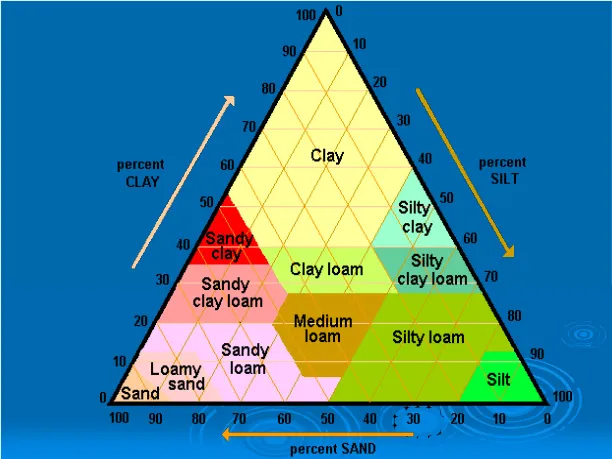
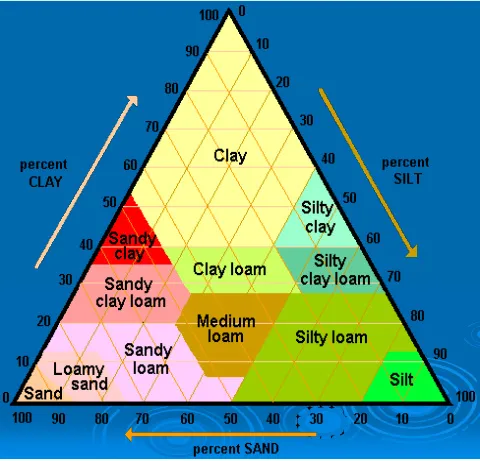
The textural triangle
It is used to determine the soil textural name after the percentages of sand, silt, and clay
are determined from a laboratory analysis. Since the soil's textural classification includes only
mineral particles and those of less than 2mm diameter, the sand plus silt plus clay percentages
equal 100 percent. (note that organic matter is not included.) Knowing the amount of any two
fractions automatically fixes the percentage of the third one.
To use the diagram, locate the percentage of clay first and project inward parallel to sand line.
Do likewise for the per cent silt and project inward parallel to clay line and for sand, project
inward parallel to silt. The point at which the projections cross or intersect will identify the class
name Some times, the intersecting point exactly fall on the line between the textural classes.
Then it is customary to use the name of the finer fraction when it happens. (eg). Soil containing
40% clay, 30% sand.
Importance of Soil Texture
Presence of each type of soil particles makes its contribution to the nature and properties of soil
as a whole
Texture has good effect on management and productivity of soil. Sandy soils are of open
character usually loose and friable.
Such type of the texture is easy to handle in tillage operations.
Sand facilitates drainage and aeration. It allows rapid evaporation and percolation.
Sandy soils have very little water holding capacity. Such soils can not stand drought and
unsuitable for dry farming.
Sandy soils are poor store house of plant nutrients
Contain low organic matter
Leaching of applied nutrients is very high.
In sandy soil, few crops can be grown such as potato, groundnut and cucumbers.
Clay particles play a very important role in soil fertility.
Clayey soils are difficult to till and require much skill in handling. When moist clayey
soils are exceedingly sticky and when dry, become very hard and difficult to break.
They have fine pores, and are poor in drainage and aeration.
They have a high water holding capacity and poor percolation, which usually results in
water logging.
They are generally very fertile soils, in respect of plant nutrient content. Rice, jute,
sugarcane can be grown very successfully in these soils.
Loam and Silt loam soils are highly desirable for cultivation
Generally, the best agriculture soils are those contain 10 – 20 per cent clay, 5 – 10 per
cent organic matter and the rest equally shared by silt and sand and 30% silt - called as
clay rather than clay loam.
Summary Cheat Sheet
Quick Recall Points
- Texture depends on relative fractions of sand, silt, and clay.
- USDA textural classes are interpreted through the textural triangle.
- Texture influences infiltration, water retention, and nutrient-holding capacity.
Exam Traps
- Texture is different from structure; texture is about particle-size distribution.
- Clay-rich soils hold more water but may show lower aeration.
References
2 sources • [1] [2]
References
Lesson Doubts
Ask questions, get expert answers