🧫 Adsorption of ions
Covers ion adsorption, cation exchange, and base saturation concepts in soil chemistry.
This lesson explains key concepts in a structured way and connects them to practical agricultural applications and exam-oriented understanding.
Adsorption of ions
exchange- Significance.
Adsorption of ions
Ion adsorption and subsequent exchange are important processes that take
place between soil colloidal particles (clays, organic matter, sesquioxides, and
amorphous minerals) and various ions. Soil colloids serve very much as a modern
bank. They are the sites within the soil where ions of essential plant nutrients are
held and protected from excessive loss by leaching. Subsequently, the nutrients can
be "withdrawn" from the colloidal "bank" sites and taken up by plant roots. In turn,
these elements can be "deposited" or returned to the colloids through the addition
of commercial fertilizers, lime, manures, and plant residues.
The charges associated with soil particles attract ions (simple and complex)
of opposite charge. In temperate region soils, negative charges generally
predominate on the soil particles (colloids), hence adsorbed cations are present in
larger quantities than anions. In more highly weathered soils (e.g. in tropics) where
1:1 type clays and Fe/Al oxides are the most dominant type of colloids, anion
adsorption and exchange is relatively more prominent.
Ion exchange reactions – Cation exchange, anion exchange and base saturation - significance
The Ion Exchange phenomenon was first identified by Harry Stephen Thompson in
England during 1850. When soil was leached (washed) with ammonium sulphate,
calcium sulphate was detected in the leachate. The ammonium ion in the solution
replaced calcium in the soil.
(NH4)2SO4 + Soil Ca Soil (NH4)2 + CaSO4
The process by which ions are exchanged between solid and liquid phases
and /or between solid phases if in close contact with each other is called ion
exchange.
The common exchangeable cations are Ca [2+] mg [2+] H [+],K [+], NH4 [+ ] and Na.
The common anions are So4 [2-], Cl [-] Po4
-3 and N03
-.
The ion exchange in soil is due to the presence of residual positive and
negative charges on the soil colloids. These residual charges result due to the
process of isomorphous substitution and ionisation of hydrogen and hydroxide
functional groups. The negative charges attract positively charged ions and the
positive charges attract negatively charged ions from soil solutions coming in
contact with colloids. The ions thus attracted are reversible and are on equivalent
proportions.
Exchange of cation is called cation exchange and exchange of anion is called
anion exchange. The cation exchange phenomenon was first discovered by
Thomasway (1850) Ion exchange is the second most important reaction is nature.
The first one is photosynthesis by green plants.
The capacity of the soil to hold cation is called cation exchange capacity.
The unit is C mol (P [+] ) / kg. The capacity to hold anion is called Anion exchange
capacity (AEC). The unit of expression is C mol (e [-] ) / kg
Mechanism of cation exchange.
Clay colloids have negative charges. Cations are attracted to the clay
particles. These cations are held on the held on the clay surfaces electro
statistically. They are held by small particles of clay and organic matter. These
small particles are called Micelle (Micro cell). The cations that can be replaced on
exchange site by other cations are called exchangeable cations. They are weekly
held and they are in direct contact with the soil solution. They can be exchanged
fairly easily. Ions that are held very lightly with the colloid may be traped between
layers of clay micelle. They do not pass to the soil solution very easily. They are
called non exchangeable cations. When any cation is added to the soil such as
Ca [++], K [+] or NH4 through fertilizers and soil amendments they are exchanged with
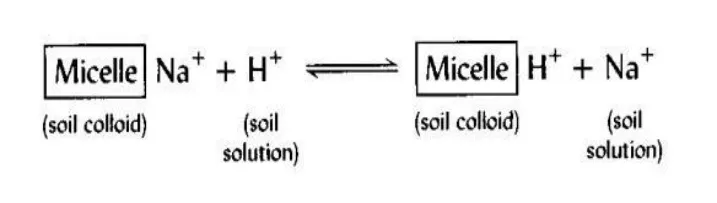
those ions held on the colloid. When calcium is added to an acid soil the following
reaction takes place.
micelle H [+ ] + Ca ------- micelle Ca + 2H [+]
H [+ ]
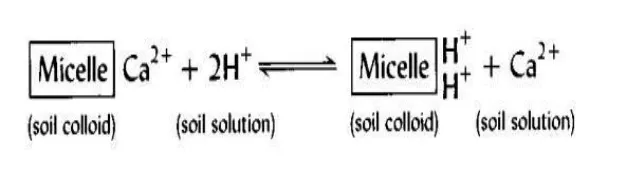
Similarly when H [+] is added to the soil solution through the decomposition of
organic matter or through acidic materials Ca [2+] is replaced from the exchange
complex by H [+] .
Micelle Ca [2+] + 2H ---------- micelle [H] + Ca [2+]
[H ]
Example: Ca [2+] exchange displaces exchangeable Na [+]
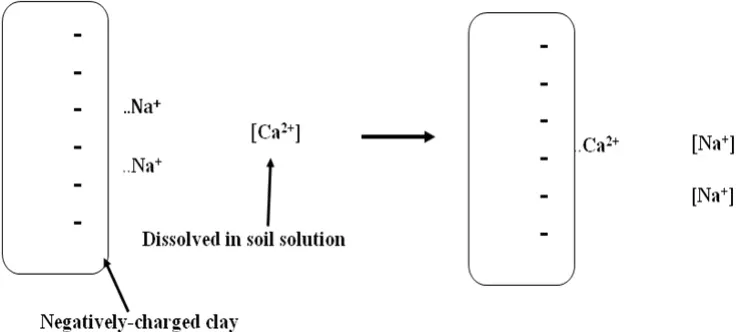
2 X Na [+] + Ca [2+] X Ca [2+] + 2Na [+] X= exchangeable
Cation exchage capacity (CEC)
The sum total of the exchangeable cations that a soil can adsorb is called as
cation exchange capacity.
It is also defined as “the amount of cationic species bound at p [H] 7.0”.
Some authors consider p [H] 4.0 as the appropriate point.
Principles governing cation exchange reaction
Reversibility
Charge equivalence
Ratio law

Anion effects on mass action
Cation selectivity
Complementary ion effect
CEC of different textural classes .
Sand 0-5 C mol (P [+] ) / Kg.
Sandy loam 5-10 ”
Loam 10-15 ”
Clay loam 15-30
Clay 30.0
CEC of important clay minerals
Kaolinite 7-10 C mol (P [+] ) / Kg
Montmorillonite 80-100 ”
Vermiculite 100-150 ”
Illite 25-30 ”
Chlorite 25-30 ”

 Fe & Al oxides 5.0 ”
Humus 200-400 ”
Factors influencing CEC
1. Soil Texture : CEC increases with fineness of the soil particles. This means
increasing clay content will increase the CEC. As the particle size decreases
the surface area increases per unit volume. This naturally increases the net
charge and the CEC.
2. Organic matter : In general CEC increases with increase in organic matter
content. The p [H] dependent charges in the organic matter cause variation in
CEC. When p [H] of the soil solution increases the CEC will also increase.
3. Nature of clay: CEC of clay minerals vary soil dominated with
montmorillonite and vermiculite have higher CEC than those dominated
with kaolinite, chlorite or illite.
4. Soil reaction : In general CEC increases with increase in soil p [H] . As the p [H]
increases the p [H] dependent charge increases. In Humus most CEC is p [H]
dependent.
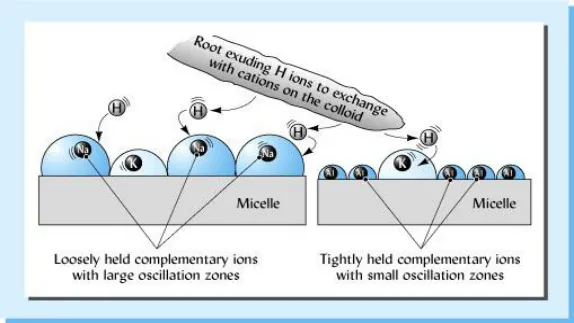
Replacing power of ions:
Replacing power of ions increases with atomic weight. Divalent cations have
more replacing power than monovalent ions. Hydrogen is an exemption. H ions
are adsorbed more strongly than other monovalent or divalent ions. The replacing
power of cations varies with the type of ion, size, degree of hydration, valence,
concentration and the kind of clay mineral involved. As it is controlled by
number of factors no single order of replacement can be given. All other factors
being equal the replacing power of monovalent cations increases in the following
order: Li < Na < K < Rb < Cs < H and for divalent cations: Mg < Ca < Sr < Ba. In
case of mixture of monovalent and divalent cations as they exist in normal soils the
replacing power increases in the following order: Na < K < NH4 < Mg < Ca < H.
This means Na is more easily replaced than K and K more easily than NH4.
In general the power of replacement is
H > Ca > Mg > NH4 > K > Na
Base saturation
The percentage of CEC that is satisfied by the base forming cations is called
base saturation percentage.
% Base saturation = Exchangeable base forming cations (C mol / kg) x 100
CEC (C mol / kg)
Aluminium and hydrogen are considered as acid forming ions. Calcium,
Magnesium, Potassium and Sodium are considered as base forming ions. Base
forming substances are called as besoids and acid forming substances are called as
acidoids. The percentage of sodium in the total CEC is called Exchangeable
sodium percentage (ESP) [(Na/CEC) x 100]. These parameters are considered
while deriving fertilizer prescription and amendments for problem soils A
knowledge of base saturation percentage is useful in many ways.
- It helps in determining the quantity of lime required to raise the p [H] of acid
soils.
- It indicates the proportion of plant nutrients in CEC. It is an index of soil
fertility.
- Degree of saturation of a particular cation in CEC indicates the ease with
which the cation can be released for plant nutrition. For example if calcium
saturation is more Ca can be very easily replaced from the exchange
complex.
- For a fertile soil it is considered that the base saturation percentage should be
more than 80.
Anion exchange
Replacement of one anion by another anion on the positively charged
colloids is called anion exchange, positive charges are due to OH of iron and
aluminium, 1:1 clays and allophone (a morphous clays).
Anion exchange is p [H] dependent. Lower the p [H] greater is the anion
exchange. Soils with Kaolinite dominant clay have higher anion exchange capacity
than montmorillonite or illite.
The relative order of anion exchange is
OH > H2PO4 > SO4 > NO3 > Cl.
Importance of anion exchange:
- The phenomenon of anion exchange is important for the release of fixed P in
the soil.
In acid soils the phosphorus is fixed as insoluble Al-Phosphate. Liming the
acid soils release fixed P. Here the OH ion replaces H2 PO4 from Al(OH)2
H2PO4.
Al(OH)2 H2 PO4 + OH Al(OH)3 + H2 PO4.
- Similarly the availability of other nutrients like NO3, SO4 and Cl are
influenced by anion exchange.
Soil colloid NO3 + Cl Soil colloid Cl + NO3
Soil solution Soil solution
Significance of ion exchange
Next to photosynthesis ion exchange is the most important reaction in the
world. Plants take up their food material from the soil through ion exchange only.
Plant roots which are in contact with the soil solution exchange the nutrients from
soil solution for H [+] ions present on the surfaces of root hairs.
Effect on soil fertility
A soil is considered to be fertile when the base saturation percentage is more
than 80. Each percent of humus contributes about 2 C mol /kg of CEC.
Montmorillonite contributes about I C mole and Kaolinite contributes about 0.08 C
mol/kg for every one percent.
Availability of applied nutrients
When fertilizers are applied to supply plant nutrients elements like K, Ca,
Mg and NH4 dissolve in soil solution. These nutrients in soil solution are
exchanged for other cation like H [+] present in the exchange complex. If there is no
cation exchange the applied nutrients would be lost in drainage water. Similar is
the case with anion radicals like PO4, NO3, SO4 etc. Soils with high CEC can
adsorb higher amounts of nutrients. Hence, in clay soils we can apply larger
quantities of fertilizers in a single dose. Sandy soils have very low CEC and in
such soils fertilizers should be applied in splits.
Effect of adsorbed cations.
When the soil exchange complex has calcium the soil will have desire able
physical properties. The activity of soil micro organisms, ammonification and
nitrification processes also are determined by the cations of exchange complex.
Toxic ions:
When the exchange complex had adsorbed metals like Cadmium, Nickel and
lead they are toxic to the crop plants.
Effect on soil p [H]
Clays with H are acidic and with Na are alkaline. The acidic and alkaline
nature of soil has its own effect on soil properties
Summary Cheat Sheet
Quick Recall Points
- Cation exchange capacity (CEC) measures nutrient-holding potential.
- Exchange selectivity differs among cations based on charge and hydrated radius.
- Base saturation indicates proportion of exchange sites occupied by base cations.
Exam Traps
- High CEC does not always mean immediate nutrient availability.
- Exchange reactions are reversible and influenced by soil solution composition.
References
2 sources • [1] [2]
References
Lesson Doubts
Ask questions, get expert answers