🧫 Soil as a source
Soil as a source.
Soil acts as the main reservoir for essential plant nutrients, and understanding this role is central to crop nutrition and yield management.


Learning objective :
To understand the importance of soil fertility
To study the essential nutrients in plant growth
Crops depend on extrinsic and intrinsic factors for their growth and environment to provide them with basic necessities for photosynthesis. These essential plant growth factors include:
-
light
-
heat
-
air
-
water
-
nutrients
-
physical support
If any one factor, or combination of factors, is in limited supply, plant growth will be adversely affected. The importance of each of the plant growth factors and the proper combination of these factors for normal plant growth is best described by the principle of limiting factors. This principle states: "The level of crop production can be no greater than that allowed by the most limiting of the essential plant growth factors." The principle of limiting factors can be compared to that of a barrel having staves of different lengths with each stave representing a plant growth factor.
Crop yield and quality depends upon the essential growth factors and the many interrelated soil, plant, environmental and agronomic factors or variables. Within this system, some of these factors cannot be controlled; others can be controlled and are manageable.
Soil is one of the key factors affecting plant growth as observed in the figure. The major functions of the soil are to provide plants with nutrients, water and oxygen.
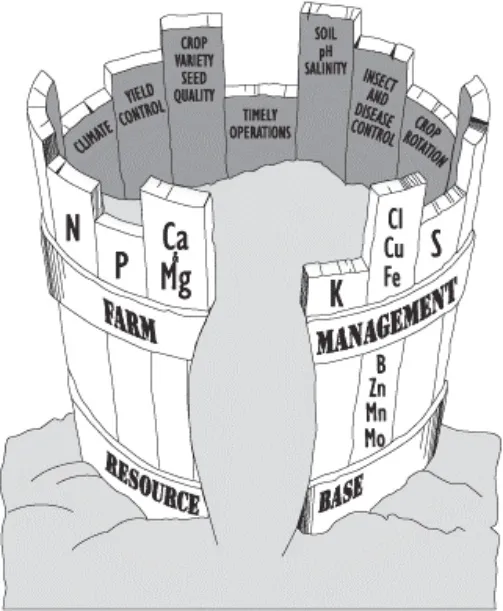
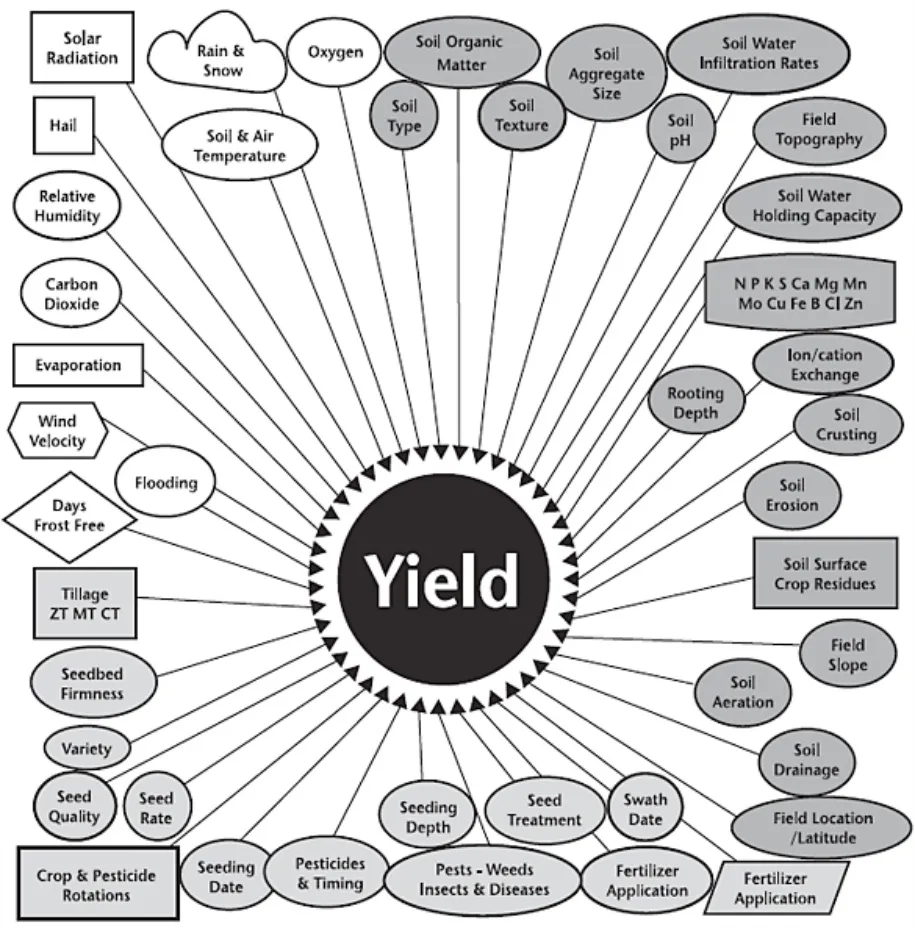
Crop Production Factors
FAO has listed seven important soil qualities which affect crop growth as given below.
| Soil Qualities | Col2 | Soil Characteristics |
|---|---|---|
| SQ1 | Nutrient availability | Soil texture, soil organic carbon, soil pH, total exchangeable bases |
| SQ2 | Nutrient retention capacity |
Soil Organic carbon, Soil texture, base saturation, cation exchange capacity of soil and of clay fraction |
| SQ3 | Rooting conditions | Soil textures, bulk density, coarse fragments, vertic soil properties and soil phases affecting root penetration and soil |
| Col1 | Col2 | depth and soil volume |
|---|---|---|
| SQ4 | Oxygen availability to roots |
Soil drainage and soil phases affecting soil drainage |
| SQ5 | Excess salts. | Soil salinity, soil sodicity and soil phases influencing salt conditions |
| SQ6 | Toxicity | Calcium carbonate and gypsum |
| SQ7 | Workability (constraining field management) |
Soil texture, effective soil depth/volume, and soil phases constraining soil management (soil depth, rock outcrop, stoniness, gravel/concretions and hardpans) |
Soil fertility is the key to sustainable agriculture. Soil fertility is defined in several ways.
Soil fertility
“Soil fertility is the ability of the soil to supply essential plant nutrients during growth period of the plants, without toxic concentration of any nutrients”. i.e “the capacity of soil to supply nutrient in available to crop”.
Soil productivity
“Soil productivity is ability of soil to produce a particular crop or sequence of crops under a specified mgt system” i.e the crop producing capacity of soil”.
All the productive soils are fertile but all the fertile soils may not be productive
Sometimes even if the soil is fertile, they are subjected to drought or other unsatisfactory growth factors or management practices.
History of development of soil fertility
Francis Bacon (1591- 1624) suggested that the principle nourishment of plants was water and the main purpose of the soil was to keep plants erect and to protect from heat and cold.
Jan Baptiste Van Helmont (1577 – 1644) was reported that water was sole nutrient of plants.
Robert Boyle (1627 – 1691) an England scientist confirmed the findings of Van Helmont and proved that plant synthesis salts, spirits and oil etc from H2O.
Anthur Young (1741 – 1820) an English agriculturist conducted pot experiment using Barley as a test crop under sand culture condition. He added charcoal, train oil, poultry dung, spirits of wine, oster shells and numerous other materials and he conduced that some of the materials were produced higher plant growth.
Priestly (1800) established the essentiality of O2 for the plant growth.
J.B. Boussingault (1802-1882) French chemist conducted field experiment and maintained balance sheet. He was first scientist to conduct field experiment. He is considered as father of field experiments.
Justus Von Liebig (1835) suggested that
a. Most of the carbon in plants comes from the CO2 of the atmosphere. b. Hydrogen and O2 comes from H2O. c. Alkaline metals are needed for neutralization of acids formed by plants as a result of
their metabolic activities. d. Phosphorus is necessary for seed formation. e. Plant absorb every thing from the soil but excrete from their roots those materials
that are not essential.
The field may contain some nutrient in excess, some in optimum and some in least, but the limiting factor for growth is the least available nutrient. The law of Mn, stated by Liebig in 1862, is a simple but logical guide for predicting crop response to fertilization. This law states that, “the level of plant production cannot be grater than that allowed by the most limiting of the essential plant growth factors”. The contributions made by Liebig to the advancement of agriculture were monumental and he is recognized as the father of Agricultural chemistry.
J.B. Lawes and J. H. Gilbert (1843) established permanent manurial experiment at Rothemsted Agricultural experiment station at England. They conducted field experiments for twelve years and their findings were
a. Crop requires both P and K, but the composition of the plant ash is no measure of
the amounts of these constituents required by the plant. b. No legume crop require N. without this element, no growth will be obtained
regardless of the quantities of P and K present. The amount of ammonium contributed by the atmosphere is insufficient for the needs of the crop. c. Soil fertility can be maintained for some years by chemical fertilizers. d. The beneficial effect of fallow lies in the increases in the available N compounds in
the soil.
Robert Warrington England showed that the nitrification could be supported by carbon disulphide and chloroform and that it would be stopped by adding a small amount of unsterilized soil. He demonstrated that the reaction was two step phenomenon. First NH3 being converted to nitrites and the nitrites to nitrites.
Essential and Beneficial Elements
“A mineral element is considered to be essential for plant growth and development if the element is involved in plant metabolic functions and the plant cannot complete its life cycle without the element.”
There are seventeen essential elements required for plant growth viz., C, H, O, N, P, K, Ca, Mg, S, Fe, Mn, Zn, Cu, B, Mo, Cl, Ni,
The following is the essentiality criteria described by Arnon and Stout (1939)
-
A plant must be unable to complete its life cycle in the absence of the mineral element.
-
The function of the element must not be replaceable by another mineral element.
-
The element must be directly involved in plant metabolism.
Beneficial Nutrients/Elements: Beneficial elements are the mineral elements that stimulate the growth and exhibit beneficial effects at very low concentration or which are essential only for certain plant species or under specific conditions are called as “beneficial elements”.Eg.Na,Va,Co,Si
D.J.Nicholas coined the term “functional or metabolic nutrient”
Any mineral element that functions in plant metabolism, whether or not its action is specific. (Cl, Si, Na, Va, Co, Se)
The following table gives the essentiality of elements established by different scientists
Essentiality of the elements established by
Carbon : Priestly (1800)
Nitrogen : Theodore De saussure (1804)
Ca, Mg, K, S : Carl sprengel (1839)
Phosphorus : Von Liebig (1844)
Iron (Fe) : E. Greiss (1844)
Manganese (Mn) : J.S. Hargue (1922)
Zinc(Zn) : Sommer and Lipman (1926)
Copper (Cu) : Sommer, Lipman and Mc Kenny (1931)
Molybdenum (Mo) : Arnon and Stout (1939)
Sodium (Na) : Brownell and wood (1957)
Cobalt(Co) : Ahamed and Evans (1959)
Boron(B) : Warring ton (1923)
Chlorine (Cl )
Nickel
:
:
Broyer (1954)
Brown et.al.(1987)
Classification of Essential Elements
- Based on the amount required by the plant i) Major nutrients – required in large quantities eg. N,P,K ii) Secondary nutrients – required in lesser quantities compared to Major nutrients eg.
Ca,Mg,S iii) Micronutrients- required in trace quantities eg. Fe, Mn, Zn, Cu, B, Mo
Classification based on the role of element in plant system
(According to TRUOG, 1954)
Structural Elements : C, H, O
ii). Accessory structural elements : N. P. S
iii). Regulator & Carriers : K, Ca, Mg
iv). Catalyst & Activators : Fe, Mn, Zn, Cu, Mo, Cl, B
Nyle C. Brady (1996).The Nature and Properties of soils. Tenth edition. Prentice hall of India Pvt.Ltd,New Delhi.
Tisdale,S.L.,Nelson,W.L.,Beaton,J.D.,Havlin,J.L.1997.Soil fertility and Fertilizers.Fifth edition, Prentice hall of India Pvt.Ltd,New Delhi.
http://www.fao.org/nr/land/soils/harmonized-world-soil-database/soil-quality-for-cropproduction/en/
https://athene.umb.no/emner/pub/EDS215/LectureSoil.htm
Fischer, G., F. Nachtergaele, S. Prieler, H.T. van Velthuizen, L. Verelst, D. Wiberg, 2008. Global Agro-ecological Zones Assessment for Agriculture (GAEZ 2008) . IIASA, Laxenburg, Austria and FAO, Rome, Italy.
http://www3.ag.purdue.edu/counties/vanderburgh/SiteCollectionDocuments/MG2011%20Lectur es/Plant%20Nutrition%20Quiz%20KEY.pdf
Questions to ponder
-
How are the essential elements essential to crops?
-
Which elements are considered to be essential for crop growth?
-
Why is some nutrient deficiencies exhibited in older leaves, while other nutrient deficiencies
show up first on newer leaves? 4) What are beneficial elements? 5) What is the difference between major and micronutrient?
Summary Cheat Sheet
Key Recall Points
- Soil as a source is exam-relevant for SSAC122 and objective questions in soil science.
- Use soil-test based interpretation with focus on pH, CEC, and nutrient availability.
- Apply the 4R principle: right source, right rate, right time, and right method.
Exam Traps
- Do not mix up soil fertility concepts with fertilizer quantity alone.
- Numerical and term-based questions often test definitions, units, and threshold values.
- In problem-solving, interpretation must follow soil reaction, crop stage, and management context.
References
3 sources • [1] [2] [3]
References
ICAR e-Course: Soil Chemistry, Soil Fertility and Nutrient Management
OfficialBrady and Weil, The Nature and Properties of Soils
BookLesson Doubts
Ask questions, get expert answers