🧫 Forms of nutrients
Forms of nutrients.
This lesson introduces essential plant nutrients, their categories, concentration ranges, and absorbable ionic forms relevant to soil fertility management.


Learning objective
To know the functions of each nutrient in plant
Primary or major nutrients: are those nutrients required relatively in large quantities by the plants for its growth and development. Ex: N, P and K.
Secondary nutrients: are those nutrients which are required by plants in moderate amounts and given secondary importance in its supply and management.
Ex: Ca, Mg and S.
Micronutrients: The nutrients which are utilized by plants in relatively smaller quantities for their growth and development, but these are equally important & essential to plants as macronutrients.
Ex: Fe, Mn, Zn, Cu, B, Mo, Cl and Ni.
Plant Nutrients
Sixteen elements are considered essential for plants. They are grouped based on their
relative abundance in plants.
Many non-essential elements are also found in plants that account for over 60
elements. Al is absorbed when soil solution is rich in Al ions. When plant materials is
burned, the remaining plant ash contains all the essential and non-essential elements
except C, H, O, N, S. Macro nutrients are absorbed in 30-100 times in proportion to that of
micronutrients.
Essential Nutrients
1 (3/4)
| Non- mineral Nutrients |
Macronutrients | Col3 | Micronutrients | Col5 |
|---|---|---|---|---|
| Non- mineral Nutrients |
Primar y |
Secondary | By all plants | Some |
| C | N | Ca | Fe | B | Na |
|---|---|---|---|---|---|
| H | P | Mg | Mn | Cl | Co |
| O | K | S | Zn | Mo | Va |
| Cu | Ni | ||||
| Si |
Chemical nature
| Metals | K, Ca, Mg, Fe, Mn, Zn, Cu, |
|---|---|
| Non-metals | C, H, O, N, P, S, Cl |
The plant content of mineral elements is affected by many factors and their
concentration in crops varies considerably.
| Nutrient | Col2 | Relative concentration (Times) |
Concentration (%) |
|---|---|---|---|
| Primary | N, K | 400-1000 | 1-1.5 |
| P | 30 |
0.1-0.3 |
|
| Secondar y |
Ca, Mg | 100-200 |
0.2-0.5 |
| S | 30 |
0.1 |
|
| Micro | Fe, Mn, B | 1-2 |
0.002-0.01 |
| Others | <1 |
<0.002 |
2
Plant Nutrients
Concentration, Mobility, forms, functions
A mineral element is considered essential to plant growth and development if the element
is involved in plant metabolic functions and the plant cannot complete its life cycle without the
element. Terms commonly used to describe level of nutrients in plants are
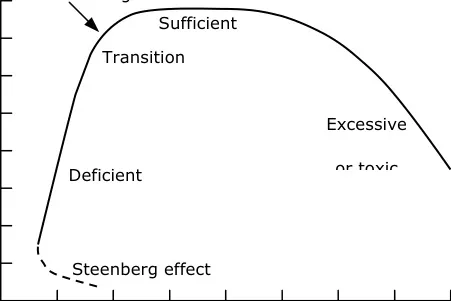
Deficient
When the concentration of an essential element is low enough to limit yield severely and distinct
deficiency symptoms are visible then that element is said to be deficient. Extreme deficiencies
can result in plant death. With moderate or slight deficiencies, symptoms may not be visible, but
yields will still be reduced.
Critical range
The nutrient concentration in the plant below which a yield response to added nutrient occurs.
Critical level or ranges vary among plants and nutrients but occur somewhere in the transition
between nutrient deficiency and sufficiency.
1 (4/4)
PLANT YIELD
NUTRIENT CONCENTRATION IN TISSUE
Sufficient
Concentration range in which added nutrients will not increase yield but can increase nutrient
concentration. The term luxury consumption is used to describe nutrient absorption by the plant
that does not influence yield.
Excessive or toxic
When the concentration of essential or other elements is high enough to reduce plant growth and
yield then it is said to be toxic. Excessive nutrient concentration can cause an imbalance in other
essential nutrients, which also can reduce yield
Concentration and plants yield
Yield is severely affected when a nutrient
is deficient. When deficiency is corrected, growth
increases more rapidly. Under severe deficiency,
rapid increase in growth with added nutrient can
cause a small decrease in nutrient concentration
due to dilution effect. This is called the
Steenberg effect
Luxury consumption
Nutrient sufficiency occurs over a wide
concentration range, wherein yield is unaffected.
Increase in nutrient concentration above the
critical range indicates that the plant is absorbing
nutrient above that needed for maximum yield.
| Forms of nutrients for Plant absorption |
Col2 |
|---|---|
| N | NH4 +, NO3 -, organic N |
| P | H2PO4 - (Primary) and HPO4 2- (Secondary) Orthophosphates |
| K | K+ |
| Ca | Ca++ |
| Mg | Mg++ |
| S | SO3 - (Sulphite) and SO4 - |
| Fe | Fe++ (Ferrous), Fe+++ (Ferric) |
| Mn | Mn++(Manganous) and Mn+++ (Manganic) 1 (2/ |
| Zn | Zn++ |
| Cu | Cu+ (Cuprous) and Cu++ (Cupric) |
| B | BO3 - and other forms |
| Mo | MoO4 -- (Molybdate) |
| Cl | Cl- |
This luxury consumption is common in most plants. Elements absorbed in excessive quantities
can reduce plant yield directly through toxicity or indirectly by reducing concentration of other
nutrient below critical ranges.
Functions of nutrients in plants:
| Nutrient | Col2 | Functions |
|---|---|---|
| Major nutrients | Major nutrients | Major nutrients |
| Nitrogen | Basic component of proteins and chlorophyll (the pigment that gives plants their green colour). Plays an essential role in plant growth. Also feeds microorganisms in the soil |
|
| Phosphorus | Plays an important role in root growth and promotes the establishment of young plants, flowering, fruiting and ripening, photosynthesis, respiration and overall plant growth. |
|
| Potassium | Moves through the plant. Promotes the movement of sugars, turgor and stem rigidity. Also increases the plant’s overall resistance to cold, diseases, insect pests, etc. Promotes the formation of flower buds, the hardening-off of woody plants and fruiting. |
|
| Secondary nutrients | Secondary nutrients | Secondary nutrients |
| Calcium | Plays a vital role in plant structure, because it is part of cell walls and holds them together. Promotes the development of the root system and the ripening of fruit and seeds. Found in the growing parts of plants (apex and buds). |
|
| Magnesium | An important part of chlorophyll. Helps fruit ripen and seeds germinate. Reinforces cell walls and promotes the absorption of phosphorous, nitrogen and sulphur by plants |
|
| Sulphur | A component of several proteins, enzymes and vitamins. Contributes to chlorophyll production. Helps plants absorb potassium, calcium and magnesium. |
|
| Micronutrients | Micronutrients | Micronutrients |
| Iron | Col2 | Essential to chlorophyll production. Also contributes to the formation of some enzymes and amino acids. |
|---|---|---|
| Boron | Essential to overall plant health and tissue growth. Promotes the formation of fruit and the absorption of water. |
|
| Manganese | Promotes seed germination and speeds plant maturity. Plays an important role in photosynthesis by contributing to chlorophyll production. Essential for nitrogen assimilation and protein formation. |
|
| Molybdenum | Essential for nitrogen assimilation by plants and nitrogen fixation by bacteria. This means that it is needed for the production of nitrogen-based proteins. |
|
| Chlorine | Stimulates photosynthesis. |
|
| Copper | Activates various enzymes. Also plays a role in chlorophyll production |
|
| Zinc | Plays an important role in the synthesis of proteins, enzymes and growth hormones. |
|
| Nickel | Key component of selected enzymes involved in N metabolism and biological N fixation. |
|
| Beneficial elements | Beneficial elements | Beneficial elements |
| Silicon | Strengthens cell walls, energy transfer & drought resistance Reduces water loss & prevents fungal infection. |
|
| Cobalt | Essential in N fixation | |
| Sodium | Na replaces K in certain functions in halophytes plants For C4 plants having dicarboxylic photosynthetic pathway |
|
| Vanadium | Essential for green algae |
Forms of elements in Mineral soil
Macro elements are available in (1) Solid (2) Cations (3) Cations in soil solution
| Nutrients | Mineral / solid | Cations | Soil solution as ions |
|---|---|---|---|
| N | Organic compounds and Amino acids | NH4 + |
NH4 +, NO2 -, NO3 - |
| P | Organic compounds, nucleic acid and inorganic compounds. Ca, Fe, Al, PO4’s |
- |
H2PO4 -, HPO4 - |
| K | Feldspar, mica, silicate clays | K+ |
K+ |
| Ca | Feldspar, hornblende, lime stone | Ca2+ |
Ca2+ |
| Mg | Mica, Hornblende, lime stone | Mg2+ | Mg2+ |
| S | Organic sources – protein, amino acids inorganic sources – Gypsum, pyrites . |
- - |
HSO4 -, SO3 2- SO4 2- |
Forms of nutrient element absorbed by plants
Nutrient element Forms absorbed
C Mainly through leaves - CO2
H HOH (Hydrogen from H2O) – H [+ ]
2-,,OH-, CO3
O CO2 mainly through leaves – O4
N NH4
K K [+]
+, NO3
Ca Ca [2+ ]
Mg Mg [2+ ]
S SO4
Fe Fe [2+] (Ferrous), Fe [3+] (ferric)
Mn Mn [2+] (Manganous), Mn [4+] (Manganic)
Zn Zn [2+ ]
Cu Cu [+] (cuprous), Cu [2+] (Cupric)
Co CO [2+ ]
Na Na [+ ]
Si Si (OH)4
Cl Cl [-]
B H3BO3 (Boric acid) H2 BO3
- (Borate)
Mo Mo O4
References: Tisdale,S.L.,Nelson,W.L.,Beaton,J.D.,Havlin,J.L.1997.Soil fertility and Fertilizers.Fifth edition, Prentice hall of India Pvt.Ltd,New Delhi.
http://www.ctahr.hawaii.edu/oc/freepubs/pdf/pnm3. From: J. A. Silva and R. Uchida, eds. College of Tropical Agriculture and Human Resources, University of Hawaii at Manoa, ©2000
http://edis.ifas.ufl.edu/hs1191
Questions to ponder
1)How will you differentiate between N and K deficiencies of corn visually?
- What is luxury consumption?
3)Which element is absorbed both in anionic and cationic forms?
- Which element is specifically involved in nitrate reduction in plants?
5)Name the nutrients whos deficiencies are first exhibited in the apical region of the growing plant?
Summary Cheat Sheet
Key Recall Points
- Forms of nutrients is exam-relevant for SSAC122 and objective questions in soil science.
- Use soil-test based interpretation with focus on pH, CEC, and nutrient availability.
- Apply the 4R principle: right source, right rate, right time, and right method.
Exam Traps
- Do not mix up soil fertility concepts with fertilizer quantity alone.
- Numerical and term-based questions often test definitions, units, and threshold values.
- In problem-solving, interpretation must follow soil reaction, crop stage, and management context.
References
3 sources • [1] [2] [3]
References
ICAR e-Course: Soil Chemistry, Soil Fertility and Nutrient Management
OfficialBrady and Weil, The Nature and Properties of Soils
BookLesson Doubts
Ask questions, get expert answers