🧫 Nitrogen—Transformation,
Nitrogen—Transformation.
This lesson explains key concepts in a structured way and connects them to practical agricultural applications and exam-oriented understanding.
Nitrogen—Transformation,


Learning objectives
a. To understand the transformation of nitrogen b. To know the factors affecting the availability of nitrogen c. To understand the deficiency symptoms of Nitrogen and corrective measures
Nitrogen
The cheap source of N is the crop residues in temperate region. In tropical soils, the total N content is 0.03 - 0.1 %. Rainfall is also source of N at 4.6 kg of N / ha is received ha [-1 ] yr [-1] . It is converted to NO3 during lighting addition of organic matter and fertilizer is other major sources. Nitrogen is an essential constituent of protein and also other non protein compounds of great physiological importance in plant metabolism. It is an integral part of chlorophyll, which is primary observer of light energy needed for photosynthesis. Nitrogen also imparts vigorous vegetative growth and governs the utilization of P,K and other elements
Forms of soil nitrogen
Inorganic forms N Organic forms of soil
- Ammonium NH4
- Amide form (NH2)
-
Nitrite NO2- Plant absorbs N as both
-
Nitrate NO3- NH4
-, NO3
-.
- Elemental N (No)
Losses of Nitrogen
- Crop removal
- Leaching (or) drainage (11-18% loss)
- Gaseous losses as NH4 or elemental N2
- Volatilization.
- Erosion (8 – 15 kg ha [-1] yr [-1] ).
- Ammonia fixation by clays
- Immobilization in organic materials.
N transformations in soils
a. N - Mineralisation b. Aminisation c. Conversation of urea
d. N Immobilization. e. N factor f. Ammonification. g. Nitrification h. Denitrification i. Organic fixation j. Elemental N loss. k.Nitrogen cycle.
N transformations in soils
Nitrogen mineralization
Mineralization is the conversation of organic N to NH4+ as a result of microbial
decomposition. Mineralization increases with a rise in temperature and is enhanced by adequate, although not excessive, soil moisture and a good supply of O2. Mineralization of organic N involves in two reactions.
i.e 1) Aminization 2) Ammonification.
Aminisation
Aminisation is the decomposition of proteins and the release of amines, amino acids and urea is called aminisation.
Bacteria NH2 NH2
Fungi H2O
H amines NH2
Amino acid Urea.
The initial step in the decomposition of organic matter by the enzymatic digestion of proteins into amino acids like, peptones and amino acid. Under aerobic protolysis the major end products are CO2 (NH4)2 SO4 and H2O. Under anaerobic conditions the end products are ammonia, amides, CO2 and H2S.
The organic compounds and proteins are mainly decomposed by various species of Pseudomonas,
Bacilli, clostridium, serrotia, Micrococcus
Generally in the neutral and sodic soils, bacteria are active and in acidic soils fungi are active.
Conversion of urea
Urea is a product of ammonization. The hydrolysis of urea by the action of increases enzyme is effected by Bacilli micrococcus, Pseudomonas, clostridium, Aeromobactor and coryne bactor.
-
- HCO3
NH4
2-.
-
- CO3
The optimum H2O holding capacity for these reactions is 50 – 75 and optimum temperature is 30 – 50°C.
The NH4 can be utilized by microorganisams and root of higher plants. Some of the released NH3 is fixed by clay especially illite. A major portion is oxidized to nitrate form. In the second reaction NO2- is further oxidized to NO3- by nitrobactor
-
is further oxidized to NO3
-
by nitrobactor
-.
2 NO2
Nitrogen immobilization
“Immobilisation is the process of conversion of inorganic N (NH4+ or NO3-) to organic N and it
is basically the reverse of N mineralization”.
“Immobilisation is the process of conversion of inorganic N (NH4
- or NO3
The Microorganisms accumulate NH4 N and NO3 – N in the form of protein, nucleic acid and other complexes. If C:N ratio is wider than 30, it favours immobilization and lesser C:N ratio encourage mineralization.
N factor
N factor is the No of units of in organic nitrogen immobilized for each 100 units of materials under going decomposition”. The average values for the nitrogen factor vary from 0.1 or < to 1.3.
Ammonification
“Amines and Aminoacids produced during aminisation of organic N are decomposed by other heterotrophs with release of NH4+ is termed Ammonifcation
R – NH2 + H2O NH3 + R – OH + energy
H2O NH4
-
- OH –
Nitrification
Nitrification is the process of biological oxidation by which the NH4- Cal form of N converts to nitrate form of N. There are two steps. (a) NH4 is converted first to NO2- and then to NO3-.
- and then to NO3
-.
Nitrosomonas
-
- 2 H2O + 4 H+
Nitrosomonas are obligate autotropic bacteria that obtain their energy from the oxidations of N and their C from CO2.
Others autotrophic bacteria Nitrosolobus, Nitrospira and nitroso vibrio and to some extend heterotrophic bacteria also can oxidize NH4+ and other N reduces, compounds to NO3-.
- and other N reduces, compounds to NO3
-.
Losses of Nitrogen
The major losses of N from the soil are due to (1) crop removal and leaching, however under certain conditions inorganic N ions can be converted to gases and lost to the atmosphere. The primary pathway of gaseous N losses are
- Denitrification 2. NH3 volatilization.
Denitrification
Denitrification is the biochemical reduction of NO3N or NO2N to gaseous N, either as molecular Nitrogen or an oxide of Nitrogen. The most probable bio chemical pathway is
Nitrate Nitrite Nitric Nitrous Nitrogen
oxide oxide
Nitrogen fixation
The conversation of elemental nitrogen to organic forms readily use able in biological process. Vermicullite and illite are capable of fixing NH4+ by a replacement of K- or Na+ for interlayer
cations in the expended lattice of clay minerals. The radius of NH4 ion 0.143° A. K [+] ion 0.133°A.
Because of NH4 and K have more or less same charge, they easily replace each other in the exchange sites.
Organic fixation
It the soil has more organic matter the NH4 will lockup as a complex. There complex are called Chelates . It release the nutrients only after its molecular break down. The facultative aerobic bacteria tiles pseudomonas, bacillus, porococcus are responsible for denitrification. It also depends upon the texture of soil. In heavy clay soils loss is upto 50% of added fertilizer.
Elemental N loss
It is due to chemical reduction. If chemical fertilizer containing amide (or) NH4 form of N, it may be oxidized to elemental N and lost.
Sources of N leading to N and NO2 gaseous loss
- Denitrification
NO3
- Nitrification
NH4
- Nitrates and Ammonium
-
- NO2
NH4
- Nitriates and aminoacids.
7.Decomposition of nitrous acid / reaction with metal cations.
-
NH3 Gas
-
Decomposition of residues and manures
Release and volatilization of NH3
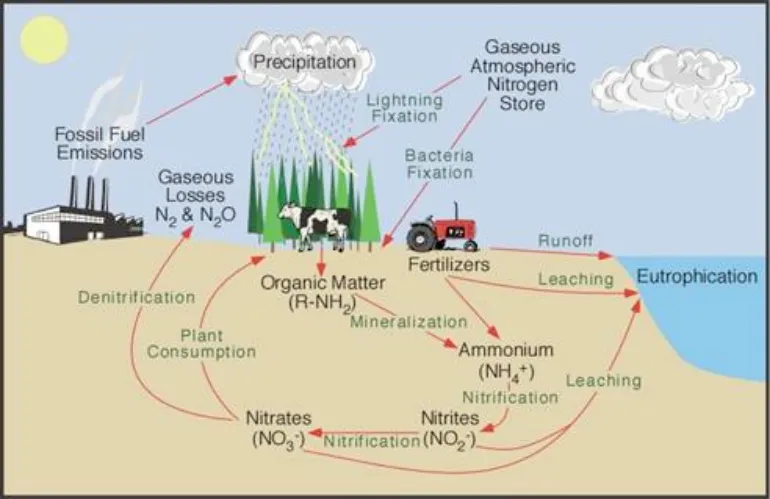
Nitrogen cycle
The cycling of N in the soil – plant – atmosphere system involves many transformations of N between inorganic and organic forms.
The N cycle can be divided into
- N inputs or gains.
- N outputs of losses
- N cycling with in the soil.
- N in plant and animal residues and N derived from the atmosphere through electrical,
combustion, biological and industrial process is added to the soil. 2. N in the residues is mobilized as NH4 by soil organisms as an end product of residue
decomposition, plant roots absorb a portion of the NH4. 3. Much of the NH4 is converted to No3
- Much of the NH4 is converted to No3- by nitrifying bacteria in a process called
nitrifications. 4. NO3 is taken up by the plant roots and is used to produce the protein in crops that are
eaten by humans or fed to live stocks. 5. Some NO3 is lost to ground H2O or drainage systems as a results of downward
movement through the soil in perculating H2O. 6. Some NO3 is consorted by denitrifying bacteria in to N2 and N2O that escape into the
atmosphere, completely the cycle.
The nitrogen cycle
Source: http://www.physicalgeography.net
Important microorganisms in BNF
| Organism s |
Properties | Active location |
|---|---|---|
| Azotobac ter |
Aerobic, free living |
Soil, water, rhizosphere, leaf surface |
| Azospirill um |
Micro aerobic rhizobacteri a; free fixers |
Free living in Rhizosphere; Colonize roots of cereals and also gives phytotonic effect |
| Rhizobiu m |
Symbiotic | Root nodules of legumes |
| Actinomy cetes, Frankia, Beijerinck ia |
Symbiotic | Non leguminous forest tree roots, leaf surfaces |
| Cyanoba cteria |
Photo autotrophic Anabaena - symbiotic |
In wetland flood water; Anabaena associate with Azolla |
Symbiotic N fixation
The symbiosis is the mutually beneficial relationship between host plant and
bacteria. The location of association is in root or stem nodules, inside cavities, or by
colonizing and penetrating plant tissue.
Legume (nodule forming)
Legumes and bacteria of the genera Rhizobium and Bradyrhizobium provide
the major biological source of fixed N (40-60%) in agricultural soils. These organisms
infect the root hairs and the cortical cells, ultimately inducing the formation root nodules
that serve as the site of N fixation. The host plant supplies the bacteria with
carbohydrates for energy and the bacteria reciprocate by supplying the plant with fixed N
compound.
Effective nodules cluster on primary roots and have pink to red centers. The red colour of
the nodule is attributed to the occurrence of leghemoglobin . The quantity of N fixed by properly
nodulated legume averages about 75% of the total N used for the plant growth. The amount of
BNF varies with Rhizobium strain, host plant, and environment.
Yield of non-legume crops often increase when they are grown following legumes
(e.g. maize after soybean). Maximum N fixation occurs only when available soil N is at a
minimum. When optimum conditions for N fixation is not prevailing, a legume crop can
deplete soil N greatly, more than a cereal, if the legume grown is not incorporated into
the same soil.
| Fixer | Host plant |
|---|---|
| Rhizobium | Alfalfa, clover, peas, bean, soybean |
| Rhizobium | Gliricidia, Leuceana, Sesbania, Mimosa, Acacia 3 (3/4) |
| Bradyrhizobium | Cowpea, groundnut, red gram |
Non-legume (nodule forming)
Roots of many species of angiosperm trees like casuarina in forests and wetlands
form distinct nodules when infected with Actinomycetes of the genus Frankia .
Non-legume (non-nodule forming)
Azospirillum, Azotobacter, and Azorhizobium, dominant N fixers in cereals like rice,
wheat, corn, sorghum, millets can grow on root surfaces and penetrate root tissues. The
organisms use carbohydrates of root exudates as source of energy. They also induce crop
growth by hormonal action. The organism Beijerinckia fixes N on leaf surfaces of tropical plants.
The Anabaena blue green algae (Cyanobacteria) inhabit cavities in the leaves of the
floating water fern Azolla and fix quantities of N comparable to those of the better Rhizobium
legume complex. It could fix about 30-105 kg N/ season taking care of 75% N requirement of
rice.
Nonsymbiotic N fixation
In wetland floodwater photoautotrophic Cyanobacteria independently do
photosynthesis and fix N up to 20–30 kg N/ ha/ year. The excess ammonia is excreted in
floodwater, which is beneficially absorbed by rice plants.
Free-living heterotroph bacteria like Azotobacter and Beijerinckia in aerobic upland
soils and Clostridium in anaerobic wetland soils effectively fix N in pockets where O2 supply is
limited. Fixation depends upon the pH, soil N level, and source of organic matter.
Industrial fixation of N
Commercially produced N is the most important source of plant nutrient in
agriculture. Industrial N fixation is by Haber-Bosch process, in which H2 and N2 gases
react to form NH3 under high temperature (1200 [O ] C) and pressure (500 atm). Anhydrous
NH3 can directly be used as fertilizer or combined to other ions as solid forms.
N additions from atmosphere
Ammonia escapes in to atmosphere from soils, manures, and industries because of volatilization. Organic N compounds remain in fine dust of air lifted from earth surface. Rainfall brings down to soil NH3, NO3-, NO2-, N2O, and organic N. About 10 to 20% of the
Rainfall brings down to soil NH3, NO3-, NO2-, N2O, and organic N. About 10 to 20% of the
NO3- in the rainfall is due to fixation of N2 by energy of lightning.
-, NO2
- in the rainfall is due to fixation of N2 by energy of lightning.
Deficiency and toxicity symptoms of Nitrogen in plants
Deficiency of N:
- Plants are stunted and yellow in appearance.
- The loss of protein N from chloroplasts. In older leaves produces the yellowing or chlorosis.
It appears first on the lower leaves, the upper leaves remain green, while under severe N deficiency lower leaves will turn brown and die. 3. The necrosis begins at the leaf tip and progress along the midrib until the leaf is dead.
In cauliflower - young leaves turn pale yellow and old leaves become orange.
In coffee - Veins becomes yellow and new leaves are very small.
Tomato - Stem become purple and hard. Flower buds become yellow and flower dropping rate also increases
Excess of Nitrogen (Toxicity of nitrogen)
a. Causes excess vegetative growth, dark green leaves, lodging, maturity is delayed with
increases susceptibility to pest and disease.
b. In cotton, weak fibre are resulted. In rice, lodging is common.
c. Lengthening of crop duration and narrow leaf.
d. Slender shoot, profuse vegetation, thick peel and skin will be rough and leathery in the
case of citrus.
e. Excess N in coffee plant, interferes the K uptake causing imbalance between N and K.
Tisdale,S.L.,Nelson,W.L.,Beaton,J.D.,Havlin,J.L.1997.Soil fertility and Fertilizers.Fifth edition, Prentice hall of India Pvt.Ltd,New Delhi.
Singh, S.S.1995.Soil fertility and Nutrient Management. Kalyani Publishers,Ludhiana.
Maliwal,G.L. and Somani,L.L. 2011.Soil Technology.Agrotech Publishing academy, Udaipur.
Questions to ponder
- How does the soil pH affect the nitrogen availability?
- What climatic factors influence nitrogen availability to crops?
- What is nitrogen fixation?
- What is C: N ratio?
- How does salinity affect nitrogen availability?
Summary Cheat Sheet
Key Recall Points
- Nitrogen—Transformation, is exam-relevant for SSAC122 and objective questions in soil science.
- Use soil-test based interpretation with focus on pH, CEC, and nutrient availability.
- Apply the 4R principle: right source, right rate, right time, and right method.
Exam Traps
- Do not mix up soil fertility concepts with fertilizer quantity alone.
- Numerical and term-based questions often test definitions, units, and threshold values.
- In problem-solving, interpretation must follow soil reaction, crop stage, and management context.
References
3 sources • [1] [2] [3]
References
ICAR e-Course: Soil Chemistry, Soil Fertility and Nutrient Management
OfficialBrady and Weil, The Nature and Properties of Soils
BookLesson Doubts
Ask questions, get expert answers