🧫 Phosphorus
Phosphorus.
Phosphorus management is critical for crop productivity because P availability is strongly controlled by soil reactions and fixation processes. This lesson covers phosphorus forms, transformations, and practical fertilizer implications.


Learning objectives
a. To understand the transformation of phosphorus b. To know the factors affecting the fixation of phosphorus c. To understand the deficiency symptoms of Phosphorus
Phosphorus is taken up by the plant in the form of H2PO4- HPO4= PO4-= through diffusion
and mass flow action.
= PO4
Phosphorus is taken up by the plant in the form of H2PO4
- HPO4
The P availability mainly depends on pH. In acid soils (Al & Fe) the presence of Al, Fe, Mn, P gets fixed as AlPO4, FePO4 and not available to the plants. Some times as CaPO4. these are insoluble in H2O.
Under hilly areas (or) high rainfall areas, all the cations will be leached leaving Fe, Al and Mn. The P availability will be reduced.
Ideal pH for available P = 6.5 - 7.5. If pH > 8.5 the fixation will be more. < 6.5 the fixation will be more.
Forms of P
Organic P : Nucleic acid and Phospho lipids
Rock Phosphate - acid soluble. If the organic matter content is high the availability of P is more since it is soluble in acid. It is highly suited to plantation crops. Rock Phosphates is black in colour. Roots also exudates acids, which will solublises the P.
Fixation is high so the P2O5 deficiency is 15 – 35%.
P is present as Apatities
-
Chlor - Ca10 (PO4)6 Cl2.
-
Fluor - Ca10(PO4)6 F2.
-
Carbonate - Ca10(PO4)6 Co3.
-
Hydroxy - Ca10(PO4)6 (OH)2.
Based on solubility the P fertilizers can be grouped into 4 groups.
- H2O soluble : (i) SSP 16% P as H2O soluble
P : (ii)TSP 45% P as H2O soluble
- Citrate soluble : Dicalcium PO4 34% P2O5.
P : Tricalcium PO4 24%
-
Acid soluble P : Anhydrious Rock phosphate 16 - 18 %
-
Both H2O and citrate soluble P: Kotka PO4 25% P2O5.
Rock phosphate is obtained in Bihar: Singlahe
Rajaithan: Udaipur
Uttar Pradesh: Mussoorri
Andhra Pradesh: Kasi pattinam
Phosphorus occurs in most plants in concentrations between 0.1 and 0.4%. Plants absorb either H2Po4- or H + PO42- ortho PO4 ions Absorption of H2PO4- is greatest at low pH values, where
either H2Po4- or H + PO42- ortho PO4 ions Absorption of H2PO4- is greatest at low pH values, where
as uptake of HPO42- is greater at higher values of soil pH, plant uptake of HPO4- is much slower
- or H + PO4
2- ortho PO4 ions Absorption of H2PO4
as uptake of HPO42- is greater at higher values of soil pH, plant uptake of HPO4- is much slower
than H2PO4-.
2- is greater at higher values of soil pH, plant uptake of HPO4
-.
Functions of P
- It has a greater role in energy storage and transfer.
- It is a constituent of nucleic acid, phytin and phospholipids
- It is essential for cell division and development
- P compounds act as energy currency within plants. The most common P energy
currency is that found in ADP and ATP. Transfer of the energy rich PO4 molecules from ATP to energy requiring substances in the plant is known as “Phosphorylation” 5. It stimulates early root development and growth and there by helps to establish
seedlings quickly. 6. It gives rapid and vigorous start to plants strengthen’s straw and decreasess lodging
tendency. 7. It is essential for seed formation because larger quantities of P is found in seed and fruit phytic acid is the principle storage from of phosphorus in seeds. 8. It increases the activity of Rhizobia and increases the formation of root nodules.
Soil P its origin and Nature
Soil P exists in many primary and secondary compounds. The apatite group of primary mineral is the original source i.e. 55% of soil P.
a) Aluminium and Iron Phosphates
In the initial stages of acid weathering Po4 becomes increasingly bound to Fe [3+] and Al [3+] ions released from silicate minerals by replacing OH [-] from hydroxyl minerals or oxygen from oxide minerals. FePO4 and ZnPO4 has been found in H2O logged or poorly drained soils, sand and silt fraction of some soils.
Calcium phosphates
The group of compounds form an important category in the young soils and the matured soils of neutral to alkaline pH ranges. The CaPO4 found either in stable or metastable state in the soil fertilizer reaction zones.
Eg. Fluorapatite - Ca10(PO4)3 Fe
Carbonate apatite - Ca10(PO4)3 Co3
Dlcalcium Po4 - Ca HPO4 2H2O
Monocalcium Po4 - CaH2PO4 H2O.
Organic phosphates
It is derived secondarily by the addition of organic matter to the soil through the growth of plants and the deposition of plant residues. The soil micro organic synthesize organic PO4 compounds and accumulate in the soil mixed with derived from plant tissues. It constitute 20 – 30% of total soil P. The major classes of organic compounds in soils are
a. Phospholipids (0.6 – 0.9%) b. Phospho proteins of nucleic acid ( 0.6 – 2.4%) c. Phosphorylated sugar d. Phytin and Inositol PO4 The ideal C : N : P : S ratio in soils are
a. Calcarious 113 : 10 : 1.3 : 1.3
b. Non calcarious 147 : 10 : 2.5 : 1.4
c. Indian soils 144 : 10 : 1.4 : 1.8
Chemistry of solid phosphorus compounds and their equilibrium
The PO4 concentration in soil solution is governed by the heterogenous equilibrium.
The reactions involved in soil Po4 equilibrium are dissolution, precipitation, solubility product principle.
By using radio active p [32] Larsen (1952) characterized the total soil PO4 into L abile and Non labile fractions and found the size of the labile pool primarily depended on soil properties and not a function of the total content of inorganic P. he correlated and equilibrium of
Fixation of phosphorus in soil
“It is the way of removal of PO4 from solution by soil which reduces the amount that plant roots can absorb”.
The factors affecting P fixation are.
clay minerals
The PO4 is fixed by clay minerals by reacting with soluble aluminum which originates from the exchanges sites or from lattice dissociation to from a highly insoluble AlPo4.
Iron and Aluminum (fixation in acid soils)
The formation of Iron and aluminium PO4 in the soil results from the combination of P with these metals in solution and their oxides hydroxides in acid soil.
2Al + 3 H2Po4 → Al2 (PO4)3 + 2 H2O + 2H [+ ]
Exchange cations and calcium carbonate (Fixation alkaline soils)
In calcareous soils, free Ca CO3 is a potent sources for ‘P’ fixation. P fixation in calcareous soil involved a rapid monolayer sorption of P in dilute concentration In CaCo3 surfaces and form less soluble compounds of di and tricalcium PO4.
Ca(H2 Po4)2 + 2 CaCo3 Ca3(Po4)2 + 2Co2 + 2 H2O
Organic matter
Organic Po4 can be fixed by soil organic matter also influences in Organic Po4 fixation. The acids produced during the transformations of Organic matter could decreases the pH and increases fixation by the solubilization of Fe and Al.
P Fixation in soil in affected by
Nature and Amount of soil minerals
Soils have high amount of Fe and Al oxides, crystalline hydrous metal oxides are usually capable of retaining more P than amorphous forms. P adsorbed to a greater extend by 1 : 1 than 2: 1 clays. The greater amounts P fixed by 1 : 1 clays is probably due to the higher amounts of Fe and Al oxides, associated with kaolinite clays that are predominate in highly weathered soils. Soils containing large quantities of clay will fix more P than soils with low clay content.
Soil pH
a. Fixation of P by Fe and Al oxides decreases with increasing pH.
b. P availability is more in soils at a max in the pH range of 5.5 to 6.5
c. At low pH values, Fe and Al ions reacts with to from al Po4 and FePo4 oxides.
d. As the pH increases, the activity of Fe and Al decreases and the results of higher amount of P librates into soil solution.
Above pH 7.0, Ca [2+] can precipitate with P as Ca –PO4
mineral and P availability again decreases.
Cation effects
Divalent cations enhance the P fixation than monovalent cations.
Anion effects
Both organic and Inorganic anions can compete with P for adsorption sites, resulting in decreases the fixation of P.
Organic matter
Addition of organic matter to soils increased P availability by
a. Formation of organoPo4 complexes that are more easily assimilate by plants. b. Anion replacement of H2Po4- on adsorption sites.
c. Coating of Fe and Al particles by humus to form a productive cover and thus reduce the
P fixation.
Temperature
The rate of most chemical and biological reactions increases with increasing temperature. Mineralization of P from soil organic matter is dependent on soil biological activity an increases in temperature.
Flooding
In most soils there is an increases in available P after flooding largely due to conversion of Fe [3+] PO4 to soluble Fe [2+] PO4 and hydrolysis of Al PO4 and thereby prevent the fixation of P in soils.
R2O3 : P2O5 (Ratio)
“R2O3 : P2O5 (Ratio) is a measure of amount of P present in the soil”. A wide ratio indicates a small P fixation and vice versa. When the ratio is narrow P fixation is more.
Addition of Zn So4
It may also cause P deficiency since it forms insoluble complex with P. This can be averted by addition of ZnSo4 more and more.
P Cycle
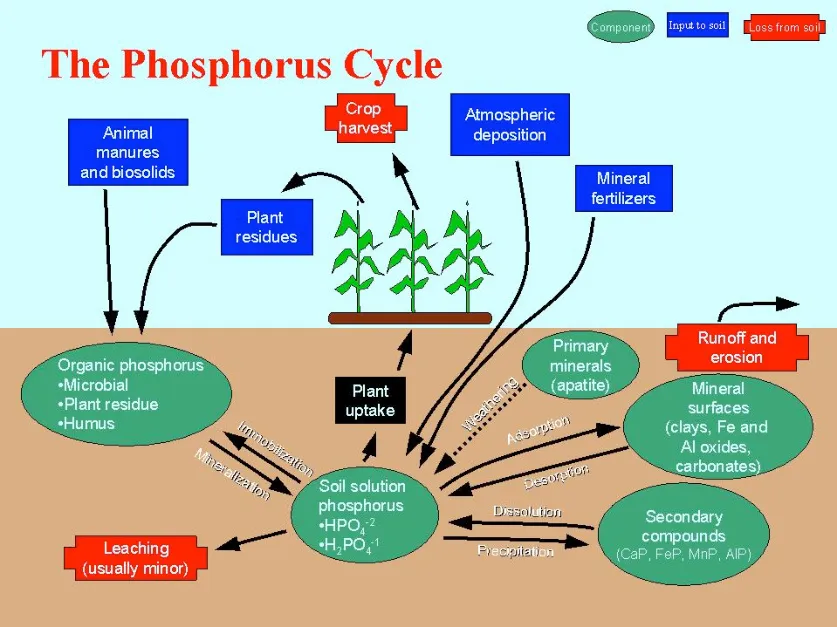
“Process by which P moves form solid and liquid phase and transformation is called P cycle”. P is taken mostly by diffusion in plants.
I. The decreases in soil solution P concentration with absorption by plants roots is buffered by both inorganic and organic fractions in soils.
Primary and secondary P minerals dissolve to re supply H2PO4- / HPO4
= in soluble.
Inorganic P adsorbed on mineral and clay surfaces as H2PO4- or HPO4= (liable inorganic P)
also can desorbs to buffer decreases in soil solution P. Numerous soil micro organic digest plant residues containing P and produce many organic plant compounds in soil and it can be mineralized through microbial activity to supply solution P.
- or HPO4
Inorganic P adsorbed on mineral and clay surfaces as H2PO4
H2O soluble fertilizer P applied to soil readily dissolves and increases the concentration of soil solution.
II. In addition to uptake of P by roots, solution P can be adsorbed on minerals surfaces and precipitated as organic P and these organic P compounds are more resistant to microbial degradation.
Soil solution P is called Intensity factor, while organic and inorganic labile P fractions are collectively Quantity factor.
Maintenance of solution P concentration for adequate P nutrition in the plant depends on the ability of labile P to replace soil solution P. “The ratio of quantity to intensity factor in called the capacity factor, “which express the relative ability of the soil to buffer changes in soil solution”.
(Inorganic) (Organic)
Plant resides
P fertilizer Puptake
Physically protected
organic P, non labile P
Labile Inorganic P Labile Organic P
Source: http://phsgirard.org/Biology/Ecology/PhosphorusCycle.webp

Y value / L value (Larsens Value)
Larsen measured the quantity of soil P involved in the isotopic dilution of applied radio active P during a growing season. It is used to calculate P supply of the soil.
L (or) Y = K x (Co - C)
C
Where, L = Avail P in soil
Co = K x total P in the Plant
C = K x P taken by the plant
K = Proportionality constant.
Deficiency symptoms
P is mobile in plants and when a deficiency occurs it is translocated from older tissues to the active meristematic regions.
-
It arrests metabolism resulting in reduction of total N of Plants.
-
Reduced sugar content.
-
Premature leaf fall.
-
Develops necrotic area on the leaf petiole and in the fruit
-
Leaves will show characteristic bluish green colour.
Toxicity of phosphorus
a. Profuse root growth i.e. lateral and fibrous root lets. b. It develops normal growth having green leaf colour. c. It may cause in some cases trace elements deficiencies i.e. Zinc and Iron.
Tisdale,S.L.,Nelson,W.L.,Beaton,J.D.,Havlin,J.L.1997.Soil fertility and Fertilizers.Fifth edition, Prentice hall of India Pvt.Ltd,New Delhi.
Singh, S.S.1995.Soil fertility and Nutrient Management. Kalyani Publishers,Ludhiana.
http://phsgirard.org/Biology/Ecology/PhosphorusCycle.webp
Questions to ponder
- What is the role of soil pH in P availability?
- P fixation is a blessing in disguise.How?
- What are the natural sources of P?
- What is C: P ratio?
- How does calcareousness affect P availability?
Summary Cheat Sheet
Key Recall Points
- Phosphorus is exam-relevant for SSAC122 and objective questions in soil science.
- Use soil-test based interpretation with focus on pH, CEC, and nutrient availability.
- Apply the 4R principle: right source, right rate, right time, and right method.
Exam Traps
- Do not mix up soil fertility concepts with fertilizer quantity alone.
- Numerical and term-based questions often test definitions, units, and threshold values.
- In problem-solving, interpretation must follow soil reaction, crop stage, and management context.
References
3 sources • [1] [2] [3]
References
ICAR e-Course: Soil Chemistry, Soil Fertility and Nutrient Management
OfficialBrady and Weil, The Nature and Properties of Soils
BookLesson Doubts
Ask questions, get expert answers