🧫 Secondary nutrients —
Secondary nutrients —.
Secondary nutrients like calcium, magnesium, and sulphur support plant structure, metabolism, and quality. This lesson reviews their forms, functions, deficiencies, and soil transformations.


Learning objectives
a. To understand the transformation of secondary elements b. To study the forms of secondary nutrients and factors affecting the availability c. To understand the deficiency symptoms of secondary nutrients
Calcium
Calcium is absorbed by plants as Ca [2+] and its concentration ranges from 0.2 to 1.0% and it is supplied through mass flow method.
Functions of calcium
- It is immobile in plants and hence the deficiency is observed in younger leaves.
- It is a constituent of cell wall and increases in stiffness of plants.
- Promotes root development and growth of plants, root elongation and cell division.
- Helps to translocate the sugar in the plants.
- It involves chromosome stability and that it is a constituent of chromosome structure.
- Affects translocation of CHO in plants.
- Encourages seed production.
- Activates enzyme phosphate and kinease.
- Accumulated protein during respiration by mitochondria and it increases their protein content.
- It binds DNA to protein molecules.
Deficiency of calcium
a. Young leaves of terminal buds dieback at the tip and margins. b. Normal growth in affected. c. Root may become short, stubby and brown. d. Causes acidity of soil. e. Cell may become rigid and brittle. f. Young leaves of cereals remain folded.
Sources of soil calcium
Earth crust contains about 3.64%. The important source of calcium is anorthite (Ca Al2, Si2O3). Generally arid region soils contain high amount of Ca regard less of texture, low rainfall and little leaching.
In arid and semiarid regions Calcite (CaCo3)
Dolomite (Ca, Mg, (Co3)2)
Gypsum (CaSo4, 2H2O)
In humid regions, even the soils formed from limestone are frequently acid in the surface layers because of the removal of Ca and other cations by leaching.
Calcium transformations in soils
In acid and humid region soils ca occurs largely in exchange form and as primary minerals. In most of these soils Ca [2+], Al [3+] and H [+] dominates the exchange complex.
The forms of Ca are
1)Solution Ca [2+] / Mg [2+]
2)Exchangeable Ca/Mg
3)Mineral Ca/Mg.
The activity of solution Ca is decreased by leaching or plant removal. If solution Ca is increased, the equilibrium shifts in the opposite direction with subsequent desorption of some of the Ca [2++] by the exchange complex. The rate of solution Ca is less complex than of K [+] . It may be (a) Lost in drainage H2O’s. (b) absorbed by organisms (c) adsorbed on the CEC (d) Repricipitated as secondary calcium compound.
Factors affecting Ca [2+] availability
-
Total Ca supply :Sandy acidic soils with low CEC having less Ca.
-
Soil pH:In acid soils Ca is not readily available to plants at low concentration.
-
CEC:Soils having low CEC might will supply more Ca [2+] .
-
% Ca saturation:High Ca [2+] saturation indicates favourable pH for plant growth and microbial activity.
-
Type of soil colloid: 2 : 1 type require higher Ca saturation than 1: 1 type.
-
Ratio of Ca [2+] to other cations : Increasing the Al [3+] conc. in soil solution reduces Ca uptake in plant.
Magnesium
Magnesium is absorbed as Mg [2+] and the concentration in crop varies between 0.1 and 0.6%. It was taken by plant by Mass flow and diffusion .
Functions of Mg in plants
- Primary constituent of chlorophyll
- Imports dark green Colour in leaves.
- Serves as a structural components in ribosomes and stabilizing the ribosome configuration for
protein synthesis. 4. Involves numbers of physiological and biochemical function. 5. Activates phosphorylating enzymes in CHO metabolism. 6. Act as a cofactor for certain enzymes other than Po4 transfer enzyme. 7. Increases in the oil content of oil seed crops. 8. Regulates the uptake of other nutrients.
Deficiency of Magnesium
- Interveinal chlorosis of the leaf in which only the leave veins remain green.
- Stiff brittle, twisted leaves, wrinkled and distortion of leaves.
- cotton –lower leaves may develop a reddish purple finally nicrotic (Redding of leaves)
- In brassica, Chlorosis with interveinal mottling uniformly distributed in older leaves while the
other vascular tissues remain green. This condition is called “Puckering”.
Sources of soil Magnesium
It constitutes 1.93% of earth crust
Primarily minerals (a) Biotite (b) Dolomite (c) Hornblende (d) olivine (e) serpentine.
Secondary minerals (a) Chlorite (b) Illite (c) Montmorillonite.
In arid region substantial amount of Mg present as Epsomite (Mg So4 7H2O)
Forms of Mg in the soil
- It occurs predominately as exchange and solution mg.
- Coarse text soil exhibits the greatest potential for Mg deficiencies.
- Competition bet NH4+ and Mg2+ also lower the Mg2+ availability to crops.
Losses of Mg
It is leached by soils and it depends on the Mg content, rate of weathering, intensity of weathering and uptake of plants.
Sulphur
Sulphur is absorbed by plant roots as So42- ions. Concentration of S in plants range between 0.1 and
0.4%.
Functions of sulphur
-
Essential for synthesis of sulphur containing amino acids cystine, cysteine and methionine.
-
Essential for synthesis of other metabolites including Co-enzyme A., Biotin, Thiamin of vitamin
B and Glutothione. 3. Synthesis of chlorophyll. 4. It is a vital part of ferredoxins i.e Fe – S – protein occurring in the chloroplasts. 5. Responsible for the characteristic smell or odor and taste of mustard, onion and Garlic.
(Puncy smell) 6. Enhances the oil formation in crops (Soya bean) 7. Increasing root growth. 8. Stimulate seed formation. 9. Promote nodule formation – Leguminous species.
Deficiency of sulphur
a. Stunted growth pale green to yellow colour. b. Immobile in plants and plants symptoms start first at younger leaves. c. Poor seed set in rapeseed. d. Tea –Tea yellows.
Sources of sulphur
- Amount has <0.05 ppm in the form of So2.
- Earth crust contains 0.06 to 0.10%.
- Sulphur bearing minerals Gypsum - CaSo4 2 H2O. Epsomite - MgSo4, 7H2O
Mirabilite - Na2So4, 10 H2O.
Pyrite - FeS2.
- Silicate min contains <0.01 % S.
- Igneous rocks 0.02 to 0.07%
Sedimentary rocks 0.02 to 0.22%
Forms of sulphur in soil
Present both organic (90%) and Inorganic forms.
The inorganic forms are
-
Solution So42-.
-
Adsorbed So4=
-
Solution So4
-
Adsorbed So4= Readily available fraction.
-
Insoluble So4=
-
Insoluble So4=
-
Reduced inorganic compounds.
Factors affecting S oxidation in soils
a. Microbial population in soil. b. Characteristics of the ‘S’ source c. Soil environmental condition. d. Soil micro flora Chemolithotropic S bacteria Thiobacilli utilized energy from oxide of
Inorganic S for the fixation of Co2 in Organic matter. e . Soil temperature
An increase in temperature increases the S oxidation rate in soil. Ideal temperature 25 – 40°C.
f . Soil moisture and aeration
S oxidizing bacteria are mostly aerobic and their activity will decline if O2 is lacking due to H2O logging. Favourable moisture is field capacity moisture.
g . Soil pH: Optimum pH 4.0 or lower.
S transformation in soils
Numerous transformations of S in soil occur from inorganic to organic forms due to the presence of hetero tropic micro organic viz.,. Thiobacillus, chlorabium, Desulfotomaculam and Desulfovibrio. When plant and animal residues are returned to the soil they are digested by microorganism releasing of the S as So4=. Most of the S remains in organic form and becomes part of soil humus.
releasing of the S as So4=. Most of the S remains in organic form and becomes part of soil humus.
The S supply to plants in largely depend on the So4= released from the organic soil fractions and from
The S supply to plants in largely depend on the So4= released from the organic soil fractions and from
the plant and animal residues.
S Mineralization and immobilization
Mineralization of “S” is the conversion of organic S to inorganic So4
=.
Immobilisation is the conversion of So4
Sulphur cycle
= to organic S.
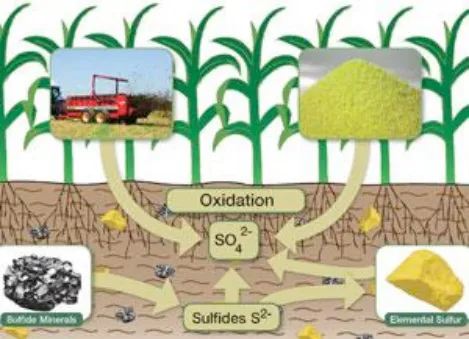
http://www.agweb.com/assets/1/9/NewsMainImage/sulfur_cycle2.webp

Factors affecting S mineralization and Immobilization.
S content of organic matter
Mineralization of S depends on the S content of he decomposing material, smaller amounts of So4= are liberated from low S containing residue.
2. Source of mineralizable sulphur :
Most of the available S removed by plants from the So4= fraction of labile S in soil Organic
matter.
Soil Temperature
Mineralization of S is impeded @ 10°C increases with increasing temperature from 20°C to 40°C and decreases of temperature >40°C.
Soil moisture
Mineralization occurs in optimum moisture conditions.
Soil pH
S released is directly proportional to pH up to pH 7.5. Above 7.5 mineralization increases more rapidly.
6. Absence or presence of plants.
Soils mineralization more S in the presence of growing plants than in their absence.
Time and cultivation
S Volatilization
Volatile S compounds are produced through microbial transformations under both aerobic and anaerobic conditions. The volatile compounds are dimethyl sulfide (CH3 SCH3) (CS2) Carbandi sulphide and mercaptons (CH3SH).
In low organic matter soils, S volatilization is negligible and increases with increasing organic matter content.
Practical aspects of S transformations.
- Crops grown on coarse texture soils are generally more susceptible to S deficiency because
these soils having low organic matter content and So4= leaching.
- Leaching losses of So4=
these soils having low organic matter content and So4
- Leaching losses of So4= can occur highly on coarse texture soils under high rainfall. Under
such conditions, So4= containing fertilizers maybe applied more frequently
such conditions, So4= containing fertilizers maybe applied more frequently
- Immobilization of added S can occur in soils having a high. C/S or N/S ratio. S
mineralisation is favored in soils with a low C/S or N/S ratio. S availability generally increases with organic matter content. 4. Actual amount of S needed will depend on the balance between all soil additions of S by
precipitation, air, irrigation H2O, crop residues fertilizers, Agriculture Chemicals and all losses through crop removal. Leaching and erosion.
Tisdale,S.L.,Nelson,W.L.,Beaton,J.D.,Havlin,J.L.1997.Soil fertility and Fertilizers.Fifth edition, Prentice hall of India Pvt.Ltd,New Delhi.
Singh, S.S.1995.Soil fertility and Nutrient Management. Kalyani Publishers,Ludhiana.
http://agropedialabs.iitk.ac.in/agrilore http://technology.infomine.com/enviromine/ard/microorganisms/roleof.htm http://www.agweb.com/article/the_secrets_of_sulfur/
Questions to ponder
- What is the importance of C:N:P:S ratio to the availability of soil sulphur?
- Is Magnesium fixed in soils?
- How is a low calcium soil condition usually corrected?
- Which crops have high calcium requirement?
- Can climate influence the availability and uptake of Calcium and Magnesium?
Summary Cheat Sheet
Key Recall Points
- Secondary nutrients — is exam-relevant for SSAC122 and objective questions in soil science.
- Use soil-test based interpretation with focus on pH, CEC, and nutrient availability.
- Apply the 4R principle: right source, right rate, right time, and right method.
Exam Traps
- Do not mix up soil fertility concepts with fertilizer quantity alone.
- Numerical and term-based questions often test definitions, units, and threshold values.
- In problem-solving, interpretation must follow soil reaction, crop stage, and management context.
References
3 sources • [1] [2] [3]
References
ICAR e-Course: Soil Chemistry, Soil Fertility and Nutrient Management
OfficialBrady and Weil, The Nature and Properties of Soils
BookLesson Doubts
Ask questions, get expert answers