🧫 Micro nutrients —
Micro nutrients —.
This lesson explains micronutrient transformations, availability, and deficiency symptoms that are essential for soil fertility management.


Learning objectives
a. To understand the transformation of micronutrients b. To study the forms of micronutrients and factors affecting the availability c. To understand the deficiency symptoms of micro nutrients
Iron
Fe is absorbed by plants roots as Fe2+, Fe3+ and chelected irons. Sufficiency range of Fe in plant tissue is 50-250 ppm.
Functions of Iron
-
It helps in the synthesis of chlorophyll.
-
Structural component of porphyrin molecules like cytochromes, hematin, hemes, ferrichrome
and hemoglobin. These substance are involved in oxidation-reduction reactors in respiration and photosynthesis.
-
Structural component of non hemine compounds like ferredoxins.
-
Constituent of enzyme systems Egl cytochrome oxidase, catalase, nitrogenase reaction in
plants.
- Component of flavoprotein like
FMN = Flavin mono nucleotides
FAD = Flavin Adinosine Dinudeotide.
Deficiency symptoms
- Deficiency symptoms occurs in younger leaves since Fe is immobile element within plant.
- It occurs in soils of calcareous or alkaline soils and poorly drained H2O logged soils.
- Younger leaves develop interveinal chlorosis with progresses rapidly over the entire leaf.
Severe cases entire leaf turns yellow colour.
Sources of iron
Earth crust contains about 5%
Primary and secondary minerals such as
1.Olivene,2.Pyrite3.Hematite,4.Goethite,5.Magrulite 6.limestone
Forms of iron
Fe occurs in Four major forms in soil.
-
Primary and secondary minerals Fe
-
Adsorbed Fe
-
Organic Fe and
-
Solution Fe.
Soil solution Fe
It occurs primarily as Fe(OH) [+] 2 [, Fe][3+][ concentration In solution is very low. In well-drained, ]
oxidized soils, the solution Fe [2+] concentration is less than that of the dominant Fe [3+] in solution. The pH dependent relationship for Fe [3+] is described as
For every increases in pH, Fe [3+] concentration decreases 1000 fold. Oxidation - redn reactions, the result of change in O2 partial pressure, exert considerable influence on the amount of soluble Fe in the soil solution. The insoluble Fe [3+] form predominates in well drained soils, while levels of soluble Fe2+ increases significantly when soils become H2O logged. In general, lowering Redox increases Fe [2+] solubility, 10 fold for each unit decreases. in pH.
Over the normal pH range in soils, total solution Fe is not sufficient to meet plant requirements for Fe even in acid soils, where Fe deficiency Occur less frequently than in high pH and caleanous soils.
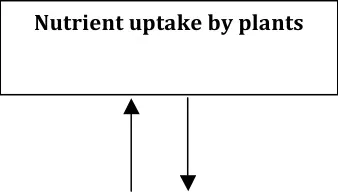
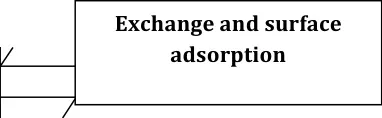
Schematic representation of Fe, Zn, Cu and Mn cycle
Mulch (straw)
| Organic matter and microorganisms |
Col2 | Col3 |
|---|---|---|
Organic matter and microorganisms |
Organic matter and microorganisms |
Soil solution |
Organic matter and microorganisms |
||
Organic matter and microorganisms |
||
| Col1 | Col2 |
|---|---|
| Solid phase minerals and precipitates |
Solid phase minerals and precipitates |
Chelates
“Is a term derived from a Greek and meaning “Claw”.
Chelates are soluble organic compounds that bond with metals such as Fe, Zn, Cu and Mn increasing their solubility and their supply to plant roots.
“Natural organic cheleates in soils are products of microbial activity and degradation of soil organic matter and plant residues. Root exudates are capable complexing nutrients substantial quantities of organic completed. Fe can be cycled through crop residue and compounds of citric acid and oxalic acids have chelating properties.
Dynamics of chelation
“The dynamics of chelation increasing solubility and transport of micronutrients”.
During active plant uptake, the concentration of chelated Fe or other micronutrient is grater in the bulk solution than at root surface the chelated Fe diffuses to the root surface in response to concentration gradient. After Fe3+ dissociates from the chelates and diffused due to concentration gradient. As the unchelated Fe3+ concentration decreases insolution because of chelation, additional Fe is desorbed from minerals surfaces or Fe minerals dissolved to resupply solution Fe.
Synthetic chelates
In soils synthetic chelates behave similarly to natural organic chelates. The choice of a chelate to use as chelate depends 1. specific micronutrient ii. Solubility of chelate in the soil. When synthetic or natural chelates are added to soils and they are readily complex with cations in soil solution.
Egl : Citric acid and Oxalic acids, two natural chelates complex Al [3+] at low pH, but when pH increasess above 5 or 6, Ca [2+] and Mg [2+] are more readily completed.
Diethylene triamine penta acetic acid (DTPA) and EDTA (Ethylene diamine tetra acetic acid) readily chelate Fe at pH < 7 and pH <6.5 respects. The chelate EDDHA (Ethylene Diamine dihydroxy phenyl acetic acid) will strongly complex Fe and is stable over the entire pH range. As a result Fe EDDHA is commonly used as an Fe fertilizer because it provides more plant available Fe than other chelates.
Factors affecting Fe availability
Soil pH, Bicarbanate and Carbonates
Fe deficiency is most often observed in high pH and calcareous soils in arid regions, but it may occur an acid soils that are very low in total Fe.
Irrigation waters and soil high in HCO3 may aggravate Fe deficiency Because of high pH levels associated with HCO3- accumulation.
In calcarious soils having pH range of 7.3 to 8.5 have Fe deficiency due to the lowest solubility of soil Fe and the formation of bicarbonate ion.
CaCO3 + CO2 + H2O -- Ca [2+] + 2HCO3
Excessive H2O and poor aeration
Flooding and submergence of soils can improve Fe availability by increaseeasing Fe [2+] canc. They actually buildup of toxic canc. of Fe [2+] organic matter removed from the eroded portions of semi arid region calcareous net soils lime induced Fe deficiency will occur.
Organic matter
Additions of organic matter to well drained soils can improve Fe avail. Due to increases the Fe [2+] solubility.
Interactions with other nutrients
Fe deficiency occur due to the accumulation of Cu, Mn, Zn, Mo and P. Fe availability decreasess when the soils are having more NO3- than NH4+ deficiency of K or Zn can reduce Fe
decreasess when the soils are having more NO3- than NH4+ deficiency of K or Zn can reduce Fe
translocation with in plants.
- than NH4
MANGANESE
Mn concentration in plant ranges from 20 to 500 ppm
Functions of Mn
-
Helps in chlorophyll formation
-
Involves in photosynthesis, particularly in evolution of O2.
-
Involves in oxidation - reduction - process in decarboxylation and hydrolysis reactions.
-
Involves in enzyme systems and various enzyme reactions in the citric acid cycle.
-
It is a substitute for Mg [2+] in many of the phosphorylating and group transfer reactions.
Deficiency of Mn
-
Immobile in plant and def. starts in the younger leaves.
-
Interveinal chlorosis occur
Oats - Gray specks / streaks
Peas - Marsh spot
Sugarbeet - speckled yellow
Sugar cane - Pahala blight - midrib pale green and white.
-
Deficiency increasess asparatic acid and decreases glutamine
-
Increases respiration
-
Accumulation N compounds mainly as amines.
Sources of Mn
Earth crust contains 1000 ppm. Various oxides and hydroxides.
Manganite MnO (OH)
Braunite Mn2O3
Factors affecting Mn availability
Soil pH and carbonates
Liming to acid soils decreases solution and exch. Mn [2+] due to precipitation Mn [2+] as MnO2.
Excessive H2O and poor aeration
H2O logging will reduce O2 and lower redox potential will increases soluble Mn [2+] . Poor aeration increases Mn availability.
Organic matter
Increases solution and exchangeable Mn.
Climatic factor
Increases soil temp during the growing season improves Mn uptake, because of greater plant growth and root activity.
Soil micro org
Deficiency caused by soil organisms oxidizing Mn [2+] to Mn [4+] .
Forms of Mn
i. Solution Mn [2+]
ii. Exchange Mn [2+]
iii. Organic bound Mn
iv. Mn Mineral
ZINC
Normal concentration in plant 25 to 150 ppm
Deficiency level is < 20 ppm
Toxic level is > 400 ppm
Zn is present in all parts of the plants. In general root contain more zinc than fruits.
Cereals : 27.8 ppm
Pulses : 34.8 ppm
Vegetables : 28.2 ppm
Fruits : 36.6 ppm
Functions of Zn
-
Essential to formation of growth harmones
-
Helps in reproduction of certain plants.
-
Stabilise rhibosomal fractions
-
Influence the activity of dehydrogenase enzymes
-
Involves in auxin metabolism like tryptophan synthetase.
Deficiency of Zn
-
Light yellow or white areas bet the veins of leaves particularly older leaves.
-
Death of tissue, discolored
-
Mal formation of fruits
-
Reduced growth hormone production.
Cotton : White bud (or) little leaf
Citrus : Mottle leaf
Potato : Fern leaf
Fruit trees : Rosette (Upnormal growth)
Paddy : Khaira
Foliar spray : 0.2 to 0.5% ZnSO4.
Sources of zinc
Soil : 10-300 ppm
Igneous rock : >10 ppm
Sedimentary : > 95 ppm
Forms of soil Zn
-
Solution Zn [2+]
-
Adsorbed Zn [2+ ]
-
Organically completed Zn [2+ ]
Factors affecting Zn availability
- Soil pH : Avail of Zn decrease with increase soil pH Zn def occur in neutral and calcareous soil. At soil pH, Zn precipitates as insoluble amorphous soil Zn, which reduces Zn [2+] in soil.
Al and Fe oxides, OM and CaCO3 increase with increasing pH.
-
Organic matter
-
Interaction with other nutrients
SO4 and N can increase the Zn uptake in plants.
Higher the soil pH, poor aeration greater the Zn deficiency
COPPER
Copper is absorbed by plants as cupric ion Cu [2+]
Normal concentration in plants 5-20 ppm.
Functions of copper
-
Essential for the synthesis of vitamin A
-
Act as a catalyst in respiration
-
Act as a “electron carrier” in enzyme which bring about oxidation reduction reactions in plants.
-
Constituent of chlorophyll.
Deficiency of copper
-
Chlorosis, withering and distortion of terminal buds.
-
Dead tissue appears along the tips and edges of leaves.
-
Multiple bud formation in the leaf axil and mal formation of leaves.
-
Guava - cracking of fruits and terminal bud die back
-
Heavy liming, excessive application of N and P - induces Cu deficiency.
Sources of copper
-
Igneous rock 10-100 ppm of Cu.
-
Sedimentary rock 4-45 ppm
-
Primary minerals contains
-
Chalcopyrite
-
Chalcocite
-
Bornite
-
Sedimentary minerals
Oxides, Carbonates, Silicates, Sulphates and Chlorides.
Forms of soil copper
-
Soil solution - ionic and completed
-
Cation exchange sites of clay and organic matter
-
Occluded and co-precipitated in soil oxide material.
-
Specific adsorption sites
-
Inorganic matter and living organisms
Factors affecting Cu availability
-
Soil texture
-
pH
-
CEE
-
Org matter content
-
Hydrous oxides
Soil texture
Sandy soils contain lower amounts of Cu than silt and clay soils.
pH
The concentration of Cu in soil solution decreases with increase in pH.
Interaction with other nutrients
Application of NPK fertilizer induce Cu deficiency
Increase N supply to crops reduce mobility of Cu in plants
High concentration of Zn, Fe and P in soil solution also can depress Cu absorption by plant roots.
BORON
B concentration in mono cotyledons and dicotyledons (20-60 ppm) varies between 6 and 18 ppm.
It is absorbed by plants as undissociated boric acid (H3BO3).
Functions of boron
-
New cell development in meristematic tissue.
-
Pollination, fruit / seed set.
-
Translocation of sugars, starches, N and P
-
Synthesis of proteins and amino acids.
-
Nodule formation in legumes
-
Regulation of CHO metabolism.
Deficiencies of Boron
-
Since it is immobile, deficiency Symptoms occurs in terminal bud growth.
-
Flowering and fruit development are restricted.
-
Sterility and mal formation of reproductive organs.
-
Thickened and curled leaves.
-
Discoloration, cracking or rotting of fruit, tubers or roots
Apple - Internal cracking.
Break down of internal tissue in root crops given rise to darkened areas referred to Brown heart / black heart : cotton - weeping disease.
Sources of boron
-
Non metal among the micronutrient
-
Low concentration in earth crust igneous rocks (<10 ppm)
-
Tourmaline and borosilicate contains B.
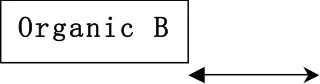
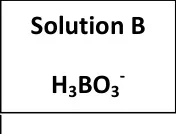
Forms of boron (Boron cycle)
B exists in 4 forms in soil.
-
Rocks and minerals.
-
Adsorbed on clay surface, Fe and Al oxides combined with O.M.
-
Boric acid (H3BO3) and 4 B (OH) [-] 4 [ in soil solution. ]
Boron cycling between the solid and solution phase is very important because of the narrow range in solution concentration the separates deficiency and toxicity in crops.
Soil solution B
H3BO3 is the predominant species in soil solution at pH values ranging from 5-9. At pH > 9.2 H3BO3- can hydrolyse to H4BO4-. It was taken by Massflow and Diffusion methods in plants.
- can hydrolyse to H4BO4
-. It was taken by Massflow and Diffusion methods in plants.
Absorbed B
B adsorption and desorption can helps to reduce B leaching losses. Main B adsorption sites are
-
Broken Si - O and Al-O- bonds at the edge of clay min.
-
Amorphous hydroxide structure
-
Al and Fe oxides and hydroxides.
Factors affecting B availability
- Soil texture : Fine text soils added B for longer period than coarse text soil.
Plants can take up larger quantity of B from sandy soils than fine text soil at equal concentration of H2O soluble B.
-
Type of clay : Mica > mont > kaolinite
-
Soil pH and liming : Less avail to plants with increase pH heavy liming lead to greater adsorption and reduced B uptake.
-
Organic matter : Avail of B in surface soil is high compared to subsurface soil.
-
Interactions with other cations
Occurrence of Ca in alkaline soil with restrict B availability. Increased K rates causes B toxicity.
- Soil moisture
Restricted moist supply reduce the B availability in the root zone.
Boron cycle in soil
Mulch (straw)
Uptake Residue Fertilizer
/ manure
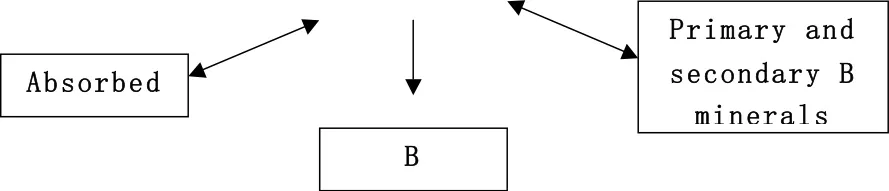
MOLYBDENUM
Non metal anion absorbed as molybdate (MoO4). It is weak acid and form complex poly anions such as phosphomdybdate. Plant contains <1 ppm Mo.
Functions of Mo
-
Essential component of enzyme NO3 reductase, which catalyses NO3- to NO2
-
Structural component of nitrogenase enzyme - involved in N fixation.
-
Essential for absorption and translocation of Fe in plant 6.
Deficiency of Mo
-
Inhibits flower formation
-
Imbalances various Amino Acids in plants.
-.
- Reduce activity of symbiotic and non symbiotic N fixation.
Cauliflower - Whip tail.
Sources of Mo
Earth crust 2 ppm : and range from 0.2 to 5 ppm.
Forms of Mo
-
Non exchangeable Mo in primary and secondary minerals.
-
Exchangeable Mo held by Fe and Al oxides.
-
Mo in soil solution
-
Organically bound Mo.
-, H2MoO4o.
Mo in solution occurs mainly as Mo4
Factors affecting Mo availability
- Soil pH and liming
=, HMoO4
Mo availability increases with increasing pH. Liming to correct acidity will increase Mo avail. Mo avail decrease with application of acid forming fertilizer (NH4)2SO4.
Reaction with Fe and Al
Strongly absorbed by Fe and Al oxides.
Interaction with other nutrients
Mg and P enhances Mo absorption by plants.
High level SO4 decrease Mo absorption by plants.
Cu and Mn decrease Mo uptake by plants.
NO3-N encourages Mo uptake
NH4-N reduces Mo uptake
The beneficial effect of NO3
- nutrition is related to the release of OH ions.
CHLORINE
Normal concentration in plant is about 0.2-2.0%. Absorbed by plants as Cl [-] through roots and aerial parts.
Functions of chloride
-
Essential for biochemical reactions Osmotic cation neutralization reactors.
-
Act as a counter ion during rapid K fluxes.
-
Involves in the evaluation of O2 in photosynthesis.
-
Creates disease resistant by increase osmotic pressure in cell sap.
Deficiency of Cl
-
Partial wilting and loss of turgidity.
-
Necrosis, leaf bronzing and reduction in growth.
Sources of Cl
i. Igneous and metamorphic rocks
ii. Soluble salts such as NaCl, CaCl2 and Mgel2.
iii. Earth crust 0.02-0.05%.
It is mobile with in the plant it can be rapidly recycled through soil systems.
COBALT
Normal concentration of Co in dry matter - 0.02 - 0.5 ppm.
Functions of cobalt
-
Essential for M.O. fixing atmosphere. N. It forms vit. B12 during growth and development of symbiotic M.O.
-
Improves growth, transpiration and photosynthesis.
-
Take parts in leg hemoglobin metabolism and Rhibonucliotide reductase.
Deficiency
-
Acidic, highly leached, sandy soils with total Co low.
-
Calcareous and peaty soils.
Factors affecting : Co availability
- Soil pH : Avail increase with increase in soil acidity, H2O logging conditions.
- Liming and drainage practices - reduce co availability.
- Application CoSO4 rectify the deficiency.
VANADIUM
Low concentration of Vanadium is beneficial for growth of Microorganisms.
Vanadium substitute for Mo in N fixation by Rhizobia.
Involves in Biological - oxidation-reduction reactions.
NICKEL
Nickel content in plant is 0.1 - 1.0 ppm dry matter basis.
Taken by plant as Ni [2+]
High levels of Ni may induce Zn or Fe deficiency
- Ni - metal component of urease that catalyse reaction.
CO (NH2)2 + H2O 2NH3 + CO2.
-
Essential for N metabolism.
-
Stimulates nodule weight and yield of crops.
SODIUM
Functions
-
Essential for maintaining turgor and growth of Plants.
-
Helps oxalic acid accumulation in Plants.
-
Helps in stomatal opening and regulate NO3
Sources of Na
Earth crust 2.8% soils
Minerals.
Forms of Na in soil
- reductase activity.
Solution, exchangeable Na and in silicate minerals.
In arid and semi arid soils Na exist in silicates, NaCl, Na2SO4
Na salts accumulating in poorly drained soils of arid and semi arid regions and causes soil salinity and sodicity.
Effect of Na on soil properties
Dispersing action of Na [+] on clay and organic matter reduces soil aggregation, permeability to air and H2O, germination and root growth.
Sodium fertilizers
Sodium NO3 : 25% Na
Rhenania PO4 12% NA
Abundant element. in lithosphere and absorbed as monosilicic acid.
Cereals and grass contain 0.2 - 2.0%.
Functions of silica
-
Contributes structure of cell wall.
-
Contributes drought tolerance to crops.
-
Regulates photosynthesis.
-
De activates invertase enzyme activity in sugarcane resulting grater sucrose production.
Larger amounts of Si are accumulated in intracellular deposits known as ‘PLANT OPALS’.
-
Increased available P.
-
Responsible for plant disease resistance.
Sources of silicon
Earth crust : 27.6% Most abundant element in earth crust.
Soils 23-35%
Primary and secondary mineral and quartz - major source.
Quartz is the most common mineral in soil, comprising 90-95% of all sand and silt fractions.
Factors affecting Si availability
-
High H2O content encourages Si uptake
-
Heavy application of N decreases Si concentration
-
Liming decreases Si uptake in plants.
-
Acidification increases Si uptake
-
Fe and Al oxides influence Uptake of Si by plants.
Si fertilizers
-
Calcium silicate slag (CaAl2 Si2O4) - 18.21% Si
-
Calcium silicate (CaSiO3) - 31% Si.
-
Sodium metasilicate NaSiO3 - 23% Si.
Chelates
Chelate is a term derived from a Greek word meaning, “claw”. Chelates are soluble
organic compounds that bond with metals ions such as Fe [3+] / Fe [2+], Zn [2+], Cu [2+], Mn [2+], and
other, thereby increasing their solubility and supply to plant roots . It is important particularly in
micronutrient availability.
Numerous natural organic compounds in soil, or synthetic compounds added to soils,
are able to complex or chelate ions of micronutrients.
Natural organic chelates in soils are products of microbial activity and degradation of
soil organic matter and plant residues. Root exudates also are capable of complexing
micronutrients.
The concentration of metal ions in solution and the quantity transported to the root by
mass flow and diffusion can be greatly increased through complexation with natural organic
chelating compounds in soil.
Substantial quantities of organic-complexed metal ions can be cycled through crop
residue, which remain available for the succeeding crop.
Many of the natural organic chelates have not been identified; however, compounds
like citric and oxalic acids have chelating properties.
Common synthetic chelates are:
Ethylene diamine tetra acetic acid (EDTA)
Diethylene triamine pentaacetic acid (DTPA)
Ethylene diamine di-o-hydroxy phenyl acetic acid (EDDHA)
Tisdale,S.L.,Nelson,W.L.,Beaton,J.D.,Havlin,J.L.1997.Soil fertility and Fertilizers.Fifth edition, Prentice hall of India Pvt.Ltd,New Delhi.
Singh, S.S.1995.Soil fertility and Nutrient Management. Kalyani Publishers,Ludhiana.
http://www.ncagr.gov/cyber/kidswrld/plant/nutrient.htm
Mortvedt,J.J.et al.(Eds.).Micronutrients in Agriculture.No.4,Soil Science Society of America,Madison,Wisconsin,USA.
Questions to ponder
- What is the role of organic matter addition on micronutrient availability to plants?
- How does Fe and Al oxides affect the micronutrient availability?
- Why is copper deficiency often referred to as reclamation disease?
- What are the ways to avert Fe chlorosis?
- What are the common manganese fertilizer materials?
Summary Cheat Sheet
Key Recall Points
- Micro nutrients — is exam-relevant for SSAC122 and objective questions in soil science.
- Use soil-test based interpretation with focus on pH, CEC, and nutrient availability.
- Apply the 4R principle: right source, right rate, right time, and right method.
Exam Traps
- Do not mix up soil fertility concepts with fertilizer quantity alone.
- Numerical and term-based questions often test definitions, units, and threshold values.
- In problem-solving, interpretation must follow soil reaction, crop stage, and management context.
References
3 sources • [1] [2] [3]
References
ICAR e-Course: Soil Chemistry, Soil Fertility and Nutrient Management
OfficialBrady and Weil, The Nature and Properties of Soils
BookLesson Doubts
Ask questions, get expert answers