🧫 FERTILITY EVALUATION
FERTILITY EVALUATION.
This lesson explains key concepts in a structured way and connects them to practical agricultural applications and exam-oriented understanding.
FERTILITY EVALUATION
LECTURE 15
FERTILITY EVALUATION BY PLANT ANALYSIS
Plant analysis is a useful diagnostic tool to ascertain if a nutrient has
been or is being assimilated. Plant analysis is also important in ascertaining
the nutrient requirements and nutrient status of plants during various stages
of growth.
A reasonably simple laboratory test of plant sample provides a
measure of nutrient availability in soil or nutrient status of plant at the time
the sample was collected. If these tests are to be useful in making fertilizer
recommendations, a coordinated laboratory-field research program must be
conducted in order to obtain the desired information.
Deficiency symptoms
Careful inspection of growing seedling or plants can help identify specific
nutrient stress. If a plant is lacking in a particular nutrient, characteristic
symptoms may appear. Nutrient deficiency symptoms must be related to
some function of the nutrient in the plant. Visual symptoms may be
caused by more than one nutrient. In a set of nutrient omission and
addition pot experiments, exact limiting nutrients can be identified.
Tissue tests
The concentration of the nutrients in the cell sap is usually a good
indication of how well the plant is supplied at the time of testing. These
semi-quantitative tests are intended mainly for verifying or predicting
deficiencies of N, P, K, S and several micronutrients.
Method: the plant parts may be chopped up and extracted with reagents.
The intensity of color developed is compared with standards and used as
a measure of nutrient concentration. Tissue tests are quick, easy to
conduct and interpret.
For tissue tests, the time of sampling and plant part to be sampled have
already been standardized for many crops. Tissue test can be done 5-6
times in a season and concentration can be monitored in the farm
premises .
There can be two peak periods of nutrient demand, one during maximum
vegetative growth and second during reproductive stage. Fertilization
can be done to maintain the peak concentration at critical stages.
Total plant analysis
As in tissue tests, a standardized method for time and method of
sampling of plant part are available for total analysis, which is done at
laboratory . The critical nutrient concentration is commonly used in
interpreting plant analysis results and diagnosing nutritional problems.
Diagnosis and Recommendation Integrated System (DRIS) 23 (12/16)
DRIS is a system that identifies all the nutritional factors limiting crop
production. Index values measure how far particular nutrients in the leaf
or plant are from optimum levels. Index values are used in the calibration
to classify yield factors in the order of limiting importance. To develop a
DRIS for a given crop, the following criteria are to be well considered.
- All factors having effect on yield
-
Relationship among factors
-
Calibration norms
-
Continually refined recommendations
DRIS was developed based on nutrient ratios . When compared to
concentration that normally varies with season, nutrient ratio does not vary
much. When a nutrient ratio has an optimal value, optimum yield occurs
unless some other limiting factor reduces the yield.
N → N ↑ N ↓
P → P ↑ P ↓
Both numerator
and denominator
optimal
Both numerator
and denominator
excessive
Both numerator and
denominator
insufficient
When the ratio is too low a response in the numerator will be obtained
if it is limiting. If the nutrient in the denominator is excessive, a yield
response may or may not occur depending on the level of other yield factors.
23 (13/16)
N/P
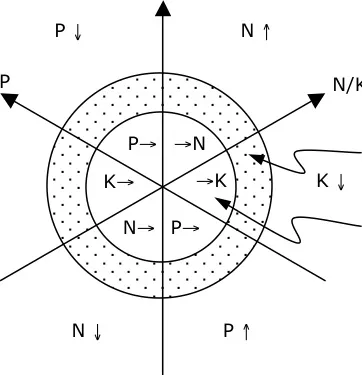
K ↑
Optimum nutrient balance
Satisfactory nutrient balance
General diagram for a DRIS; constructed on
nutrient ratios for N-P-K
When the ratio is too high the reverse it true. Usually N/S, K/Mg,
K/Ca, Ca + Mg /K, N/P ratios are commonly used. Initially relationship
among N-P-K is calibrated.
Thus, DRIS has several advantages to integrate much nutrient
concentration at various stages, in different seasons suitable for many
cultivars of a crop.
DRIS has been found suitable for several grain crops and perennial
fruit trees.
CROP LOGGING
23 (14/16)
An excellent example of the use of plant analysis in crop production is
the crop logging carried out for sugarcane in Hawaii. The crop log, which is
a graphic record of the progress of the crop, contains a series of chemical
and physical measurements. Critical nutrient concentration approach is
used in the crop log system.
In sugarcane, plant is sampled at 35 days and analyzed for N, sugar,
moisture and weight of young sheath tissue. Nutrients like P and K are
monitored at critical stages. Based on moisture, irrigation is scheduled.
Based on nutrient content, fertilizer application is done. By this record
keeping, the productivity of crop is increased.
BIOLOGICAL TESTS
Simpler and rapid laboratory/ green house techniques utilize small
quantity of soil to quantify nutrient supplying power of a soil.
Tests using higher plants:
Neubauer seedling method: The neubauer technique is based on the uptake
of nutrients by a large number of plants grown on a small amount soil. The
roots thoroughly penetrate the soil, exhausting available nutrient supply
within a short time. Usually 100 seedlings of rye or oats made to feed 100 g
soil mixed with 50 g sand. Blank without soil is also run. Total P 23 (15/16) 2O5 and
K2O uptake is calculated and blank value is detected to get root soluble
P2O5 and K2O. Values designated as Neubauer Nos. (mg/ 100 g soil) are
used to determine the deficiency. These tables give the maximum values
of available macro and micronutrients for satisfactory yields of various
crops.
Standard and Demont technique: It is a modified neubauer technique. Round
cardboard cartons with bottom removed are nested in a container and filled
with sand. Seeds are sown. After 2-3 weeks of growth, a carton containing
the plants is nested in a second carton holding 200 g soil or soil + fertilizer.
When the mat of roots meets soil, it is allowed to feed for 3-4 days. Then
nutrient uptake is estimated.
Deficiency test of sunflower for Boron
Sunflower is grown in the test soil supplied with nutrient solution with
all essential nutrients excepting boron. From the day of appearance of B
deficiency symptoms of leaves, the soil is identified as deficient (<28 days),
moderately deficient (28-36 days), and not deficient (>36 days).
Microbiological methods:
In the absence of nutrients, certain microorganisms exhibit behavior
similar to that of higher plants. For example, growth of Azotobacter or
Aspergillus niger reflects nutrient deficiency in the soil. The soil is grouped
from very deficient to not deficient in the respective elements, depending on
the amount of colony growth. In comparison with methods that utilize
growing of higher plants, microbiological methods are rapid, simple and
require little space.
Sacket and Stewart technique
23 (16/16)
For identifying P and K deficiency test soil is divided in to 4 portions.
Solution containing soluble P, K, and P+K are added in 3 portions and one
portion was allowed as check. They are inoculated with Azotobacter and
incubated for 72 hrs. Based on colony growth deficiency is identified.
Melich Cunninghamella – plaque test :
Cunninghamella is sensitive for P. Test soil is mixed with nutrient
solution and a paste is prepared. The paste is spread on a clay dish.
Cunninghamella is inoculated at the centre and incubated for 5-6 days.
Based on the diameter of mycelial growth, the soil is diagnosed as deficient
(<10 cm), moderately deficient (11-21 cm), or not deficient (>22 cm).
Mulder _ Aspergillus niger _ test for Cu and Mg
Colours of mycelial and spores are used to delineate the deficiency of
Cu and Mg. This method is used for Mo, Co, Mn, S, Zn also.
Summary Cheat Sheet
Key Recall Points
- FERTILITY EVALUATION is exam-relevant for SSAC122 and objective questions in soil science.
- Use soil-test based interpretation with focus on pH, CEC, and nutrient availability.
- Apply the 4R principle: right source, right rate, right time, and right method.
Exam Traps
- Do not mix up soil fertility concepts with fertilizer quantity alone.
- Numerical and term-based questions often test definitions, units, and threshold values.
- In problem-solving, interpretation must follow soil reaction, crop stage, and management context.
References
3 sources • [1] [2] [3]
References
ICAR e-Course: Soil Chemistry, Soil Fertility and Nutrient Management
OfficialBrady and Weil, The Nature and Properties of Soils
BookLesson Doubts
Ask questions, get expert answers