⚪ Urea Manufacturing
Industrial steps, reactions, and handling basics involved in manufacturing urea fertilizer.
Urea is the most widely used nitrogen fertilizer, and its manufacturing process is fundamental for fertilizer technology and nutrient management.
Manufacturing of Urea
U rea: CO (NH2)2 (42 to 46% N)
The main principle involved in the process of manufacture is combining pure
ammonia with pure CO2 and removing one molecule of H2O from the resulting NH4 CO3
to form Urea. The CO2 and NH3 are allowed to react in the liquid phase under greatly
elevated pressure and temperature and this process requires highly specialized
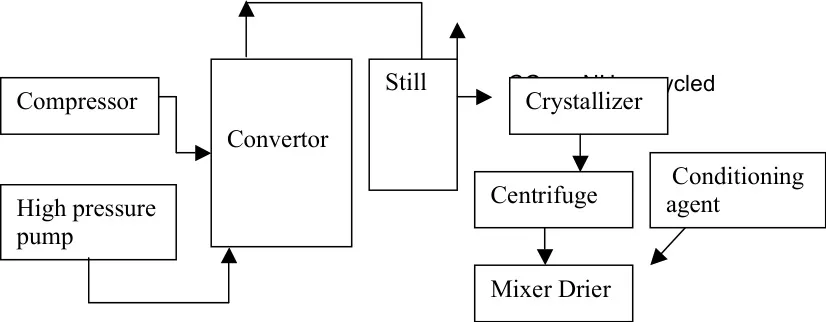
equipment. The CO2 and NH3 are compressed and heated as they enter the converter
where urea is formed. A large excess of NH3 is used in order to increase the conversion
rate. The un reacted NH3 and CO2 are removed by means of an evaporator still and are
then recycled. The urea solution is pumped to the crystalizer where cooling and
crystallization take place. The urea crystals are centrifuged and dried.
FLOW CHART FOR UREA MANUFACTURE
CO2
NH3
Summary Cheat Sheet
| Topic | Key exam point |
|---|---|
| Main product | Urea |
| Nutrient content | About 46% N |
| Basic raw materials | Ammonia and carbon dioxide |
| Core reaction logic | Urea is synthesized through ammonium carbamate intermediate under pressure |
| Finishing steps | Concentration, prilling, or granulation are key processing steps |
| Product class | Highly concentrated nitrogenous fertilizer |
| Agronomic note | Widely used because of high N analysis and relatively low transport cost per unit nutrient |
| Manufacturing memory point | Flow chart sequence is frequently asked in process-based questions |
| Storage note | Moisture sensitivity and caking management matter in handling |
| Trap | Do not confuse urea manufacture with manufacture of ammonium fertilizers like ammonium sulphate or nitrate |
References
3 sources • [1] [2] [3]
References
Principles of Soil Science and Agricultural Chemistry — Standard BSc Agriculture Textbook
BookLesson Doubts
Ask questions, get expert answers