☠️ Organophosphate Insecticides I
Major organophosphate insecticides, their preparation notes, toxicity, and mode of action.
Organophosphate insecticides are widely used but require careful handling due to high mammalian toxicity. This lesson outlines major compounds, preparation notes, and mode of action.
MONOCROTOPHOS, PHOSPHAMIDAN, MALATHION AND CHLORPYRIPHOS
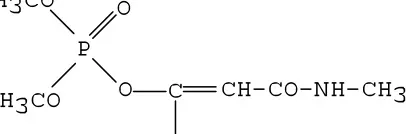
a) Monocrotophos (Azodrin)
Derivative of phosphoric acid
Monocrotophos (Dimethyl-1 methyl-2-methyl carbamoyl-venyl phosphate)
(Monocrotophos)
LD50: 21 mg/g
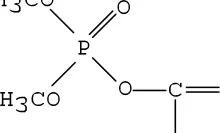
b) Phosphamidon (Dimecron)
(2-chloro-2diethyl carbamyl-1-methylvinyl dimethyl phosphate)
Derivative of Phosphoric Acid
Phosphamidon is produced by reacting equimolecular quantities of trimethyl
phosphite with boiling solution of diethylamide of dichloroacetic acid in chlorobenzene.
O CH3
| |
(CH3O)3P+CH3CO C Cl2 CON(C2H5)2(CH3O)2-P-O-C=CCl-CON-(C2H2)2+CH3Cl
Phosphamidon is very similar to mevinphos in toxicity has a broad spectrum of activity
against biting and sucking pests and spider mites.
LD50: 10 mg
Pure phosphamidon is colourless. Commercial product is bright violet due to the
presence of a dye. B.P. 70°C, with a faint pleasant odour.
 Highly soluble in water, alcohol, acetone, slightly soluble in saturated
bydrocarbons like hexane and insoluble in kerosene. Does not clogg the nozzles and
hence suited to ultra low volume and low volume sprays.
 - Phosphamidon is stable in neutral and weak acidic aqueous solutions.

 - It is rapidly hydrolysed in alkaline medium.

 - Stable for 2 years when stored in closed containers.

 - It is compatible with most pesticides except alkaline ones.

 - When mixed with captan it is synergistic. Toxicity is reduced when mixed
with copper oxychloride.
- When insects feed on this, the choline esterase is inhibited and the insect
gets killed.
- Used as a systemic to control sucking pests in cotton.
c) Malathion
(0, 0-dimethyl S-(1, 2, dicarbethoxy) ethyl phosphorus dithioate)
Derivatives of Dithiophosphoric acid
Dithiophosphoric acid + Maleic acid Malathion
Malathion is obtained by addition of dimethyl dithiophosphoric acid to maleic acid
ester in the presence of basic catalyts.
Malathion was introduced in 1950 by the American Cyanamid company. It is an
important and widely used contact insecticide and acaricide for the control of aphids, red
spidermites, leafhoppers and thrips on a wide range of vegetable and other crops. It
was important in the history of development of OP insecticides since it was the first
member with a broad spectrum of contact insecticidal activity combined with the
remarkably low mammalian toxicity (LD50: 1300 mg/kg rats). Malathion is also valuable
to control insect vectors eg. Mosquitoes and can be used as a substitute for
organochlorine insecticides.
Pure malathion is a colourless liquid boiling at 120°C. It is sparingly soluble in
water but highly soluble in most of the organic solvents except in saturated
bydrocarbons.
Malathion on prolonged heating at 150°C is isomerised and goes over to thiolo
isomers.
d) Chlorpyriphos (Dursban)
(0, 0-diethyl 0-(3, 5, 6 trichlorophyridine-2 yl phosphorothioate)
Derivative of Thiophosphoric acid
Chlorpyrifos is used for mosquito control but may also be employed against
ectoparasites on domestic animals.
LD50: 135-163 mg/kg rat oral.
Metallic ions in soils often interact with organophosphorus insecticides; the cupric
ion is a very effective calalyst for the degradation of some organophosphorus esters,
such as diazinon and chlorpyrifos.
Chlorpyrifos has low acute mammalian toxicity in the 2000-5000 mg/kg range.
Many organophosphorus insecticides contain heterocyclic moieties with nitrogen
heterocycles. The only important pyridine derivatives are chlorpyrifos and chlorpyrifos
methyl. Chlorpyrifos is a very valuable contact insecticide some 3500 tonnes were used
in USA in 1982. It has a wide spectrum of activity, by contact, ingestion and vapour
action. It is moderately persistant and retains its activity in soil for 2-4 months and is
valuable against mosquito and fly larvae, cabbage root fly, aphids and codling and winter
moths on fruit trees.
Chlorpyrifos has become one of the most widely applied insecticides in homes
and restaurants against cockroaches, and other domestic pests. It is a comparatively
safe insecticide. Chlorpyrifos methyl (R=CH3) is quite volatile and is used to control
insects in grain stores.
Summary Cheat Sheet
| Topic | Key exam point |
|---|---|
| Main class | Organophosphate insecticides |
| Mode of action | Inhibit acetylcholinesterase (AChE) |
| Common examples | Monocrotophos, phosphamidon, malathion, chlorpyriphos |
| Chemical basis | Derivatives of phosphoric or thiophosphoric acid |
| Toxicology note | Generally high acute toxicity risk compared with many older botanicals |
| Use theme | Widely used in insect pest management across crops |
| Residue caution | Safety interval and correct dosage are critical |
| Antidote theme | Atropine is classically linked with OP poisoning management in toxicology discussions |
| Exam distinction | Organophosphates differ from carbamates even though both affect AChE |
| Trap | Do not confuse chlorpyriphos/malathion class with organochlorines or carbamates |
References
3 sources • [1] [2] [3]
References
Principles of Soil Science and Agricultural Chemistry — Standard BSc Agriculture Textbook
BookLesson Doubts
Ask questions, get expert answers