🍄 Organic Fungicides
Organic fungicides such as dithiocarbamates, with their characteristics and field use.
This lesson explains key concepts in a structured way and connects them to practical agricultural applications and exam-oriented understanding.
Organic fungicides
use of Zineb and Maneb
Dithiocarbamates (Organic sulphur compounds)
Investigations of the DuPont Company (USA) showed that some of the
derivatives of dithiocarbamic acid H2N,CSH had insecticidal and fungicidal properties.
However dithiocarbamic acid itself is not known to exist in the free state. When the
primary and secondary aliphatic and aromatic amines are treated with carbon-di
sulphide in alcoholic solutions, dithiochrbamates are produced.
The hydrogen attached to S dissociates and may be replaced by a metal or other
radicals producing a variety of derivatives. The group > NCS is considered to be
essential for insecticidal and fungicidal action. By reacting dimethylamine and CS2
under alkaline conditions, Thiram and salts of Na, Fe and Cd were prepared. Nabam
was produced by reacting ethylene diamine and CS2. Subsequently the heavy metal
complexes of dithiocarbamates like Ziram and Ferbam and complexes of
bisdithiocarbamates like maneb and zineb were developed.
A large number of derivatives of dithiocarbamic acid possess fungicidal
properties. They can be classified as follows.
-
Metalic dithiocarbamates – Ziram and Ferbam
-
Thiuram disulphide (Thiram) –S-Slinkage
-
Bis dithiocarbamates – Manels, Nabam, Zineb
A) Zineb (Dithane-A 78)
Dithane-Z 78 is a white crystalline substance insoluble in water and most organic
solvents; moderately soluble in pyridine. It is unstable in the presence of moister, heat,
light and alkali. Moist compound under unfavourable storage conditions may
decompose to 50% in a year. To reduce the chance of explosive evolution of CS2, Zineb
has to be stored in a well ventilated place at low temperatures. It is compatible with
most insecticides like Ferbam.
It is formulated as wettable powder. Its residual effect depends on weather and
season. Zineb can be of great use on Zn deficient soils.
B) Maneb (Dithane-M 45, Manzate)
It is the manganese salt of ethyulene bisdithiocarbamic acid; is similar to zineb, in
most physical and chemical properties. Decomposes rapidly under high temperature
and moisture. It is a yellow crystalline substance insoluble in water and organic
solvents. Compatibility is similar to Ferbam. When stored in bulk, Maneb i s capable of
spontaneous decomposition with charring which can be avoided by diluting with an inert
material. Other analogues are Dithane C-31, Propineb, Thioneb (carbathene).
Thiram as tetra methyl thiuram disulphide was the first compound to be
applied as a fungicide and is still used, especially against moulds and as
a seed dressing against soil fungi causing damping off. Thiram is
prepared by the interaction of carbon disulphide and dimethylamine in the
presence of NaOH which is subsequently oxidized to thiram.
Later work resulted in the discovery of the fungicidal activity of zinc and
ferric salts of dimethyl dithiocarbamates known as ziram and ferbam
respectively. Disodium ethylene bis dithiocarbamate or nabum is also
fungicidal and is used to control stem rots. Nabum is the insoluble zinc
and manganese salts known as zineb and maneb which are produced by
reaction with an aqueous solution of zinc and manganese sulphate have
largely replaced water soluble. These are used as protectant fungicides
and are applied for the control of wide range of phyto pathogenic fungi
such as downy mildews. They have very low mammalian toxicities (LD 50
- 7000 mg kg [-1] ).
Metham-sodium (N- methyl dithiocarbamate) is a valuable soil sterilant
for the control of damping off diseases.
Mancozeb, a coordinated complex of zinc and manganous salts was
introduced in 1962. Maneb and mancozeb are formulated with synthetic
fungicides to reduce development of resistance.
The dithiocarbamates owe their fungicidal activity due to their ability to
chelate with metal cations such as copper. The dithiocarbamates get
metabolized to isothio cyanates which react with vital thiol compounds
with in the fungal cell.
Heterocyclic N compounds
Captan (N-(trichloromethylthio)-4-cyclohexane-1,2-dicarboximide) is a
very effective and persistent foliage fungicide against many soil and seed
borne diseases. Analogues that have been subsequently developed as
foliar fungicides include folpet and difolatan, which are most active
against potato blight. These are some of the safest fungicides (LD 50 >
10000 mg kg [-1] ).
Captan interacts with cellular thiols to produce thiophosgene which poison
the fungus.
Dichlofluanid, introduced by Bayer is a broad spectrum protective
fungicide which is less sensitive than captan.
Phenols
The majority of phenols, especially those containing chlorine, are toxic to
microorganisms, their bacterial action has been known for along time and
many phenols are also fungicidal. However many are phytotoxic.
Shirlan or salicylanilide is used to inhibit the growth of moulds on cotton
and against a number of laef diseases as tomato mould.
Dinocap is a non systemic aphicide and contact fungicide which is
effective for the control of powdery of mildew on many horticultural crops.
Low mammalian toxicity LD 50 > 980 mg kg [-1] .
Binapacryl is closely related to dinocap and is used for the control of
powdery mildew on apples.
Oxine α-hydroxy quinoline is a protectant fungicide, when suitably
formulated, appears to possess limited systemic action. Oxine has a
striking capacity to form chelates with metals (Cu) which is effective
against a range of phytopathogenic fungi.
Chlorobenzenes and related compounds
2,6-dichloro-4-nitro aniline was marketed in 1959 by Boots Ltd. Especially
valuable for the control of Botrytis in tomatoes and against fungal
organisms causing post harvest decay of fruits.
Penta chloro nitro benzene (PCNB) called quintazene is a widely used
soil fungicide for damping off diseases. Chloroneb is used to control soil
borne fungi as seed dressings or by soil application.
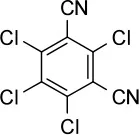
Chlorothalonil is a broad spectrum foliar or soil applied fungicide used in
many crops. Sandoz kavach.
Chlorothalonil
Quinones
A number of quinines occur in plants and are also products of fungal
metabolism.
Dichlone is more stable in light has been used as a seed dressing agent
and a foliage spray against powdery mildew.
Dodine (N-dodecyl guanidine acetate) has been known asa bactericide
(1941) and more recently has been shown to have fungicidal activity.
Dodine is a cationic surfactant is generally formulated as wettable
powder. Low mammalian Toxicity (LD 50 > 1500 mg kg [-1] ).
Guazatine is mainly used as seed dressing agent for cereals at 0.6 –0.8
g ai kg [-1] of seed and against post harvest diseases. (LD 50 > 500 mg kg [-1] ).
The fungicidal activity of these compounds probably depend on their
ability to alter the permeability of the fungal cell wall, causing loss of vital
cellular components such as amino acids and P compounds.
Dicarboximides
All members contain the 3,5-dichlorophenyl moiety and the fungicidal
activity depends on the presence of the two chlorine atoms in 3, 5
positions.
Procymidone, hydantoin, iporodione and vinclozolin have been
extensively used for the control of Botrytis and Scelrotinia sp in cereals,
fruits and vegetables but their use is restricted due to the development of
resistance.
More recently metomedan, chlozolinate and myclozoline have been
introduced.
Drazoxolon (ICI,1960) is a valuable seed dressing agent against
damping off diseases.
The dicarboximides have low mammalian toxicities (LD 50 > 3500 mg kg [-] .
Summary Cheat Sheet
| Topic | Key exam point |
|---|---|
| Main class | Organic fungicides |
| Major group highlighted | Dithiocarbamates |
| Common examples | Mancozeb, zineb, thiram, captan |
| Other groups in lesson | Heterocyclic N compounds, phenols, chlorobenzenes, quinones, dicarboximides |
| Action pattern | Mostly broad-spectrum protectant activity in many older organic fungicides |
| Agronomic role | Widely used in crop disease prevention and seed/foliar treatments |
| Exam distinction | Organic fungicides are chemically distinct from inorganic copper/sulphur fungicides |
| Product identity point | Example matching is a major recall area in this lesson |
| Management caution | Correct formulation and spray interval matter for protectant fungicides |
| Trap | Do not confuse dithiocarbamates with systemic fungicides like benzimidazoles or triazoles |
References
3 sources • [1] [2] [3]
References
Principles of Soil Science and Agricultural Chemistry — Standard BSc Agriculture Textbook
BookLesson Doubts
Ask questions, get expert answers