🥭 Food Production Including Horticulture Crops and Its Importance in the Economy and Nutritional Security
Study how horticulture supports food production, economy, employment, and nutritional security in Class 12th Agriculture.
Food Production Including Horticulture Crops and Its Importance in the Economy and Nutritional Security
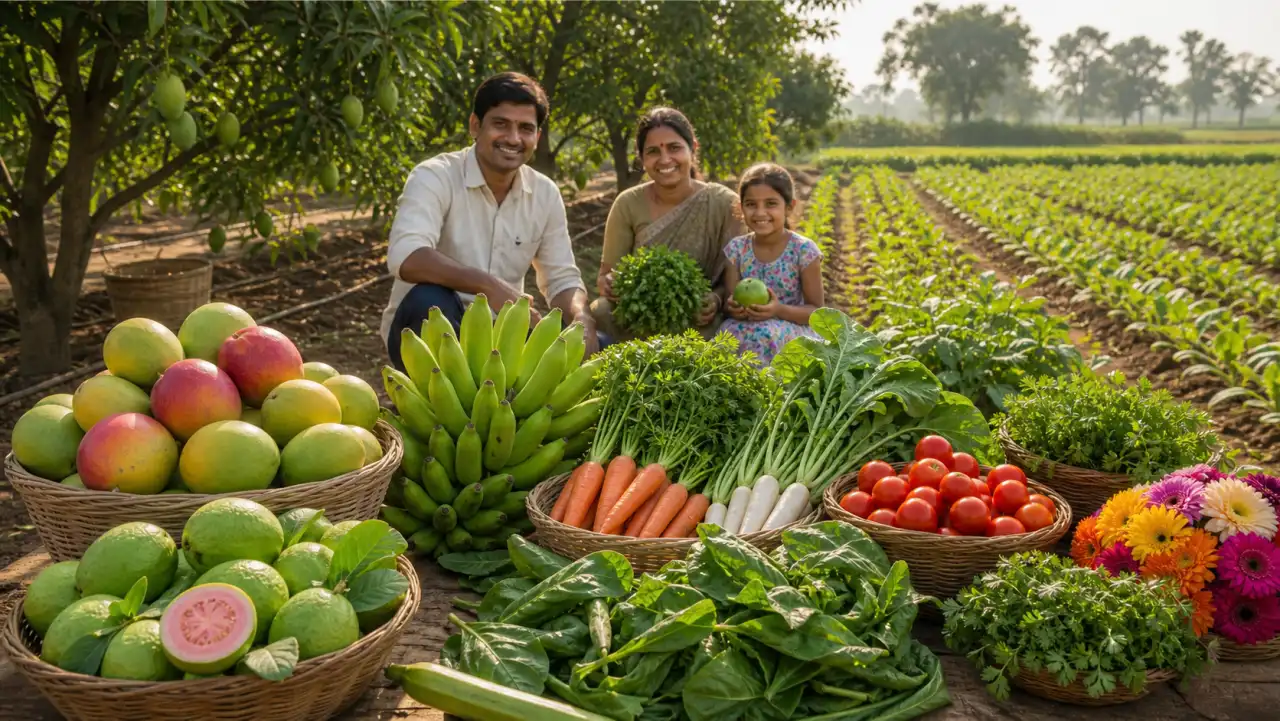
Food production is not only about growing enough grain. A strong agricultural system must also provide fruits, vegetables, fibre, employment, and nutrition. That is why horticulture is an important part of Class 12 Agriculture.
Start with a real-life picture
Imagine two lunch plates:
- Plate A has rice or roti only.
- Plate B has rice or roti, dal, spinach, carrot, guava, and a little salad.
Both plates may remove hunger, but only Plate B builds nutritional security. This is the doorway into horticulture. Fruits, vegetables, spices, plantation crops, flowers, medicinal crops, and processed products make agriculture more nutritious, more profitable, and more connected with daily life.
Keep asking: How does this crop help a family, a farmer, an industry, and the country at the same time?
Pro Content Locked
Upgrade to Pro to access this lesson and all other premium content.
₹99 charged monthly · Cancel anytime
- All Agriculture & Banking Courses
- AI Lesson Questions (100/day)
- AI Doubt Solver (50/day)
- Glows & Grows Feedback (30/day)
- AI Section Quiz (20/day)
- 22-Language Translation (100/day)
- Recall Questions (20/day)
- AI Quiz (15/day)
- AI Quiz Paper Analysis (100/day)
- AI Step-by-Step Explanations (100/day)
- Spaced Repetition Recall (FSRS)
- AI Tutor
- Immersive Text Questions
- Audio Lessons — Hindi & English
- Mock Tests & Previous Year Papers
- Summary & Mind Maps
- XP, Levels, Leaderboard & Badges
- Generate New Classrooms
- Voice AI Teacher (AgriDots Live)
- AI Revision Assistant
- Knowledge Gap Analysis
- Interactive Revision (LangGraph)
🔒 Secure via Razorpay · Cancel anytime · No hidden fees
Food Production Including Horticulture Crops and Its Importance in the Economy and Nutritional Security
Food production is not only about growing enough grain. A strong agricultural system must also provide fruits, vegetables, fibre, employment, and nutrition. That is why horticulture is an important part of Class 12 Agriculture.
Start with a real-life picture
Imagine two lunch plates:
- Plate A has rice or roti only.
- Plate B has rice or roti, dal, spinach, carrot, guava, and a little salad.
Both plates may remove hunger, but only Plate B builds nutritional security. This is the doorway into horticulture. Fruits, vegetables, spices, plantation crops, flowers, medicinal crops, and processed products make agriculture more nutritious, more profitable, and more connected with daily life.
Keep asking: How does this crop help a family, a farmer, an industry, and the country at the same time?
What is horticulture?
Horticulture is the branch of agriculture that deals with fruits, vegetables, flowers, medicinal plants, spices, plantation crops, ornamentals, and their post-harvest handling.
In practical study, this scope also includes aromatic crops, shrubs, climbers, ornamental trees, and processing-linked crops. Horticulture is therefore wider than fruit growing alone; it is a broad field of plant production and value addition.
In simple terms, horticulture may include:
- fruit crops
- vegetable crops
- ornamental plants
- commercial flowers
- medicinal and aromatic crops
- spice crops
- plantation crops
- individual trees, shrubs, and climbers
- post-harvest management and processing
Why horticulture is important
| Area | Why it matters |
|---|---|
| Food supply | Fruits and vegetables increase the diversity and quality of the diet |
| Income | Many horticultural crops give high returns per unit area |
| Employment | Orchards, nurseries, floriculture, and vegetable production create regular work |
| Waste land use | Some fruit crops can grow on uneven or less productive land |
| Industry | Processing units need raw material for jam, juice, pickles, dehydration, and beverages |
| Nutrition | Horticultural produce supplies vitamins, minerals, fibre, and protective foods |
A simple analogy
Think of cereal crops as the base of a meal and horticultural crops as the quality upgrade. Cereals provide bulk calories. Horticulture adds colour, taste, vitamins, minerals, fibre, processing value, employment, and market diversity. Its importance therefore connects food, income, employment, industry, culture, medicine, and nutrition.
Expanded importance of horticulture in the economy
Horticulture is a powerful economic branch because it supports the farm, the household, and many downstream industries at the same time.
High output from limited land
One major reason horticulture is important is that many horticultural crops produce a high quantity of useful produce or a high market value from a comparatively small area. In a land-scarce country, this becomes economically important.
The point becomes clearer with a few yield examples:
- paddy may produce around 30 q/ha
- banana may produce 300-500 q/ha
- pineapple may reach about 450 q/ha
- grapes may produce about 90-150 q/ha
Students do not need to memorize every figure perfectly, but they should remember the main idea: horticulture can give very high output per unit area.
High income per unit area
Well-managed orchards, vegetable fields, flower units, spice blocks, and nursery enterprises often return more income per hectare than many ordinary field crops. This is why horticulture is often seen as a commercial engine within agriculture.
A well-kept orchard of crops like apple, grapes, or sweet orange can generate strong net returns per hectare. The exact rupee figure is less important than the central idea: horticulture often combines biological value with commercial value very efficiently.
High employment generation
Horticulture is labour-intensive. Planting, staking, training, pruning, harvesting, grading, sorting, packaging, processing, and market handling all require labour. That makes horticulture especially valuable where rural employment is a policy and livelihood concern.
The difference becomes very clear when employment days are compared. Even if the exact number is not quoted in every answer, the message remains the same: horticulture creates far more labour demand and livelihood opportunity.
Some memorable comparative figures are:
- ordinary agriculture around 143 employment days/year/ha
- horticulture around 870 employment days/year/ha
The exact values can vary with crop and region, but the concept is clear: horticulture is labour-intensive and livelihood-rich.
Productive use of uneven and difficult land
Some fruit and plantation crops can be grown on hilly, undulating, or partially marginal lands where ordinary arable cropping is less suitable. This means horticulture expands the productive use of land resources.
Perennial horticultural systems are especially useful where topography limits ordinary agronomic cropping.
It also connects this with hilly and undulating regions such as places where mango and cashew are grown successfully even when broad-acre field crops are less practical.
Raw material for industries
Horticultural crops feed many industries:
- canning
- juice and beverage processing
- jam, jelly, preserve, and candy making
- dehydration and drying
- flower processing
- spice processing
- medicinal and aromatic products
So horticulture is not only about fresh produce; it is also about value addition.
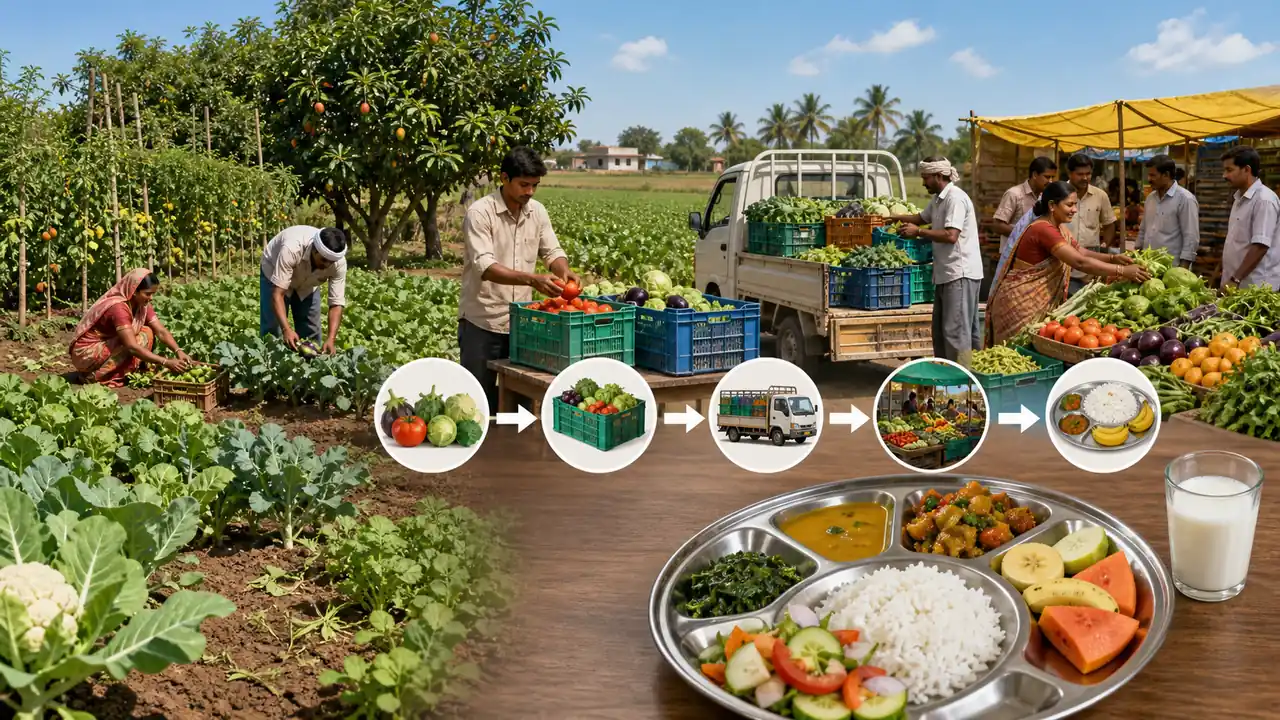
The same mango, four careers
A mango orchard can support much more than fruit selling:
- the farmer earns from fresh fruit
- labourers earn during pruning, harvesting, grading, and packing
- processors make pulp, pickle, juice, and dried slices
- traders, transporters, cold-storage workers, and retailers earn from the chain
This is why horticulture is livelihood-rich. One crop can create a mini economy around it.
Cultural, ornamental, and medicinal value
Many horticultural plants also carry religious, aesthetic, or medicinal value. This makes horticulture a unique branch where agriculture interacts with health, culture, and landscape.
This point deserves special weight because several horticultural plants are culturally symbolic, religiously important, aesthetically valuable, or medicinally useful. That is one reason horticulture cannot be reduced to “only market gardening.”
Textbook examples of cultural and medicinal importance
Memorable examples include:
- coconut as Kalpavriksha
- banana as apple of paradise and a plant of virtues
- pipal as a sacred tree
- bel associated with Lord Shiva
- lotus associated with major Hindu deities
It also lists medicinal examples such as:
- rose water for eye use
- saffron in medicines
- papain from papaya as a digestive enzyme
- sweet lime in liver-related use
- pomegranate rind and guava pectin in digestive care
- neem in skin irritation and allied uses
Triphala is also remembered as a mixture based on aonla, baheda, and harad.
Horticulture and national security
When people hear “food security,” they often think only about cereals. But real nutritional security also needs fruits, vegetables, and protective foods. Horticulture supports this by improving:
- vitamin intake
- mineral intake
- dietary fibre intake
- livelihood stability for farming families
Nutrition at a glance
Fruits and vegetables are rich in micronutrients and fibre. Different produce groups support different needs:
| Nutrient group | Main role in the body | Common agriculture examples |
|---|---|---|
| Carbohydrates | Energy | banana, sweet potato, cassava |
| Proteins | Growth and repair | pea, cowpea, nuts |
| Fats | Stored energy | almond, walnut, avocado |
| Vitamins | Regulation and protection | carrot, aonla, guava, leafy vegetables |
| Minerals | Bones, blood, enzymes, nerves | amaranth leaves, curry leaf, onion, garlic |
| Fibre | Digestion and gut health | leafy vegetables, fruits with pulp, root crops |
Horticulture and nutritional security
Food security in the narrow sense means enough food quantity. Nutritional security is a wider idea: it means the diet should also be balanced, protective, and health-supporting. Horticulture is central to nutritional security because fruits and vegetables supply several components that cereals alone cannot supply adequately.
Balanced-diet guidance from ICMR, New Delhi supports this idea by recommending regular intake of leafy vegetables, root and tuber vegetables, other vegetables, and fruits. The practical message is simple: cereal calories alone do not make a balanced diet.
ICMR-style recommendation memory line
A simple daily recommendation pattern is:
- 125 g leafy vegetables
- 100 g root and tuber vegetables
- 75 g other vegetables
- total vegetables about 300 g/day
- fruits about 120 g/day
This recommendation directly links horticulture with balanced-diet planning.
Carbohydrates
Carbohydrates are a major source of energy. Banana, cassava, sweet potato, dates, and some dried fruit products contribute significantly to this group. One gram of carbohydrate gives about four calories of energy.
Carbohydrates are the chief energy source, and the daily need is often discussed at roughly 400-500 g per person. So horticultural crops contribute not only protective nutrition but also energy nutrition.
Carbohydrates are also grouped into:
- monosaccharides
- disaccharides
- polysaccharides
This gives students a useful bridge between nutrition science and crop examples.
Carbohydrate-rich horticultural examples
These produce examples show that horticulture also contributes energy-rich foods:
- raisins
- dried apricot
- dates
- dried karonda
- bael
- cassava
- sweet potato
- potato
- banana
These examples help students see that horticultural foods are not only vitamin-rich; some are also important energy foods.
Proteins
Although most fruits are not protein-rich, certain vegetables and nuts improve protein intake. Peas, beans, cowpea, and tree nuts contribute to growth and tissue repair.
Proteins are built from amino acids, and one gram of protein provides about four calories of energy. This helps connect horticultural foods with body-building nutrition too.
Proteins contain nitrogen and are built from amino acids, including a group of essential amino acids that the human body cannot synthesize adequately on its own.
Useful produce examples include:
- cashew nut
- almond
- walnut
- lima bean
- pea
- cowpea
This makes protein discussion more concrete in an agriculture classroom.
Fats
Most vegetables are low in fat, but crops like avocado and nuts provide concentrated energy. One gram of fat gives about nine calories of energy.
Nut crops such as almond, walnut, pecan, and cashew show that horticulture also contributes energy-dense food through fat-rich produce.
That is why horticulture should not be taught as only low-calorie protective food. Some horticultural products also supply concentrated energy and premium nutritional value.
An important point is examples such as:
- pecan nut
- walnut
- almond
- cashew nut
- avocado
So a good answer can say that horticulture contributes both protective nutrition and concentrated energy nutrition.
Vitamins
Horticultural crops are especially important because of their role as vitamin sources:
- yellow-orange and leafy vegetables help with vitamin A support
- aonla, guava, chillies, and fresh produce help with vitamin C support
- leafy vegetables and selected produce help with several B-group vitamins
- green plant materials also contribute to other protective vitamin systems
The main patterns worth retaining are:
- vitamin A support from carrot, muskmelon, squash, and leafy vegetables
- carotenoids as the precursor group to vitamin A
- a major role of fruits and vegetables in vitamin C intake
- broader support for B-group vitamins through fresh produce, legumes, and selected nuts
The text also gives useful deficiency ideas:
- vitamin A deficiency may lead to night blindness and xerophthalmia
- vitamin B1 deficiency is linked with beriberi and weakness
You do not always need to write every deficiency in a short answer, but knowing them helps build a stronger long answer.
Vitamin summary
Keep these vitamin links ready for short and long answers:
- vitamin A -> carrot, muskmelon, winter squash, leafy vegetables; deficiency may cause night blindness
- vitamin B1 -> deficiency linked with beriberi
- vitamin B2 -> deficiency may cause dry scaly skin and cracking at the corners of the mouth
- vitamin C -> deficiency causes scurvy; about 90% of vitamin C in the diet may come from fruits and vegetables
- vitamin B3 -> deficiency linked with pellagra
- vitamin B6 -> linked with energy and nervous-system function
- vitamin B12 -> mainly from animal foods, not typical fruit-and-vegetable sources
- vitamin D -> associated with sunlight synthesis in the body
- vitamin E -> called an anti-sterility vitamin in older textbook language
- vitamin K -> linked with proper blood clotting
High-value source examples for vitamins
Some memorable source examples are:
- Barbados cherry, aonla, and guava for very strong vitamin C
- mango, papaya, and carrot for vitamin A support
- sweet corn for vitamin E
- leafy greens such as palak, bathua, fenugreek leaves, and amaranth leaves for multiple protective nutrients
Minerals
Leafy vegetables, fruits, onions, garlic, and related produce help support calcium, iron, phosphorus, potassium, and folate-rich diets. This is one reason vegetables are called protective foods.
Minerals can be understood as both regulatory and body-building nutrients, so a good exam answer can mention that horticultural foods support enzyme function, blood health, bone health, and general metabolism.
Mineral notes
These quick mineral points are especially useful:
- calcium is supported strongly by green leafy vegetables such as agathi and curry leaf
- iodine deficiency is associated with goitre
- dry karonda, date, and amaranth leaves are used as iron-rich examples
- almond, cashew, walnut, amaranth leaves, and garlic appear in the phosphorus discussion
- spinach and amaranth leaves are named for potassium
- green leafy vegetables are highlighted for folic acid, especially for women
These details turn the lesson from a general nutrition note into a more complete agriculture chapter.
Fibre
Dietary fibre improves digestion, bowel movement, satiety, and overall gut health. Fruits and vegetables are far better fibre sources than highly refined diets.
One idea deserves special attention here: fibre has both direct and indirect advantages. In answer writing, it should not be treated as a minor extra point. It is one of the reasons fruits and vegetables are called protective foods.
Its functions can be explained more fully as follows:
- increases bulk
- decreases bowel transit time
- helps absorb toxins
- helps clean the colon of mucus and undigested particles
- slows stomach emptying and increases satiety
It further notes two broad fibre forms:
- soluble fibre
- insoluble fibre
Common source examples include:
- fig
- guava
- potato
- broccoli
- cabbage
- cauliflower
- corn
- tomatoes
- apples
- bananas
Some memorable figures also appear here, such as about 7 g/100 g fibre in fig and about 6.9% in guava, with potato as a strong vegetable example.
Lesson-aligned nutrient memory bank
The nutrition part of this chapter is long because the textbook wants students to connect horticulture with human health. Do not study these nutrients like isolated biology facts. Study them as proof that fruits and vegetables are essential for nutritional security.
Carbohydrate sources from horticultural crops
Carbohydrates are the chief energy-giving nutrients in the human diet. They include simple sugars and complex storage forms. In horticultural produce, students should remember the broad groups:
| Group | Simple meaning | Examples to remember |
|---|---|---|
| Monosaccharides | single sugar units | glucose, fructose, mannose |
| Disaccharides | two sugar units | sucrose, lactose, maltose |
| Polysaccharides | many sugar units | starch, cellulose, saccharin-like complex forms |
High-carbohydrate fruits here include raisins, dried apricot, date, dried karonda, banana, and bael. Important vegetable examples include cassava, sweet potato, and potato. The main idea is simple: roots, tubers, dried fruits, and some fruits can become concentrated energy foods.
Protein sources and essential amino acid idea
Proteins are nitrogen-containing compounds and form an important part of protoplasm. A useful answer should include three points:
- proteins build and repair body tissues
- proteins are made of amino acids
- some amino acids are essential because the body cannot synthesize them in enough quantity
Cashew nut, almond, walnut, pea, lima bean, and cowpea are useful examples here. For agriculture students, they show how pulses, nuts, and legumes connect crop production with protein security.
Fat as concentrated energy
Fat is the most concentrated energy source among the three major energy nutrients. A quick comparison helps:
| Nutrient | Energy value |
|---|---|
| Carbohydrate | about 4 calories/g |
| Protein | about 4 calories/g |
| Fat | about 9 calories/g |
Pecan nut, walnut, almond, cashew nut, and avocado are important fruit and nut examples here. Vegetable examples are less fat-rich, but Bengal gram, potato, and small bitter gourd are mentioned as reference examples. The main conclusion is that horticulture does not only provide vitamins; it also contributes energy and body-building nutrients through selected crops.
Vitamin-wise crop and deficiency map
Each vitamin should be connected with four things: solubility group, function, deficiency, and crop examples.
Water-soluble vitamins
| Vitamin | Key deficiency or role | Horticultural examples |
|---|---|---|
| Vitamin B1 or thiamine | beriberi, muscular weakness, appetite loss, neuritis | cashew nut, walnut, almond, palak, pea |
| Vitamin B2 or riboflavin | dry scaly skin, cracks at mouth corners, cracked lips | bael, papaya, cashew nut, pineapple, palak, chillies, fenugreek leaves |
| Vitamin B3 or nicotinic acid | pellagra, nervous and digestive disturbance | litchi, palak, amaranthus leaves |
| Vitamin B6 or pyridoxine | low energy, reduced brain function, high homocysteine | summer squash, bell pepper, turnip greens, shiitake mushroom, spinach |
| Vitamin B12 or cyanocobalamin | pernicious anaemia, reduced RBC formation | mainly animal foods; not a fruit and vegetable vitamin |
| Vitamin C or ascorbic acid | scurvy, weak gums, poor healing | Barbados cherry, aonla, guava, drumstick leaves, coriander leaves, chillies, broccoli |
Vitamin C deserves special attention because a very large share of dietary vitamin C comes from fruits and vegetables. Aonla and guava are especially strong Indian examples. Barbados cherry is another high-value memory example.
Fat-soluble vitamins
| Vitamin | Key idea | Lesson-aligned examples or notes |
|---|---|---|
| Vitamin A | vision, epithelial health, carotene precursor | carrot, muskmelon, winter squash, leafy vegetables, mango, papaya, bathua leaves, colocasia leaves, turnip greens |
| Vitamin D | bone health through calcium metabolism | synthesized by body in sunlight; deficiency causes rickets in children and osteomalacia in adults |
| Vitamin E | anti-sterility vitamin, protects tissues | sweet corn is noted as a rich source |
| Vitamin K | blood clotting | anti-haemorrhagic vitamin; deficiency delays coagulation |
Vitamin A is important because it connects horticulture with eye health. Night blindness, xerophthalmia in children, and keratinisation of eye epithelial cells are all linked with its deficiency. Carrot is a classic example because carotenoids act as a precursor of vitamin A.
Mineral-wise crop and deficiency map
Minerals are micronutrients for human nutrition, but their absence can create very visible health problems. The examples below are useful for one-mark and short-answer questions.
| Mineral | Requirement or health point | Crop examples emphasized |
|---|---|---|
| Calcium | needed for bones, teeth, and body functions | litchi, karonda, agathi leaves, curry leaves |
| Iodine | deficiency causes goitre | onion, garlic, beet, agathi leaves |
| Iron | needed for blood and oxygen transport | dry karonda, date, amaranthus leaves |
| Phosphorus | important in energy transfer and body tissues | almond, cashew nut, walnut, amaranthus leaves, garlic |
| Potassium | important electrolyte and cell function mineral | spinach, amaranthus leaves |
| Sodium | important electrolyte | celery, green onion, Chinese cabbage |
| Folic acid | important for growth, nervous system, and women | green leafy vegetables |
When writing answers, do not turn this into a random list. Use the pattern: nutrient -> function/deficiency -> crop source. This makes the answer look organized and prevents missed marks.
Crop-wise protective food table
This table helps students revise the horticultural crops mentioned across the nutrition discussion.
| Crop or crop group | Why it is remembered |
|---|---|
| Aonla | very rich vitamin C source |
| Guava | vitamin C and fibre-rich fruit |
| Barbados cherry | extremely high vitamin C reference fruit |
| Carrot | beta-carotene and vitamin A precursor |
| Mango and papaya | fruit sources of vitamin A activity |
| Bathua and colocasia leaves | vitamin A-rich leafy vegetables |
| Drumstick leaves | vitamin C-rich leafy vegetable |
| Coriander leaves and chillies | vitamin C source examples |
| Amaranthus leaves | iron, phosphorus, potassium, and folic-acid-linked leafy vegetable |
| Agathi and curry leaves | calcium-rich leafy examples |
| Onion, garlic, beet | iodine-linked examples in this topic |
| Fig and guava | strong fibre examples |
| Potato | important vegetable fibre and carbohydrate example |
| Cashew nut, walnut, almond | protein, fat, and mineral examples |
Writing the nutrition-security answer
If the question asks how horticulture supports nutritional security, build the answer in layers:
- It supplies protective foods such as fruits and vegetables.
- It improves diet quality beyond cereal calories.
- It provides carbohydrates, proteins, fats, vitamins, minerals, and fibre.
- It supports ICMR-style balanced-diet recommendations through daily vegetable and fruit intake.
- It reduces hidden hunger by supplying micronutrients like vitamin A, vitamin C, iron, calcium, and folic acid.
- It supports local availability of fresh produce and processed products.
This is the main difference between food security and nutritional security. Food security asks whether people have enough food. Nutritional security asks whether the diet also contains the right protective and body-supporting nutrients.
Practice bank
Short answers
- Define horticulture and list its major branches.
- Why can horticulture produce more food or value per unit area than many field crops?
- Explain how horticulture creates employment in rural areas.
- Give examples of horticultural crops suitable for waste land or undulating land.
- Mention industries that depend on fruits, vegetables, and flowers as raw material.
- Explain religious and aesthetic importance of horticultural crops with examples.
- Write a short note on medicinal importance of horticultural crops.
- Explain the ICMR daily recommendation for fruits and vegetables.
- Classify carbohydrates with examples.
- Why are fruits and vegetables called protective foods?
Fill in the blanks
- The branch of agriculture dealing with fruits, vegetables, flowers, spices, medicinal plants, and post-harvest handling is called __________.
- The daily vegetable recommendation discussed in this topic adds up to about __________ grams per day.
- One gram of fat provides about __________ calories of energy.
- Vitamin C deficiency causes __________.
- Vitamin A deficiency may cause __________ blindness.
- Vitamin B1 deficiency causes __________.
- Iodine deficiency causes __________.
- The maximum dietary fibre example among fruits in this topic is __________.
- Carotenoids are precursors of vitamin __________.
- Green leafy vegetables are good sources of __________ acid.
Objective-style revision
| Question | Best answer idea |
|---|---|
| Which nutrient gives the most energy per gram? | fat |
| Which vitamin is known as ascorbic acid? | vitamin C |
| Which vitamin is linked with blood coagulation? | vitamin K |
| Which vitamin is synthesized through sunlight? | vitamin D |
| Which fruit is a strong vitamin C example? | aonla or guava |
| Which mineral deficiency causes goitre? | iodine |
| Which group includes carrot and leafy vegetables as examples? | vitamin A/carotene sources |
| Which nutrient group contains glucose, fructose, and starch? | carbohydrates |
| Which dietary component gives bulk and improves bowel movement? | fibre |
| Which nutrition concept goes beyond calorie availability? | nutritional security |
If you are asked, Write the importance of horticulture, a high-scoring answer usually covers:
- high production or high value per unit area
- high employment generation
- better use of marginal or uneven land
- supply of industrial raw material
- medicinal, ornamental, and cultural value
- strong role in nutritional security
If the question is more nutrition-focused, also add:
- supply of carbohydrates, vitamins, minerals, and fibre
- role in balanced diet beyond cereal calories
Student memory grid
| Theme | Main idea |
|---|---|
| Economy | high value and high labour demand |
| Land use | can support difficult terrain in many cases |
| Industry | strong link with processing and value addition |
| Nutrition | rich in vitamins, minerals, and fibre |
| Security | supports balanced diet, not just calorie supply |
Why students should connect horticulture with nutrition
The same crop can be studied in more than one way:
- as a farm commodity
- as a nutrition source
- as a market crop
- as a processing raw material
This is why the topic naturally joins horticultural importance with the nutritive value of fruits and vegetables.
Chapter structure
Do not memorize the importance points as a loose list. Convert each point into a cause-and-effect line:
| Point | Clear statement |
|---|---|
| High output | Because many horticultural crops produce high yield or value from limited land, they improve farm income per unit area. |
| Employment | Because pruning, staking, harvesting, grading, packing, and processing need labour, horticulture creates rural employment. |
| Nutrition | Because fruits and vegetables supply vitamins, minerals, fibre, and protective foods, horticulture improves diet quality. |
| Industry | Because fruits, vegetables, flowers, spices, and plantation crops can be processed, horticulture supports value addition. |
This answer style shows understanding, not only memory.
Final notes
Waste-land, cultural and medicinal crop examples
It is also worth remembering that horticulture can use land that is not ideal for ordinary field crops. Examples include wood apple, custard apple, karonda, litchi, cashew nut, and coconut, depending on climate and site suitability.
For cultural and religious value, remember examples such as Sita Ashok, Banyan, Adam's Fig, and Nelumbo nucifera. For medicinal and processing value, connect arjun bark, pomegranate rind, and guava pectin with the idea that horticultural crops supply health, industry, and traditional-use materials, not only fresh food.
Vitamin names and deficiency spellings
| Nutrient | Scientific or common name | Deficiency clue |
|---|---|---|
| Vitamin A | retinol / carotene | nyctalopia, xerophthalmia, keratinisation |
| Vitamin B1 | thiamine | weakness and nerve-related symptoms |
| Vitamin B2 | riboflavin | mouth and skin lesions |
| Vitamin C | ascorbic acid | scurvy-like bleeding and weak connective tissue |
| Vitamin E | tocopherol | reproductive and antioxidant role |
| Vitamin K | phylloquinone | blood-clotting role |
| Iodine | mineral element | goitre |
These spellings are useful because one-mark questions often test exact vocabulary rather than long explanation.
One-mark nutrition memory
One one-mark fact often repeated from this topic is that the per-capita per-day vegetable requirement is 85 g. Keep it as a minimum memory figure, while also remembering that a balanced diet still needs diversity from grains, fruits, vegetables, pulses, and protective foods.
Summary Cheat Sheet
| Concept / Topic | Key Details / Explanation |
|---|---|
| Horticulture | Horticulture is the branch of agriculture dealing with fruits, vegetables, flowers, spices, plantation crops, medicinal and aromatic plants, ornamentals, shrubs, climbers, and post-harvest handling. |
| Importance in the economy | Horticulture improves the economy through high production or value per unit area, high income, strong employment generation, productive use of uneven or marginal land, and raw material supply to processing industries. |
| Employment value | Horticulture is labour-intensive because planting, pruning, training, grading, harvesting, packing, transport, and processing all need labour. The lesson highlights roughly 143 employment days/year/ha in ordinary agriculture versus about 870 employment days/year/ha in horticulture. |
| Industrial linkage | Fruits, vegetables, flowers, spices, and plantation crops support canning, juice and beverage making, jam, jelly, preserve, candy, dehydration, flower processing, spice processing, and medicinal-product industries. |
| Cultural, ornamental, and medicinal value | The lesson links horticulture with culture and health through examples like coconut as Kalpavriksha, bel with Lord Shiva, lotus with Hindu deities, and medicinal examples such as papain from papaya, rose water, saffron, pomegranate rind, and guava pectin. |
| Nutritional security | Nutritional security means more than enough calories. It means a balanced, protective, and health-supporting diet, so fruits and vegetables are essential because cereals alone cannot provide all nutrients adequately. |
| Protective foods | Fruits and vegetables are called protective foods because they improve diet quality by supplying vitamins, minerals, and fibre, and they help reduce hidden hunger. |
| ICMR-style daily recommendation | A simple balanced-diet memory line from the lesson is 125 g leafy vegetables + 100 g root and tuber vegetables + 75 g other vegetables = about 300 g vegetables/day, plus about 120 g fruits/day. |
| Carbohydrates | Carbohydrates are the chief energy-giving nutrients. The lesson classifies them into monosaccharides, disaccharides, and polysaccharides. Important horticultural examples include banana, bael, dates, raisins, dried apricot, cassava, sweet potato, and potato. |
| Proteins | Proteins build and repair body tissues and are made of amino acids. The lesson uses cashew nut, almond, walnut, pea, lima bean, and cowpea as protein-linked horticultural examples. |
| Fats and energy values | Fat is the most concentrated energy nutrient. The key memory values are 1 g carbohydrate = 4 calories, 1 g protein = 4 calories, and 1 g fat = 9 calories. Fat-rich examples mentioned include pecan nut, walnut, almond, cashew nut, and avocado. |
| Vitamin C and major deficiency clue | Vitamin C (ascorbic acid) deficiency causes scurvy. High-value examples are Barbados cherry, aonla, guava, drumstick leaves, coriander leaves, chillies, and broccoli. |
| Vitamin A and major deficiency clue | Vitamin A supports vision and epithelial health; its deficiency may cause night blindness, xerophthalmia, and keratinisation. Carotenoids are precursors of vitamin A, and common examples are carrot, mango, papaya, muskmelon, bathua leaves, colocasia leaves, and turnip greens. |
| Other vitamin memory points | Vitamin B1 (thiamine) deficiency causes beriberi. Vitamin D is linked with sunlight and bone health. Vitamin E is remembered as the anti-sterility vitamin. Vitamin K is linked with blood clotting. |
| Mineral deficiency clues | Iodine deficiency causes goitre. The lesson also stresses calcium for bones and teeth, iron for blood and oxygen transport, phosphorus for energy transfer, potassium and sodium as electrolytes, and folic acid for growth and the nervous system. |
| Crop examples for minerals and fibre | Onion, garlic, and beet are iodine-linked examples; amaranthus leaves are linked with iron, phosphorus, potassium, and folic acid; agathi leaves and curry leaves are calcium-linked. Fig and guava are memorable fibre examples, and green leafy vegetables are important sources of folic acid. |
| Cause-and-effect answer line | A strong answer writes horticulture as a chain: high output -> more income, labour demand -> more employment, processing linkage -> more industrial value, and vitamins + minerals + fibre -> better nutritional security. |
Lesson Doubts
Ask questions, get expert answers