🌱 Soil Fertility and Productivity
Study soil fertility, soil productivity, the factors governing both, and the practical difference between them.
Soil Fertility and Productivity
One of the most important distinctions in agriculture is the difference between fertility and productivity. A soil may have nutrient-supplying power and still fail to produce a strong crop if other conditions are poor.
Start with a farmer's puzzle
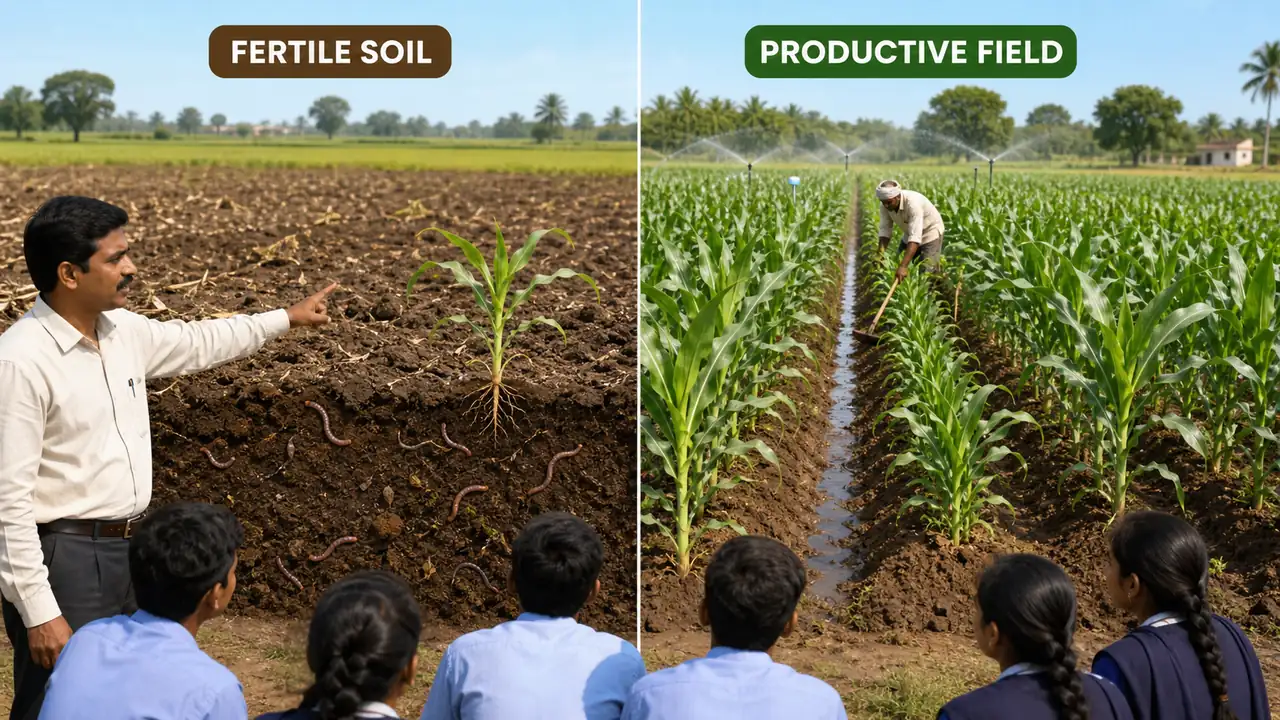
A farmer has two plots. Soil test values in Plot A look good, but the crop stays weak because the field remains waterlogged after rain. Plot B has moderate fertility, but the farmer improves drainage, adds organic matter, irrigates at the right stage, and controls pests on time. Plot B gives better yield.
This puzzle explains the whole lesson:
- fertility tells whether the soil can supply nutrients
- productivity tells whether the crop can actually perform in the field
So this chapter is not just terminology. It teaches why real farming needs diagnosis plus management.
Soil fertility and soil productivity
Soil fertility is the ability of soil to provide essential nutrients to plants in available form and suitable balance.
Pro Content Locked
Upgrade to Pro to access this lesson and all other premium content.
₹99 charged monthly · Cancel anytime
- All Agriculture & Banking Courses
- AI Lesson Questions (100/day)
- AI Doubt Solver (50/day)
- Glows & Grows Feedback (30/day)
- AI Section Quiz (20/day)
- 22-Language Translation (100/day)
- Recall Questions (20/day)
- AI Quiz (15/day)
- AI Quiz Paper Analysis (100/day)
- AI Step-by-Step Explanations (100/day)
- Spaced Repetition Recall (FSRS)
- AI Tutor
- Immersive Text Questions
- Audio Lessons — Hindi & English
- Mock Tests & Previous Year Papers
- Summary & Mind Maps
- XP, Levels, Leaderboard & Badges
- Generate New Classrooms
- Voice AI Teacher (AgriDots Live)
- AI Revision Assistant
- Knowledge Gap Analysis
- Interactive Revision (LangGraph)
🔒 Secure via Razorpay · Cancel anytime · No hidden fees
Soil Fertility and Productivity
One of the most important distinctions in agriculture is the difference between fertility and productivity. A soil may have nutrient-supplying power and still fail to produce a strong crop if other conditions are poor.
Start with a farmer's puzzle
A farmer has two plots. Soil test values in Plot A look good, but the crop stays weak because the field remains waterlogged after rain. Plot B has moderate fertility, but the farmer improves drainage, adds organic matter, irrigates at the right stage, and controls pests on time. Plot B gives better yield.
This puzzle explains the whole lesson:
- fertility tells whether the soil can supply nutrients
- productivity tells whether the crop can actually perform in the field
So this chapter is not just terminology. It teaches why real farming needs diagnosis plus management.
Soil fertility and soil productivity
Soil fertility is the ability of soil to provide essential nutrients to plants in available form and suitable balance.
Soil productivity is the ability of soil to produce a specified crop yield under proper management, inputs, and environmental conditions.
Productivity is therefore the result of fertility working together with management, environment, and field conditions.
IMPORTANT
A soil may be fertile but still not productive if drainage, aeration, water supply, crop management, or pest conditions are poor.
Why the distinction matters
Fertility is mainly a nutrient concept. Productivity is a crop-performance concept. Productivity includes fertility, but it also includes many practical realities:
- soil structure
- drainage
- market support
- weather
- pests and diseases
- management skill
That is why all productive soils are fertile, but not all fertile soils are productive.
The relationship can be stated very directly:
- all productive soils are fertile
- all fertile soils are not necessarily productive
This distinction is central to understanding the topic.
Factors governing soil fertility
These factors can be grouped into natural and human-influenced causes.
Natural factors
Parent material
The mineral composition of the original rock or parent material strongly influences the nutrient reserve and inherent character of the soil.
This is why two fields that look similar on the surface may behave differently if they originated from different parent materials.
Topography
Soils on upper slopes often lose fine particles and nutrients through runoff and erosion, while lower positions may collect washed materials.
Topography therefore affects both soil depth and nutrient retention. A steep position often suffers faster topsoil loss, while a lower position may receive deposited material.
Climate
Climate influences decomposition, leaching, weathering, and biological activity. In some warm and wet regions, nutrient loss can be faster.
The contrast is direct here: tropical climates may lose fertility faster because organic matter decomposes rapidly, while temperate-region soils may retain it better under slower decomposition.
Depth of soil profile
Deep soils usually allow better root spread, better moisture storage, and greater nutrient access than shallow soils.
Physical condition of soil
Texture, structure, porosity, and aeration affect root growth and nutrient availability.
Even if nutrients are present chemically, a hard, compact, airless, or poorly structured soil can stop roots from using them efficiently.
Soil age and erosion
Old or degraded soils may lose fertility if nutrients and topsoil are not replenished. Erosion is especially harmful because the most fertile surface layer is removed first.
This is important because fertility is built slowly but can be lost quickly when soil is misused or exposed.
Newer soils may also be structurally and nutritionally better than older exhausted soils where long-term vegetation and weathering have reduced the original reserve.
Artificial or management-related factors
- waterlogging
- cropping system
- soil pH
- soil microorganisms
- organic matter content
- method and time of tillage
In practical farming terms, these are the factors that the cultivator can influence most directly.
These factors show that fertility can be improved or reduced through management.
Important points include nutrient status in soil as a direct fertility factor, reminding students that fertility is not only a theoretical property; it is shaped by the actual nutrient reserve available in the field.
Fertility should therefore be treated as dynamic rather than fixed. It can decline under poor management or improve where pH, organic matter, tillage, and biological activity are handled wisely.
Why fertility and productivity are related but different
The central lesson is simple:
- fertility explains nutrient-supplying capacity
- productivity explains total crop performance
So productivity is really the field expression of fertility plus management plus environment.
This helps students avoid a common mistake: treating fertilizer recommendation as the whole answer to crop yield.
Easy analogy: ingredients versus cooked meal
Soil fertility is like having good ingredients in the kitchen. Soil productivity is like serving a good cooked meal. Ingredients are necessary, but cooking skill, time, water, fuel, and hygiene also matter. Similarly, nutrients are necessary, but drainage, weather, pest control, crop choice, irrigation, and management decide the final yield.
Factors governing soil productivity
Productivity depends on more than nutrient status alone. The main factors are:
- soil fertility
- soil physical condition
- farm or soil location
- market demand of crops
- transportation facilities
- weather conditions
- insect-pest and disease attack
Notice that several of these are not laboratory soil properties. They are field and farm realities.
This is exactly why productivity is always broader than fertility: a soil may test well and still perform poorly if practical constraints dominate.
A practical field example
Imagine a soil with adequate nitrogen, phosphorus, and potassium:
- if it remains waterlogged, root respiration suffers
- if pests damage the crop, yield falls
- if irrigation is untimely, nutrient uptake falls
- if market access is poor, the economically useful productivity also falls
This is why the textbook insists that productivity is not a laboratory number alone.
Difference between fertility and productivity
| Soil fertility | Soil productivity |
|---|---|
| Shows nutrient-supplying ability | Shows crop-yield potential under management |
| More closely linked with inherent soil property | More strongly linked with management and environment |
| Evaluated by soil testing | Evaluated by actual crop performance |
| May exist without high field yield | Requires suitable total conditions |
| Is narrower in meaning | Is broader in meaning |
It should also be remembered that productivity is a function of fertility, but fertility alone cannot guarantee productivity.
Students can summarize the relationship like this:
Productivity = fertility + physical condition + water + management + protection + environment
Comparison points to remember
The difference can be summarized in direct comparison form:
- fertility is an index of available nutrients to plants
- productivity indicates crop yield outcome
- fertility is more inherent to the soil
- productivity depends on fertility plus management, climate, and location
- fertility is often evaluated by soil testing
- productivity is judged by crop production
These phrasing patterns make the contrast easier to understand.
Easy field example
A soil can be chemically fertile but still produce a poor crop if:
- drainage is bad
- water is not available on time
- weeds and pests are severe
- the soil is compacted
- crop management is poor
This is the easiest way to remember the difference.
Why this chapter matters for the rest of Unit 1
The later chapters on nutrient classification, soil testing, irrigation, and pest management all connect back to this idea:
- nutrient chapters explain fertility
- soil testing chapters help measure fertility
- irrigation chapters improve productivity
- pest management chapters protect productivity
This bridge lesson exists to help students connect the whole unit mentally. Nutrients build fertility, but water, structure, and crop protection decide whether that fertility becomes real yield.
Lesson-aligned fertility factor expansion
These fertility factors are easiest to remember when each one is converted into a cause-and-effect sentence. That keeps the explanation natural instead of memorized.
Natural factors in detail
| Natural factor | How it affects fertility | Field intuition |
|---|---|---|
| Parent material | controls the original mineral reserve of soil | soils from nutrient-rich rocks usually begin with better fertility potential |
| Topography | affects erosion, runoff, and deposition | upper slopes often lose topsoil; lower slopes may receive washed material |
| Climate | controls weathering, leaching, and organic-matter decomposition | warm wet conditions may speed decomposition and nutrient loss |
| Depth of soil profile | controls root spread, water storage, and nutrient volume | deep soils usually support stronger roots than shallow soils |
| Physical condition | includes texture, structure, porosity, and aeration | compact or poorly structured soil restricts roots even if nutrients are present |
| Soil age | older soils may be more weathered and depleted | continuous vegetation, leaching, and nutrient removal can reduce reserves over time |
| Soil erosion | removes fertile topsoil | loss of topsoil means loss of organic matter, microbes, and plant nutrients |
| Nutrient status | reflects the actual available nutrient pool | deficiency or imbalance reduces crop response |
The strongest line to remember is this: fertility is not created by one factor. It is the combined result of mineral origin, soil depth, topsoil protection, biological activity, and management.
Artificial or management factors in detail
| Management factor | Why it matters |
|---|---|
| Waterlogging | reduces aeration, harms roots, changes nutrient availability, and can create toxic conditions |
| Cropping system | repeated cropping without nutrient return depletes soil; balanced rotations protect fertility |
| Soil pH | controls nutrient availability and microbial activity |
| Soil microorganisms | decompose organic matter, fix nitrogen, solubilize nutrients, and improve nutrient cycling |
| Organic matter content | improves structure, water holding, cation exchange, and microbial life |
| Method and time of ploughing | affects tilth, aeration, residue mixing, moisture conservation, and erosion risk |
This is why the same fertilizer recommendation may perform differently in two fields. One field may have good drainage, organic carbon, pH, and microbial life; the other may be compacted, acidic or alkaline, waterlogged, or eroded.
Lesson-aligned productivity factor expansion
Soil productivity is wider than fertility. It includes factors such as fertility, physical condition, farm location, market demand, transportation, weather, and pest or disease attack. Each one changes the final crop performance.
| Productivity factor | How it changes crop output |
|---|---|
| Soil fertility | supplies nutrients in available and balanced form |
| Soil physical condition | controls root growth, aeration, drainage, and water movement |
| Soil or farm location | affects access to labour, irrigation, market, and services |
| Market demand | decides whether a crop is economically productive for the farmer |
| Transportation facility | protects produce value by enabling quick movement to market |
| Weather condition | rainfall, temperature, wind, and humidity directly affect crop growth |
| Insect-pest and disease attack | can reduce yield even in a fertile, well-managed field |
This is a very important Class 12 idea: productivity is not only biological yield. In practical agriculture, the farmer also cares about whether the crop can be harvested, transported, sold, and protected.
Fertility versus productivity: writing-ready comparison
| Point | Soil fertility | Soil productivity |
|---|---|---|
| Core meaning | ability to supply essential nutrients | ability to produce a specified crop yield |
| Main nature | nutrient-supplying property | crop-performance result |
| Depends on | physical, chemical, and biological soil properties | fertility plus management, climate, location, and crop protection |
| Inherent or not | mainly an inherent soil property | not purely inherent; strongly management-dependent |
| Evaluation | soil testing and nutrient diagnosis | actual crop yield under defined management |
| Rule | all fertile soils may not be productive | all productive soils must have fertility support |
Simple contrast examples
- A deep alluvial soil with good nutrients but severe waterlogging may be fertile but not productive.
- A field with good fertility but no transport facility may not be economically productive for a perishable vegetable crop.
- A fertile soil under heavy pest attack can give low yield.
- A moderately fertile soil with good irrigation, good variety, pest management, and market access may be highly productive after proper nutrient management.
Bridge to soil testing and nutrient management
Once fertility is understood as the soil's nutrient-supplying power, the next question is how to measure it. That naturally leads to soil sampling, pH testing, organic carbon estimation, and laboratory-based recommendations.
Once we know that productivity also depends on management, the next question is: how do we improve the whole system? That leads to manures, fertilizers, biofertilizers, irrigation methods, and integrated pest management.
Think of Unit 1 as a crop-production chain:
| Link in the chain | Unit 1 lesson connection |
|---|---|
| Need for crop production | horticulture and nutritional security |
| Nutrient base | fertility and productivity |
| Diagnosis | soil testing, pH, organic carbon |
| Correction | manures, fertilizers, biofertilizers, INM |
| Water support | soil moisture and irrigation |
| Protection | insect-pest management and IPM |
If one link breaks, the crop suffers. A soil can have nutrients but no moisture. A field can have irrigation but poor structure. A crop can grow well vegetatively but suffer pest loss. The integrated view is the real message of advanced crop production.
Fertility and productivity at a glance
Define in one line
- Soil fertility: the ability of soil to supply all essential plant nutrients in available form and suitable balance.
- Soil productivity: the capability of soil to produce a specified crop yield under defined management, input, and environmental conditions.
Short-answer prompts
- Why does parent material affect fertility?
- How does topography affect soil nutrient status?
- Why may tropical-region soils lose organic matter faster?
- Why are deep soils generally better for crop growth than shallow soils?
- How does erosion reduce fertility?
- Why does waterlogging reduce crop performance?
- How does soil pH affect nutrient availability?
- Why are microorganisms important for fertility?
- Why is productivity linked with market demand and transportation?
- Explain with an example: all fertile soils are not productive.
Fill in the blanks
- Soil fertility is mainly an index of available __________.
- Soil productivity is evaluated through crop __________.
- The upper slope may be less fertile because of erosion and __________.
- Deep soils allow better root __________.
- Organic matter supports soil structure and __________ activity.
- Soil pH affects nutrient __________.
- Waterlogging reduces soil __________ around roots.
- Market demand is a factor of soil __________, not soil fertility alone.
- All productive soils are __________, but all fertile soils are not productive.
- Soil testing is more directly related to measuring soil __________.
Applied practice
| Situation | Best explanation |
|---|---|
| Soil test is good but yield is low | check waterlogging, compaction, pests, weather, and management |
| Upper-slope crop is weaker than lower-slope crop | erosion and runoff may have removed topsoil and nutrients |
| Vegetable field has good crop but poor profit | transport, grading, market timing, or price may limit productivity |
| Fertilizer response is weak | pH, moisture, organic matter, root health, or nutrient imbalance may be limiting |
| Same soil gives different yield in two seasons | weather and management can change productivity |
Core recall block
Students should be able to answer the following without hesitation:
- define soil fertility
- define soil productivity
- list natural factors affecting fertility
- list management factors affecting fertility
- list factors affecting productivity
- differentiate fertility and productivity in 4 to 6 clear points
This distinction deserves special attention because it guides the rest of the unit.
Diagnostic Revision Notes
- Soil fertility means nutrient-supplying power.
- Soil productivity means actual crop-yield ability under management.
- Parent material, topography, climate, depth, structure, and erosion influence fertility.
- Market, transport, weather, and pest pressure influence productivity too.
Soil testing begins with good sampling. A bad sample gives a bad recommendation.
- collect soil from several spots in the field
- remove stones, trash, and unusual patches
- mix well and send a representative sample
This fits the topic closely because soil productivity decisions often begin with correct diagnosis. A bad sample may make even a fertile field look poor or a problematic field look normal.
The practical logic is simple: recommendation quality depends on sample quality. So representative sampling is a scientific step, not only a clerical task.
Diagnosis must begin correctly. A wrong sample can produce a wrong fertilizer recommendation, and then even a potentially productive field may be managed badly.
Two important soil test ideas:
| Term | Meaning |
|---|---|
| Soil pH | Tells whether the soil is acidic, neutral, or alkaline |
| Organic carbon | Indicates the level of organic matter and long-term soil health |
These two are especially useful because they connect invisible soil condition with visible crop performance.
The underlying logic is simple here:
- soil testing helps evaluate fertility in the laboratory
- crop performance helps evaluate productivity in the field
This makes the topic a bridge between lab diagnosis and practical agriculture.
Manures, fertilizers, and biofertilizers
| Input | Main role |
|---|---|
| Manure | Adds organic matter and slowly releases nutrients |
| Fertilizer | Supplies nutrients in concentrated, quick-acting form |
| Biofertilizer | Uses beneficial microorganisms to improve nutrient availability |
Examples of biofertilizers include Rhizobium, Azotobacter, and phosphate-solubilizing microbes.
This also prepares students to see fertility as a biological topic, not only a chemical one.
The bridge lesson is important here because it prepares students to understand why fertility improvement is never only about adding fertilizer bags. Soil organisms, organic matter, and pH correction all play a role.
Integrated nutrient management
Integrated nutrient management means combining:
- organic sources
- chemical fertilizers
- biofertilizers
- crop residues and local resources
The goal is not only yield, but also soil health over time.
In source logic, nutrient management should protect tomorrow’s productivity as well as today’s crop.
That is why fertility is connected with long-term sustainability, not just immediate nutrient addition.
It also reminds students that poor ploughing time, poor cropping choice, waterlogging, or weak biological activity can reduce fertility even where fertilizers are available.
Why INM belongs in a fertility chapter
If only chemical inputs are discussed, students may think fertility is a short-term feeding problem. INM corrects that misunderstanding by teaching that sustainable productivity comes from combining:
- immediate nutrient supply
- organic matter support
- biological activity
- reduced nutrient loss
- long-term soil-health improvement
Irrigation and soil moisture
Plants need water in the root zone at the right time. Irrigation is the artificial supply of water when rainfall is not enough.
Major methods of irrigation
| Method | Best known feature |
|---|---|
| Surface irrigation | Traditional and simple, but can waste water |
| Sprinkler irrigation | Water is sprayed like rain |
| Drip irrigation | Water reaches the root zone directly with high efficiency |
Precision irrigation and pressure irrigation are important because they save water and improve water-use efficiency.
The bridge point here is that water management is part of productivity, not separate from it. Even a fertile soil fails if root-zone water is badly managed.
That simple sentence is one of the strongest practical lessons in the topic.
The link between fertility and irrigation is very deliberate: nutrients must not only be present in soil, they must also move into the plant under favourable moisture conditions.
This is one of the simplest but most powerful lessons in the unit: availability on paper is not the same as uptake in the field.
Insect-pest management and IPM
Plant protection should not depend only on chemical sprays. Integrated Pest Management, or IPM, combines different methods to keep pests below damaging levels.
Main IPM tools
- cultural control
- mechanical control
- biological control
- need-based chemical control
This is another clear proof that productivity is broader than fertility. A nutrient-rich field still loses yield if pests are not managed intelligently.
Why this chapter is the backbone of Unit 1
This is not a small introduction. It provides the logic for the whole unit:
- horticulture shows why crop production matters
- fertility explains the nutrient base
- soil testing explains diagnosis
- manures and fertilizers explain correction
- irrigation explains root-zone support
- IPM explains crop protection
If students understand this bridge chapter properly, the rest of Unit 1 feels connected rather than scattered.
- need-based chemical control
Pest management fits this bridge chapter well because it protects productivity. Unchecked insects and diseases can cancel out the benefit of good fertility and irrigation.
This is why Unit 1 is built as a chain: soil -> nutrients -> testing -> water -> protection. The crop succeeds only when all of them work together.
Mini field diagnosis practice
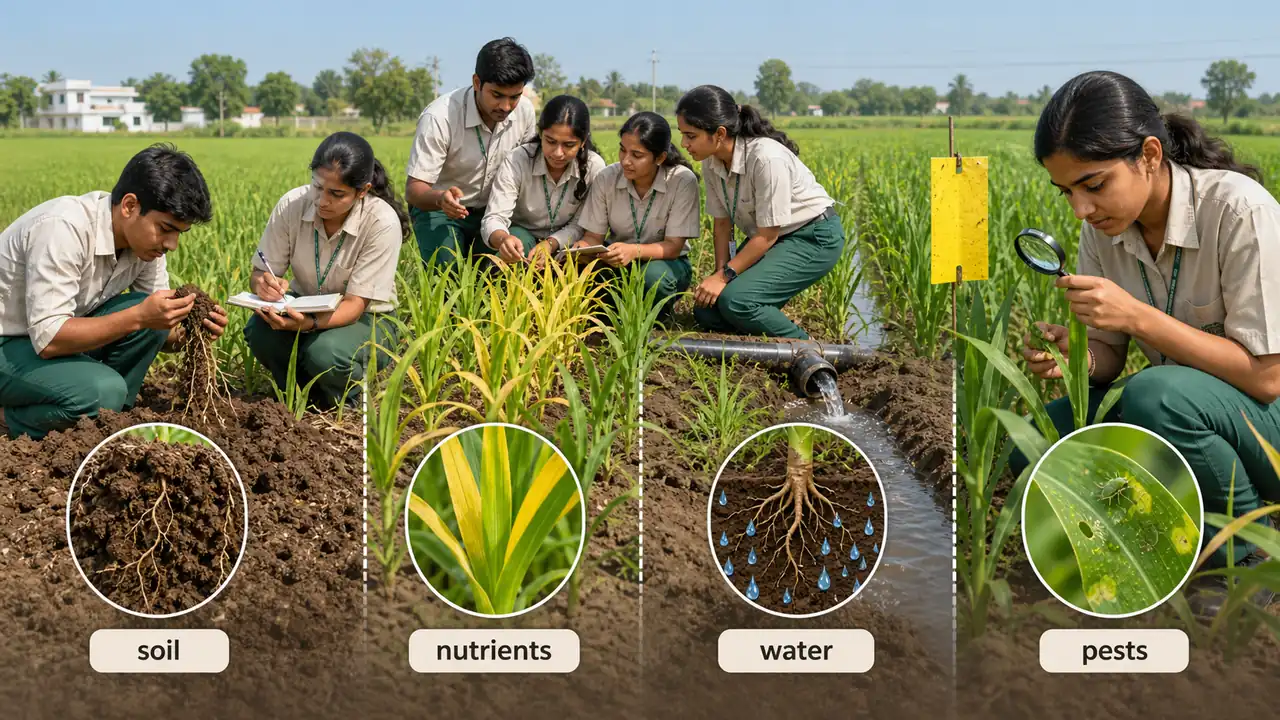
Use this four-question method whenever you read a crop-production case:
- Is the soil fertile? Check nutrient supply, pH, organic matter, and biological activity.
- Can roots use that fertility? Check structure, depth, drainage, aeration, and moisture.
- Is management supporting the crop? Check tillage, irrigation, crop rotation, input timing, and weed control.
- Is the crop protected? Check insects, diseases, and market or transport constraints.
This method turns the topic into a practical decision tool instead of a set of isolated definitions.
NOTE
IPM does not mean “never use chemicals.” It means using chemicals wisely, only when needed, and along with other methods.
Summary Cheat Sheet
| Concept / Topic | Key Details / Explanation |
|---|---|
| Soil fertility | Soil fertility is the ability of soil to supply essential nutrients in available form and suitable balance to plants. It is mainly a nutrient-supplying concept. |
| Soil productivity | Soil productivity is the ability of soil to produce a specified crop yield under proper management, inputs, and environmental conditions. It is a crop-performance concept. |
| Core difference | Fertility explains nutrient supply, while productivity explains actual field performance. Therefore, all productive soils are fertile, but all fertile soils are not necessarily productive. |
| Why a fertile soil may still give low yield | A soil may be fertile but still perform poorly because of waterlogging, poor drainage, weak aeration, compaction, untimely irrigation, insect-pest attack, disease pressure, poor management, or bad market and transport conditions. |
| Natural factors affecting fertility | Important natural factors are parent material, topography, climate, depth of soil profile, physical condition of soil, soil age, erosion, and nutrient status. |
| Parent material and topography | Parent material influences the original mineral reserve of the soil, while topography affects runoff, erosion, deposition, soil depth, and nutrient retention. |
| Climate, depth, and physical condition | Climate affects weathering, leaching, decomposition, and biological activity. Deep soils allow better root spread and moisture storage. Texture, structure, porosity, and aeration decide how well roots can use nutrients. |
| Erosion and soil age | Erosion removes the fertile topsoil first, and older degraded soils may lose nutrient reserve and organic matter over time. |
| Management factors affecting fertility | Major human-influenced factors are waterlogging, cropping system, soil pH, soil microorganisms, organic matter content, and method and time of tillage. |
| Soil pH and microorganisms | Soil pH controls nutrient availability and microbial activity. Microorganisms help decomposition, nitrogen fixation, nutrient solubilization, and nutrient cycling. |
| Organic matter and organic carbon | Organic matter improves soil structure, water holding, cation exchange, and microbial life. Organic carbon is a simple but important indicator of organic-matter status and long-term soil health. |
| Factors affecting productivity | Productivity depends on soil fertility, soil physical condition, soil or farm location, market demand, transportation facilities, weather conditions, and insect-pest and disease attack. |
| Fertility versus productivity formula | A simple memory line is: Productivity = fertility + physical condition + water + management + protection + environment. |
| Soil testing and diagnosis | Soil testing is more directly related to fertility, while actual crop performance shows productivity. Good diagnosis begins with representative soil sampling; a bad sample gives a bad recommendation. |
| Nutrient management bridge | Manures add organic matter and slow nutrient release, fertilizers give concentrated quick-acting nutrients, and biofertilizers use beneficial microorganisms. Integrated Nutrient Management (INM) combines organic sources, fertilizers, biofertilizers, and crop residues for yield plus long-term soil health. |
| Irrigation link with productivity | Irrigation is part of productivity, not separate from it. Even a fertile soil fails if root-zone water is badly managed. Drip irrigation is efficient because it supplies water close to the roots. |
| IPM link with productivity | Integrated Pest Management (IPM) combines cultural, mechanical, biological, and need-based chemical control. A nutrient-rich field can still lose yield if pests are not managed intelligently. |
| Unit 1 bridge idea | This lesson is the backbone of Unit 1: fertility explains the nutrient base, soil testing measures it, irrigation improves productivity, and IPM protects productivity. |
Lesson Doubts
Ask questions, get expert answers