🧪 Essential Plant Nutrients, Classification, Functions and Deficiency Symptoms
Study essential plant nutrients, their classification, function, mobility, beneficial elements, and deficiency symptoms.
Essential Plant Nutrients, Classification, Functions and Deficiency Symptoms
Plants need essential nutrients to complete their life cycle, form healthy tissues, and produce good yield.
Start with the plant as a living factory
Think of a plant as a tiny green factory:
- leaves are solar panels
- roots are the supply lines
- xylem and phloem are transport routes
- nutrients are workers and machine parts
If nitrogen is missing, the factory cannot build enough proteins and chlorophyll. If potassium is weak, water regulation and enzyme activity suffer. If calcium or boron is missing, new growing points become weak. This is why deficiency symptoms are not random marks on leaves. They are clues about which factory function is failing.
Nutrient groups
| Group | Nutrients |
|---|---|
| Primary nutrients | Nitrogen, phosphorus, potassium |
| Secondary nutrients | Calcium, magnesium, sulphur |
| Micronutrients | Iron, zinc, copper, manganese, boron, molybdenum, chlorine, nickel |
The essential-element list is treated as 17 because nickel is now included among essential elements.
Pro Content Locked
Upgrade to Pro to access this lesson and all other premium content.
₹99 charged monthly · Cancel anytime
- All Agriculture & Banking Courses
- AI Lesson Questions (100/day)
- AI Doubt Solver (50/day)
- Glows & Grows Feedback (30/day)
- AI Section Quiz (20/day)
- 22-Language Translation (100/day)
- Recall Questions (20/day)
- AI Quiz (15/day)
- AI Quiz Paper Analysis (100/day)
- AI Step-by-Step Explanations (100/day)
- Spaced Repetition Recall (FSRS)
- AI Tutor
- Immersive Text Questions
- Audio Lessons — Hindi & English
- Mock Tests & Previous Year Papers
- Summary & Mind Maps
- XP, Levels, Leaderboard & Badges
- Generate New Classrooms
- Voice AI Teacher (AgriDots Live)
- AI Revision Assistant
- Knowledge Gap Analysis
- Interactive Revision (LangGraph)
🔒 Secure via Razorpay · Cancel anytime · No hidden fees
Essential Plant Nutrients, Classification, Functions and Deficiency Symptoms
Plants need essential nutrients to complete their life cycle, form healthy tissues, and produce good yield.
Start with the plant as a living factory
Think of a plant as a tiny green factory:
- leaves are solar panels
- roots are the supply lines
- xylem and phloem are transport routes
- nutrients are workers and machine parts
If nitrogen is missing, the factory cannot build enough proteins and chlorophyll. If potassium is weak, water regulation and enzyme activity suffer. If calcium or boron is missing, new growing points become weak. This is why deficiency symptoms are not random marks on leaves. They are clues about which factory function is failing.
Nutrient groups
| Group | Nutrients |
|---|---|
| Primary nutrients | Nitrogen, phosphorus, potassium |
| Secondary nutrients | Calcium, magnesium, sulphur |
| Micronutrients | Iron, zinc, copper, manganese, boron, molybdenum, chlorine, nickel |
The essential-element list is treated as 17 because nickel is now included among essential elements.
What makes a nutrient essential?
An element is considered essential when:
- the plant cannot complete its life cycle without it
- the deficiency is specific and cannot be replaced fully by another element
- the element directly participates in plant metabolism or enzyme action
This is the scientific logic behind the list of essential nutrients.
Student trick: function first, symptom second
Do not learn deficiency symptoms as isolated lines. First ask what the nutrient does:
| If the nutrient mainly helps... | Deficiency usually affects... |
|---|---|
| chlorophyll and protein building | leaf colour and growth |
| energy transfer | root growth, flowering, and maturity |
| cell wall and growing points | young tissues and shoot tips |
| enzyme activation | many small physiological processes |
This makes symptoms easier to remember because each symptom becomes a story, not a random fact.
Broader classification system
The classification goes beyond the simple macro-versus-micro division.
Structural or framework nutrients
These are the large building-block nutrients that form much of plant material:
- carbon
- hydrogen
- oxygen
The text calls these framework or structural nutrients because they directly participate in building plant structure.
Macronutrients
These are required in larger quantities. They include:
- primary nutrients -> nitrogen, phosphorus, potassium
- secondary nutrients -> calcium, magnesium, sulphur
Micronutrients
These are required in small quantity but remain essential:
- iron
- manganese
- boron
- zinc
- copper
- molybdenum
- chlorine
- nickel
Beneficial nutrients
Some elements are especially useful in many crops even if they are not essential for every plant species:
- sodium
- silicon
- cobalt
- vanadium
Such elements may not be required by all plants, yet they can still promote growth strongly in certain species or special crop situations.
Ultra-micro and quasi-essential ideas
Two additional category ideas are also useful here:
- ultra-micro nutrients are needed in extremely tiny amount
- quasi-essential elements are not treated exactly like the classic essential elements, but their deficiency still creates serious abnormal growth
Silicon is the most important example here. It is highlighted because it helps plant rigidity, stress tolerance, and normal development in many crops.
Quantity-based grouping
The textbook gives a rough quantity logic:
- macronutrients are present in relatively larger concentration
- micronutrients are needed in much smaller quantity
- ultra-micro nutrients are needed in extremely tiny concentration
This helps students remember an important principle: small requirement does not mean small importance.
Classification by mobility in soil
Mobile nutrients
These tend to move more freely:
- nitrate
- sulphate
- chloride
Less mobile nutrients
These can move somewhat but are also held in soil:
- ammonium
- potassium
- calcium
- magnesium
Immobile nutrients
These are more easily fixed or strongly held:
- phosphate forms
- zinc in many soils
This mobility-in-soil classification matters because nutrients that move easily are more prone to leaching, while fixed nutrients may remain unavailable even when total soil content is not low.
Classification by mobility within the plant
This helps explain where deficiency symptoms appear first.
| Mobility | Usual examples | Deficiency often appears first |
|---|---|---|
| Highly mobile | N, P, K | older leaves |
| Moderately mobile | Zn | mixed or intermediate pattern |
| Less mobile | S, Fe, Mn, Cl, Cu, Mo | younger leaves |
| Immobile | Ca, B | growing points and new tissues |
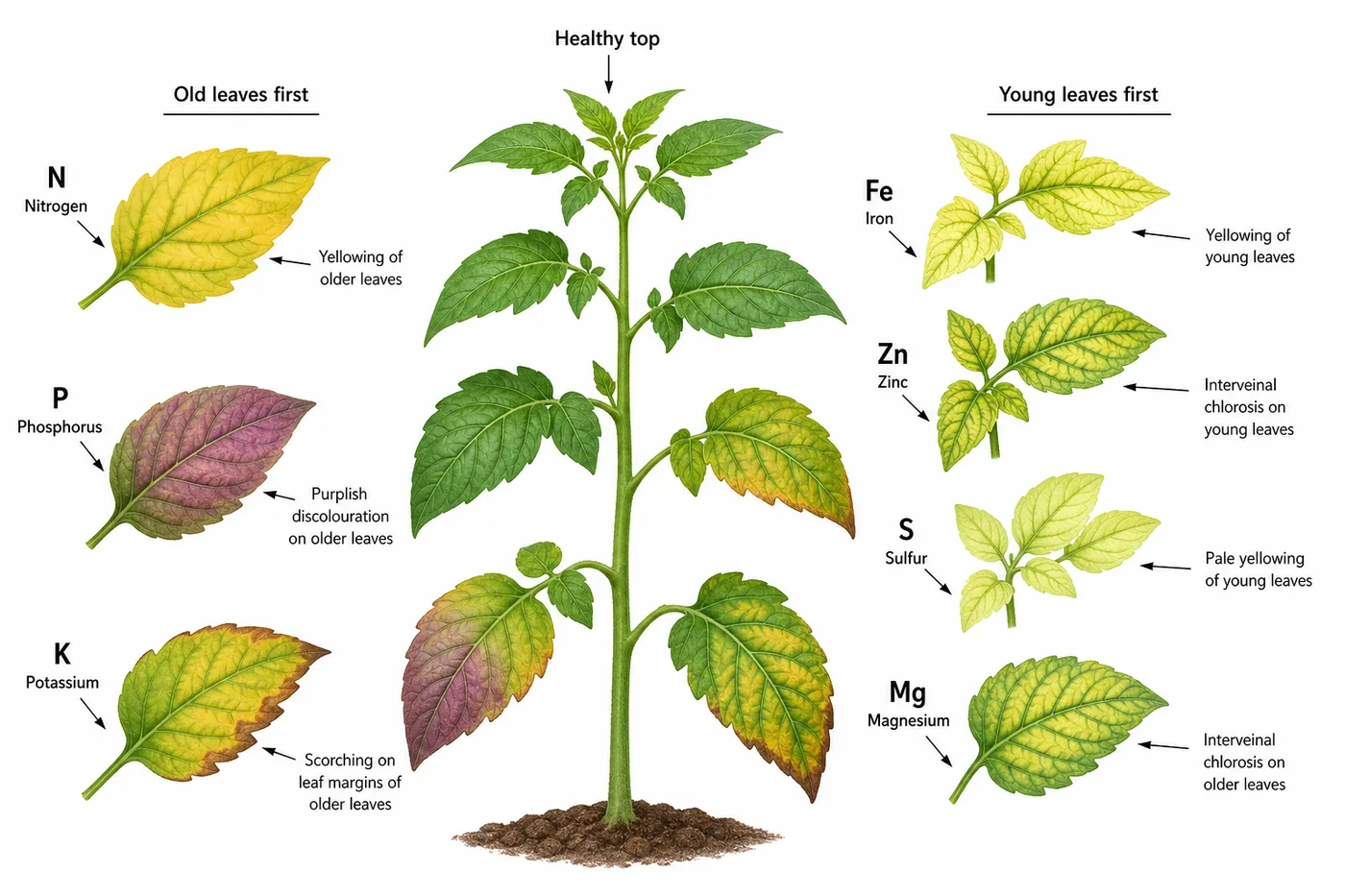
A very direct diagnosis memory line is:
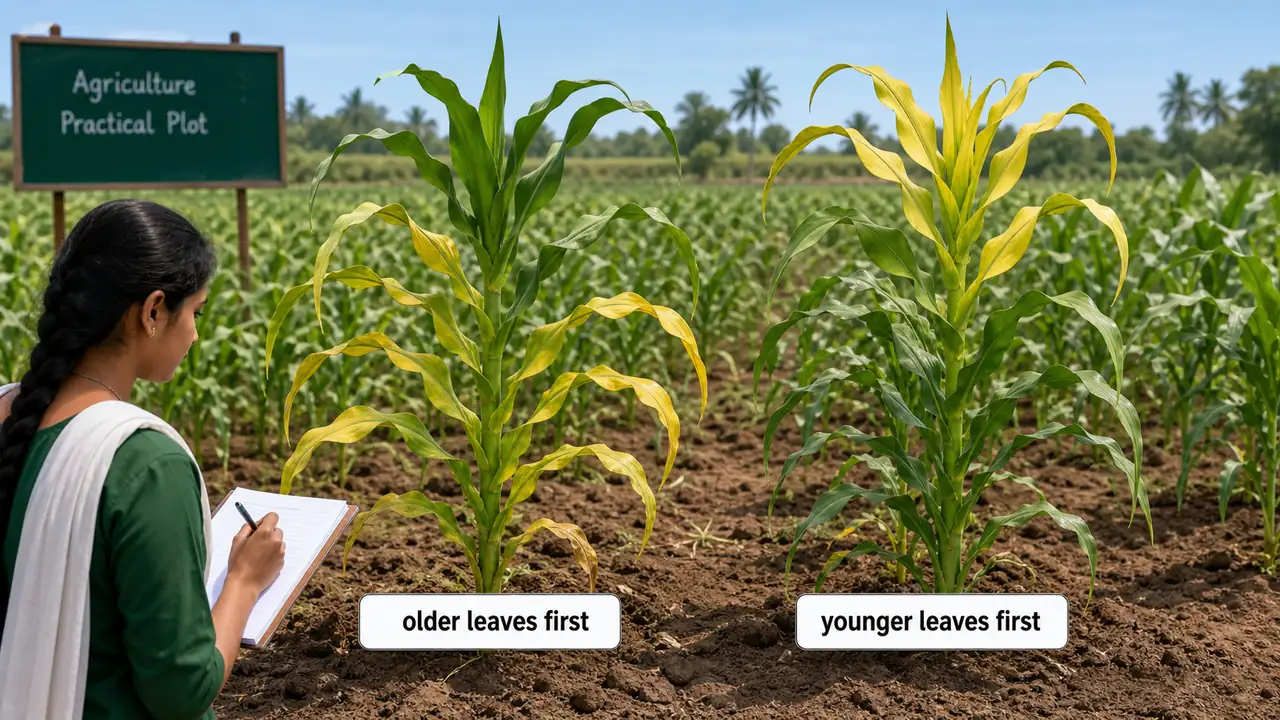
- old leaves first -> N, P, K, Mg, Mo
- new leaves first -> Fe, Cu, Cl, S, Mn
- old and new leaves -> Zn may show a mixed pattern
- apical bud -> Ca and B
This one lesson memory line is one of the fastest diagnosis tools in the whole chapter.
Framework nutrients and uptake logic
Nutrient study is linked with symbols and source forms. A simple memory grid is:
| Nutrient | Symbol | Common source or uptake idea |
|---|---|---|
| Carbon | C | from CO2 in air |
| Hydrogen | H | from water |
| Oxygen | O | from air and water |
| Nitrogen | N | mainly NH4+ and NO3- |
| Phosphorus | P | mainly phosphate forms |
| Potassium | K | K+ |
This matters because plant deficiency depends not only on how much nutrient exists in nature, but on whether the nutrient is present in the correct absorbable form.
Main functions
| Nutrient | Key role |
|---|---|
| Nitrogen | Green growth, leaves, proteins |
| Phosphorus | Roots, energy transfer, early growth |
| Potassium | Water balance, strength, stress tolerance |
| Calcium | Cell wall development |
| Magnesium | Chlorophyll formation |
| Sulphur | Protein and enzyme systems |
Uptake forms and tissue-level meaning
Plants do not absorb nutrients only by name. They absorb them in particular ionic or molecular forms.
| Nutrient | Usual uptake form |
|---|---|
| Nitrogen | NH4+, NO3- |
| Phosphorus | H2PO4-, HPO4^2- |
| Potassium | K+ |
| Calcium | Ca2+ |
| Magnesium | Mg2+ |
| Sulphur | SO4^2- |
| Iron | Fe2+, Fe3+ |
| Manganese | Mn2+ |
| Boron | H3BO3 |
| Zinc | Zn2+ |
| Copper | Cu2+ |
| Molybdenum | MoO4^2- |
| Chlorine | Cl- |
| Nickel | Ni2+ |
This matters because soil pH, moisture, microbial action, and fixation all influence whether the plant can actually take up the nutrient.
Functional logic of the major nutrients
Nitrogen
Nitrogen is strongly connected with proteins, enzymes, protoplasm, and chlorophyll. That is why it promotes leafy growth, greenness, and vegetative vigour.
Deficiency clue: because nitrogen moves inside the plant, yellowing often begins in older leaves.
Nitrogen should be connected with:
- amino acids and proteins
- chlorophyll and photosynthesis
- vitamins and enzyme systems
- protein improvement in grain crops
- stronger dry-matter production in leafy vegetables
When deficiency becomes severe, the visible effects include:
- reduced cell division
- stunted growth
- pale green to yellow older leaves
- drying or dropping of older leaves
- greater sensitivity to disease and weather stress
- early maturity in some crops, which finally reduces yield and quality
Excess clue: too much nitrogen may produce dark green luxuriant growth, delayed maturity, and lodging.
Phosphorus
Phosphorus is associated with root growth, seed formation, energy transfer, and early plant establishment.
Deficiency clue: slow growth, weak roots, delayed maturity, and in some crops dark green to purplish tints.
Students should also remember:
- ATP and energy-transfer reactions
- DNA, RNA, and phospholipid systems
- early root development
- normal seed and fruit development
- more uniform maturity
Phosphorus deficiency is strongly linked with:
- weak and stunted early growth
- delayed maturity
- poor seed and fruit development
- dark green to purple tints on leaves, veins, or stems under stronger deficiency
Excess clue: very high phosphorus may induce iron, zinc, and manganese deficiency and may even mimic calcium-related imbalance.
Potassium
Potassium helps regulate water balance, stem strength, stress tolerance, and disease resistance.
Deficiency clue: scorching at leaf margins, weak growth, and poor resistance to stress.
Several added functions should also be remembered:
- regulation of plant water use
- support for photosynthesis and protein synthesis
- help in drought tolerance and winter hardiness
- better keeping quality and storage quality of produce
Deficiency often shows:
- scorching or firing along leaf margins
- slow growth
- weak stalks and lodging
- poor root system
- small shrivelled seed or fruit
- lower disease resistance
Excess clue: too much potassium may trigger magnesium or calcium deficiency because of cation imbalance.
Calcium
Calcium is needed in cell wall formation and active growing tissues.
Deficiency clue: new growth and root tips suffer first because calcium is not easily relocated.
Calcium is also linked with:
- membrane stability
- cell integrity and permeability
- activation of some enzyme systems
- carbohydrate transfer
- detoxification of organic acids
- better seed production in some crops like groundnut
- indirect yield improvement through liming of acidic soils
Important deficiency clues:
- root tips blacken and rot
- terminal buds fail
- apical growth stops
- acid soils often show higher risk
Excess clue: very high calcium may create imbalance and suppress magnesium or potassium uptake in some soils.
Magnesium
Magnesium is part of chlorophyll and therefore closely tied to photosynthesis.
Deficiency clue: chlorosis, often with greener veins compared with the surrounding tissue.
Magnesium is also connected with:
- ribosomes and protein synthesis
- phosphate metabolism
- respiration
- activation of many enzyme systems
Typical deficiency pattern:
- yellowish, bronze, or reddish leaves
- veins may remain greener for some time
Excess clue: too much magnesium may contribute to imbalance with calcium under unfavourable cation relations.
Sulphur
Sulphur contributes to amino acids, proteins, vitamins, and characteristic odours in crops like onion and garlic.
Deficiency clue: symptoms may resemble nitrogen deficiency, but young tissues can be affected more readily.
Sulphur should also be remembered as a nutrient that:
- forms cystine, cysteine, and methionine
- supports vitamin-B related systems
- promotes nodulation in legumes
- can raise oil content in oilseed crops
Deficiency usually shows:
- chlorosis of younger or longer leaves
- stunted growth in stronger deficiency
- confusion with nitrogen deficiency if diagnosis is careless
Sulphur is also tied to oil content and nodulation, which is why it is especially important in oilseeds and legumes.
Important micronutrient clues
Iron
Helps in chlorophyll-related processes and redox systems.
Typical clue: interveinal chlorosis on younger leaves.
Iron is placed among the less-mobile nutrients in the plant, so young leaves are the key observation point.
Manganese
Manganese supports several enzyme and oxidation-reduction processes.
Typical clue: deficiency tends to appear on younger tissues and may resemble chlorotic imbalance in developing leaves.
Zinc
Important for growth regulators, enzymes, and normal leaf expansion.
Typical clue: short internodes, smaller leaves, and chlorosis.
Zinc can be understood as moderately mobile, which explains why symptom pattern may appear on both older and newer foliage.
Boron
Important in pollen activity, sugar movement, and young tissue development.
Typical clue: deformed young leaves, poor fruit or flower set, and growing-point problems.
The textbook specifically links boron with pollen-germination, pollen-tube growth, seed formation, and meristematic growth.
Copper
Supports enzyme systems and reproductive performance in many crops.
Copper deficiency is also linked with:
- reduced leaf size
- pale yellow leaves
- loss of turgidity
- bluish-green cast in some crops
Molybdenum
Important in nitrate reduction and nitrogen metabolism.
Because molybdenum is involved in nitrogen metabolism, its deficiency can sometimes resemble nitrogen-related disturbance rather than a simple leaf-colour issue.
Chlorine and nickel
Both chlorine and nickel are included in the essential list. Even if detailed questions are less common on them, it is still useful to remember:
- chlorine is an essential micronutrient
- nickel completes the modern essential-element list
Deficiency, function, and toxicity should be studied together
One of the best ways to learn this chapter is to read each nutrient in three parts:
- function in the plant
- deficiency symptom
- excess or imbalance effect
That is the same logic used throughout the function-deficiency-toxicity treatment.
A few excess or toxicity ideas
- excess nitrogen -> dark-green luxuriant growth, delayed maturity, lodging
- excess phosphorus -> induced deficiency of Fe, Zn, or Mn
- excess potassium -> magnesium or calcium imbalance
- excess calcium -> suppression of magnesium or potassium uptake in some cases
These examples help students remember that nutrient disorder can come from too much as well as too little.
Deficiency-symptom memory grid
| Symptom pattern | Nutrient to suspect first |
|---|---|
| Older leaves turn pale | N, Mg |
| Young leaves turn yellow | Fe, S |
| Leaf margins scorch | K |
| Root and early growth weak | P |
| Growing point damaged | Ca, B |
| Small leaves and rosetting | Zn |
Expanded nutrient function, deficiency, and toxicity bank
This topic becomes much easier when it is studied as a role -> shortage symptom -> excess risk pattern.
| Nutrient | Major function logic | Deficiency logic | Excess or imbalance logic |
|---|---|---|---|
| Nitrogen | amino acids, proteins, enzymes, chlorophyll, vegetative growth | pale green to yellow older leaves, stunting, early maturity, lower yield | dark green luxuriant growth, delayed maturity, lodging, greater stress and disease susceptibility |
| Phosphorus | root development, seed development, ATP, DNA, RNA, phospholipids, early growth | slow weak growth, stunting, delayed maturity, poor seed and fruit development, purple tint in severe cases | may induce iron, zinc, manganese, or calcium deficiency symptoms |
| Potassium | water regulation, disease resistance, stem strength, photosynthesis, drought tolerance, crop quality | marginal scorching, weak roots, lodging, small shrivelled seed or fruit, poor disease resistance | may create magnesium or calcium imbalance |
| Calcium | cell wall membrane, cell integrity, enzyme activation, seed production, soil-acidity correction through liming | poor root growth, black or rotten roots, failure of terminal buds and root tips | may induce magnesium or potassium deficiency in some situations |
| Magnesium | central part of chlorophyll, ribosome structure, protein synthesis, phosphate metabolism | yellowish, bronze, or reddish leaves while veins remain green | toxicity is rare |
| Sulphur | sulphur amino acids, enzymes, vitamins, nodulation, chlorophyll formation, oil content | chlorosis of longer/younger leaves, stunting, symptoms may resemble nitrogen deficiency | reduced growth and yellowing or scorching under excess |
| Boron | pollen germination, pollen tube growth, seed and cell wall formation, meristem growth, sugar transport | reduced leaf size, distorted new leaves, flower or fruit abortion, poor grain fill, stunting | leaf-tip yellowing followed by necrosis from tip or margin inward |
| Copper | enzyme systems, photosynthesis, plastocyanin, chlorophyll and pigment stability | reduced leaf size, pale leaves, low turgor, curling, poor flowering | reduced growth, iron-chlorosis-like symptoms, root abnormality |
| Iron | chlorophyll synthesis catalyst, oxidation-reduction reactions, oxygen carrier | interveinal chlorosis of young leaves, severe whitening | excess symptoms are uncommon but may create bronzing or spots |
| Manganese | enzyme systems, chlorophyll synthesis support, photosynthesis | interveinal chlorosis and brownish specks, often in high-organic-matter or alkaline soils | blotchy chlorosis and brown spots |
| Zinc | growth hormones, tryptophan and IAA link, enzyme activation, chlorophyll and carbohydrate production | short internodes, small deformed leaves, meristem injury, interveinal chlorosis | very toxic in excess; may interfere with iron |
| Molybdenum | nitrate reductase and nitrogen fixation in legumes | interveinal chlorosis, wilting, marginal necrosis of upper leaves, common in acid soils | rare, because plants need very small quantity |
| Chlorine | water splitting, stomatal regulation, turgor, moisture-stress response, enzyme activation | upper-leaf chlorosis, wilting, low growth | leaf tip or margin burning, bronzing, splitting |
| Cobalt | linked with symbiotic nitrogen fixation by Rhizobium in legumes | nitrogen-deficiency-like chlorosis and stunting in cobalt-poor soils | not usually a general crop-field toxicity topic |
| Nickel | urease enzyme, urea and ureide metabolism | young leaf chlorosis/necrosis and poor viable seed production may occur | needed in very small quantity; toxicity risk rises if accumulated |
How to read this table
The table is easiest to use through three linked ideas for each nutrient:
- Function: what the nutrient does in plant metabolism.
- Deficiency: where and how the shortage appears.
- Toxicity or imbalance: what excess may disturb.
For potassium, for example, the links are water regulation, stem strength, disease resistance, photosynthesis, drought tolerance, and produce quality on one side, with marginal scorching, weak roots, lodging, and poor seed or fruit quality on the deficiency side, and magnesium or calcium imbalance on the excess side.
Definition reminder
The classical essentiality criteria of Arnon and Stout can be summarized like this:
- without the element, the plant cannot complete its life cycle
- deficiency of that element is specific and cannot be completely replaced by another
- the element directly participates in metabolism or enzyme action
This is the scientific foundation of the entire chapter.
Common deficiency clues
- Nitrogen deficiency often causes yellowing of older leaves.
- Phosphorus deficiency may reduce root growth and cause stunting.
- Potassium deficiency often shows scorching or drying along leaf margins.
- Zinc deficiency may cause smaller leaves and short internodes.
- Iron deficiency usually appears as yellowing in young leaves.
Short memory questions
- Which deficiency usually appears first on older leaves? -> N, P, K and other mobile nutrients
- Which deficiency is seen at the growing point? -> Ca and B
- Which nutrient is central to chlorophyll? -> Mg
- Which deficiency often causes purple tints? -> P
- Which deficiency often causes marginal scorching? -> K
How to study deficiency symptoms
Do not memorize symptoms as random facts. Link them with the nutrient's role:
- if the nutrient is linked to chlorophyll, think yellowing
- if it is linked to roots or flowering, think poor establishment
- if it is linked to strength or transport, think weak growth or poor stress response
Beneficial elements in crop growth
The lesson also points toward beneficial elements like silicon and sodium.
Silicon
Silicon is often discussed because it may:
- improve plant rigidity
- reduce lodging
- improve tolerance to drought and temperature stress
- help reduce some disease and insect damage
Sodium and cobalt
These may support specific physiological or biological functions in certain crops or crop-microbe systems.
Visual reinforcement
For visual explanation, these BioRender templates are useful starting points:
These work especially well for comparing nitrogen, phosphorus, potassium, and micronutrient deficiency visually.
Additional notes
Named nutrient-history facts
- Arnon and Stout (1939) gave the classic essentiality criteria.
- Nickel is included in the modern essential nutrient list and is commonly remembered with the 2009 update point.
- Epstein (1999) and Epstein & Bloom (2005) are useful names for quasi-essential or beneficial element discussion, especially silicon.
Nutrient, uptake and tissue-concentration table
This table connects each nutrient with symbol, principal uptake form, source, and tissue concentration. It is especially helpful when exact classification is asked instead of only deficiency symptoms.
Before reading the table, notice the scale difference. Carbon, hydrogen, and oxygen dominate plant dry matter because they build the body of the plant. Micronutrients look tiny in percentage, but they can decide whether enzymes, hormones, and growing tissues work normally. In agriculture, small quantity never means small importance.
| Class | Nutrient | Symbol | Principal uptake form | Main source | Tissue concentration | ppm equivalent |
|---|---|---|---|---|---|---|
| Framework | Carbon | C | CO2 | Air | 45.0% | 450000 |
| Framework | Hydrogen | H | H2O | Water | 6.0% | 60000 |
| Framework | Oxygen | O | H2O, O2 | Air / water | 45.0% | 450000 |
| Primary macro | Nitrogen | N | NH4+, NO3- | Soil | 1.4% | 14000 |
| Primary macro | Phosphorus | P | H2PO4-, HPO4^2- | Soil | 0.1% | 1000 |
| Primary macro | Potassium | K | K+ | Soil | 1.0% | 10000 |
| Secondary macro | Calcium | Ca | Ca2+ | Soil | 0.5% | 5000 |
| Secondary macro | Magnesium | Mg | Mg2+ | Soil | 0.2% | 2000 |
| Secondary macro | Sulphur | S | SO4^2-, SO2 | Soil | 0.1% | 1000 |
| Micro | Iron | Fe | Fe2+, Fe3+ | Soil | 0.01% | 100 |
| Micro | Manganese | Mn | Mn2+ | Soil | 0.005% | 50 |
| Micro | Boron | B | H3BO3 | Soil | 0.002% | 20 |
| Micro | Zinc | Zn | Zn2+ | Soil | 0.002% | 20 |
| Micro | Copper | Cu | Cu2+ | Soil | 0.0006% | 6 |
| Micro | Molybdenum | Mo | MoO4^2- | Soil | 0.00001% | 0.1 |
| Micro | Chlorine | Cl | Cl- | Soil | 0.01% | 100 |
| Micro | Nickel | Ni | Ni2+ | Soil | trace | trace |
| Beneficial | Cobalt | Co | Co2+ | Soil | trace | trace |
| Beneficial | Vanadium | V | V+ | Soil | trace | trace |
| Beneficial | Sodium | Na | Na+ | Soil | trace | trace |
| Beneficial / quasi-essential | Silicon | Si | Si(OH)4 | Soil | variable | variable |
Reference classification reminders
| Classification basis | Lesson-aligned grouping |
|---|---|
| Quantity in tissue | macronutrients above about 1 mg/g dry weight; micronutrients at ≤ 1 mg/g; ultra-micro nutrients below about 1 ppb |
| Soil mobility | mobile: NO3-, SO4^2-, BO3^2-, Cl-, Mn2+; less mobile: NH4+, K+, Ca2+, Mg2+, Cu2+; immobile: phosphate forms and Zn2+ |
| Plant mobility | highly mobile: N, P, K; moderately mobile: Zn; less mobile: S, Fe, Mn, Cl, Mo, Cu; immobile: Ca, B |
Beneficial and quasi-essential elements
Vanadium is noted in relation to green algae such as Chlorella. Sodium helps osmotic balance in some crops and is linked with potato tuberization. Silicon is especially valuable in rice and grasses because it can reduce lodging and improve tolerance to powdery mildew, rice blast, hoppers, stem borers, drought, salinity, and some heavy-metal stresses.
Diagnosis examples
Use these cases to connect tables with real crop observation:
- A maize field turns pale green first on older leaves. Think of a mobile nutrient, especially nitrogen, because the plant shifts it from old leaves to young leaves.
- A tomato crop has weak new growth and poor growing tips. Think of calcium or boron because they are poorly mobile and symptoms appear in young tissues.
- A rice crop lodges easily after wind and rain. Along with nitrogen balance, remember silicon because it strengthens grasses and improves stress tolerance.
- A pulse crop looks weak even when nitrogen fertilizer is not the main issue. Think of nodulation, molybdenum, cobalt, and microbial support.
The same method can be used in field diagnosis: observe symptom location, connect mobility, mention function, then suggest confirmation through soil or plant testing.
Summary Cheat Sheet
| Concept / Topic | Key Details / Explanation |
|---|---|
| Essential plant nutrients | A nutrient is essential when the plant cannot complete its life cycle without it, its deficiency is specific and not fully replaceable by another element, and it directly participates in metabolism or enzyme action. |
| Total essential-element idea | The lesson treats the essential list as 17 elements, with nickel included in the modern essential-element set. |
| Primary, secondary, and micronutrients | Primary nutrients are nitrogen, phosphorus, potassium. Secondary nutrients are calcium, magnesium, sulphur. Micronutrients include iron, zinc, copper, manganese, boron, molybdenum, chlorine, and nickel. |
| Framework nutrients | Carbon, hydrogen, and oxygen are called framework or structural nutrients because they build much of the plant body. |
| Beneficial and quasi-essential elements | Important beneficial elements mentioned are sodium, silicon, cobalt, and vanadium. Silicon is especially emphasized for rigidity, stress tolerance, and reduced lodging. |
| Quantity logic | Macronutrients are needed in larger quantity, micronutrients in small quantity, and ultra-micro nutrients in extremely tiny amount. The key idea is small requirement does not mean small importance. |
| Mobility in soil | More mobile soil nutrients include nitrate, sulphate, and chloride; less mobile ones include ammonium, potassium, calcium, and magnesium; more immobile forms include phosphates and often zinc. |
| Mobility inside the plant | Mobility inside the plant explains symptom position. Highly mobile nutrients like N, P, and K usually show deficiency first on older leaves, while less mobile nutrients often affect younger leaves or growing points. |
| Fast diagnosis memory line | Old leaves first -> N, P, K, Mg, Mo; new leaves first -> Fe, Cu, Cl, S, Mn; mixed pattern -> Zn; apical bud and growing points -> Ca and B. |
| Uptake-form logic | Plants absorb nutrients in specific forms such as NH4+ / NO3- for N, H2PO4- / HPO4^2- for P, K+ for K, Ca2+ for Ca, Mg2+ for Mg, SO4^2- for S, Zn2+ for Zn, Cl- for Cl, and Ni2+ for Ni. |
| Nitrogen | Nitrogen supports proteins, enzymes, protoplasm, chlorophyll, and leafy vegetative growth. Deficiency usually causes pale green to yellow older leaves, stunting, and early maturity. Excess nitrogen may cause luxuriant dark-green growth, delayed maturity, and lodging. |
| Phosphorus | Phosphorus is linked with root growth, ATP, DNA, RNA, seed formation, and early establishment. Deficiency causes slow growth, weak roots, delayed maturity, and sometimes dark green to purplish tints. Excess phosphorus may induce iron, zinc, and manganese deficiency. |
| Potassium | Potassium helps water balance, stem strength, stress tolerance, photosynthesis, and disease resistance. Deficiency often shows leaf-margin scorching, weak stalks, poor roots, and shrivelled produce. Excess potassium may create magnesium or calcium imbalance. |
| Calcium | Calcium is required for cell walls, membrane stability, and active growing tissues. Because it is poorly relocated, deficiency affects root tips, terminal buds, and apical growth first. |
| Magnesium | Magnesium is the central part of chlorophyll and supports photosynthesis, ribosomes, respiration, and phosphate metabolism. Deficiency often causes yellowish, bronze, or reddish leaves with greener veins. |
| Sulphur | Sulphur is important in amino acids, proteins, vitamins, nodulation, and oil content. Deficiency can resemble nitrogen shortage but often affects younger tissues more readily. |
| Key micronutrient clues | Iron deficiency gives interveinal chlorosis on young leaves. Zinc deficiency gives short internodes, small leaves, and chlorosis. Boron deficiency affects pollen activity, sugar movement, young leaves, and growing points. Molybdenum is important in nitrate reduction and nitrogen metabolism. |
| Symptom memory grid | High-value clue lines are older leaves pale -> N or Mg, young leaves yellow -> Fe or S, leaf margins scorch -> K, root and early growth weak -> P, growing point damaged -> Ca or B, and small leaves with rosetting -> Zn. |
| Deficiency diagnosis method | Study each nutrient through function -> deficiency symptom -> toxicity or imbalance effect. This prevents random memorization and improves field diagnosis. |
| Beneficial-element clues | Silicon can improve rigidity, drought tolerance, resistance to lodging, and reduced disease or insect damage, especially in rice and grasses. Cobalt supports symbiotic nitrogen fixation, and sodium may support specific crop functions. |
| Best way to answer this chapter | A strong answer connects function + uptake form + mobility + deficiency clue + excess or imbalance effect, and then confirms field suspicion through soil or plant testing. |
Lesson Doubts
Ask questions, get expert answers