🧫 Soil Sampling, pH, Organic Carbon and Testing
A full lesson on representative soil sampling, sample processing, soil pH, soil organic carbon, and the practical value of soil testing.
Soil Sampling, pH, Organic Carbon and Testing
Modern agriculture talks a lot about soil health cards, balanced fertilization, and efficient nutrient use. But none of these ideas become useful unless the soil sample is collected properly. A laboratory can analyze only a few grams of soil, yet that small quantity is expected to represent the condition of a full field. So the success of soil testing begins in the field, not in the laboratory.
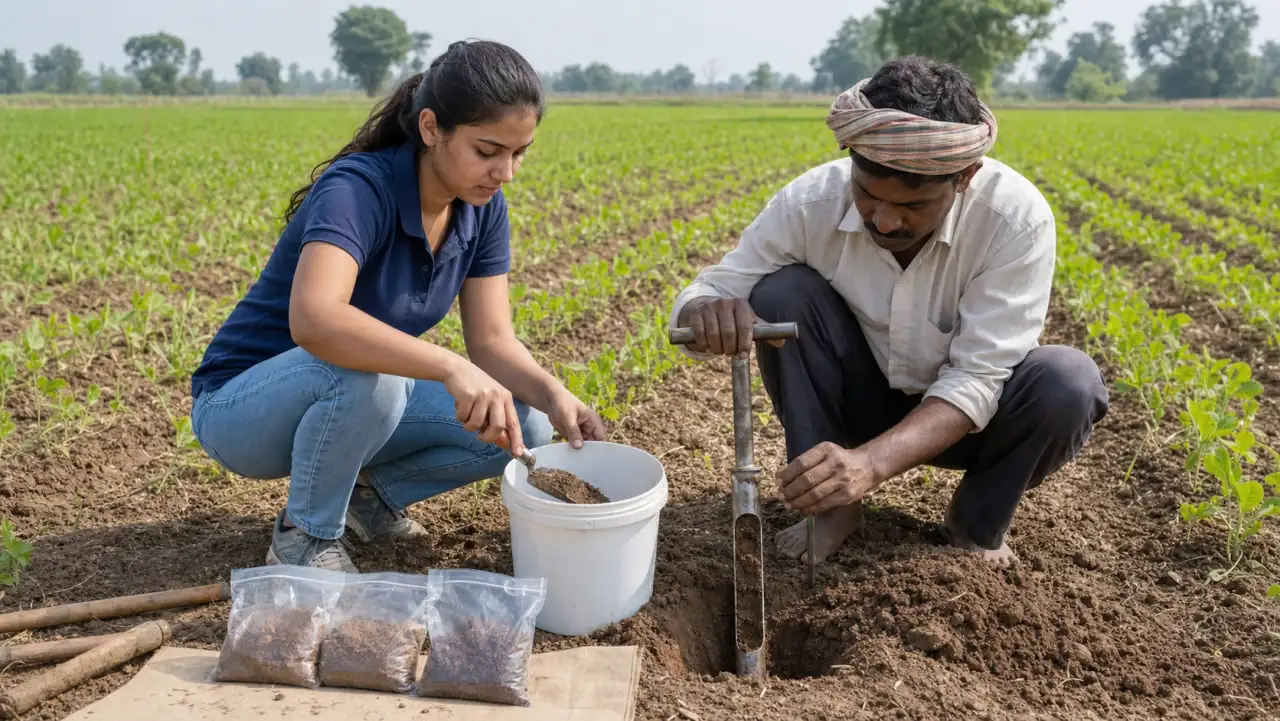
Start with the tea-sugar analogy
If you want to know whether a cup of tea is sweet, you do not test only the sugar settled at the bottom. You stir the tea first and then taste a representative sip. Soil sampling follows the same logic. The field may have patches, slopes, old fertilizer spots, cattle-dung areas, and irrigation channels. A correct sample must represent the normal field, not an unusual corner.
Pro Content Locked
Upgrade to Pro to access this lesson and all other premium content.
₹99 charged monthly · Cancel anytime
- All Agriculture & Banking Courses
- AI Lesson Questions (100/day)
- AI Doubt Solver (50/day)
- Glows & Grows Feedback (30/day)
- AI Section Quiz (20/day)
- 22-Language Translation (100/day)
- Recall Questions (20/day)
- AI Quiz (15/day)
- AI Quiz Paper Analysis (100/day)
- AI Step-by-Step Explanations (100/day)
- Spaced Repetition Recall (FSRS)
- AI Tutor
- Immersive Text Questions
- Audio Lessons — Hindi & English
- Mock Tests & Previous Year Papers
- Summary & Mind Maps
- XP, Levels, Leaderboard & Badges
- Generate New Classrooms
- Voice AI Teacher (AgriDots Live)
- AI Revision Assistant
- Knowledge Gap Analysis
- Interactive Revision (LangGraph)
🔒 Secure via Razorpay · Cancel anytime · No hidden fees
Soil Sampling, pH, Organic Carbon and Testing
Modern agriculture talks a lot about soil health cards, balanced fertilization, and efficient nutrient use. But none of these ideas become useful unless the soil sample is collected properly. A laboratory can analyze only a few grams of soil, yet that small quantity is expected to represent the condition of a full field. So the success of soil testing begins in the field, not in the laboratory.
Start with the tea-sugar analogy
If you want to know whether a cup of tea is sweet, you do not test only the sugar settled at the bottom. You stir the tea first and then taste a representative sip. Soil sampling follows the same logic. The field may have patches, slopes, old fertilizer spots, cattle-dung areas, and irrigation channels. A correct sample must represent the normal field, not an unusual corner.
This analogy captures the whole idea: wrong sample -> wrong test result -> wrong recommendation -> wasted money and weak crop.
The four phases of a good soil-testing programme
Soil testing can be understood as a sequence of four linked steps:
- collection of soil sample
- analysis of soil sample
- interpretation of the result
- recommendation for the farmer
If the first step is weak, the final fertilizer recommendation also becomes weak. That is why soil sampling is often called the most critical part of soil testing.
Why soil sampling is important
- it gives a practical picture of nutrient status
- it helps identify deficiency or toxicity problems
- it supports balanced fertilizer recommendation
- it reduces wasteful nutrient use
- it helps locate problem soils that restrict crop growth
- it lets farmers compare field condition with crop response
- it improves the efficiency of inputs and the skill of decision making
Soil sampling is the foundation of practical fertilizer recommendation. A bad sample does not merely create a bad number; it creates a bad management decision for the whole field.
What a representative soil sample means
A representative sample is a composite sample that reflects the true fertility condition of the selected field area. It should come from many normal places in the same field, not from one convenient point.
If the field is fairly uniform in appearance and management, one properly collected composite sample may represent about 4-5 hectares. But if the field varies in slope, colour, texture, crop growth, or management history, then separate composite samples must be collected from each different zone.
Places that should not be sampled
Some spots naturally give misleading results. These areas should be avoided:
- recently fertilized patches
- bunds and field boundaries
- irrigation channels
- marshy or waterlogged tracts
- area near trees and wells
- cattle dung heaps and compost piles
- unusual patches that do not represent the main field
These examples show what a representative field sample really means.
Tools required for soil sampling
Important examples include:
- spade or khurpi
- tube auger
- screw auger
- plastic bucket
- clean plastic bags
- scale
- waterproof marker
Which tool suits which field
- In soft and moist soil, a tube auger, spade, or khurpi works well.
- In hard or dry soil, a screw-type auger is more convenient.
Sampling depth
Sampling depth depends on the rooting pattern of the crop.
| Crop situation | Usual sampling depth |
|---|---|
| Most field crops | 15-20 cm |
| Most pasture crops | about 10 cm |
| Deep-rooted crops like sugarcane, cotton, plantation and horticultural crops | up to 80-100 cm |
Why depth matters
If depth is wrong, the result becomes misleading. A shallow sample from a deep-rooted crop field may miss the nutrient condition of the deeper root zone, while an unnecessarily deep sample from ordinary field crops may dilute the useful topsoil picture.
Correct depth selection is therefore a crop-specific scientific decision, not a routine digging act.
Time of sampling
Soil should be sampled well before planting or sowing so that analysis and recommendation are available on time.
How often should soil testing be done
- If only one crop is grown in a year, testing once in three years is usually sufficient.
- Under intensive cultivation with 2-3 crops a year, sampling should preferably be done every year before sowing the first crop in the sequence.
Method of sampling
The largest error in soil analysis often comes from the sample itself. Therefore the field must be sampled carefully.
Zigzag pattern
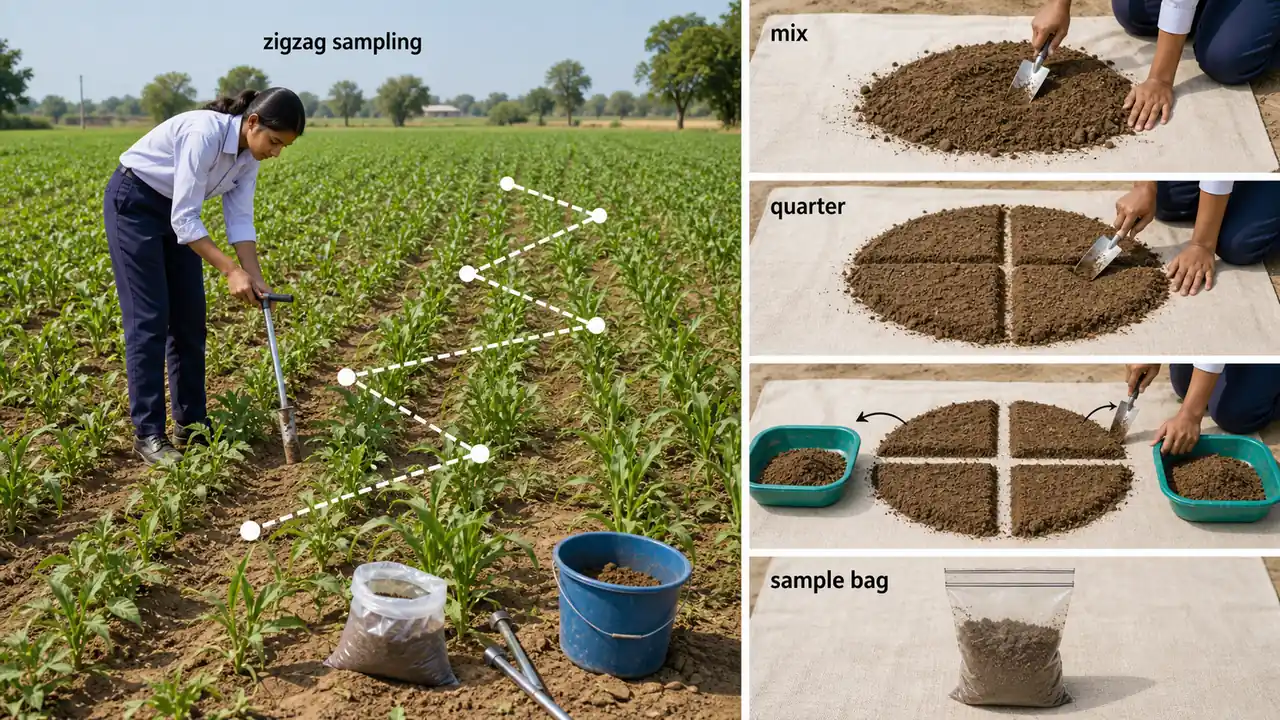
Soil samples should be collected in a zigzag manner to cover the entire field.
Think of the zigzag path as asking the whole field for its opinion. If you ask only one corner, you may hear a lie. If you ask many normal points, the final composite sample becomes more honest.
Number of subsamples
Usually 10-25 subsamples or soil cores are collected from a uniform field and mixed together to form one representative composite sample.
Spade method
If a spade or khurpi is used:
- clean the selected spot
- make a V-shaped cut up to the required depth
- remove a uniform slice, about 2.5 cm thick, from one side
- collect similar slices from many places
- mix them thoroughly
This is a classic procedure-based short-answer question.
Quartering method for reducing sample size
After mixing, the bulk sample is still too large for lab submission. So it is reduced by the quartering method.
Steps in quartering
- spread the mixed soil on a clean sheet or paper
- divide it into four equal parts by making a + sign
- discard soil from two opposite quarters
- mix the remaining two parts
- repeat the process until about 500 g sample remains
This final reduced sample is kept in a clean bag for further preparation.
Quartering continues until a manageable laboratory sample remains, generally around half a kilogram.
Sample preparation
Fresh field soil is often moist and cannot be stored safely in that condition because chemical and biological changes continue during storage.
Proper preparation steps
- spread the sample on plastic or thick brown paper
- dry it in the shade
- do not sun-dry it
- remove stones, coarse concretions, roots, leaves, and undecomposed residues
- break large lumps gently by hand
- crush the dry soil lightly with a wooden mortar and pestle
- pass it through a 2 mm sieve
- discard the coarse material left above the sieve
Why sun drying is prohibited
Sun drying is avoided here. Shade drying is preferred, usually around 20-25°C and moderate relative humidity, because excessive heating can alter the condition of the sample and reduce the reliability of the test.
Sample storage
Processed samples should be sent for analysis as early as possible. Until then, they should be stored in:
- clean polythene bags, or
- plastic containers
They must be properly tied and tagged so that no mix-up happens.
Information that should accompany a sample
Each sample bag or tag should carry useful field details such as:
- farmer's name
- address
- date of sampling
- sampling depth
- previous crop
- intended crop
- fertilizer history, if available
This supporting information helps experts give more precise recommendations.
The logic here is simple and practical: a soil-test result becomes much more useful when the analyst knows the cropping history, intended crop, and nutrient background of the field.
Practical benefits of soil testing for farmers
Soil testing is not merely a formal laboratory exercise. It has clear field-level benefits.
- farmers become alert about nutrient deficiency or toxicity
- they can identify problem soils
- they gain skill in rational nutrient use
- they understand the value of recommended fertilizer doses
- they can observe how balanced nutrient management improves yield
Soil pH
The term pH comes from a French expression meaning power of hydrogen. It measures the concentration or activity of hydrogen ions (H+) and hydroxyl ions (OH-) in soil.
In simple language:
- low pH = acidic soil
- pH around 7 = neutral soil
- high pH = alkaline soil
pH scale and its meaning
The pH scale runs from 0 to 14.
| pH value | Soil reaction |
|---|---|
| Below 7 | acidic |
| 7 | neutral |
| Above 7 | alkaline or basic |
As the amount of H+ increases, pH decreases and the soil becomes more acidic. As the amount of OH- increases, pH rises and the soil becomes more alkaline.
Why one pH unit matters a lot
pH is measured on a logarithmic scale. This means a change of one unit is not small. It means a ten-fold change in hydrogen ion activity.
- soil pH 6 has 10 times more H+ ions than soil pH 7
- soil pH 5 has 100 times more H+ ions than soil pH 7
This is why even a small-looking pH change can strongly influence nutrient behaviour in soil.
Why soil pH matters in agriculture
Soil pH affects:
- nutrient availability
- fertilizer efficiency
- root growth
- microbial activity
- overall crop response
That is why the same fertilizer dose may produce different results in different soils.
Measurement of soil pH
The most accurate common method is the pH meter.
A simpler but less accurate method uses:
- indicators
- dyes
Both the accurate and the simple method should be remembered.
PH gives many clues about soil behaviour, so it is not just one more report entry. It is a key signal for nutrient availability, reaction status, and management need.
Carbon and the carbon cycle
Carbon is one of the basic elements of life. It is found in air, water, soil, rock, plants, animals, coal, oil, and many other natural systems.
Carbon that is not locked in rock or deep ocean keeps moving through different reservoirs. This continuous movement is called the carbon cycle.
Carbon and plant-soil relationship
- plants absorb carbon from the air
- they convert it into plant tissue
- part of that tissue returns to soil as residue
- decomposition returns carbon to the soil and atmosphere
So the soil is not just a place for root support. It is also a major active carbon store.
Agriculture's role in the carbon cycle
Agriculture can either help keep carbon in soil or speed up its loss to the atmosphere. Farming practices influence both:
- the amount of soil organic carbon
- the quality of soil health
This makes soil management important not only for crop production but also for long-term sustainability and resilience.
Soil organic carbon
Soil organic carbon, often written as SOC, refers only to the carbon part of soil organic compounds. It is an important indicator because laboratories usually measure SOC directly and then estimate organic matter from it.
Importance of soil organic carbon
Higher soil organic carbon usually improves:
- soil structure and tilth
- aeration
- water retention
- drainage balance
- nutrient holding capacity
- biological activity
- erosion resistance
- yield stability
When soil organic carbon declines, the soil often becomes less stable, less resilient, and more vulnerable to nutrient loss.
Carbon sequestration and farming
When carbon is stored in the soil rather than lost to the atmosphere, the process is called carbon sequestration.
Agriculture can support sequestration by reducing unnecessary soil disturbance and increasing carbon addition to the soil.
This becomes a management challenge: how can soil organic carbon be raised while carbon loss to the atmosphere is reduced? The answer lies in residue, tillage, and organic-input strategy.
Management practices that help increase soil organic carbon
Several practices help increase soil organic carbon:
| Practice | Main effect |
|---|---|
| Conservation tillage | reduces disturbance and protects stored carbon |
| Crop residue retention | returns carbon to soil |
| Cover crops | add root and shoot biomass and reduce erosion |
| Manure and compost use | increase organic carbon and improve aggregation |
| Inclusion of perennial crops | contributes more long-term root biomass and litter |
The most important of them are:
- reduced disturbance
- residue return
- manure and compost addition
- perennial-root and litter contribution
These are among the strongest well-supported management lines in the entire SOC section.
Why reduced disturbance helps
Heavy disturbance increases soil aeration and can accelerate loss of carbon as CO2. Reduced tillage helps slow that loss and maintain physical stability.
Soil organic carbon vs soil organic matter
Students often confuse these two terms.
- Soil organic carbon = only the carbon component
- Soil organic matter = the entire organic material fraction
Because organic matter is difficult to measure directly, labs often estimate it from SOC.
Conversion formula
About 58% of soil organic matter exists as carbon. Therefore:
Organic matter (%) = total organic carbon (%) × 1.72
This formula is often asked in fill-in-the-blank questions.
Why SOC matters to farmers
Higher soil organic carbon is repeatedly linked with:
- better tilth
- greater aggregation
- improved infiltration
- greater water retention
- reduced erosion
- reduced nutrient leaching
- better yield stability
So SOC should be understood as both a soil-health indicator and a productivity-supporting factor.
C:N ratio
The ratio of carbon to nitrogen in organic residue and microbial matter is called the C:N ratio.
Why C:N ratio matters
Fresh plant residues are usually rich in carbon and relatively poor in nitrogen. So they often begin with a wide C:N ratio, around 40:1.
As decomposition proceeds:
- microbes consume carbon-rich material
- carbon is released as CO2
- the material gradually becomes more humified
- the C:N ratio narrows
Humus commonly has a much narrower ratio, around 10:1.
Nitrogen block during decomposition
When very carbon-rich material is added to soil, microbes use available soil nitrogen for their own growth. This causes a temporary nitrogen immobilization or block. As decomposition advances and the ratio approaches about 20:1, nitrogen becomes more available again.
C:N ratio of cultivated soils
The usual cultivated-soil range is:
- about 8:1 to 15:1
- average around 10:1 to 12:1
Important answer areas
Students should be ready to write on:
- process of soil sample collection
- precautions during sampling
- sample preparation and storage
- meaning and importance of soil pH
- carbon cycle
- importance of soil organic carbon
- difference between soil organic carbon and soil organic matter
- C:N ratio and its agricultural importance
One bad sample, one bad season
A farmer collects soil from near a compost heap because it is easy to dig there. The test report shows high fertility, so the farmer applies less fertilizer to the whole field. But most of the field is actually poorer than that compost-rich spot, and the crop becomes weak.
This is why so many precautions are given. Soil sampling is not a formality. It is a scientific decision that can influence the entire crop plan.
Soil-testing sequence
Soil testing follows a connected chain:
representative sampling -> clean preparation -> laboratory analysis -> interpretation -> fertilizer recommendation -> better nutrient-use efficiency
This sequence can save fertilizer cost, correct pH-related problems, and improve long-term soil health through organic carbon management.
Summary Cheat Sheet
| Concept / Topic | Key Details / Explanation |
|---|---|
| Soil-testing programme | A good soil-testing programme follows four linked steps: collection of soil sample -> analysis -> interpretation -> recommendation. The first step is critical because wrong sample -> wrong test result -> wrong recommendation. |
| Representative soil sample | A representative sample is a composite sample that reflects the true fertility condition of a field area. One composite sample may represent about 4-5 hectares only when the field is uniform; variable zones should be sampled separately. |
| Places to avoid during sampling | Do not sample from recently fertilized spots, bunds, irrigation channels, marshy areas, near trees or wells, dung heaps, compost piles, or other unusual patches. |
| Common tools | Useful sampling tools include spade or khurpi, tube auger, screw auger, plastic bucket, clean plastic bags, scale, and waterproof marker. |
| Sampling depth | Common depths are 15-20 cm for most field crops, about 10 cm for most pasture crops, and up to 80-100 cm for deep-rooted crops such as sugarcane, cotton, plantation, and horticultural crops. |
| Time and frequency of sampling | Soil should be sampled well before sowing or planting. Testing once in three years may be enough for one crop per year, but under 2-3 crops annually, testing is preferably done every year before the first crop. |
| Field sampling method | Soil is collected in a zigzag pattern from about 10-25 subsamples, then mixed to make one representative composite sample. With the spade method, a V-shaped cut is made and a uniform slice is collected from one side. |
| Quartering method | After thorough mixing, the soil is spread on a clean sheet, divided into four parts, two opposite quarters are discarded, and the remaining two are remixed until about 500 g sample remains. |
| Sample preparation | The sample should be shade-dried, not sun-dried; stones, roots, and residues are removed; lumps are gently crushed; and the sample is passed through a 2 mm sieve before storage or dispatch. |
| Information sent with sample | A proper sample label should include farmer's name, address, date, sampling depth, previous crop, intended crop, and fertilizer history so the recommendation becomes field-specific. |
| Soil pH meaning | pH means power of hydrogen and shows soil reaction. Below 7 = acidic, 7 = neutral, and above 7 = alkaline or basic. |
| Why one pH unit matters | pH is logarithmic, so a change of one unit means a ten-fold change in hydrogen-ion activity. Soil pH 6 has 10 times more H+ than soil pH 7, and pH 5 has 100 times more. |
| Why soil pH matters | Soil pH affects nutrient availability, fertilizer efficiency, root growth, microbial activity, and overall crop response. It helps explain why the same fertilizer dose behaves differently in different soils. |
| Soil pH measurement | The most accurate common method is the pH meter; simpler but less accurate methods use indicators and dyes. |
| Soil organic carbon | Soil organic carbon (SOC) is only the carbon part of soil organic compounds. It is an important soil-health indicator linked with structure, tilth, water retention, drainage balance, nutrient holding, biological activity, erosion resistance, and yield stability. |
| Carbon sequestration and SOC management | Carbon sequestration means storing carbon in soil rather than losing it to the atmosphere. Practices that increase SOC include conservation tillage, residue retention, cover crops, manure or compost use, and inclusion of perennial crops. |
| Soil organic carbon vs organic matter | Soil organic carbon is only the carbon fraction, while soil organic matter is the whole organic material fraction. Organic matter is commonly estimated from SOC using Organic matter (%) = total organic carbon (%) × 1.72. |
| C:N ratio | The C:N ratio is the ratio of carbon to nitrogen in organic residues or microbial matter. Fresh residues often have a wide ratio around 40:1, humus is much narrower around 10:1, and cultivated soils usually lie around 8:1 to 15:1. |
| Nitrogen immobilization clue | When very carbon-rich residue is added, microbes temporarily use available soil nitrogen, causing nitrogen immobilization. As decomposition proceeds and the ratio narrows toward about 20:1, nitrogen becomes more available again. |
| Best way to answer this chapter | A strong answer links representative sampling, clean sample preparation, laboratory testing, pH interpretation, SOC importance, the ×1.72 conversion, and the agricultural meaning of the C:N ratio. |
Lesson Doubts
Ask questions, get expert answers