🌱 Introduction of Manure, Fertilizer, Biofertilizer, Their Method of Application and Integrated Nutrient Management
Study manure, fertilizer, biofertilizer, composting, nutrient application methods, and integrated nutrient management.
Introduction of Manure, Fertilizer, Biofertilizer, Their Method of Application and Integrated Nutrient Management
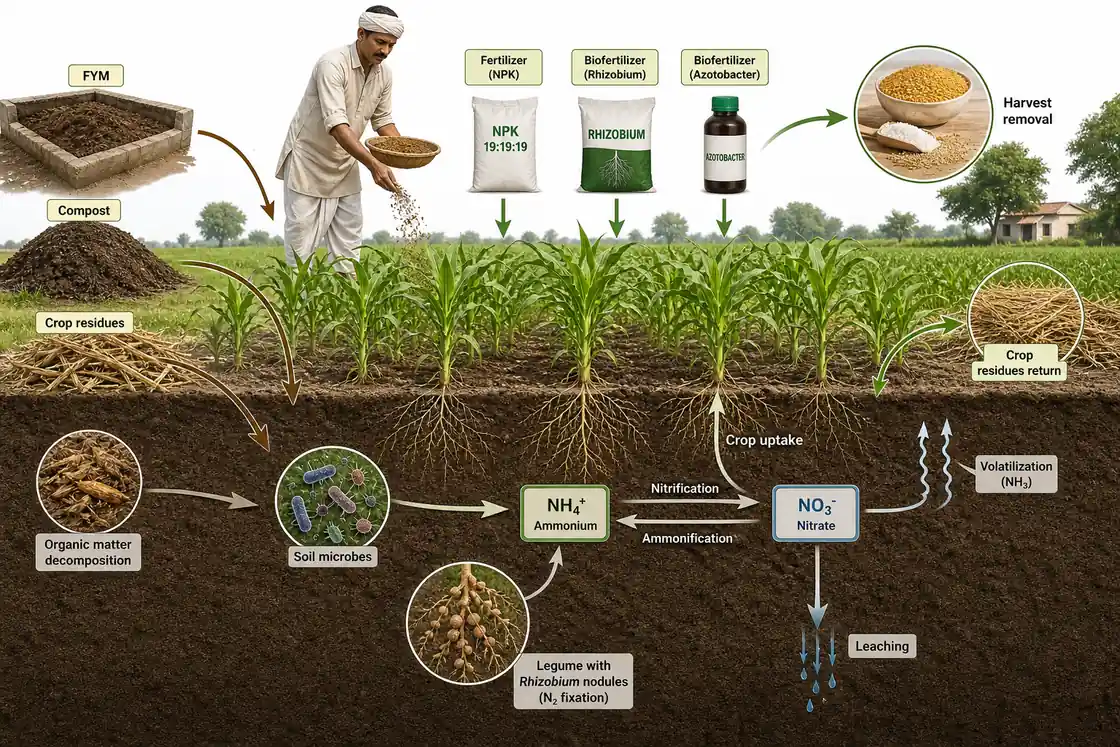
Crop nutrition does not depend on one source alone. Farmers use organic and inorganic sources together to supply nutrients efficiently and maintain soil health.
Start with the balanced-diet idea
A crop also needs a balanced diet. Manure is like slow home-cooked food for the soil because it improves structure, organic matter, and microbial life. Fertilizer is like a concentrated nutrient supplement because it supplies a specific nutrient quickly. Biofertilizer is like adding helpful workers near the root zone because microbes fix or mobilize nutrients.
Integrated Nutrient Management, or INM, means not choosing only one. It means combining sources so that the crop gets nutrients now and the soil stays healthy for future crops.
Pro Content Locked
Upgrade to Pro to access this lesson and all other premium content.
₹99 charged monthly · Cancel anytime
- All Agriculture & Banking Courses
- AI Lesson Questions (100/day)
- AI Doubt Solver (50/day)
- Glows & Grows Feedback (30/day)
- AI Section Quiz (20/day)
- 22-Language Translation (100/day)
- Recall Questions (20/day)
- AI Quiz (15/day)
- AI Quiz Paper Analysis (100/day)
- AI Step-by-Step Explanations (100/day)
- Spaced Repetition Recall (FSRS)
- AI Tutor
- Immersive Text Questions
- Audio Lessons — Hindi & English
- Mock Tests & Previous Year Papers
- Summary & Mind Maps
- XP, Levels, Leaderboard & Badges
- Generate New Classrooms
- Voice AI Teacher (AgriDots Live)
- AI Revision Assistant
- Knowledge Gap Analysis
- Interactive Revision (LangGraph)
🔒 Secure via Razorpay · Cancel anytime · No hidden fees
Introduction of Manure, Fertilizer, Biofertilizer, Their Method of Application and Integrated Nutrient Management
Crop nutrition does not depend on one source alone. Farmers use organic and inorganic sources together to supply nutrients efficiently and maintain soil health.
Start with the balanced-diet idea
A crop also needs a balanced diet. Manure is like slow home-cooked food for the soil because it improves structure, organic matter, and microbial life. Fertilizer is like a concentrated nutrient supplement because it supplies a specific nutrient quickly. Biofertilizer is like adding helpful workers near the root zone because microbes fix or mobilize nutrients.
Integrated Nutrient Management, or INM, means not choosing only one. It means combining sources so that the crop gets nutrients now and the soil stays healthy for future crops.
What manure means
Manure is an organic material added to soil mainly to improve fertility, organic matter, and soil condition. In the broader agricultural sense, it includes plant- and animal-based materials that improve soil productivity after decomposition or gradual nutrient release.
What fertilizer means
Fertilizer is a concentrated nutrient source supplied to meet crop demand more directly and rapidly.
What biofertilizer means
Biofertilizers are living microbial preparations that help improve nutrient availability or nutrient-fixing activity in soil and around plant roots.
Basic differences
| Input | Main feature |
|---|---|
| Manure | bulky, organic, improves soil condition |
| Fertilizer | concentrated nutrient source |
| Biofertilizer | microbial support for nutrient availability |
Extended difference between manure and fertilizer
| Basis | Manure | Fertilizer |
|---|---|---|
| Origin | plant or animal based | industrially manufactured |
| Nature | organic | chemical or mineral |
| Nutrient concentration | lower | higher |
| Release pattern | slow | comparatively quick |
| Soil organic matter | increases | generally does not increase |
| Effect on soil condition | improves structure and biology | may not improve structure directly |
| Risk from excess | usually lower if well managed | excess may burn or imbalance crop nutrition |
Why each one matters
Manures
- add organic matter
- improve soil structure
- support microbial activity
- release nutrients slowly
Organic manures should also be remembered for the way they:
- improve physical, chemical, and biological properties of the soil
- improve water-holding capacity
- help maintain a better carbon-nitrogen balance
- reduce rapid nutrient loss
- support long-term fertility and productivity
Farm example: why FYM alone may not be enough
If a vegetable crop needs quick nitrogen during rapid growth, farmyard manure alone may release nutrients too slowly. But if the farmer uses only urea again and again, soil organic matter and structure may decline over time. A better approach is to combine compost or FYM, soil-test-based fertilizer, and suitable biofertilizer. That is the practical meaning of INM.
Common groups of manures
Bulky organic manures
- farmyard manure
- compost
- green manures
Concentrated organic manures
- oil cakes
- bone meal
- blood meal
- fish meal
Farmyard manure and compost
Farmyard manure
Farmyard manure is the decomposed mixture of dung, urine, litter, and leftover fodder material from farm animals. It is one of the most important traditional nutrient sources because it improves both crop nutrition and soil condition.
The standard school-level composition of FYM is roughly:
| Material | Approximate nutrient content |
|---|---|
| FYM | 0.5% N, 0.25% P2O5, 0.4% K2O |
It also reminds students that a large part of cattle dung may still be diverted as fuel, which means valuable nutrients are lost from agricultural recycling.
Compost
Compost is decomposed organic matter produced from plant wastes, farm residues, and related biodegradable materials under managed conditions.
Indian agriculture recognizes several composting methods:
- Bangalore method
- Indore method
- Indore heap method
- Coimbatore method
- NADEP method
- ADCO method
You do not always need to reproduce every step of every method, but you should remember that composting systems differ in pit or heap design, aeration, turning, moisture management, and time taken for maturity.
What makes the main methods different
Bangalore method
- useful where refuse and night soil are part of the system
- trench or pit based
- starts with short aerobic activity and then continues under slower semi-anaerobic breakdown
- often takes 6-8 months or longer
- nutrient loss is comparatively low
Indore method
- built around residues, dung, urine earth, ash, and water
- follows careful layering in pits
- requires repeated turning and moistening
- compost may become ready in around 4 months
Indore heap method
- useful in rainy conditions or where above-ground heaps are preferred
- alternates carbon-rich and nitrogen-rich layers
- may also use a green-manure crop like sunhemp when extra nitrogenous material is needed
Coimbatore method
- uses pit filling, mud plastering, and later turning
- begins with more anaerobic action and later shifts toward aerobic decomposition
- compost becomes ready in about 4 months
NADEP method
- based on aerobic decomposition with better natural air flow
- associated with Narayan Rao Pandhari Pande
- top sealing helps reduce moisture loss
ADCO method
- uses ADCO powder as a starter
- reminds students that decomposition can be accelerated through planned microbial help
Green manuring
Green manuring means growing a green crop, often a legume, and incorporating it into the soil before or around flowering in order to improve fertility and organic matter.
Important points:
- common crops include dhaincha and sunhemp
- it adds organic matter
- it helps improve nitrogen economy
- it supports soil condition and microbial activity
A few additional points are also worth remembering:
- incorporation is usually done at or near flowering stage
- it is commonly turned into soil about 45 days before sowing the next crop
- dhaincha is especially useful in alkali and difficult soils
- green manuring can happen either by growing the crop in the same field or by adding green leaves collected from outside
Common green-manure crops
| Crop | Botanical name |
|---|---|
| Sunhemp | Crotalaria juncea |
| Dhaincha | Sesbania aculeata |
| Sweet clover | Melilotus indica |
| Black gram | Vigna mungo |
| Mung bean | Vigna radiata |
| Cluster bean | Cyamopsis tetragonoloba |
| Cowpea | Vigna sinensis |
| Pea | Pisum sativum |
| Lentil | Lens culinaris |
| Moth bean | Vigna aconitifolia |
The exact source table gives different nitrogen and organic-matter values, but the main point is that different green-manure crops contribute different biomass and nitrogen depending on crop type and environment.
Oil cakes and concentrated organic materials
Oil cakes, especially non-edible oil cakes, are valuable because they supply nutrients in concentrated organic form. Neem cake is especially important in Indian agricultural teaching because of its broader soil and nutrient-management usefulness.
A few practical details are especially important here:
- castor, neem, mahua, karanja, linseed, rape seed, and cotton seed cakes can be used
- non-edible oil cakes are valued both for nutrients and for compounds that may slow nitrification
- neem cake is discussed especially through nimbin and nimbicidine
- mahua cake decomposes slowly, so it should be applied much earlier than sowing
Timing clues
- ordinary oil-cake manure is often applied around 15 days before sowing
- mahua cake may need around 2 months before sowing
Biofertilizers in practice
Biofertilizers are living microbial inoculants. They do not act like bagged NPK fertilizers. Instead, they support nutrient fixation, solubilization, or availability.
Common examples include:
- Rhizobium
- Azotobacter
- Azospirillum
- phosphate-solubilizing microbes
Biofertilizers can also be understood through a broader classification.
Nitrogen-fixing biofertilizers
| Group | Important examples | Main association |
|---|---|---|
| Symbiotic | Rhizobium | legumes |
| Symbiotic | Frankia | non-legume associations like casuarina |
| Symbiotic | Anabaena azollae with Azolla | rice-field systems |
| Associative | Azospirillum | grasses and several non-legumes |
| Free-living | Azotobacter | many non-leguminous crops |
| Other groups | Clostridium, Nostoc, Anabaena | special soil or water situations |
Phosphate-linked biofertilizers
| Function | Examples |
|---|---|
| P-solubilizing bacteria | Bacillus, Pseudomonas, Rhizobium in some systems |
| P-solubilizing fungi | Penicillium, Aspergillus awamori |
| P-mobilizing mycorrhizae | Glomus, Gigaspora, Acaulospora, Scutellospora, Sclerocystis |
Other useful groups
| Group | Example | Use idea |
|---|---|---|
| Zinc or silicate solubilizers | Bacillus species | improve nutrient availability |
| PGPR | Pseudomonas fluorescens | growth promotion and rhizosphere health |
They are especially valuable when used correctly with crop type, soil condition, and moisture in mind.
Role of biofertilizers in agriculture
Biofertilizers play a bigger role than many students first expect:
- they partly supplement fertilizer demand
- they may improve mineral uptake, water uptake, and root development
- they can produce growth-promoting substances such as IAA, vitamins, and gibberellin-like compounds
- they can suppress some soil-borne pathogens
- they help decomposition and nutrient cycling
- they are cheaper and less polluting than many heavy external inputs
Fertilizers
- provide nutrients quickly
- help correct visible nutrient deficiency
- support higher crop demand where soil supply is insufficient
Biofertilizers
- support nutrient cycling
- help biological nitrogen fixation in suitable cases
- improve efficiency of nutrient use
Methods of application
Nutrients may be applied through:
- broadcasting
- placement near root zone
- top dressing
- basal application before sowing or planting
- seed or root treatment in the case of some biofertilizers
Methods of biofertilizer application
The crop-specific logic is important here.
Rice-linked systems
- BGA in rice -> soil application after transplanting
- Azolla in rice -> used as green manure or as dual/intercrop biomass
Legumes
- Rhizobium -> seed treatment and sometimes soil application
Non-legumes
- Azotobacter and Azospirillum -> seed treatment
- seed-material treatment for crops such as potato, sugarcane, and sweet potato
- seedling root dipping for transplanted vegetables and flowers
- soil application where suitable
Phosphate-solubilizing microorganisms
- seed treatment
- seed-material treatment
- seedling root dipping
- soil application
Mycorrhiza
- inoculation in seedbeds or nursery situations
- inoculation in potting mixture or potted soil
Rhizobium and nitrogen fixation
Rhizobium deserves special attention because it is the classic symbiotic nitrogen fixer in agriculture.
Important points include:
- the name Rhizobium was established by Frank in 1889
- it forms association with legume roots
- the plant supplies carbohydrates and energy
- the bacteria help convert atmospheric nitrogen into a usable form
Host-group patterns such as pea group, soybean group, lupin group, alfalfa group, bean group, and clover group show that strain-crop compatibility matters.
Why nitrogen fixation matters in INM
Biological nitrogen fixation reduces part of the external nitrogen burden and supports long-term soil fertility, especially where legumes are used intelligently in rotation or as part of mixed nutrient management.
Phosphate-solubilizing and mobilizing biofertilizers
A useful distinction should be made between:
- P-solubilizing organisms that help release phosphorus from insoluble compounds
- P-mobilizing organisms such as mycorrhizae that help plants absorb phosphorus more effectively
This distinction is worth remembering because “phosphate biofertilizer” is not a single uniform group.
Plant-growth-promoting rhizobacteria
This discussion also includes PGPR such as Pseudomonas fluorescens.
Why they matter:
- they produce growth-promoting substances
- they support root development
- they can improve rhizosphere health
- they may help suppress some pathogens
So biofertilizers are not only nutrient agents; some also act as biological growth-support systems.
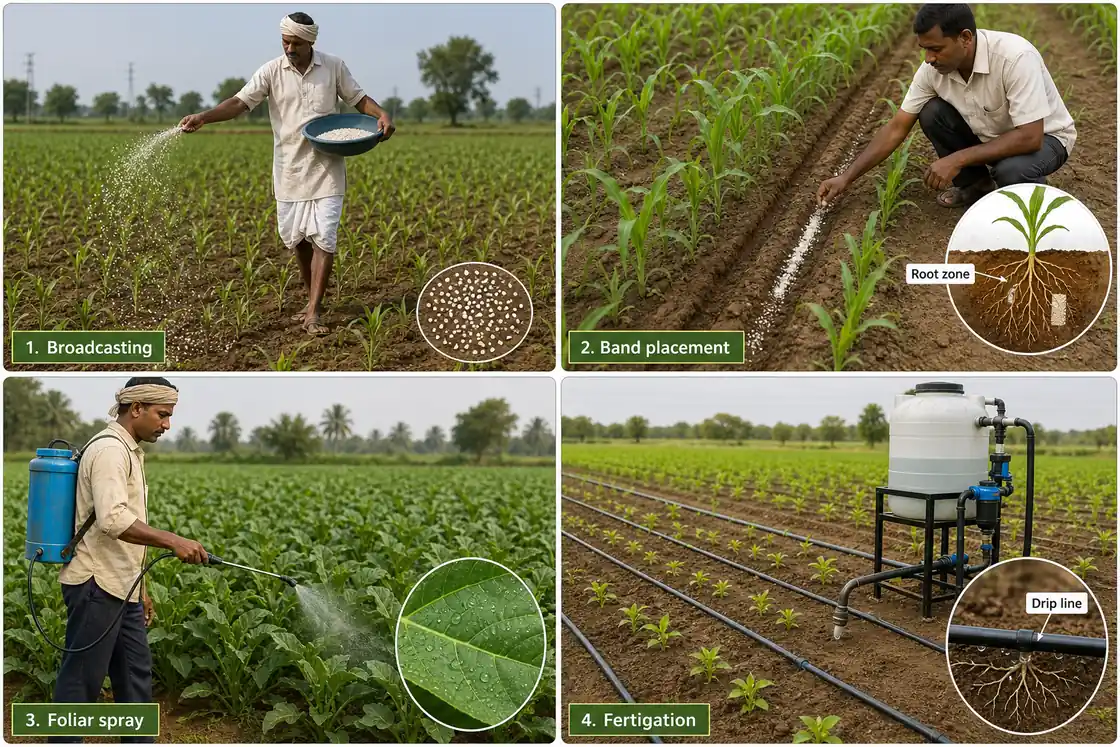
Detailed methods of fertilizer application
Broadcasting
Broadcasting means spreading fertilizer uniformly over the field surface.
Two common forms are:
- basal application at sowing or planting
- top dressing, especially for standing crops that need additional nitrogen
Weakness: when spread everywhere, fertilizer contacts a larger soil mass, which can increase fixation and stimulate weeds.
Placement
Placement means putting fertilizer at a specific place with reference to the seed or root zone.
Important forms include:
- plough-sole placement
- deep placement
- localized placement
- drilling with seed-cum-fertilizer drill
- side dressing
- band placement
- pellet application in paddy-like conditions
Strength: nutrient-use efficiency is often better because fertilizer is concentrated nearer to the active root zone.
Foliar application
Foliar feeding means spraying nutrient solution on leaves. It is especially useful for quick correction of some deficiencies and for micronutrient management in suitable cases.
Fertigation
Fertigation means applying soluble fertilizers through irrigation water. This connects nutrient supply with water management and is especially relevant in efficient irrigation systems.
Why integrated nutrient management matters
INM means using multiple nutrient sources in a planned and balanced way instead of depending only on one source.
INM aims to achieve
- balanced crop nutrition
- better nutrient-use efficiency
- improved soil health over time
- reduced waste and imbalance
- sustainable productivity
The long source section on INM makes one strong argument: neither fertilizers alone nor organics alone can sustain intensive agriculture for the long term. Real soil fertility management requires integration.
INM is an old practical idea and may also appear under related terms such as IPNS or INSAM. The core meaning remains the same: optimize all possible nutrient resources for sustained productivity.
Why INM is necessary
Integrated nutrient management became important because single-source dependence creates problems:
- falling organic matter
- poor nutrient-use efficiency
- secondary and micronutrient imbalance
- declining soil physical health
- overdependence on chemical correction alone
Two deeper reasons explain this:
- nutrient demand in intensive agriculture is too large to be met by one source alone
- long-term experiments show that combined use performs better than isolated dependence on only fertilizers or only organics
INM attempts to balance immediate response with long-term sustainability.
What INM tries to achieve in textbook terms
- maintenance or adjustment of soil fertility
- optimum nutrient supply
- sustaining desired productivity
- improving yield and quality
- addressing environmental concerns
Simple INM logic
A smart nutrient strategy often combines:
- soil organic matter support from manure
- targeted nutrient supply from fertilizers
- biological support from biofertilizers
The ideal message is not "chemical bad, organic good" or the reverse. The real lesson is balance, timing, efficiency, and soil health.
This gives both immediate crop response and longer-term soil benefit.
Main components of INM
Important examples include:
- fertilizers
- organic manures
- legumes
- crop residues
- biofertilizers
These components complement one another:
- fertilizers give quick and targeted supply
- manures improve long-term soil condition
- legumes contribute biologically fixed nitrogen
- residues recycle biomass and nutrients
- biofertilizers improve biological efficiency and nutrient availability
Why crop residues matter
Crop residues are not just waste. When recycled properly, they:
- return nutrients to soil
- build stable organic matter
- improve soil health
- reduce the loss caused by residue burning
Main advantages of INM
- restoration and maintenance of soil fertility
- sustained crop productivity
- prevention of secondary and micronutrient deficiency
- better fertilizer-use efficiency
- improvement in physical, chemical, and biological health of soil
Long-term experiments also support these advantages, showing that combined organic and inorganic nutrient use is generally superior to sole dependence on one source alone.
Nitrogen-cycle connection
Nutrient management should also be connected with the nitrogen cycle:
- nitrogen can be fixed biologically
- ammonium can be converted to nitrate through nitrification
- nitrate can be lost through denitrification under poor conditions
This matters because nutrient management is not only about what is added to the soil, but also what is transformed and lost after addition.
Source-complete manure and fertilizer memory bank
Manures, fertilizers, biofertilizers, and INM can be understood as one connected story. A student should not learn them as four isolated definitions. The better sequence is:
- manure improves the living soil body
- fertilizer supplies concentrated nutrients quickly
- biofertilizer uses microorganisms to mobilize or fix nutrients
- INM combines all sources so that yield and soil health both remain stable
Manures by origin and preparation
| Manure type | Main idea | How to remember it |
|---|---|---|
| Farmyard manure | decomposed dung, urine, litter, and farm wastes | the everyday mixed farm manure |
| Compost | decomposed plant and animal refuse | waste converted into humus-rich material |
| Green manure | a crop grown and incorporated in the field | grow biomass, then plough it back |
| Green leaf manure | leaves/twigs collected from elsewhere and mixed into soil | import green biomass into the field |
| Oil cake manure | residue left after oil extraction from seeds | concentrated organic nutrient source |
| Poultry manure | droppings and litter from poultry units | richer and faster acting than bulky FYM |
Organic manures are bulky but valuable. Their nutrient percentage is usually lower than chemical fertilizers, yet their impact on soil structure, moisture retention, microbial activity, and long-term fertility is high.
Green manuring and green leaf manuring
Green manuring is especially useful before a main crop when the field has enough time and moisture to raise a short-duration biomass crop. Leguminous green manure crops are preferred because they add organic matter and support nitrogen economy through symbiotic nitrogen fixation. Common examples include sunhemp and dhaincha.
Green leaf manuring is slightly different. Here the farmer does not necessarily grow the biomass in the same field. Leaves and tender twigs from suitable plants are brought from bunds, wasteland, trees, or nearby areas and incorporated into the soil. This is useful where there is not enough time to grow a green manure crop in the field.
Oil cakes and careful timing
Oil cakes are organic residues left after extracting oil from seeds. Some are edible and used mainly as feed or food-related material, while non-edible cakes are more commonly used as manure. Oil cake manure should be mixed into the soil before sowing so that decomposition can begin and nutrients become safer and more available for crop roots.
Why manures cannot simply replace fertilizers everywhere
Manures are excellent soil conditioners, but their nutrient concentration is low. If a high-yielding crop requires a large and timely dose of nitrogen, phosphorus, or potassium, relying only on bulky organic material may not meet crop demand at the correct stage. This is why the discussion moves toward INM instead of saying that one source is always superior.
Biofertilizer organisms and their roles
| Biofertilizer group | Typical organisms | Main function |
|---|---|---|
| Symbiotic nitrogen fixers | Rhizobium | fixes nitrogen in legume root nodules |
| Free-living nitrogen fixers | Azotobacter, Azospirillum | adds nitrogen support without a strict nodule system |
| Blue-green algae | cyanobacteria in wetland rice systems | supports nitrogen addition in paddy ecology |
| Phosphate solubilizers | phosphate-solubilizing bacteria and fungi | convert unavailable phosphorus into more available forms |
| Mycorrhiza | arbuscular mycorrhizal fungi | improves root absorption area, especially phosphorus uptake |
| Potassium and zinc solubilizers | KMB and Zn-solubilizing cultures | support availability of less mobile nutrients |
Biofertilizers do not work like chemical fertilizer bags. They are living inoculants, so their performance depends on storage, carrier quality, moisture, temperature, crop compatibility, and correct field use. A dry, overheated, expired, or incorrectly applied culture may perform poorly even if its name is correct.
Liquid biofertilizers
Improved forms such as liquid biofertilizers also deserve notice. Their advantage is better shelf life, easier handling, and more uniform application when compared with older carrier-based cultures. The important idea is the direction of technology: biofertilizer use is becoming more precise and reliable.
Integrated nutrient management as a system
Integrated nutrient management should be understood as a system:
- soil test first, so nutrient decisions are not blind
- crop requirement next, because different crops remove different nutrients
- fertilizer for precise and timely nutrient supply
- manure and compost for organic matter and soil condition
- legumes, green manure, and residues for biological recycling
- biofertilizers for microbial nutrient support
- correct placement, timing, and dose to reduce losses
This shows why INM is both a productivity strategy and a conservation strategy.
Key fertilizer-application methods
Fertilizer application methods are best understood by linking each method with its field use and its main caution:
- broadcasting spreads fertilizer over the soil surface and is simple, but losses can increase if nutrients are left poorly placed
- placement keeps fertilizer nearer the root zone and usually improves nutrient-use efficiency
- foliar spray is useful when a quick correction is needed through leaf absorption
- fertigation delivers soluble fertilizer through irrigation water and helps match nutrient supply with water management
- deep placement is especially useful in paddy fields where nitrogen loss from the surface can be high
Summary Cheat Sheet
| Concept / Topic | Key Details / Explanation |
|---|---|
| Manure | Manure is an organic material added mainly to improve fertility, organic matter, and soil condition. It is bulky, slow releasing, and important for long-term soil health. |
| Fertilizer | Fertilizer is a concentrated nutrient source used to meet crop demand more directly and rapidly. |
| Biofertilizer | Biofertilizers are living microbial preparations that improve nutrient fixation, mobilization, or availability around the root zone. |
| Basic distinction | Manure improves soil body and microbial life, fertilizer gives quick concentrated nutrient supply, and biofertilizer adds beneficial microorganisms to improve nutrient use. |
| Farmyard manure and compost | FYM is decomposed dung, urine, litter, and fodder waste. A standard school-level memory line is about 0.5% N, 0.25% P2O5, and 0.4% K2O. Compost is decomposed plant and animal refuse. |
| Major composting methods | Important composting methods are Bangalore, Indore, Indore heap, Coimbatore, NADEP, and ADCO. Bangalore is slower and more pit-based, while Indore and Coimbatore are remembered as important managed compost systems. |
| Green manuring | Green manuring means growing a crop, usually a legume, and incorporating it into soil near flowering to improve organic matter and nitrogen economy. Common crops are dhaincha and sunhemp. |
| Concentrated organic manures | Examples of concentrated organic manures include oil cakes, bone meal, blood meal, and fish meal. |
| Oil-cake facts | Important oil cakes include castor, neem, mahua, karanja, cottonseed, rapeseed, sesame, and groundnut cake. Oil-cake manure is often applied about 15 days before sowing, but mahua cake may be applied about 2 months before sowing because it decomposes slowly. |
| Neem-cake clue | Neem cake is important because compounds like nimbin and nimbicidine are associated with slowed nitrification and useful nutrient-management effects. |
| Nitrogen-fixing biofertilizers | Key nitrogen-fixing groups are Rhizobium in legumes, Frankia in some non-legume associations, Azospirillum in associative systems, Azotobacter as a free-living fixer, and Anabaena azollae with Azolla in rice systems. |
| Phosphate biofertilizers | P-solubilizing microorganisms help release phosphorus from insoluble forms, while P-mobilizing mycorrhizae help plants absorb phosphorus more effectively. Examples include Bacillus, Pseudomonas, Penicillium, Aspergillus awamori, and Glomus. |
| PGPR | Plant-growth-promoting rhizobacteria (PGPR) such as Pseudomonas fluorescens help root growth, rhizosphere health, and sometimes pathogen suppression. |
| Major application methods | Nutrients may be applied by broadcasting, placement, top dressing, basal application, foliar spray, fertigation, soil injection, seed treatment, seedling root dipping, or soil application depending on the source and crop. |
| Broadcasting versus placement | Broadcasting is simple but exposes fertilizer to more fixation and weed competition. Placement puts fertilizer nearer the root zone, often improving nutrient-use efficiency. |
| Foliar and fertigation facts | Foliar application gives quick correction, especially for some micronutrients and urea. Fertigation applies soluble fertilizers through irrigation water. |
| Biofertilizer use logic | Rhizobium is mainly used with legumes; Azotobacter and Azospirillum are commonly used as seed treatment or seedling treatment in non-legumes; mycorrhiza is important in nursery or potting situations. |
| Rhizobium fact | Rhizobium is the classic symbiotic nitrogen fixer associated with legume root nodules; the name is linked with Frank (1889). |
| Integrated Nutrient Management (INM) | INM means balanced and planned use of manures, fertilizers, biofertilizers, legumes, crop residues, and other local nutrient sources so that crops get nutrients now and soil health remains strong over time. |
| Why INM is needed | INM is needed because depending on one source alone can lead to falling organic matter, poor nutrient-use efficiency, secondary and micronutrient imbalance, and weaker soil physical health. |
| Main aim of INM | INM aims at balanced crop nutrition, better nutrient-use efficiency, improved soil health, sustained productivity, and reduced nutrient loss or waste. |
Lesson Doubts
Ask questions, get expert answers