💧 Soil Moisture and Irrigation Methods
A full lesson on soil moisture, available water, irrigation requirement, and major irrigation systems including sprinkler and drip.
Soil Moisture and Irrigation Methods
Water is the medium through which plants absorb nutrients, maintain turgidity, continue cell expansion, regulate temperature, and finally produce biomass and yield. In field agriculture, success does not depend only on how much rain falls. It depends on how much water is actually stored in soil, how much of that water is available to roots, and how efficiently irrigation is planned.
Start with the sponge analogy
Soil behaves like a sponge, but not all water in the sponge is useful to roots. Some water drains out quickly, some stays available, and some is held so tightly that roots cannot pull it out. Irrigation science begins with this simple question: How much water is in the root zone, and how much of it can the crop actually use?
Pro Content Locked
Upgrade to Pro to access this lesson and all other premium content.
₹99 charged monthly · Cancel anytime
- All Agriculture & Banking Courses
- AI Lesson Questions (100/day)
- AI Doubt Solver (50/day)
- Glows & Grows Feedback (30/day)
- AI Section Quiz (20/day)
- 22-Language Translation (100/day)
- Recall Questions (20/day)
- AI Quiz (15/day)
- AI Quiz Paper Analysis (100/day)
- AI Step-by-Step Explanations (100/day)
- Spaced Repetition Recall (FSRS)
- AI Tutor
- Immersive Text Questions
- Audio Lessons — Hindi & English
- Mock Tests & Previous Year Papers
- Summary & Mind Maps
- XP, Levels, Leaderboard & Badges
- Generate New Classrooms
- Voice AI Teacher (AgriDots Live)
- AI Revision Assistant
- Knowledge Gap Analysis
- Interactive Revision (LangGraph)
🔒 Secure via Razorpay · Cancel anytime · No hidden fees
Soil Moisture and Irrigation Methods
Water is the medium through which plants absorb nutrients, maintain turgidity, continue cell expansion, regulate temperature, and finally produce biomass and yield. In field agriculture, success does not depend only on how much rain falls. It depends on how much water is actually stored in soil, how much of that water is available to roots, and how efficiently irrigation is planned.
Start with the sponge analogy
Soil behaves like a sponge, but not all water in the sponge is useful to roots. Some water drains out quickly, some stays available, and some is held so tightly that roots cannot pull it out. Irrigation science begins with this simple question: How much water is in the root zone, and how much of it can the crop actually use?
This is why field capacity, wilting point, available water, evapotranspiration, and irrigation requirement are studied before irrigation methods.
Soil water and soil moisture
Water present in soil is called soil moisture. It is held in the pore spaces of the soil and is one of the most important soil components from the crop point of view.
Soil water is explained here in both physical and biological ways. Both classifications matter because they describe different sides of the same problem.
Physical classification of soil water
1. Hygroscopic water
This water forms a very thin film around soil particles and is held so tightly that plant roots cannot absorb it.
- it is unavailable to plants
- it is retained with very high force
- it cannot be removed by ordinary root activity
2. Capillary water
Capillary water is held in the small or capillary pores of the soil. It is retained by surface forces, but its molecules remain mobile enough for plant roots to use.
- this is the main available water
- it can move in the liquid state
- it is held strongly enough to remain in the root zone
- it is still absorbable by plant roots
Think of capillary water as the useful water stored in small tubes inside soil. It does not run away immediately like gravitational water, but it is not locked too tightly like hygroscopic water. For crop production, this is the main water bank.
3. Gravitational water
This water occupies larger pores and moves downward under the force of gravity.
- it is present when soil holds water beyond field capacity
- it reduces aeration
- it is generally not useful to plants
- its prolonged presence can harm root growth
Biological classification of soil water
This classification is based on how much of the water can actually be used by plants.
Available water
This is the water present between:
- field capacity, and
- wilting point
It is the most important moisture fraction for crop growth.
Unavailable water
This includes:
- the full hygroscopic water fraction, and
- the part of capillary water that is held below wilting point
Plants cannot use this water effectively.
Super available or superfluous water
This is water beyond field capacity. It includes gravitational water and some water from larger spaces. It is not beneficial if it remains too long because it reduces air supply in soil.
Field capacity
Field capacity is the maximum amount of water a soil can hold against the force of gravity after excess water has drained away.
In practical terms, it is the upper limit of useful soil water storage after drainage.
Why it matters:
- it represents the full root-zone recharge point after irrigation or rain
- it is used in irrigation planning
- water beyond this stage drains downward and is not efficiently stored for crop use
Wilting point
Wilting point is the soil-moisture condition at which roots cannot absorb water fast enough to maintain plant turgidity, so wilting occurs.
It is also useful to distinguish:
- temporary wilting = the plant may recover if transpiration falls or conditions improve
- permanent wilting point = the plant cannot recover unless water is added
Why available moisture matters more than total water
A field may contain water and still show moisture stress if:
- much of the water is held too tightly
- the root zone is shallow
- drainage is poor and aeration is low
- hot weather raises water demand sharply
So in crop production, available moisture is the real working concept.
Why irrigation is needed
- rainfall may be uneven
- crops need water at critical growth stages
- moisture stress reduces yield and quality
- some soils hold useful water for shorter periods
Infiltration and soil-water entry
When water on the soil surface enters the soil, the process is called infiltration.
Infiltration rate influences:
- how fast rainwater enters soil
- how well irrigation water is used
- runoff loss
- irrigation method suitability
Very low infiltration may create runoff problems. Very high infiltration may make surface irrigation less efficient.
Water requirement and irrigation requirement
The total water need of a crop is broader than the amount applied through irrigation alone.
Water requirement
Water requirement includes the water needed for:
- evapotranspiration
- special operations, if required
- unavoidable application losses
Irrigation requirement
Irrigation requirement is the part of crop water need that must be supplied by irrigation after accounting for rainfall and soil contribution.
Net and gross irrigation requirement
Net irrigation requirement
Net irrigation requirement is the amount of water required to bring the root-zone soil moisture back up to field capacity.
In simple terms:
- it is the actual water needed by the crop root zone
- it equals the moisture deficit between field capacity and current root-zone moisture
Gross irrigation requirement
Gross irrigation requirement is the total water that must be delivered in the field, including application losses. So it is always larger than net irrigation requirement.
Factors influencing irrigation scheduling
Irrigation planning depends on:
- available soil moisture
- crop stage
- frequency of irrigation
- root-zone depth
- climate and evaporative demand
- soil type
Major irrigation methods
| Method | Main idea |
|---|---|
| Surface irrigation | water flows over the soil surface |
| Subsurface irrigation | water is applied below the surface and rises by capillarity |
| Sprinkler irrigation | water is sprayed over the field |
| Drip irrigation | water is delivered near the root zone |
Surface irrigation
Surface irrigation is the oldest and most widely used irrigation method. Water is applied over the land surface and moves according to gravity.
Surface irrigation has several common forms that are worth knowing by name.
Common types of surface irrigation
- wild or uncontrolled flooding
- border strip irrigation
- check basin irrigation
- basin irrigation
- ring method
- furrow irrigation
Main strengths
- simple and familiar
- does not require highly complex equipment
- widely used in ordinary field crops
Main limitations
- runoff loss
- uneven distribution
- possible deep percolation near the inlet
- lower water-use efficiency in many situations
- difficult efficiency estimation in some field conditions
Border strip method
In this controlled flooding method, the field is divided into long strips separated by borders. Water flows down the strip with controlled spread.
It is useful where:
- land can be prepared in strips
- water control is possible
- broad field crops are grown
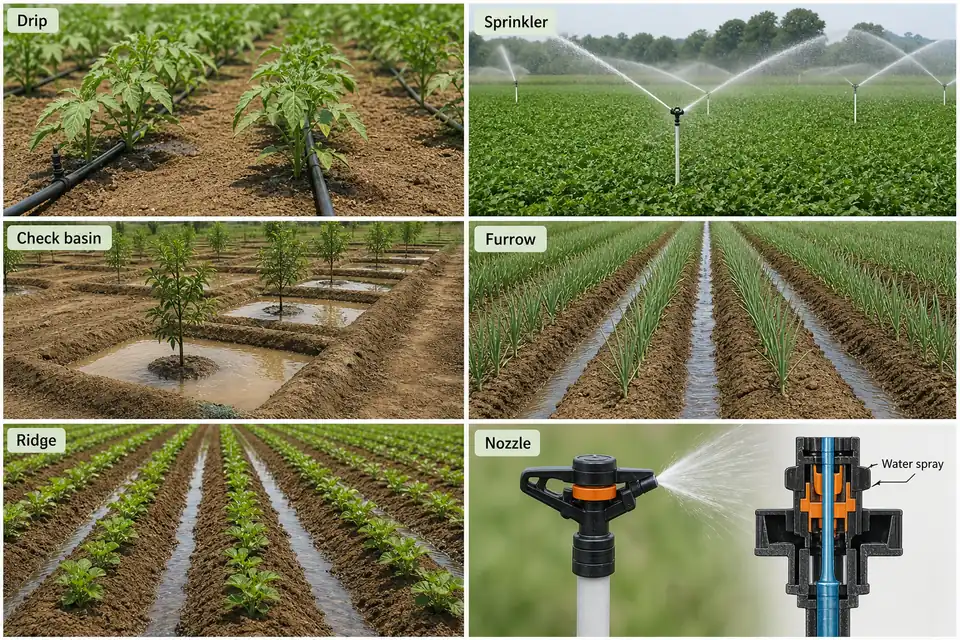
Check basin method
In this method, level or nearly level plots are enclosed by bunds or dikes. Water is admitted plot by plot.
Advantages include:
- better control over water distribution
- reduced runoff and percolation loss
- good suitability across many soils
The lesson notes that this is a very popular method in India and commonly used in crops like wheat, barley, chickpea, and vegetables.
Basin and ring method
Basin method
This is commonly used in orchards. Water is applied to a basin around one tree or a small group of trees.
Ring method
This is especially suitable for fruit trees. Because the stem base is not directly flooded, it helps reduce certain disease problems and lowers the risk of damping off.
Furrow method
Here, small channels called furrows are made along the crop rows. Water flows through the furrows and infiltrates laterally and vertically into the root zone.
It is especially suitable for row crops.
Advantages of furrow irrigation
- only part of the soil surface is wetted
- evaporation loss is lower than full flooding
- water can be managed flexibly
- high efficiency is possible with good management
Disadvantages of furrow irrigation
- water may be lost at the downstream end
- furrow making requires labour
- erosion can increase
- it often needs more labour than other surface methods
Subsurface irrigation
Subsurface irrigation means applying water below the soil surface so that moisture reaches roots mainly through capillary rise.
Conditions favorable for subsurface irrigation
- impervious subsoil at suitable depth
- permeable upper soil
- good lateral movement of water
- moderate slope
- fairly uniform topography
Types
- natural sub-irrigation
- artificial sub-irrigation
Artificial systems can be costly, but they may save a large amount of water and improve yield where conditions suit them.
Sprinkler irrigation
Sprinkler irrigation applies water in the form of a spray, somewhat like artificial rainfall. Water is sprayed into the air and falls on the soil surface in a fairly uniform pattern.
Rotating sprinkler-head systems are common, and the wetted area depends on:
- nozzle size
- water pressure
- sprinkler spacing
Portable systems are also possible using flexible pipes.
Conditions favorable for sprinkler irrigation
- very porous soils where surface irrigation is difficult
- steep or undulating land
- shallow soils
- erosive soils
- areas where surface leveling is difficult
- limited channel size for surface distribution
Advantages of sprinkler irrigation
- more uniform water distribution
- water saving compared with conventional methods
- suitable for varied topography
- less soil erosion
- better root-zone aeration
- better seed germination under proper management
- fertilizer saving is possible
Sprinkler systems generally operate around 2 to 2.5 kg/cm² pressure.
Disadvantages of sprinkler irrigation
- high initial cost
- poor efficiency in windy weather
- more evaporation loss in hot conditions
- water should be free from debris
- careful handling of equipment is necessary
- power is needed for pumping
- high-intensity spray may damage some crops
- generally less suitable for many tree situations
Pressure irrigation and precision irrigation
Sprinkler and drip are both examples of pressure irrigation because water is moved under pressure through pipes and delivery devices rather than simply flowing over the field.
Precision irrigation means applying the right quantity of water, at the right time, and in the right place.
This reduces:
- water loss
- nutrient loss
- waterlogging risk
- unnecessary weed growth
It also improves input-use efficiency, especially in high-value crops.
Drip irrigation
Drip or trickle irrigation supplies water directly to the root zone through a network of pipes and small outlets called emitters or drippers.
Important examples include:
- main line
- sub-mains
- laterals
- valves
- drippers or emitters
- pressure gauges
- water meters
- filters
- pumps
- fertilizer tank
- pressure regulator
- vacuum breaker
Water is generally supplied at a controlled low discharge, often around 1 to 10 litres per hour at the emitter.
Why drip is important
- saves water
- reduces wastage
- keeps inter-row area drier
- improves application efficiency
- supports high-value and row crops well
Advantages of drip irrigation
- very low water loss
- high water saving
- better plant growth and yield
- labour and energy saving
- weed control in non-wetted area
- no soil erosion
- improved fertilizer efficiency
- especially useful in saline and alkaline conditions when managed properly
The approximate operating pressure is noted near 2.5 kg/cm².
Disadvantages of drip irrigation
- high skill is needed for design and installation
- emitters may clog due to sand, clay, debris, salts, or organic growth
- the system is not ideal for very closely planted crops like wheat and many cereals
Rain gun irrigation
Rain guns are high-discharge sprinkler devices used for wider coverage. They operate under higher pressure and are useful where large-radius watering is needed.
Students should remember the idea rather than all numerical specifications: rain guns are basically powerful sprinkler devices suitable for larger wetted radius.
Matka or pitcher irrigation
Matka irrigation is another low-cost localized method in which a buried earthen pitcher slowly releases water into the surrounding soil. Crops are planted around the pitcher and use the moisture that seeps through the porous wall.
It is especially useful as a localized moisture-supply method where water is scarce and crop spacing allows such arrangement.
Water requirement of crops
Different crops require different total quantities of water. Common examples show that:
- rice and sugarcane have very high water requirement
- wheat and maize need moderate quantities
- vegetables and fruit crops differ according to species and stage
Students do not need to memorize every number immediately, but they should remember the relative pattern:
- rice, sugarcane, banana -> high requirement
- wheat, maize, groundnut, potato -> medium range
- several pulses and some oilseeds -> comparatively lower than the highest-demand crops
Critical stages of irrigation
One of the most important parts of this chapter is the concept of critical stage.
A critical stage is the growth stage at which moisture stress can cause major yield reduction.
Important examples
| Crop | Important critical stages |
|---|---|
| Rice | initial tillering, flowering |
| Wheat | crown root initiation, tillering, jointing, booting, flowering, milk, dough |
| Maize | early vegetative stage, tasseling, silking |
| Groundnut | flowering, pegging, pod filling |
| Sugarcane | germination, tillering, grand growth |
| Mustard | before flowering, pod filling |
| Cotton | branching, square formation, flowering, boll development |
Crown root initiation in wheat and tasseling-silking in maize are especially important phrases to remember.
How irrigation methods should be compared
When comparing irrigation methods, focus on:
- water-use efficiency
- labour and management need
- distribution control
- crop suitability
- wastage level
Method-wise irrigation summary
The main logic is simple: every irrigation method is a different way of bringing water to the root zone. Compare them by water saving, labour, cost, uniformity, and crop suitability.
Surface irrigation family
Surface irrigation allows water to move over the land surface by gravity. It is simple and common, but it can waste water if the field is not level or if the stream size is not controlled.
| Method | Where it fits | Main caution |
|---|---|---|
| Flooding | closely spaced crops or fields where precise control is difficult | uneven distribution and water loss |
| Check basin | orchards and level fields divided into basins | bunds must be maintained |
| Border strip | close-growing crops on gentle uniform slope | needs proper strip length and grade |
| Furrow irrigation | row crops such as maize, cotton, vegetables, sugarcane | water should run in furrows, not drown the ridge |
| Ring basin | fruit trees | water is applied around the tree without wetting the trunk directly |
For students, furrow irrigation is especially intuitive: roots use water from the wetted furrow sides, while the crop row remains relatively aerated.
Subsurface irrigation
Subsurface irrigation supplies water below the soil surface. It may happen through a controlled water table or through buried pipes. Its advantage is reduced evaporation loss from the surface. Its limitation is that it needs suitable soil and careful management, otherwise salts or waterlogging may create problems.
Sprinkler irrigation
Sprinkler irrigation imitates rainfall by applying water under pressure through nozzles. It is useful for light soils, uneven land, and crops where surface flooding is unsuitable. It also helps when water is limited and uniform application is needed.
Remember the limitation: wind can disturb distribution, and the system needs pressure, pipes, nozzles, and maintenance. Therefore, sprinkler is efficient, but not automatically cheap.
Drip or trickle irrigation
Drip irrigation delivers water drop by drop near the root zone. It saves water because only the active root area is wetted. It also supports fertigation, where soluble fertilizers are applied through irrigation water.
Common examples are fruit crops, vegetables, plantations, nurseries, and widely spaced high-value crops. The main care points are filtration, emitter clogging, pressure regulation, and correct lateral spacing.
Rain gun and matka irrigation
Rain guns are high-discharge sprinkler devices that throw water over a larger radius. They are useful where portable high-pressure irrigation is needed. Matka irrigation is a low-cost local method where a buried earthen pot slowly releases water through its porous wall. The first is pressure-based and equipment-heavy; the second is simple, localized, and useful in water-scarce small plots.
Crop-stage reasoning for irrigation
Critical stages matter because yield loss is not equal at every growth stage. Moisture stress during vegetative growth may sometimes be partly recovered, but stress during flowering, pollination, grain filling, pod formation, or fruit enlargement usually causes direct yield loss.
How to write critical-stage answers
Use this pattern:
- name the crop
- state the most sensitive stages
- explain why the stage is sensitive
- connect moisture stress with final yield
Example: in wheat, crown root initiation is critical because it establishes the root system that supports later tillering and nutrient uptake. In maize, tasseling and silking are critical because pollination failure directly reduces grain number. In groundnut, pegging and pod filling are critical because reproductive structures are forming below the soil surface.
Precision and pressure irrigation
Precision irrigation means water is applied according to the actual need of the crop, soil, and stage. Pressure irrigation means water is distributed through a pressurized system such as sprinkler or drip.
The two ideas often overlap, but they are not identical. A pressure system can still be badly managed. Precision comes from correct scheduling, uniformity, measurement, and crop-stage understanding.
Water-saving answer keywords
- right amount
- right time
- right place
- reduced runoff
- reduced deep percolation
- reduced evaporation
- better fertilizer-use efficiency
- better root-zone moisture
These keywords help students write strong short answers on drip, sprinkler, and precision irrigation.
Summary Cheat Sheet
| Concept / Topic | Key Details / Explanation |
|---|---|
| Soil moisture | Soil moisture is the water present in soil pores. Crop performance depends not on total water alone, but on how much of that water is actually available to roots. |
| Physical forms of soil water | Soil water is physically classified as hygroscopic water, capillary water, and gravitational water. |
| Hygroscopic water | Hygroscopic water is held as a thin film around soil particles with very high force and is unavailable to plants. |
| Capillary water | Capillary water is the main available water for plants because it is held in small pores strongly enough to stay in the root zone but loosely enough for roots to absorb. |
| Gravitational water | Gravitational water occupies larger pores and drains downward under gravity. It is generally not useful if it remains long and may reduce aeration. |
| Biological classification | Biologically, soil water is grouped into available water, unavailable water, and super available or superfluous water. |
| Field capacity | Field capacity is the maximum water a soil holds against gravity after excess water has drained away. It is the upper useful limit of root-zone water storage. |
| Wilting point | Wilting point is the moisture condition at which roots cannot absorb water fast enough to maintain turgidity. Permanent wilting point means the plant cannot recover unless water is added. |
| Available moisture | Available water is the water between field capacity and wilting point. This is the real working moisture fraction for crop growth. |
| Infiltration | Infiltration is the entry of water from the soil surface into the soil. It affects runoff, irrigation suitability, and water-use efficiency. |
| Water requirement | Water requirement (WR) includes water needed for evapotranspiration, special operations, and application losses. |
| Irrigation requirement | Irrigation requirement (IR) is the part of crop water need that must be supplied by irrigation after accounting for rainfall and soil contribution. A key relation is IR = WR - (ER + S). |
| Net and gross irrigation requirement | Net irrigation requirement is the water needed to restore root-zone moisture to field capacity. Gross irrigation requirement is net requirement plus application and conveyance losses. |
| Major irrigation methods | The major irrigation methods are surface irrigation, subsurface irrigation, sprinkler irrigation, and drip irrigation. |
| Surface irrigation | Surface irrigation applies water over the land surface by gravity. Common forms are wild flooding, border strip, check basin, basin, ring, and furrow irrigation. |
| Check basin and furrow | Check basin irrigation uses level plots enclosed by bunds and is popular in India. Furrow irrigation suits row crops and wets only part of the surface, reducing evaporation compared with full flooding. |
| Subsurface irrigation | Subsurface irrigation applies water below the surface so moisture reaches roots mainly by capillary rise. It needs suitable soil, subsoil, and topography. |
| Sprinkler irrigation | Sprinkler irrigation sprays water like artificial rainfall. It suits porous soils, uneven land, shallow soils, erosive soils, and places where leveling is difficult. It saves water but needs pressure, equipment, and careful maintenance. |
| Drip irrigation | Drip or trickle irrigation applies water directly near the root zone through emitters or drippers. It saves water, reduces non-wetted weeds, improves fertilizer-use efficiency, and is especially suitable for high-value and widely spaced crops. |
| Pressure and precision irrigation | Sprinkler and drip are pressure irrigation methods. Precision irrigation means the right amount of water, at the right time, in the right place. |
| Other localized methods | Rain guns are high-discharge sprinkler devices for larger radius coverage. Matka or pitcher irrigation is a low-cost localized method where a buried porous pot slowly releases water. |
| Relative crop water requirement | High-water-demand crops include rice, sugarcane, and banana. Medium-demand examples include wheat, maize, groundnut, and potato. Several pulses and oilseeds generally need less than the highest-demand crops. |
| Critical irrigation stages | A critical stage is the stage at which moisture stress causes major yield reduction. |
| High-value stage examples | Important memory lines are wheat -> crown root initiation, maize -> tasseling and silking, groundnut -> flowering, pegging, pod filling, rice -> initial tillering and flowering, and sugarcane -> germination, tillering, grand growth. |
| Best lesson takeaway | Good irrigation is not just more water. It is right amount + right stage + right method, based on available moisture, crop stage, and root-zone need. |
Lesson Doubts
Ask questions, get expert answers