📝 Advance Crop Production Practice and Revision
A recap lesson bringing together the main crop-production concepts of Unit 1.
Advance Crop Production Practice and Revision
This recap chapter follows the main Unit 1 lessons and brings concept recall, terminology, and applied understanding together.
Unit structure
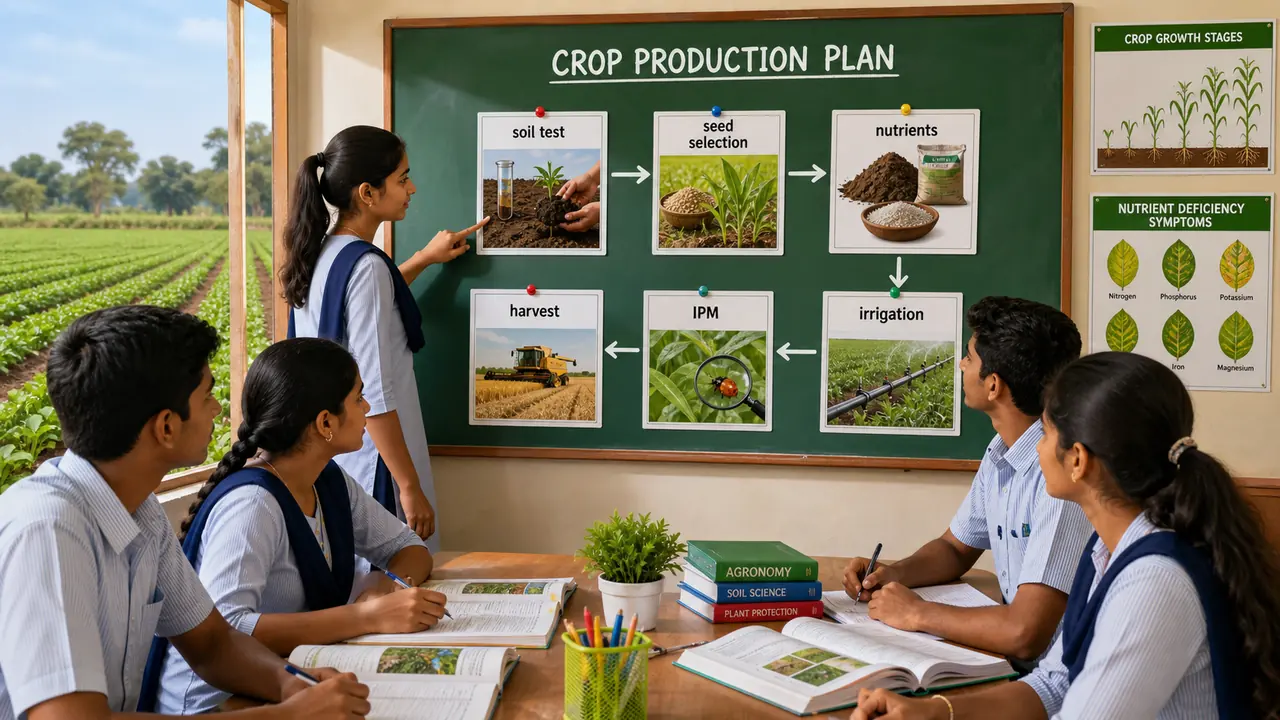
Treat Unit 1 like one crop season:
- choose crops that feed and employ people through horticulture
- understand whether soil can supply nutrients
- diagnose soil through sampling and testing
- correct nutrition through manure, fertilizer, biofertilizer, and INM
- manage water at critical stages
- protect the crop through IPM
This chain helps the whole unit read like one crop-production sequence.
Unit sequence
Move in four rounds:
- revise definitions and one-line differences
- test yourself through objective and fill-in-the-blank questions
- answer short and long questions in your own words
- finish by speaking the full logic of soil -> nutrients -> water -> pest management
Objective check
- Horticultural crops are especially valued because they usually give:
- higher value, better nutrition, and more employment per unit area
- Soil fertility refers mainly to:
- the ability of soil to supply nutrients in available form
- Soil productivity is broader than fertility because it includes:
- actual crop performance under field conditions
- Macronutrients are required:
- in comparatively larger quantities
- Soil sampling should represent:
- the average condition of the field
- Organic carbon is a practical indicator of:
- organic matter status and long-term soil health
- INM means:
- integrated nutrient management
- Drip irrigation is especially useful when the target is:
- precise root-zone application with minimum wastage
- IPM depends on:
- combining cultural, mechanical, biological, and chemical methods
- Mechanical control in pest management includes:
- hand collection, traps, barriers, and destruction of infested parts
- A systemic pesticide is one that:
- is absorbed and translocated within plant tissues
- Soil solarization is mainly used to:
- reduce soil-borne pests, pathogens, and weed seeds using trapped heat
- A parasitoid differs from an ordinary parasite because it:
- eventually kills the host
- Hyperparasitism means:
- a parasite or parasitoid attacking another parasite or parasitoid
- The nutrient that was later added to complete the essential list is:
- nickel
- Deficiency at the apical bud most strongly suggests:
- calcium or boron deficiency
Fill in the blanks
- __________ is the ability of soil to provide essential nutrients in available form.
- __________ is broader than fertility because it includes real yield under practical conditions.
- Nitrogen, phosphorus, and potassium are called __________ nutrients.
- Soil pH around 7 is considered __________.
- Organic carbon is closely associated with soil __________ matter.
- Sprinkler and drip are examples of __________ irrigation systems.
- Integrated Nutrient Management is abbreviated as __________.
- Integrated Pest Management is abbreviated as __________.
- A pesticide that moves within the plant body is called a __________ pesticide.
- Solar heating of moist soil under polythene for pest suppression is called soil __________.
- A chemical used specifically against fungal diseases is called a __________.
- An insect that develops on or in another insect host and ultimately kills it is called a __________.
- A pesticide absorbed and moved within the plant body is called a __________ pesticide.
- Repeated laying of eggs by the same parasitoid species in one host is called __________.
- Attack of one parasitoid upon another parasitoid is called __________.
- Soil pH near seven is considered __________.
- The ability of soil to produce crop yield under defined management is called __________.
- An element without which the plant cannot complete its life cycle is called __________.
- Deficiency appearing first on older leaves often suggests a more __________ nutrient within the plant.
- Calcium and boron deficiency are often first noticed near the __________ point.
Match the terms
Try to match the left column with the best meaning on the right.
Pro Content Locked
Upgrade to Pro to access this lesson and all other premium content.
₹99 charged monthly · Cancel anytime
- All Agriculture & Banking Courses
- AI Lesson Questions (100/day)
- AI Doubt Solver (50/day)
- Glows & Grows Feedback (30/day)
- AI Section Quiz (20/day)
- 22-Language Translation (100/day)
- Recall Questions (20/day)
- AI Quiz (15/day)
- AI Quiz Paper Analysis (100/day)
- AI Step-by-Step Explanations (100/day)
- Spaced Repetition Recall (FSRS)
- AI Tutor
- Immersive Text Questions
- Audio Lessons — Hindi & English
- Mock Tests & Previous Year Papers
- Summary & Mind Maps
- XP, Levels, Leaderboard & Badges
- Generate New Classrooms
- Voice AI Teacher (AgriDots Live)
- AI Revision Assistant
- Knowledge Gap Analysis
- Interactive Revision (LangGraph)
🔒 Secure via Razorpay · Cancel anytime · No hidden fees
Advance Crop Production Practice and Revision
This recap chapter follows the main Unit 1 lessons and brings concept recall, terminology, and applied understanding together.
Unit structure
Treat Unit 1 like one crop season:
- choose crops that feed and employ people through horticulture
- understand whether soil can supply nutrients
- diagnose soil through sampling and testing
- correct nutrition through manure, fertilizer, biofertilizer, and INM
- manage water at critical stages
- protect the crop through IPM
This chain helps the whole unit read like one crop-production sequence.
Unit sequence
Move in four rounds:
- revise definitions and one-line differences
- test yourself through objective and fill-in-the-blank questions
- answer short and long questions in your own words
- finish by speaking the full logic of soil -> nutrients -> water -> pest management
Objective check
- Horticultural crops are especially valued because they usually give:
- higher value, better nutrition, and more employment per unit area
- Soil fertility refers mainly to:
- the ability of soil to supply nutrients in available form
- Soil productivity is broader than fertility because it includes:
- actual crop performance under field conditions
- Macronutrients are required:
- in comparatively larger quantities
- Soil sampling should represent:
- the average condition of the field
- Organic carbon is a practical indicator of:
- organic matter status and long-term soil health
- INM means:
- integrated nutrient management
- Drip irrigation is especially useful when the target is:
- precise root-zone application with minimum wastage
- IPM depends on:
- combining cultural, mechanical, biological, and chemical methods
- Mechanical control in pest management includes:
- hand collection, traps, barriers, and destruction of infested parts
- A systemic pesticide is one that:
- is absorbed and translocated within plant tissues
- Soil solarization is mainly used to:
- reduce soil-borne pests, pathogens, and weed seeds using trapped heat
- A parasitoid differs from an ordinary parasite because it:
- eventually kills the host
- Hyperparasitism means:
- a parasite or parasitoid attacking another parasite or parasitoid
- The nutrient that was later added to complete the essential list is:
- nickel
- Deficiency at the apical bud most strongly suggests:
- calcium or boron deficiency
Fill in the blanks
- __________ is the ability of soil to provide essential nutrients in available form.
- __________ is broader than fertility because it includes real yield under practical conditions.
- Nitrogen, phosphorus, and potassium are called __________ nutrients.
- Soil pH around 7 is considered __________.
- Organic carbon is closely associated with soil __________ matter.
- Sprinkler and drip are examples of __________ irrigation systems.
- Integrated Nutrient Management is abbreviated as __________.
- Integrated Pest Management is abbreviated as __________.
- A pesticide that moves within the plant body is called a __________ pesticide.
- Solar heating of moist soil under polythene for pest suppression is called soil __________.
- A chemical used specifically against fungal diseases is called a __________.
- An insect that develops on or in another insect host and ultimately kills it is called a __________.
- A pesticide absorbed and moved within the plant body is called a __________ pesticide.
- Repeated laying of eggs by the same parasitoid species in one host is called __________.
- Attack of one parasitoid upon another parasitoid is called __________.
- Soil pH near seven is considered __________.
- The ability of soil to produce crop yield under defined management is called __________.
- An element without which the plant cannot complete its life cycle is called __________.
- Deficiency appearing first on older leaves often suggests a more __________ nutrient within the plant.
- Calcium and boron deficiency are often first noticed near the __________ point.
Match the terms
Try to match the left column with the best meaning on the right.
- Soil fertility -> nutrient-supplying capacity
- Soil productivity -> actual crop output under given management
- Biofertilizer -> beneficial living microorganism that improves nutrient availability
- Drip irrigation -> localized application near roots
- Sprinkler irrigation -> water distributed like rainfall
- Soil solarization -> heat-based disinfestation of upper soil layer
- Parasitoid -> host-killing biological control agent
- Hyperparasitism -> parasite attacking another parasite
- Old-leaf symptom -> suspect mobile nutrients first
- Apical-bud symptom -> suspect calcium or boron first
Very short answer drill
- Define soil fertility.
- Define soil productivity.
- What is a representative soil sample?
- What is soil pH?
- What is a biofertilizer?
- What is precision irrigation?
- What is a systemic pesticide?
- What is a fungicide?
- What is soil solarization?
- What is biological control of insect pests?
- What is superparasitism?
- What is hyperparasitism?
- What is varietal resistance?
- What is a contact pesticide?
- What is a beneficial plant nutrient?
- What is a quasi-essential element?
- What is a mobile nutrient in soil?
- What is an immobile nutrient in soil?
Terminology drill
These are terms that often appear in textbook-style questions and are worth memorizing carefully:
- Pesticide = a substance used to prevent, destroy, repel, or manage pests.
- Fungicide = a pesticide meant specifically for fungal diseases.
- Systemic pesticide = a chemical absorbed by the plant so the pest is affected while feeding.
- Biological control = suppression of pests with living natural enemies such as predators, parasitoids, or pathogens.
- Parasitoid = an organism whose immature stage develops on a host and kills it.
- Protelian parasite = a form in which parasitic behavior is seen in only a particular stage of the life cycle.
- Superparasitism = repeated egg laying by individuals of the same parasitoid species in the same host.
- Hyperparasitism = one parasite or parasitoid using another parasite or parasitoid as host.
- Essential nutrient = an element without which the plant cannot complete its life cycle and whose role cannot be fully replaced by another element.
- Beneficial nutrient = an element not required by all plants but capable of promoting growth in some species or situations.
- Quasi-essential element = an element such as silicon whose deficiency may cause major abnormalities even if it is treated separately from the classic essential list.
Short-answer practice
- Explain the difference between soil fertility and soil productivity.
- Why is representative soil sampling important before fertilizer recommendation?
- Write a short note on the role of organic carbon in soil health.
- Differentiate between manure, fertilizer, and biofertilizer.
- Why are macronutrients and micronutrients both essential even though the required quantity differs?
- Why are drip and sprinkler considered more controlled than ordinary surface irrigation?
- What is the logic of integrated nutrient management?
- Why should pest management not depend on a single method?
- Explain soil solarization as a preventive method.
- Why are natural enemies valuable in sustainable crop protection?
- What is the role of varietal resistance in IPM?
- Differentiate between systemic and non-systemic pesticide.
- Differentiate between mobile and immobile nutrients in the plant.
- Differentiate between mobile and immobile nutrients in the soil.
- Why do deficiency symptoms of calcium and boron usually appear in growing tissues?
- Why is nickel important in the modern essential-element list?
Long-answer style prompts
- Explain the importance of horticulture in nutrition, income, employment, and diversification of agriculture.
- Classify plant nutrients and describe how deficiency symptoms help in diagnosis.
- Describe the role of soil testing, pH, and organic carbon in nutrient recommendation.
- Write a detailed note on methods of irrigation with special reference to sprinkler and drip systems.
- Explain integrated nutrient management as a balance between organic, inorganic, and biological nutrient sources.
- Describe integrated pest management and discuss the place of cultural, biological, mechanical, and chemical tools in it.
- Draw or explain a simple flow chart of IPM.
- Explain the essentiality criteria used for classifying plant nutrients as essential.
- Classify plant nutrients into structural, macro, micro, beneficial, ultra-micro, and quasi-essential groups.
- Explain why nutrient mobility affects the position of deficiency symptoms on the plant.
Applied questions
- A farmer has uneven crop growth in a field. Explain why soil sampling must be done carefully before suggesting fertilizers.
- A student says, "If a soil is fertile, it must always be productive." Do you agree? Explain with reasons.
- A vegetable grower faces both water shortage and weed pressure. Which irrigation method would you prefer and why?
- In a pest outbreak, why is repeated spraying alone considered a weak long-term strategy?
- How can good agronomy itself reduce pest incidence even before pesticides are used?
- A plant shows yellowing first on older leaves. How would nutrient mobility help you start diagnosis?
- A crop shows damaged growing points and poor new growth. Which nutrient group would you suspect first and why?
- Why can a nutrient be present in soil but still remain unavailable to the plant?
Important points to remember
- Fertility and productivity are related, but not identical.
- Soil testing becomes more meaningful when sampling is representative.
- Deficiency symptoms help diagnosis, but they should be interpreted with field context.
- Organic carbon is not just a number; it reflects resilience, structure, and biological health.
- INM means efficiency with balance, not simply adding more fertilizer.
- IPM means prevention first, monitoring second, and chemical action only when justified.
- Biological control works best when the agro-ecosystem is not constantly disturbed.
- Varietal resistance and selective insecticide use are important parts of IPM.
- Essentiality depends on life-cycle completion, specificity, and metabolic role.
- Mobility in soil affects loss or fixation; mobility in plant affects symptom location.
- Old leaf -> mobile nutrient, new leaf -> less mobile nutrient, apical bud -> Ca/B is a high-value revision line.
Full Unit 1 concept checklist
Use this checklist to verify that no major concept from the unit is left unrevised.
| Lesson area | Concepts that must be covered |
|---|---|
| Horticulture and nutrition | definition, crop groups, high yield, high return, employment, waste-land use, undulating-land use, industry, religious value, medicinal value, reputation, nutrition |
| Human nutrition | carbohydrates, proteins, fats, vitamins, minerals, fibre, ICMR intake recommendation, energy values, deficiency diseases |
| Soil fertility and productivity | definitions, natural fertility factors, artificial fertility factors, productivity factors, difference table, field examples |
| Essential nutrients | Arnon and Stout criteria, 17 essential elements, nickel inclusion, structural nutrients, primary and secondary macronutrients, micronutrients, beneficial and quasi-essential nutrients |
| Nutrient mobility | mobile/less mobile/immobile in soil, mobile/moderate/less mobile/immobile in plant, symptom position on old leaves, new leaves, and apical bud |
| Deficiency symptoms | functions, deficiency, toxicity of major nutrients, chlorosis, necrosis, stunting, purpling, scorching, poor root or flower development |
| Soil testing | sampling, pH, organic carbon, representative sample, diagnostic logic, lab recommendation |
| Manures and fertilizers | FYM, compost, vermicompost, green manure, oil cakes, chemical fertilizers, biofertilizers, INM |
| Irrigation | soil water, field capacity, wilting point, available water, surface irrigation, sprinkler, drip, efficiency |
| Pest management | pest, pesticide groups, pesticide formulation, biological control, parasitoid terms, IPM components, examples, advantages and disadvantages |
Lesson-wise exam revision grid
01-01 Horticulture and nutritional security
| Question type | What to write |
|---|---|
| Define horticulture | branch dealing with fruits, vegetables, flowers, spices, plantation crops, medicinal and aromatic plants, ornamentals, post-harvest handling, and processing |
| Importance | high production, high returns, employment, industry, marginal land use, nutritional value, cultural value, medicinal value |
| Nutrition answer | fruits and vegetables supply vitamins, minerals, fibre, carbohydrates, some proteins and fats; they prevent hidden hunger |
| ICMR line | leafy vegetables, root and tuber vegetables, other vegetables, and fruits should together support a balanced daily diet |
| Examples | banana and pineapple for high yield; apple/grapes/sweet orange for income; mango/cashew on uneven land; jam/jelly/pickle/juice industries |
01-02 Fertility and productivity
| Question type | What to write |
|---|---|
| Fertility | ability to supply essential plant nutrients in available form and proper balance |
| Productivity | ability to produce specified crop yield under defined management and environment |
| Natural factors | parent material, topography, climate, soil depth, physical condition, soil age, erosion, nutrient status |
| Artificial factors | waterlogging, cropping system, pH, microorganisms, organic matter, method and time of ploughing |
| Productivity factors | fertility, physical condition, location, market demand, transport, weather, pests and diseases |
| Core difference | fertility is nutrient potential; productivity is actual crop performance |
01-03 Essential nutrients
| Question type | What to write |
|---|---|
| Essentiality criteria | life cycle cannot be completed without it; deficiency is specific; element is part of essential metabolite or enzyme system |
| Structural nutrients | carbon, hydrogen, oxygen |
| Primary macronutrients | nitrogen, phosphorus, potassium |
| Secondary macronutrients | calcium, magnesium, sulphur |
| Micronutrients | iron, manganese, boron, zinc, copper, molybdenum, chlorine, nickel |
| Beneficial nutrients | sodium, vanadium, silicon, cobalt |
| Quasi-essential | silicon is often treated as quasi-essential because deficiency may cause growth abnormalities |
01-04 Soil testing
| Question type | What to write |
|---|---|
| Sampling principle | sample must represent the field, not an unusual patch |
| pH | affects nutrient availability, microbial activity, and fertilizer response |
| Organic carbon | indicates organic matter, soil biological activity, structure, and long-term resilience |
| Mistake to avoid | do not sample near bunds, compost heaps, irrigation channels, or abnormal patches |
| Final logic | correct sample gives correct diagnosis; wrong sample gives wrong recommendation |
01-05 Nutrient sources and INM
| Question type | What to write |
|---|---|
| Manures | bulky organic materials improving soil health and slow nutrient release |
| Fertilizers | concentrated nutrient sources, faster and more specific |
| Biofertilizers | living microbes that fix, solubilize, mobilize, or improve nutrient availability |
| INM | combined use of organic, inorganic, and biological sources for yield plus soil health |
| High-value sentence | INM feeds the crop and protects the soil for future crops |
01-06 Soil moisture and irrigation
| Question type | What to write |
|---|---|
| Irrigation | artificial application of water to crop root zone when rainfall is inadequate |
| Soil water constants | field capacity, permanent wilting point, available water |
| Surface irrigation | simple but may waste water if unmanaged |
| Sprinkler | sprays water like rainfall; useful where levelling is difficult |
| Drip | applies water near root zone; high water-use efficiency |
| Exam connection | nutrients must be dissolved and transported in water for uptake |
01-07 IPM
| Question type | What to write |
|---|---|
| IPM | integrated use of all suitable pest-control methods to keep pest population below damaging level |
| Components | resistant varieties, mechanical methods, biological control, chemical control, regulatory methods |
| Biological control terms | parasite, predator, parasitoid, ectoparasite, endoparasite, superparasitism, hyperparasitism, multiple parasitism |
| Chemical control | useful for quick action but may harm beneficial organisms and environment if overused |
| Biological control | safe, economical, self-perpetuating in many cases, but slower and needs ecological understanding |
| IPM rule | chemicals are used need-based, not as the only method |
High-yield memory tables
Deficiency disease table from nutrition
| Deficiency | Disease or symptom |
|---|---|
| Vitamin A | night blindness, xerophthalmia, epithelial keratinisation |
| Vitamin B1 | beriberi, weakness, neuritis, appetite loss |
| Vitamin B2 | dry scaly skin and cracks at mouth corners |
| Vitamin B3 | pellagra and digestive/nervous disturbance |
| Vitamin B6 | low energy and disturbed brain function |
| Vitamin B12 | pernicious anaemia |
| Vitamin C | scurvy |
| Vitamin D | rickets in children and osteomalacia in adults |
| Vitamin E | reproductive and tissue-degeneration related problems |
| Vitamin K | delayed or faulty blood coagulation |
| Iodine | goitre |
| Folic acid | anaemia, nervous disturbance, impaired growth |
Nutrient symptom location table
| Symptom location | Nutrient group to suspect first |
|---|---|
| Older leaves | N, P, K, Mg, Mo |
| Newer leaves | Fe, Cu, Cl, S, Mn |
| Both old and new leaves | Zn |
| Apical bud or growing point | Ca, B |
Nutrient mobility table
| Mobility basis | Category | Examples |
|---|---|---|
| In soil | mobile | nitrate, sulphate, borate, chloride, manganese forms |
| In soil | less mobile | ammonium, potassium, calcium, magnesium, copper |
| In soil | immobile | phosphate forms and zinc |
| In plant | highly mobile | nitrogen, phosphorus, potassium |
| In plant | moderately mobile | zinc |
| In plant | less mobile | sulphur, iron, manganese, chlorine, molybdenum, copper |
| In plant | immobile | calcium, boron |
Pesticide classification table
| Pesticide type | Target |
|---|---|
| Acaricide | mites and ticks |
| Insecticide | insects |
| Fungicide | fungal diseases |
| Herbicide | weeds |
| Nematicide | nematodes |
| Rodenticide | rats and rodents |
Biological control vocabulary
| Term | Meaning |
|---|---|
| Parasite | organism deriving nutrition from another organism |
| Predator | organism that kills another organism for food |
| Ectoparasite | parasite feeding from outside the host body |
| Endoparasite | parasite living inside the host body |
| Parasitoid | immature stage develops on or in host and eventually kills it |
| Protelian parasite | immature stage is parasitic but adult stage is not |
| Superparasitism | egg laying in a host already parasitized by same species |
| Hyperparasitism | parasite developing on another parasite |
| Multiple parasitism | two or more parasite species using the same host |
Case-based questions for deeper practice
- A vegetable grower applies enough fertilizer, but crop growth remains weak after heavy rainfall and standing water. Explain using fertility and productivity.
- A farmer takes soil from only one corner near a compost heap and sends it for testing. Why will the recommendation be unreliable?
- A crop shows yellowing first on old leaves. Which nutrient mobility concept will help you?
- A crop shows death of growing points and poor young tissue development. Which nutrients should be suspected first?
- A student says all pesticides are insecticides. Correct the statement using classification.
- A farmer uses repeated broad-spectrum spraying. What risks will this create for natural enemies and IPM?
- A field has good nutrient status but poor market access for a perishable horticultural crop. Is the soil fertile? Is the enterprise productive?
- A pulse crop is included in rotation before a cereal. Explain how this may support soil fertility.
- A drip system is installed in a water-scarce vegetable farm. Explain the link between water saving and nutrient uptake.
- A pest is controlled by releasing a parasitoid mass-reared in a laboratory. Which biological-control approach does this represent?
One complete crop plan
Choose one crop, such as tomato, wheat, rice, banana, or cotton. Then write a short plan with these headings:
| Heading | What to include |
|---|---|
| Nutrition role | food, income, or protective-food value |
| Soil diagnosis | sampling, pH, organic carbon, major nutrient concern |
| Nutrient plan | manure, fertilizer, biofertilizer, and timing |
| Water plan | irrigation method and critical stage |
| Pest plan | scouting, biological or mechanical support, need-based chemical use |
This exercise joins the entire unit into one realistic farm decision.
One-page long-answer skeletons
Importance of horticulture
Start with definition. Then write the importance under headings: high yield per unit area, high income per unit area, employment generation, use of waste and undulating land, raw material for industry, religious/aesthetic value, medicinal value, reputation and enterprise value, and nutritional security. End with the statement that horticulture improves both economic security and diet quality.
Fertility versus productivity
Define both. Explain that fertility is about nutrient supply while productivity is about actual crop output. Give a comparison table. Add natural and artificial fertility factors. Add productivity factors like market, transport, weather, and pest pressure. End with the line: all productive soils are fertile, but all fertile soils are not necessarily productive.
Essential nutrients and deficiency symptoms
Begin with essentiality criteria. State that 17 elements are essential for higher green plants, with nickel included in the modern list. Classify nutrients into structural, macro, micro, beneficial, ultra-micro, and quasi-essential groups. Explain mobility in soil and plant. End with symptom-location diagnosis: old leaves, new leaves, both leaves, and apical bud.
Integrated nutrient management
Define INM. Explain the role of manures, fertilizers, biofertilizers, crop residues, and organic matter. Show how chemical fertilizers give quick nutrient supply, manures improve soil health, and biofertilizers improve biological nutrient availability. End by saying that INM aims at yield, efficiency, and long-term soil sustainability.
Integrated pest management
Define IPM. Explain components: resistant varieties, mechanical control, biological control, chemical control, and regulatory measures. Discuss biological control vocabulary and advantages. Explain that insecticides have a role when pest population crosses tolerable level, but they should be selective and need-based. End with IPM as an ecological and economic crop-protection system.
Oral recall drill
Try to explain these aloud without looking:
- Why horticulture matters for nutrition and farm income
- Why fertility alone does not guarantee productivity
- How pH affects nutrient availability
- Why drip irrigation can improve efficiency
- How IPM protects crops while reducing overdependence on pesticides
- Why deficiency location helps identify the nutrient involved
- Why silicon is treated as a quasi-essential or highly useful element in many crops
Peer-teaching drill
Teach one concept to a friend in exactly two minutes:
- explain fertility versus productivity using two fields
- explain nutrient mobility using old-leaf and young-leaf symptoms
- explain soil sampling using the tea-sugar analogy
- explain irrigation using the sponge analogy
- explain IPM using the doctor analogy
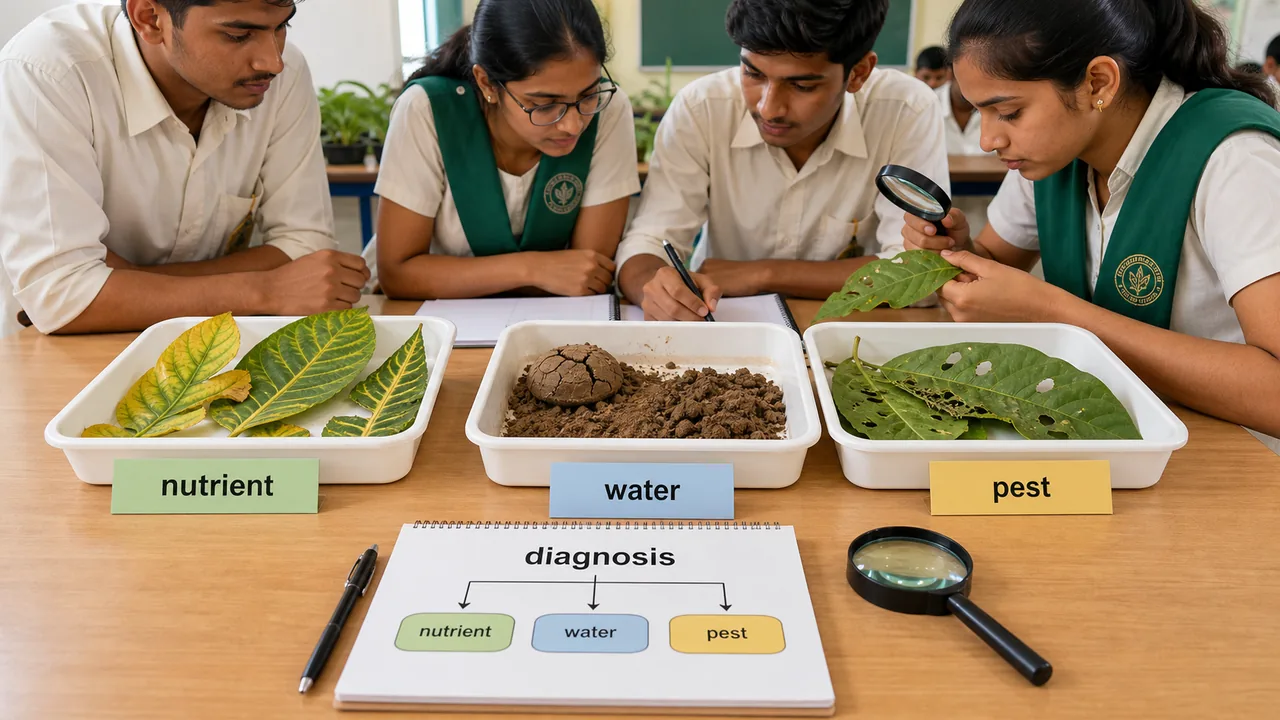
If the idea can be repeated clearly with an example, the concept is well understood.
Answer key
Fill in the blanks answers
- Soil fertility
- Soil productivity
- primary / major macronutrient
- neutral
- organic
- micro / pressurized
- INM
- IPM
- systemic
- solarization
- fungicide
- parasitoid
- systemic
- superparasitism
- hyperparasitism
- neutral
- soil productivity
- essential nutrient
- mobile
- growing / apical
Final recap
- Horticulture = high value, nutrition, and employment.
- Soil fertility ≠ soil productivity.
- Representative sampling = better recommendation.
- Organic carbon = a key clue to long-term soil health.
- INM and IPM are both integration-based approaches.
- Good crop production depends on the combined management of soil, nutrients, water, and pests.
- Nickel completes the current essential-nutrient list.
- Nutrient diagnosis becomes easier when you connect mobility + function + symptom location.
Summary Cheat Sheet
| Concept / Topic | Key Details / Explanation |
|---|---|
| Unit 1 revision chain | Revise Unit 1 in this order: horticulture -> soil -> nutrients -> soil testing -> nutrient management -> irrigation -> IPM. |
| Horticulture revision core | Horticulture should be remembered through high value per unit area, employment generation, industrial linkage, nutritional security, and cultural or medicinal importance. |
| Soil-revision focus | In soil topics, remember soil fertility, soil productivity, representative sampling, soil pH, organic carbon, and the rule that all productive soils are fertile, but all fertile soils are not necessarily productive. |
| Essential-nutrient revision core | Revise structural nutrients, primary and secondary macronutrients, micronutrients, beneficial elements, and the essentiality criteria. Keep nickel in mind as part of the modern essential list. |
| Nutrient-diagnosis shortcut | Keep this line ready: old leaf -> mobile nutrient, new leaf -> less mobile nutrient, apical bud -> calcium or boron. |
| Soil-testing memory line | A correct soil recommendation begins with a representative sample, correct depth, good sample preparation, and understanding of pH plus organic carbon. |
| Nutrient-management recall | Connect manure, fertilizer, biofertilizer, and INM instead of treating them as isolated terms. INM means balanced use of organic, inorganic, and biological nutrient sources for yield plus soil health. |
| Irrigation recall | Focus on available water, field capacity, wilting point, irrigation requirement, method comparison, and critical irrigation stages such as wheat at crown root initiation and maize at tasseling-silking. |
| Pest-management recall | Remember that IPM means observation first, integration second, and chemical use only when justified. Include cultural, mechanical, biological, and selective chemical methods in answers. |
| Biological-control vocabulary | High-value terms are predator, parasitoid, superparasitism, hyperparasitism, and soil solarization as a preventive technique. |
| Best answer approach | Strong Unit 1 answers connect soil diagnosis, balanced nutrition, water management, and crop protection as one crop-production system. |
Lesson Doubts
Ask questions, get expert answers