🌾 Concept, History, Principles and Status of Organic Farming
A deeper lesson on the meaning, history, principles, and status of organic farming in the Indian context.
Concept, History, Principles and Status of Organic Farming
Organic farming is a system of crop and livestock production that depends mainly on natural, biological, and locally available resources. Its purpose is not only to produce crops, but also to protect soil life, maintain ecological balance, and keep agriculture productive for the long term.
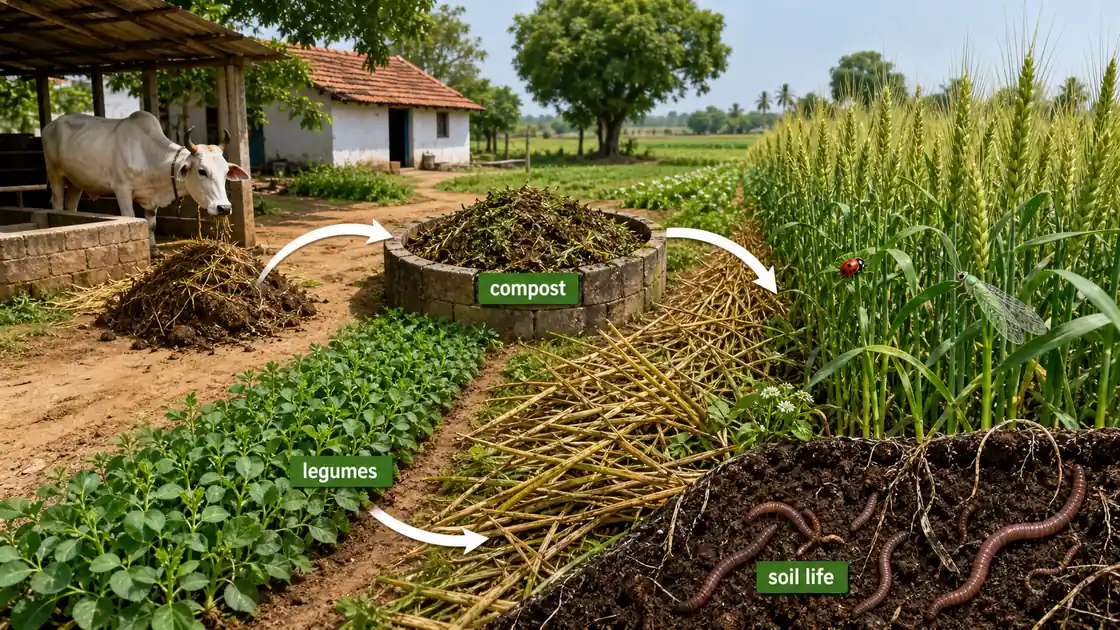
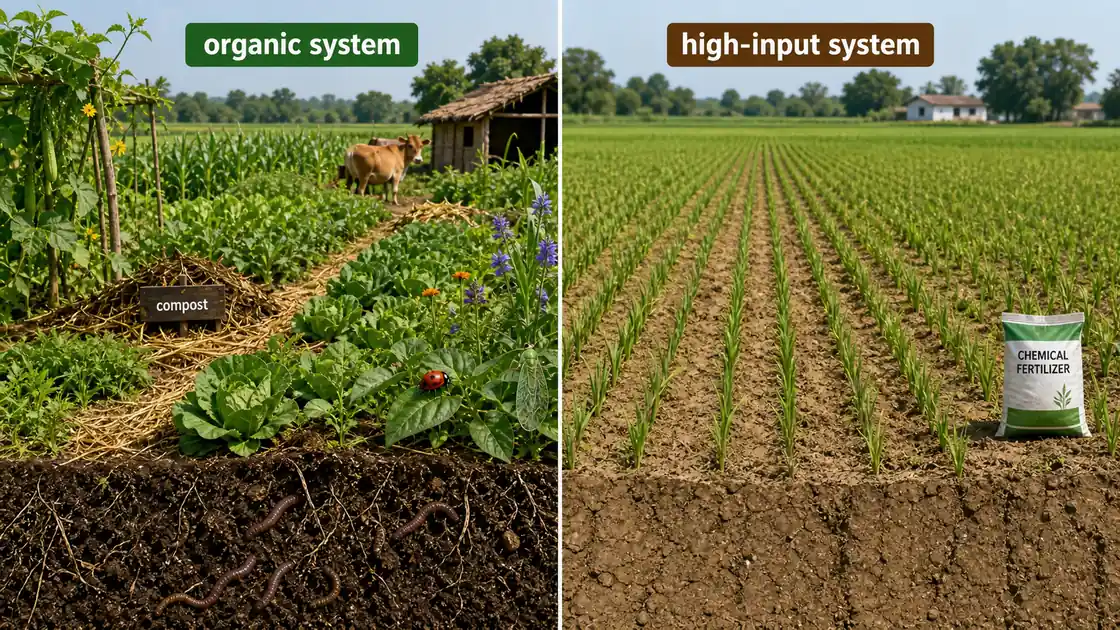
Two neighbouring fields may produce the same crop, yet their condition after harvest can be very different. In one field, residues are burnt, the soil is left bare, and the next crop depends heavily on purchased inputs. In the other field, residues are composted, dung is returned to the land, legumes are rotated with cereals, and the soil remains covered for longer. Organic farming follows the logic of the second field. It tries to keep the farm working like a living cycle in which waste becomes a resource again.
Meaning and concept of organic farming
Organic farming is often explained as farming without synthetic fertilizers and pesticides, but that description is too narrow. In reality, it is a whole-farm approach based on:
Pro Content Locked
Upgrade to Pro to access this lesson and all other premium content.
₹99 charged monthly · Cancel anytime
- All Agriculture & Banking Courses
- AI Lesson Questions (100/day)
- AI Doubt Solver (50/day)
- Glows & Grows Feedback (30/day)
- AI Section Quiz (20/day)
- 22-Language Translation (100/day)
- Recall Questions (20/day)
- AI Quiz (15/day)
- AI Quiz Paper Analysis (100/day)
- AI Step-by-Step Explanations (100/day)
- Spaced Repetition Recall (FSRS)
- AI Tutor
- Immersive Text Questions
- Audio Lessons — Hindi & English
- Mock Tests & Previous Year Papers
- Summary & Mind Maps
- XP, Levels, Leaderboard & Badges
- Generate New Classrooms
- Voice AI Teacher (AgriDots Live)
- AI Revision Assistant
- Knowledge Gap Analysis
- Interactive Revision (LangGraph)
🔒 Secure via Razorpay · Cancel anytime · No hidden fees
Concept, History, Principles and Status of Organic Farming
Organic farming is a system of crop and livestock production that depends mainly on natural, biological, and locally available resources. Its purpose is not only to produce crops, but also to protect soil life, maintain ecological balance, and keep agriculture productive for the long term.
Two neighbouring fields may produce the same crop, yet their condition after harvest can be very different. In one field, residues are burnt, the soil is left bare, and the next crop depends heavily on purchased inputs. In the other field, residues are composted, dung is returned to the land, legumes are rotated with cereals, and the soil remains covered for longer. Organic farming follows the logic of the second field. It tries to keep the farm working like a living cycle in which waste becomes a resource again.
Meaning and concept of organic farming
Organic farming is often explained as farming without synthetic fertilizers and pesticides, but that description is too narrow. In reality, it is a whole-farm approach based on:
- healthy soil
- biological cycles
- local resource recycling
- ecological balance
- long-term sustainability
The farm is treated as a living system in which soil organisms, plants, animals, and human needs remain connected. A good definition in simple school language is:
Organic farming is a system of farming that maintains soil fertility, crop health, and sustainable production mainly through natural, biological, and locally available resources.
This idea becomes easier to understand when soil is compared with the digestive system of the farm. When digestion is healthy, food is converted efficiently. In the same way, when soil biology is active, residues, manures, roots, and microbes are converted into plant-available nutrients. Organic farming therefore strengthens the internal working of the farm instead of depending entirely on outside inputs.
Why organic farming became important again
Interest in organic farming increased because many difficulties became visible in highly input-intensive agriculture:
- declining soil structure and long-term fertility
- rising dependence on purchased fertilizers and pesticides
- increasing cost of cultivation
- pest resistance in repeatedly sprayed systems
- concern over residues, pollution, and health effects
For this reason, organic farming is seen as a present need. It aims to protect the productive base of agriculture while reducing ecological damage and helping farmers build a more durable farming system.
Soil as a living entity
One of the central ideas of organic farming is that soil is alive. Soil is not merely a place where roots stand. It contains bacteria, fungi, actinomycetes, earthworms, insects, and decomposing organic matter. These living components help in:
- decomposition of residues
- nutrient release and recycling
- improvement of soil structure
- water infiltration and moisture retention
- suppression of some soil-borne problems
That is why compost, residue recycling, soil cover, and biological activity are so important in organic farming. A crumbly garden soil rich in roots and organisms usually supports crops better than a lifeless, compact surface.
Main principles of organic farming
Organic farming rests on a few broad principles:
| Principle | Practical meaning |
|---|---|
| Work within a closed system | use more local and on-farm resources |
| Maintain long-term soil fertility | protect organic matter and biological life |
| Avoid pollution | reduce harmful side effects of farming techniques |
| Produce good-quality food | focus on both nutrition and quantity |
| Reduce fossil-energy dependence | prefer more sustainable production logic |
| Respect livestock needs | keep animal management closer to natural needs |
| Support farmer livelihood | farming must also remain economically viable |
These principles are easier to remember through the sequence Recycle, Protect, Produce, Respect, Sustain. Together they show that organic farming is both an ecological and an economic approach.
Main pillars of the organic system
Field practice alone is not enough to build a strong organic sector. Organic farming also depends on four practical supports:
- organic threshold standards
- reliable certification and regulation
- suitable technology packages
- efficient market networks
These pillars matter because a farmer must not only produce organically, but also prove quality, follow accepted standards, and reach buyers who value the produce.
Historical background in India
Traditional Indian agriculture relied heavily on farmyard manure, crop residues, livestock integration, and local biological knowledge. Although it was not described as certified organic farming, many of its working methods were ecological in nature. Nutrients were recycled through dung, composted biomass, and mixed farming.
In village agriculture, cattle were important not only for milk but also for draught power and manure. This close relationship between crops, animals, and soil helped maintain production for long periods without factory-made synthetic inputs.
Shift towards chemical farming
During the 1950s and 1960s, India faced food shortage and growing population pressure. To increase output rapidly, agriculture moved towards the Green Revolution model, which promoted:
- high-yielding or hybrid seeds
- chemical fertilizers
- chemical pesticides
- irrigation expansion
This change played a major role in solving food scarcity and strengthening food-grain production. At the same time, long-term overdependence on chemicals created new concerns such as soil degradation, residue problems, higher production costs, and pest resistance.
A balanced answer should therefore present both sides clearly:
- the Green Revolution addressed an urgent national food problem
- organic farming later gained importance as a corrective approach for sustainability
Present status of organic farming in India
Organic farming in India has expanded through certification, research, state support, and export demand. Important points commonly remembered in this unit are:
- India has a large area under organic certification.
- India has one of the highest numbers of organic producers in the world.
- Madhya Pradesh is a leading state in certified organic area.
- Sikkim is recognised as India’s first fully organic state.
- Uttarakhand is also associated with strong organic promotion.
- Institutions such as the National Centre of Organic Farming, Ghaziabad, and the National Organic Farming Research Institute in Sikkim support the sector.
India is also known for exporting oilseeds, processed foods, cereals, pulses, tea, and spices. These details show that organic farming is no longer a marginal activity. It is linked with production, certification, policy support, research, and trade.
Important status facts for exams
Students should keep a few status facts ready for objective and short-answer questions:
- Australia is remembered as a leading country in area under organic farming.
- India is noted for having a very large number of organic producers.
- Sikkim is India’s first organic state.
- Madhya Pradesh is a leading state in certified organic area.
- Oilseeds are an important organic export group from India.
These facts are useful only when connected with the larger idea that organic farming is expanding because of sustainability concerns, organised certification, and market demand.
Summary Cheat Sheet
| Concept / Topic | Key Details / Explanation |
|---|---|
| Meaning of organic farming | Organic farming is a whole-farm system that maintains soil fertility, crop health, and sustainable production mainly through natural, biological, and locally available resources. |
| Core logic | It works like a living cycle in which residues, manures, legumes, livestock waste, and soil organisms keep nutrients moving instead of relying only on synthetic outside inputs. |
| Main aims | The main goals are soil health, ecological balance, long-term sustainability, and production of safer, good-quality food. |
| Soil as a living entity | Soil is called living because bacteria, fungi, actinomycetes, earthworms, and other organisms help in decomposition, nutrient recycling, better structure, and moisture management. |
| Broad principles | Organic farming emphasizes a closed system, long-term fertility, pollution avoidance, reduced fossil-energy dependence, respect for livestock, and economic viability for farmers. |
| Historical Indian background | Traditional Indian farming already followed many organic ideas through farmyard manure, crop-residue recycling, mixed farming, and close crop-livestock integration. |
| Green Revolution shift | The Green Revolution used high-yielding seeds, chemical fertilizers, chemical pesticides, and irrigation expansion to solve food shortage, but long-term overuse later created soil and sustainability concerns. |
| Four support pillars | A strong organic sector needs standards, certification/regulation, technology packages, and market networks so production can be trusted and sold properly. |
| Present status in India | India has a large certified organic area, one of the world’s highest numbers of organic producers, and support from institutions, certification systems, and export demand. |
| Important factual points | Sikkim is India’s first fully organic state; Madhya Pradesh is a leading state in certified organic area; Australia is often remembered for large organic area; oilseeds are an important export group. |
Lesson Doubts
Ask questions, get expert answers