🪴 Certification, Schemes and Kitchen Gardening
A deeper lesson on standards, certification, support systems, and kitchen gardening as a practical organic model.
Certification, Schemes and Kitchen Gardening
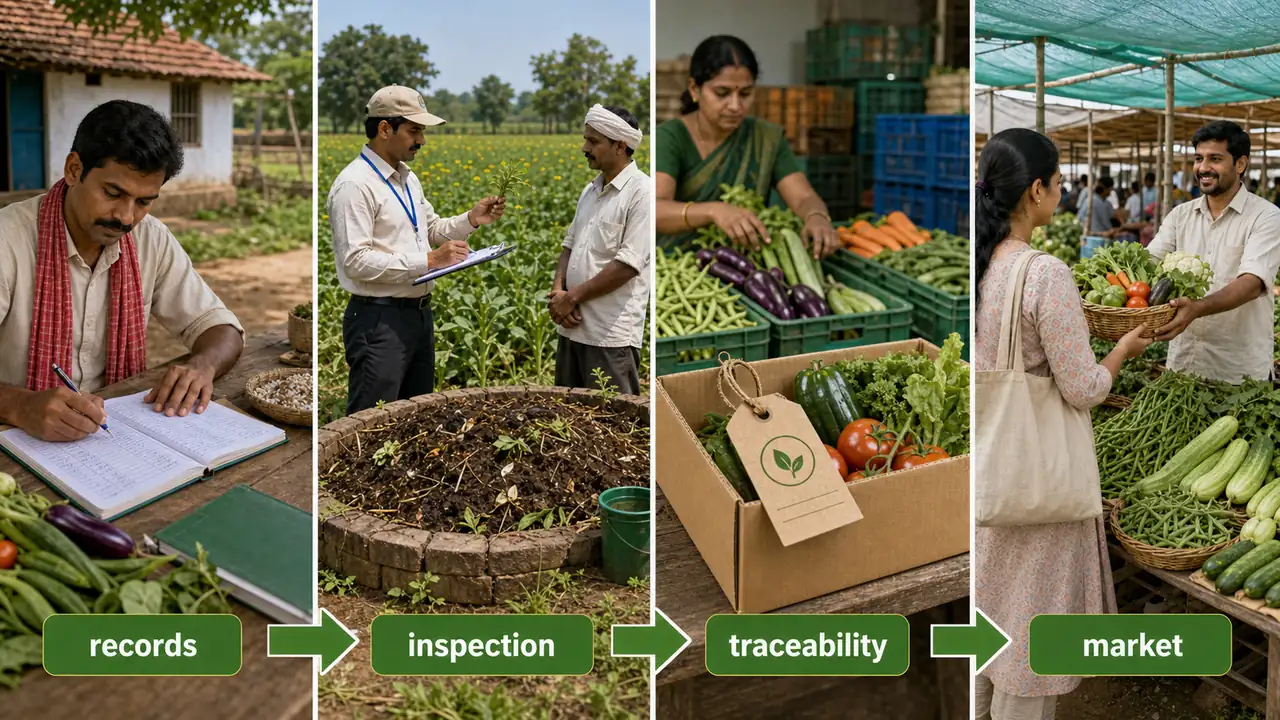
Organic farming becomes economically meaningful only when good production is supported by standards, records, verification, and practical local adoption. A buyer in the market cannot inspect every farm personally, so trust has to be built through an organised system.
Suppose two farmers sell tomatoes and both claim that their produce is organic. One farmer keeps records and follows certified procedures, while the other only makes a verbal claim. The buyer will trust the first farmer more easily. This is why certification becomes the bridge between field practice and market identity.
Meaning and importance of certification
Certification shows that a product has been produced according to accepted organic standards. It matters because:
- consumers need trust
- markets need verification
- farmers need recognition for premium pricing
- export trade requires proof rather than claims
Certification may be compared with a school report card. A student may say that they have studied well, but the report card gives an approved record. In the same way, certification provides checked evidence that organic standards have been followed.
Pro Content Locked
Upgrade to Pro to access this lesson and all other premium content.
₹99 charged monthly · Cancel anytime
- All Agriculture & Banking Courses
- AI Lesson Questions (100/day)
- AI Doubt Solver (50/day)
- Glows & Grows Feedback (30/day)
- AI Section Quiz (20/day)
- 22-Language Translation (100/day)
- Recall Questions (20/day)
- AI Quiz (15/day)
- AI Quiz Paper Analysis (100/day)
- AI Step-by-Step Explanations (100/day)
- Spaced Repetition Recall (FSRS)
- AI Tutor
- Immersive Text Questions
- Audio Lessons — Hindi & English
- Mock Tests & Previous Year Papers
- Summary & Mind Maps
- XP, Levels, Leaderboard & Badges
- Generate New Classrooms
- Voice AI Teacher (AgriDots Live)
- AI Revision Assistant
- Knowledge Gap Analysis
- Interactive Revision (LangGraph)
🔒 Secure via Razorpay · Cancel anytime · No hidden fees
Certification, Schemes and Kitchen Gardening
Organic farming becomes economically meaningful only when good production is supported by standards, records, verification, and practical local adoption. A buyer in the market cannot inspect every farm personally, so trust has to be built through an organised system.
Suppose two farmers sell tomatoes and both claim that their produce is organic. One farmer keeps records and follows certified procedures, while the other only makes a verbal claim. The buyer will trust the first farmer more easily. This is why certification becomes the bridge between field practice and market identity.
Meaning and importance of certification
Certification shows that a product has been produced according to accepted organic standards. It matters because:
- consumers need trust
- markets need verification
- farmers need recognition for premium pricing
- export trade requires proof rather than claims
Certification may be compared with a school report card. A student may say that they have studied well, but the report card gives an approved record. In the same way, certification provides checked evidence that organic standards have been followed.
Parts of the organic support system
Organic farming grows properly only when several supports work together:
| Part | Function |
|---|---|
| Standards | define what is accepted as organic |
| Certification | verifies compliance |
| Regulatory system | maintains reliability |
| Market network | connects products to buyers |
| Technology support | helps farmers shift and manage correctly |
This structure shows that organic farming is not only an ecological practice. It is also an institutional and commercial system.
Why regulation and public support matter
Without standards and regulation, genuine farmers may not receive fair recognition and consumers may not trust organic claims. Organised support also helps farmers during the transition period, when costs, records, and certification requirements can feel difficult.
For exam answers, the purpose of government support should be stated clearly:
- promotion of compost and bio-input production
- help for organic area development
- certification support
- extension and training
- assistance linked with horticulture and soil health
When scheme tables appear lengthy, they become easier to understand through three questions:
- What is being supported?
- Who receives the support?
- Why does it help organic farming become practical?
Important schemes related to organic farming
National Project on Organic Farming (NPOF)
NPOF is presented as a major programme supporting organic farming. It encourages:
- biofertilizer production units
- biopesticide production units
- compost preparation from agro-waste and fruit-vegetable waste
- strengthening of organic-input supply systems
This shows that government support is not limited to advice. It also includes infrastructure for producing organic inputs.
National Horticulture Mission (NHM) and HMNEH
These missions support:
- vermicompost units
- adoption of organic farming on a per-hectare basis
- certification support for groups of farmers
Such support is especially useful in horticulture, where high-value crops are closely linked with organised markets.
Rashtriya Krishi Vikas Yojana (RKVY)
RKVY allows support for organic-farming promotion through state-level approval. This connects organic farming with broader agricultural development planning.
National Food Security Mission (NFSM)
NFSM is linked especially with pulses and cluster demonstrations where biofertilizers such as Rhizobium and phosphate-solubilising bacteria are promoted. This is important because biological inputs are relevant not only for niche farming, but also for major crop programmes.
ICAR and research support
ICAR contributes through research on:
- biofertilizers
- phosphocompost
- vermicompost
- municipal waste compost
- crop- and soil-specific improved strains
- package of practices for different regions and crops
Strong descriptive answers mention both government schemes and research institutions together.
Biofertilizers and organic inputs
Organic farming is supported scientifically through living microbial inputs and improved organic manures. Important names include:
- Rhizobium
- Azotobacter
- Azospirillum
- Acetobacter
- phosphate-solubilising bacteria
- potash-mobilising bacteria
- zinc-solubilising bacteria
These help improve nutrient availability and connect organic farming with soil-health improvement.
Meaning of kitchen gardening
Kitchen gardening means growing vegetables, herbs, and useful plants near the home mainly for family use. It is also called home gardening or backyard vegetable cultivation.
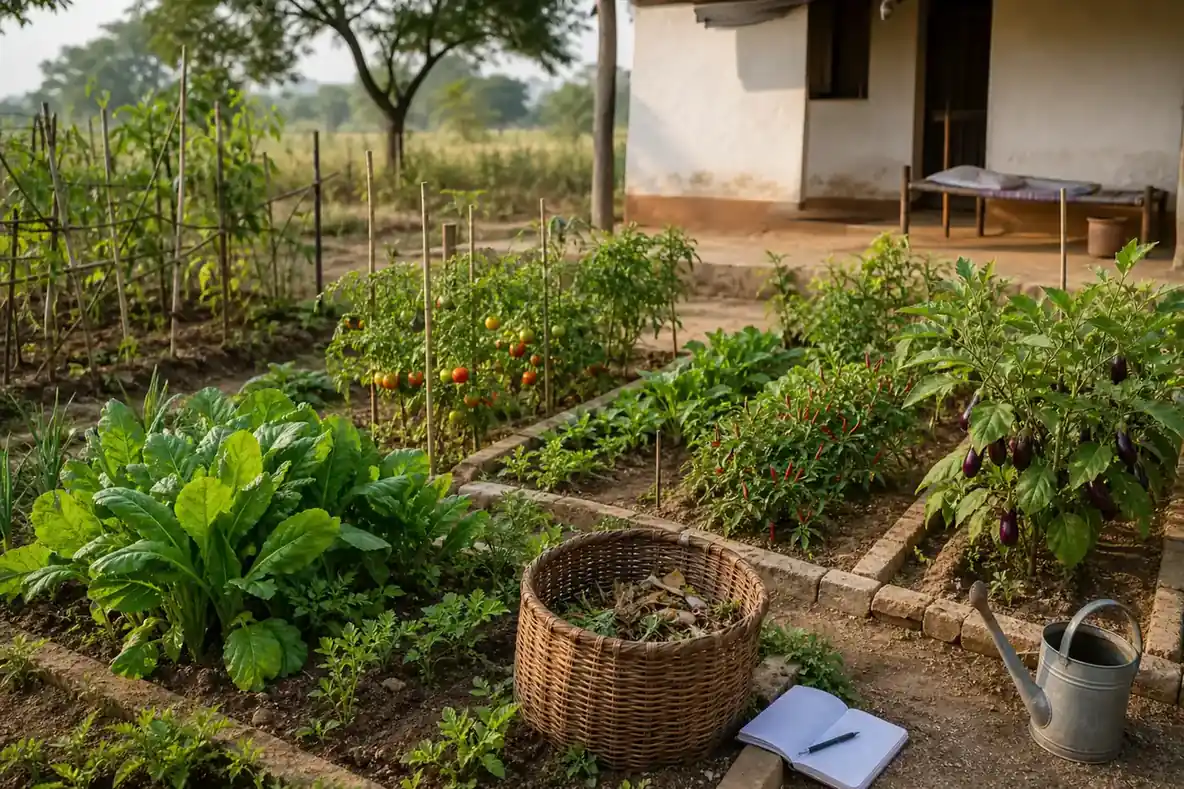
A kitchen garden is a small practical model of organic farming. Compost, sunlight, irrigation, crop rotation, mixed cropping, and continuous supply can all be observed in a limited space. For this reason, it is one of the easiest ways to understand organic principles in daily life.
Importance of kitchen gardening
A well-planned kitchen garden can:
- supply fresh vegetables throughout the year
- improve family nutrition
- reduce household expenditure on vegetables
- make useful use of organic household waste
- create a healthy green environment
- turn leisure time into productive activity
It also helps students and families understand agriculture as a living practice instead of a list of definitions.
Principles of planning a kitchen garden
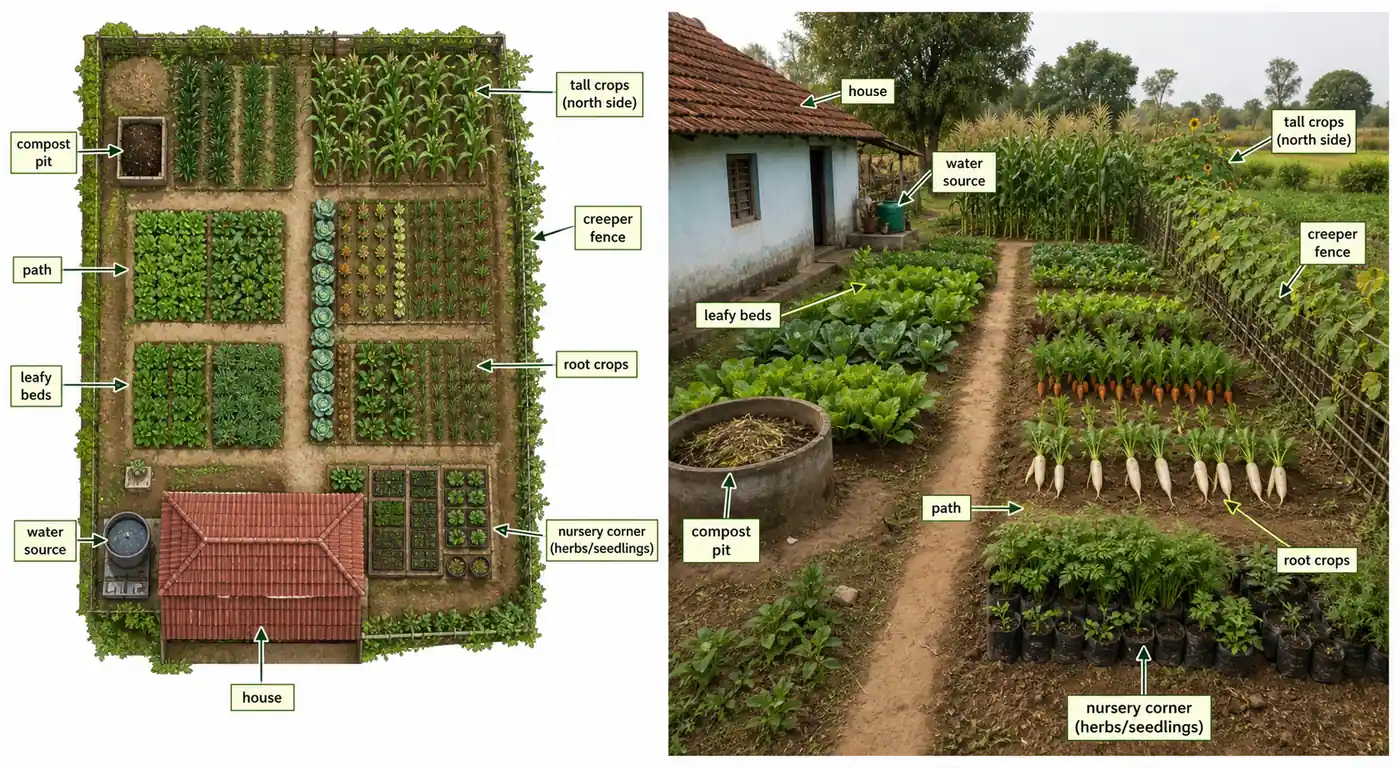
Kitchen gardening is not random planting. It follows a clear layout logic:
- choose a sunny place
- use compost and decomposed organic matter
- grow seasonal vegetables
- practise mixed cropping and crop rotation
- irrigate lightly but regularly
- observe pests and diseases early
- avoid keeping any part of the land vacant
Some standard planning points are especially important:
- papaya, lemon, lime, and karonda should be planted on the northern side so that their shade does not affect vegetable beds
- cucurbits and beans should be trained on borders or fences
- root crops such as radish, carrot, and turnip should be raised on ridges
- a compost pit should be provided in one corner
- sowing should be staggered for continuous supply
- shade-tolerant crops such as ginger and turmeric can be grown under fruit trees
For a family of about five to six members, roughly 250 to 300 square metres may be sufficient for a good kitchen garden. A single member may be planned with about 20 m² in memory-based questions.
Suitable plants for a kitchen garden
Common examples include:
- papaya
- banana
- grapes
- lime
- karonda
Named small-space examples often remembered are:
- Amrapali mango
- Pusa Nanha papaya
These examples show that a kitchen garden can combine vegetables, fruits, and utility crops in a compact area.
Advantages of organic farming
The lesson also points to broader advantages of organic farming:
Soil-related advantages
- improvement of soil structure and tilth
- better aeration
- easier root penetration
- improved water-holding capacity
- better nutrient retention
Plant-related advantages
- supply of a wider range of nutrients
- improved physiological growth
- stronger crop balance under suitable conditions
Economic advantages
- reduced dependence on purchased inputs
- productive use of farm wastes and by-products
- possibility of premium prices
- greater income security in diversified systems
Environmental and health advantages
- reduced pollution
- lower harmful chemical chain effects
- support for regeneration of degraded areas
- better food-quality image among consumers
Summary Cheat Sheet
| Concept / Topic | Key Details / Explanation |
|---|---|
| Meaning of certification | Certification proves that produce has been grown according to accepted organic standards, so market trust is based on verified records rather than verbal claims. |
| Why certification matters | It gives consumer trust, supports premium pricing, helps farmers gain recognition, and is essential for export markets. |
| Main support system | Organic farming works best when standards, inspection, records, regulation, market networks, and technology support operate together. |
| Important schemes | NPOF supports biofertilizer, biopesticide, and compost units; NHM/HMNEH support vermicompost, organic adoption, and group certification; RKVY supports organic promotion through state plans; NFSM promotes biofertilizers in crop programmes. |
| ICAR and research support | ICAR strengthens organic farming through research on biofertilizers, phosphocompost, vermicompost, municipal-waste compost, and crop- or region-specific packages of practice. |
| Important biofertilizers | Common names to remember are Rhizobium, Azotobacter, Azospirillum, Acetobacter, phosphate-solubilising bacteria, potash-mobilising bacteria, and zinc-solubilising bacteria. |
| Meaning of kitchen gardening | Kitchen gardening is a home-scale model of organic farming where vegetables and useful plants are grown near the house mainly for family use. |
| Kitchen garden layout rules | Climbers such as cucurbits and beans go on borders/fences, root crops such as radish and carrot go on ridges, a compost pit is kept in one corner, and tall fruit plants are placed on the north side to avoid shading beds. |
| Size and plant examples | A family kitchen garden may need about 250-300 m² for 5-6 members; examples often remembered are papaya, banana, grapes, lime, karonda, Amrapali mango, and Pusa Nanha papaya. |
| Best unit conclusion | Organic farming becomes practical and trustworthy when field practice, certification, government support, research institutions, and household-level models like kitchen gardening reinforce each other. |
Lesson Doubts
Ask questions, get expert answers