🛒 Organic Products, Markets and Rural Economy
A deeper lesson on organic product groups, market pathways, exports, and the rural-economic role of organic farming.
Organic Products, Markets and Rural Economy
Organic farming is not only a method of protecting soil and crops. It is also part of a wider economic system that includes processing, certification, transport, marketing, and rural employment.
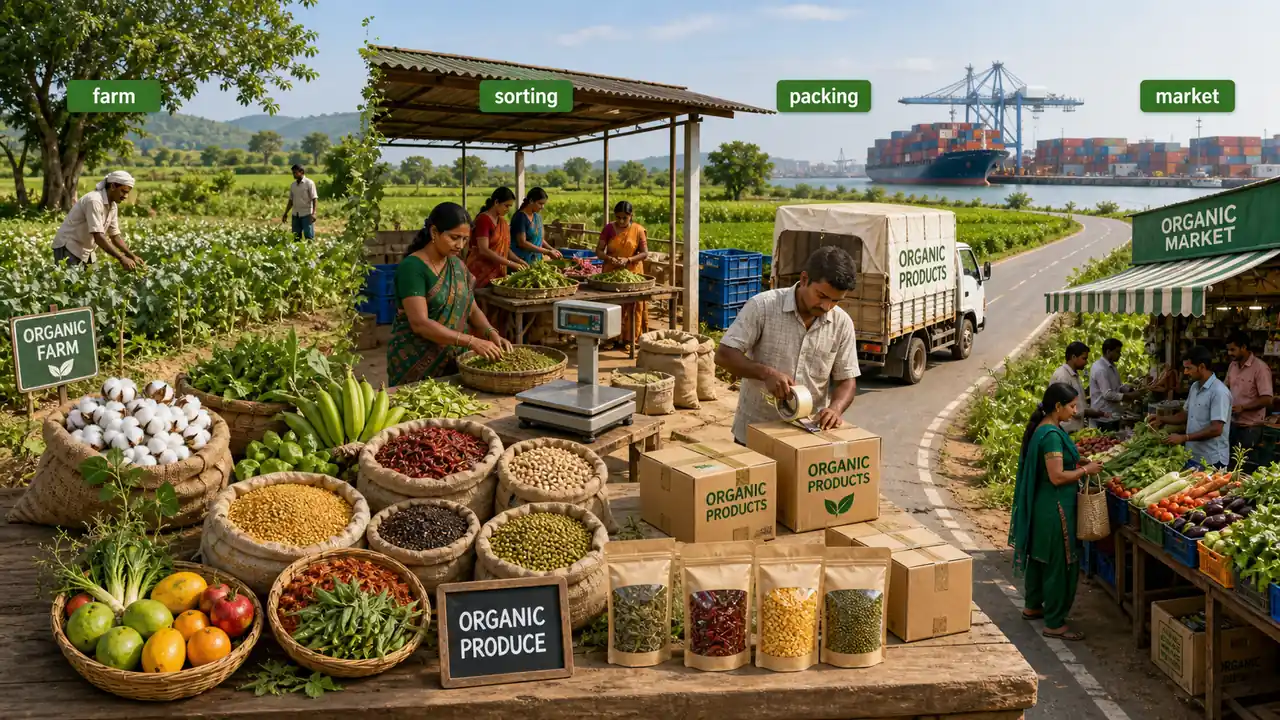
Take the example of a packet of organic turmeric. Before it reaches the buyer, many steps must work properly: production in the field, harvest, drying, cleaning, record keeping, certification, packing, transport, and sale. A crop can be grown carefully, but unless these later steps are organised, it may not reach the market as a trusted organic product.
Major groups of organic products
India’s organic product basket includes many categories:
- cereals
- pulses
- fruits
- vegetables
- spices
- oilseeds
- tea
- processed foods
- herbs
- cotton and related products
These become easier to remember when grouped by use.
Staple food products
- wheat
- rice
- maize
- pulses such as red gram and black gram
Fresh and nutrition-oriented products
- banana
- mango
- orange
- pineapple
- brinjal
- garlic
- potato
- tomato
- onion
High-value products
- chilli
- cardamom
- turmeric
- black pepper
- ginger
- vanilla
- clove
- cinnamon
- nutmeg
- mace
- tea
- coffee
Industrial and non-food products
- cotton
- textiles
- herbal products
- jaggery and sugar
This classification helps students remember that organic farming is not limited to fresh vegetables. It also reaches export crops, processed foods, plantation products, and fibre crops.
Pro Content Locked
Upgrade to Pro to access this lesson and all other premium content.
₹99 charged monthly · Cancel anytime
- All Agriculture & Banking Courses
- AI Lesson Questions (100/day)
- AI Doubt Solver (50/day)
- Glows & Grows Feedback (30/day)
- AI Section Quiz (20/day)
- 22-Language Translation (100/day)
- Recall Questions (20/day)
- AI Quiz (15/day)
- AI Quiz Paper Analysis (100/day)
- AI Step-by-Step Explanations (100/day)
- Spaced Repetition Recall (FSRS)
- AI Tutor
- Immersive Text Questions
- Audio Lessons — Hindi & English
- Mock Tests & Previous Year Papers
- Summary & Mind Maps
- XP, Levels, Leaderboard & Badges
- Generate New Classrooms
- Voice AI Teacher (AgriDots Live)
- AI Revision Assistant
- Knowledge Gap Analysis
- Interactive Revision (LangGraph)
🔒 Secure via Razorpay · Cancel anytime · No hidden fees
Organic Products, Markets and Rural Economy
Organic farming is not only a method of protecting soil and crops. It is also part of a wider economic system that includes processing, certification, transport, marketing, and rural employment.
Take the example of a packet of organic turmeric. Before it reaches the buyer, many steps must work properly: production in the field, harvest, drying, cleaning, record keeping, certification, packing, transport, and sale. A crop can be grown carefully, but unless these later steps are organised, it may not reach the market as a trusted organic product.
Major groups of organic products
India’s organic product basket includes many categories:
- cereals
- pulses
- fruits
- vegetables
- spices
- oilseeds
- tea
- processed foods
- herbs
- cotton and related products
These become easier to remember when grouped by use.
Staple food products
- wheat
- rice
- maize
- pulses such as red gram and black gram
Fresh and nutrition-oriented products
- banana
- mango
- orange
- pineapple
- brinjal
- garlic
- potato
- tomato
- onion
High-value products
- chilli
- cardamom
- turmeric
- black pepper
- ginger
- vanilla
- clove
- cinnamon
- nutmeg
- mace
- tea
- coffee
Industrial and non-food products
- cotton
- textiles
- herbal products
- jaggery and sugar
This classification helps students remember that organic farming is not limited to fresh vegetables. It also reaches export crops, processed foods, plantation products, and fibre crops.
Why markets matter in organic farming
Organic production becomes sustainable for farmers only when the following conditions are present:
- buyers trust the product
- certification systems function properly
- market links are available
- price realisation is fair
Without these supports, organic farming remains only a production effort and may not become a reliable livelihood.
The basic market chain can be understood as follows:
| Stage | Meaning |
|---|---|
| Production | crop is grown according to organic standards |
| Record keeping | farm activities are documented |
| Certification | trust is verified |
| Aggregation | produce from many farmers may be collected |
| Processing or packing | product becomes market-ready |
| Sale | domestic or export buyer pays for trusted produce |
This chain shows why organisation is important in the organic sector. One farmer may produce organically, but markets often demand volume, uniformity, traceability, and proper handling.
Export significance of organic products
India exports several organic commodities, especially:
- oilseeds
- processed food products
- cereals and millets
- tea
- pulses
- spices
Organic products from India are linked with markets in:
- the European Union
- the United States
- Australia
- Canada
- Japan
- Switzerland
- South Africa
- Middle East countries
The exact export figures may belong to a particular historical period, but the central idea remains the same: strong quality and certification make export possible.
India’s position in the organic sector
India is considered important in the world organic sector because it has:
- a large number of organic farmers
- significant certified area
- substantial organic production
- an export-oriented product basket
Different rankings may vary depending on whether area, certified area, or number of producers is being compared. Students should therefore read status statements carefully.
Contribution of organic farming to the rural economy
Organic farming can support the rural economy in many ways:
- value addition
- local input production
- compost-making enterprises
- labour use in diversified systems
- premium-value niche marketing
- reduced dependence on purchased chemical inputs in some situations
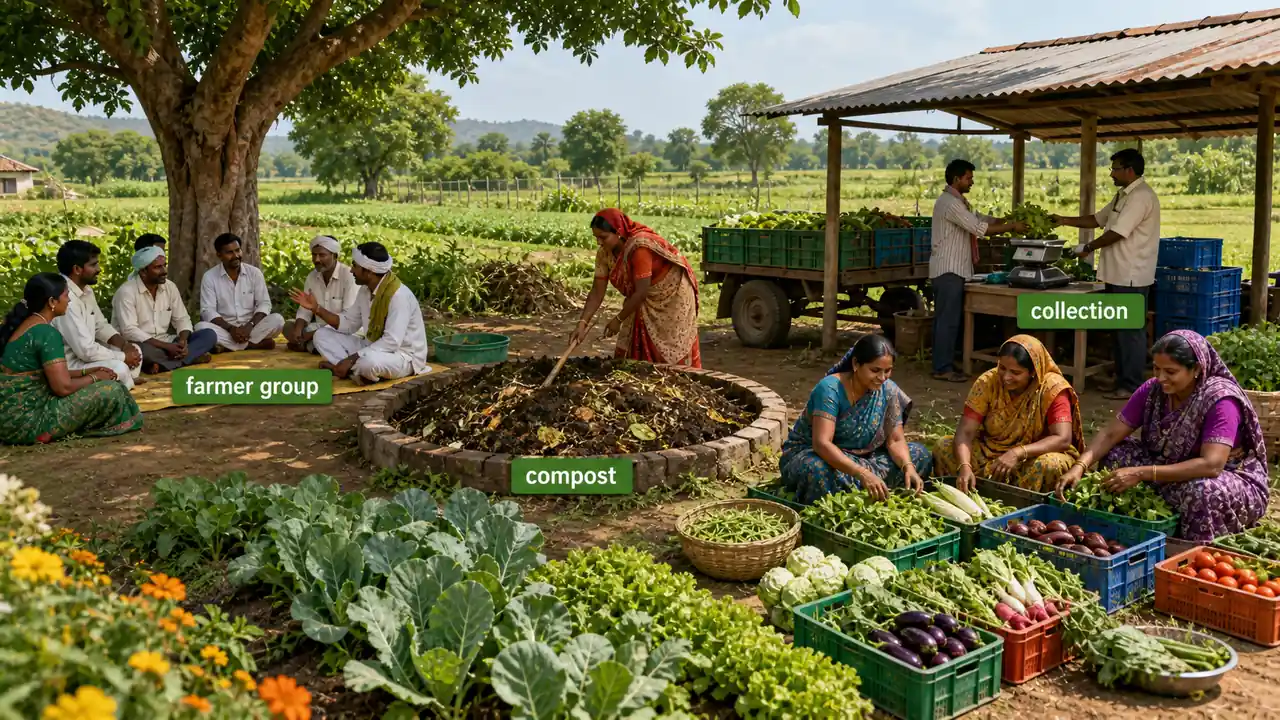
It can also encourage:
- village-level composting
- small bio-input enterprises
- farmer producer groups
- women’s participation in seed saving, home gardening, value addition, and local marketing
- diversified farm planning instead of dependence on one crop
This is why organic farming is discussed as part of rural development and not only crop production.
Why farmers shift towards organic systems
Farmers may move towards organic farming for several practical reasons:
- concern for long-term soil fertility
- reduced cost of cultivation in some local systems
- hope for better-quality produce
- more stable performance in balanced systems
- lower dependence on purchased external inputs
For small and marginal farmers especially, the use of locally available inputs can reduce financial risk.
Practical constraints in the transition period
The shift to organic farming is not always easy. Important difficulties include:
- delayed premium-price realisation
- certification difficulty
- storage and marketing problems
- risk during the transition period
- need for institutional support
A balanced answer should mention both opportunity and limitation. Organic farming offers ecological and economic promise, but success depends on support systems, buyer trust, and organised market access.
Summary Cheat Sheet
| Concept / Topic | Key Details / Explanation |
|---|---|
| Economic meaning of organic farming | Organic farming becomes economically meaningful only when production is linked with record keeping, certification, packing, transport, and sale. |
| Main product groups | India’s organic basket includes cereals, pulses, fruits, vegetables, spices, oilseeds, tea, processed foods, herbs, cotton, and related products. |
| Grouped examples | Staple products include wheat, rice, and pulses; fresh products include banana, mango, brinjal, garlic, and tomato; high-value products include turmeric, black pepper, cardamom, ginger, and tea. |
| Why markets matter | Markets matter because farmers need trust, traceability, proper handling, and fair price realisation for organic farming to become a reliable livelihood. |
| Organic market chain | The usual chain is production -> record keeping -> certification -> aggregation -> processing/packing -> sale, which explains how organic produce reaches organised buyers. |
| Main export categories | Important export groups are oilseeds, processed foods, cereals and millets, tea, pulses, and spices. |
| India’s global position | India is important in the world organic sector because of its large producer base, significant certified area, and broad export-oriented product basket. |
| Rural economy contribution | Organic farming supports the rural economy through composting, value addition, local input enterprises, labour use in diversified systems, women’s participation, and farmer groups. |
| Why farmers shift | Farmers may shift because of concern for long-term soil fertility, reduced dependence on purchased inputs, better produce quality, and lower financial risk in some local systems. |
| Transition constraints | Major limits are delayed premium-price realisation, certification difficulty, storage and marketing problems, and the need for stronger institutional support during transition. |
Lesson Doubts
Ask questions, get expert answers