📝 Organic Farming Practice and Revision
A revision lesson with concept checks and short-answer practice for Unit 2.
Organic Farming Practice and Revision
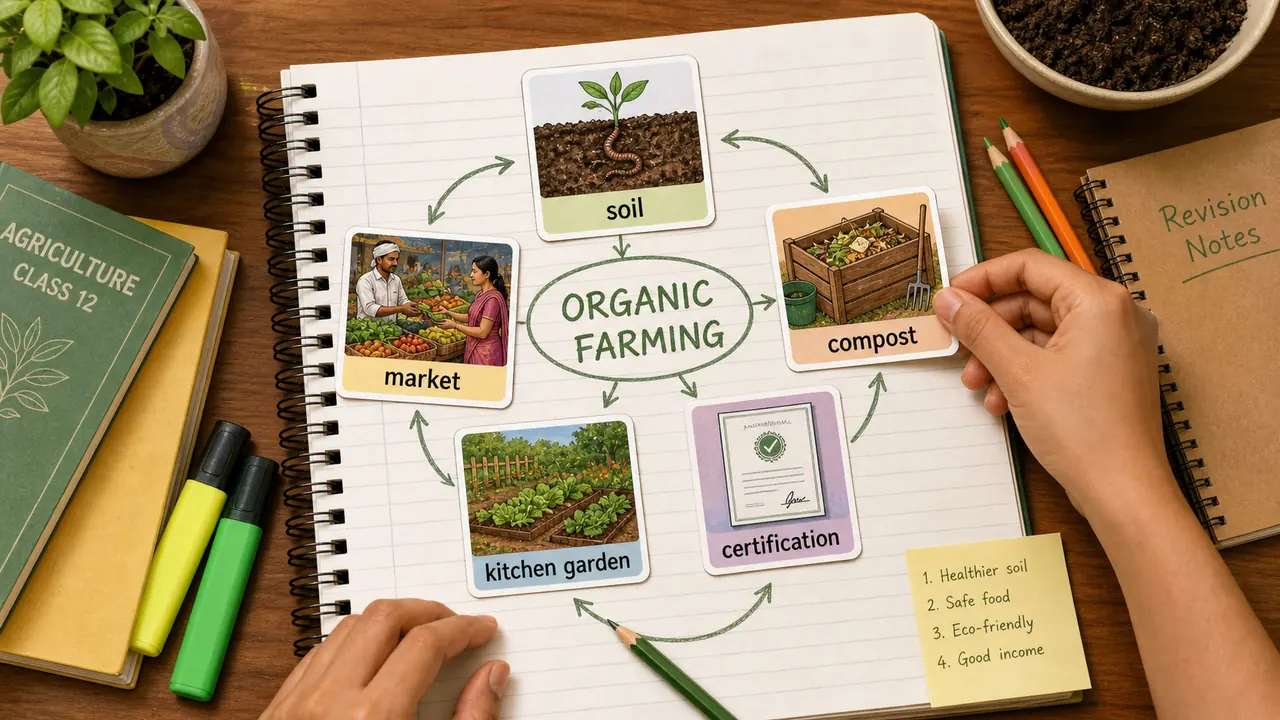
Unit 2 is easiest to revise as one connected chain: living soil, recycling, certification, support systems, kitchen gardening, markets, and rural economy.
Unit sequence
Move through the unit in this order:
- begin with the meaning of organic farming and the idea of living soil
- connect that idea with principles such as recycling, ecological balance, and long-term fertility
- revise certification and schemes as the organised support behind organic farming
- use kitchen gardening as the household-level example
- end with markets, exports, and the rural economy
If you can explain that sequence aloud in two minutes, the unit is already well organized in memory.
Core concept revision
- Organic farming = farming based mainly on natural, biological, and local resources with minimum dependence on synthetic inputs.
- Certification = the verification system that gives trust to organic claims.
- Kitchen garden = a planned home garden that supplies vegetables and demonstrates organic principles in a small space.
- Organic market = a system in which production, records, certification, packing, transport, and price realisation all matter.
Quick objective check
- Organic farming mainly tries to protect:
- soil life, ecological balance, and long-term sustainability
- One major reason for renewed interest in organic farming is:
- declining soil health and rising cost of chemical-intensive farming
- Sikkim is remembered in this unit as:
- India’s first organic state
- A country often remembered for large area under organic farming is:
- Australia
- Organic certification is important mainly because it:
- builds market trust and supports premium-price recognition
- A key institutional support centre mentioned in the unit is:
- National Centre of Organic Farming, Ghaziabad
- Biofertilizers linked with organic and soil-health programmes include:
- Rhizobium, Azotobacter, Azospirillum, and phosphate-solubilising bacteria
- Kitchen gardening is mainly done to:
- provide fresh vegetables to the family throughout the year
- Climbers such as cucurbits and beans in a kitchen garden are best:
- trained on the border or fence
- Root crops such as radish and carrot are preferably grown:
- on ridges
Fill in the blanks
- Organic farming treats the soil as a __________ entity. Answer cue: living
- Concern for organic farming increased after the long-term side effects of the __________ Revolution became visible. Answer cue: Green
- The first organic state of India mentioned in this unit is __________. Answer cue: Sikkim
- One of the major export groups in Indian organic trade is __________. Answer cue: oilseeds
- The scheme NPOF supports units for biofertilizer, biopesticide, and __________ production. Answer cue: compost
- In kitchen gardening, a compost pit should be kept in one __________ of the garden. Answer cue: corner
- Proper __________ should be followed in selecting vegetable crops in the kitchen garden. Answer cue: crop rotation
- Under fruit trees, shade-tolerant crops like ginger and __________ can be grown. Answer cue: turmeric
- The term organic farming was coined by __________. Answer cue: Lord Northbourne
- The father of organic farming is __________. Answer cue: Albert Howard
Match the following
| Column A | Column B |
|---|---|
| Organic threshold standards | define accepted organic practice |
| Certification | verifies compliance |
| Market network | connects produce with buyers |
| Kitchen garden | family nutrition and fresh vegetables |
| ICAR support | research and technology packages |
Short-answer practice
- Define organic farming in your own words.
- Explain why organic farming is considered a present need.
- State any two principles of organic farming.
- Why is soil called a living entity in this chapter?
- Why is certification necessary in organic produce marketing?
- Mention any two government supports for organic farming.
- What is the purpose of kitchen gardening?
- Why are fruit plants placed on the north side of a kitchen garden?
- How can organic farming help the rural economy?
- Why does transition to organic farming sometimes become difficult for farmers?
Long-answer practice
- Explain the concept, history, and present need of organic farming in India.
- Discuss the principles and present status of organic farming.
- Explain the importance of certification and government schemes in promoting organic farming.
- Describe the layout, planning principles, and benefits of a kitchen garden.
- Discuss the role of organic products, markets, and exports in the rural economy.
Caselet practice
Caselet 1: soil and recycling
A farmer notices that the soil has become hard and water does not enter easily. The farmer begins adding compost, returning residues, growing legumes in rotation, and reducing unnecessary chemical inputs.
Pro Content Locked
Upgrade to Pro to access this lesson and all other premium content.
₹99 charged monthly · Cancel anytime
- All Agriculture & Banking Courses
- AI Lesson Questions (100/day)
- AI Doubt Solver (50/day)
- Glows & Grows Feedback (30/day)
- AI Section Quiz (20/day)
- 22-Language Translation (100/day)
- Recall Questions (20/day)
- AI Quiz (15/day)
- AI Quiz Paper Analysis (100/day)
- AI Step-by-Step Explanations (100/day)
- Spaced Repetition Recall (FSRS)
- AI Tutor
- Immersive Text Questions
- Audio Lessons — Hindi & English
- Mock Tests & Previous Year Papers
- Summary & Mind Maps
- XP, Levels, Leaderboard & Badges
- Generate New Classrooms
- Voice AI Teacher (AgriDots Live)
- AI Revision Assistant
- Knowledge Gap Analysis
- Interactive Revision (LangGraph)
🔒 Secure via Razorpay · Cancel anytime · No hidden fees
Organic Farming Practice and Revision
Unit 2 is easiest to revise as one connected chain: living soil, recycling, certification, support systems, kitchen gardening, markets, and rural economy.
Unit sequence
Move through the unit in this order:
- begin with the meaning of organic farming and the idea of living soil
- connect that idea with principles such as recycling, ecological balance, and long-term fertility
- revise certification and schemes as the organised support behind organic farming
- use kitchen gardening as the household-level example
- end with markets, exports, and the rural economy
If you can explain that sequence aloud in two minutes, the unit is already well organized in memory.
Core concept revision
- Organic farming = farming based mainly on natural, biological, and local resources with minimum dependence on synthetic inputs.
- Certification = the verification system that gives trust to organic claims.
- Kitchen garden = a planned home garden that supplies vegetables and demonstrates organic principles in a small space.
- Organic market = a system in which production, records, certification, packing, transport, and price realisation all matter.
Quick objective check
- Organic farming mainly tries to protect:
- soil life, ecological balance, and long-term sustainability
- One major reason for renewed interest in organic farming is:
- declining soil health and rising cost of chemical-intensive farming
- Sikkim is remembered in this unit as:
- India’s first organic state
- A country often remembered for large area under organic farming is:
- Australia
- Organic certification is important mainly because it:
- builds market trust and supports premium-price recognition
- A key institutional support centre mentioned in the unit is:
- National Centre of Organic Farming, Ghaziabad
- Biofertilizers linked with organic and soil-health programmes include:
- Rhizobium, Azotobacter, Azospirillum, and phosphate-solubilising bacteria
- Kitchen gardening is mainly done to:
- provide fresh vegetables to the family throughout the year
- Climbers such as cucurbits and beans in a kitchen garden are best:
- trained on the border or fence
- Root crops such as radish and carrot are preferably grown:
- on ridges
Fill in the blanks
- Organic farming treats the soil as a __________ entity. Answer cue: living
- Concern for organic farming increased after the long-term side effects of the __________ Revolution became visible. Answer cue: Green
- The first organic state of India mentioned in this unit is __________. Answer cue: Sikkim
- One of the major export groups in Indian organic trade is __________. Answer cue: oilseeds
- The scheme NPOF supports units for biofertilizer, biopesticide, and __________ production. Answer cue: compost
- In kitchen gardening, a compost pit should be kept in one __________ of the garden. Answer cue: corner
- Proper __________ should be followed in selecting vegetable crops in the kitchen garden. Answer cue: crop rotation
- Under fruit trees, shade-tolerant crops like ginger and __________ can be grown. Answer cue: turmeric
- The term organic farming was coined by __________. Answer cue: Lord Northbourne
- The father of organic farming is __________. Answer cue: Albert Howard
Match the following
| Column A | Column B |
|---|---|
| Organic threshold standards | define accepted organic practice |
| Certification | verifies compliance |
| Market network | connects produce with buyers |
| Kitchen garden | family nutrition and fresh vegetables |
| ICAR support | research and technology packages |
Short-answer practice
- Define organic farming in your own words.
- Explain why organic farming is considered a present need.
- State any two principles of organic farming.
- Why is soil called a living entity in this chapter?
- Why is certification necessary in organic produce marketing?
- Mention any two government supports for organic farming.
- What is the purpose of kitchen gardening?
- Why are fruit plants placed on the north side of a kitchen garden?
- How can organic farming help the rural economy?
- Why does transition to organic farming sometimes become difficult for farmers?
Long-answer practice
- Explain the concept, history, and present need of organic farming in India.
- Discuss the principles and present status of organic farming.
- Explain the importance of certification and government schemes in promoting organic farming.
- Describe the layout, planning principles, and benefits of a kitchen garden.
- Discuss the role of organic products, markets, and exports in the rural economy.
Caselet practice
Caselet 1: soil and recycling
A farmer notices that the soil has become hard and water does not enter easily. The farmer begins adding compost, returning residues, growing legumes in rotation, and reducing unnecessary chemical inputs.
Questions
- Which principle of organic farming is shown here?
- Why are soil organisms important in this case?
- Why will improvement take time instead of appearing in a single week?
Answer cues: recycling, soil as a living entity, improvement of organic matter, gradual biological recovery
Caselet 2: market trust
Two farmers sell vegetables. Both claim that their produce is organic, but only one keeps records and follows group certification.
Questions
- Which farmer is more likely to reach a premium market?
- Why is certification important for export?
- Why is record keeping part of organic farming?
Answer cues: trust, traceability, verification, buyer confidence
Caselet 3: kitchen garden planning
A family wants fresh vegetables throughout the year. They plant papaya and lemon on the north side, climbers on the boundary, root crops on ridges, and leafy vegetables in repeated sowings.
Questions
- Why are tall or perennial plants placed on the north side?
- Why are climbers grown on the boundary?
- Why should leafy vegetables receive regular space in the garden?
Answer cues: avoid shade, save central space, frequent harvest and nutrition
Answer-opening practice
| Question type | Strong opening line |
|---|---|
| Definition | Organic farming is a whole-system farming approach that maintains soil life, ecological balance, and sustainable production mainly through natural and biological resources. |
| Certification | Certification is the verification system that converts organic practice into trusted organic identity in the market. |
| Kitchen garden | A kitchen garden is a planned home garden that supplies fresh vegetables and demonstrates organic principles at household scale. |
| Rural economy | Organic farming supports the rural economy when production, certification, value addition, and market access are connected. |
Summary Cheat Sheet
| Concept / Topic | Key Details / Explanation |
|---|---|
| Unit revision chain | Revise the unit in this order: living soil -> principles -> certification and schemes -> kitchen gardening -> markets and rural economy. |
| Organic farming definition | Organic farming means ecological system management based mainly on natural, biological, and local resources, not merely farming without chemicals. |
| Most important core idea | Soil is treated as a living entity, so recycling, composting, legumes, and biological activity are central to the chapter. |
| Certification answer line | Certification gives trust, traceability, and organised market identity to organic produce, especially when buyers cannot inspect the farm directly. |
| Schemes and institutions to mention | Strong revision answers should use NPOF, NHM/HMNEH, RKVY, NFSM, ICAR, and the National Centre of Organic Farming, Ghaziabad. |
| Biofertilizer recall | Frequently asked names are Rhizobium, Azotobacter, Azospirillum, and phosphate-solubilising bacteria. |
| Kitchen garden essentials | A kitchen garden is the easiest home-scale model of organic farming and should include compost use, crop rotation, regular sowing, and continuous vegetable supply. |
| Kitchen garden layout facts | Climbers go on the boundary, root crops go on ridges, tall fruit plants go on the north side, and a compost pit stays in one corner. |
| Organic market chain | Organic products gain value only when linked with records, certification, packing, transport, and sale. |
| Rural economy role | Organic farming strengthens the rural economy through local enterprises, value addition, composting, and farmer-group participation. |
| Caselet answer cues | Soil caselets should use recycling and biological recovery; market caselets should use trust, verification, and traceability; kitchen-garden caselets should use avoid shade, save space, and frequent harvest. |
Lesson Doubts
Ask questions, get expert answers