📦 Post-Harvest Basics for Fruits, Vegetables and Cereals
A deeper lesson on the meaning, scope, losses, and importance of post-harvest management.
Post-Harvest Basics for Fruits, Vegetables and Cereals
Harvest is not the end of agricultural production. If produce is bruised, badly stored, poorly packed, or delayed in transport, a large part of its value is lost after it leaves the field.
Start with a market scene
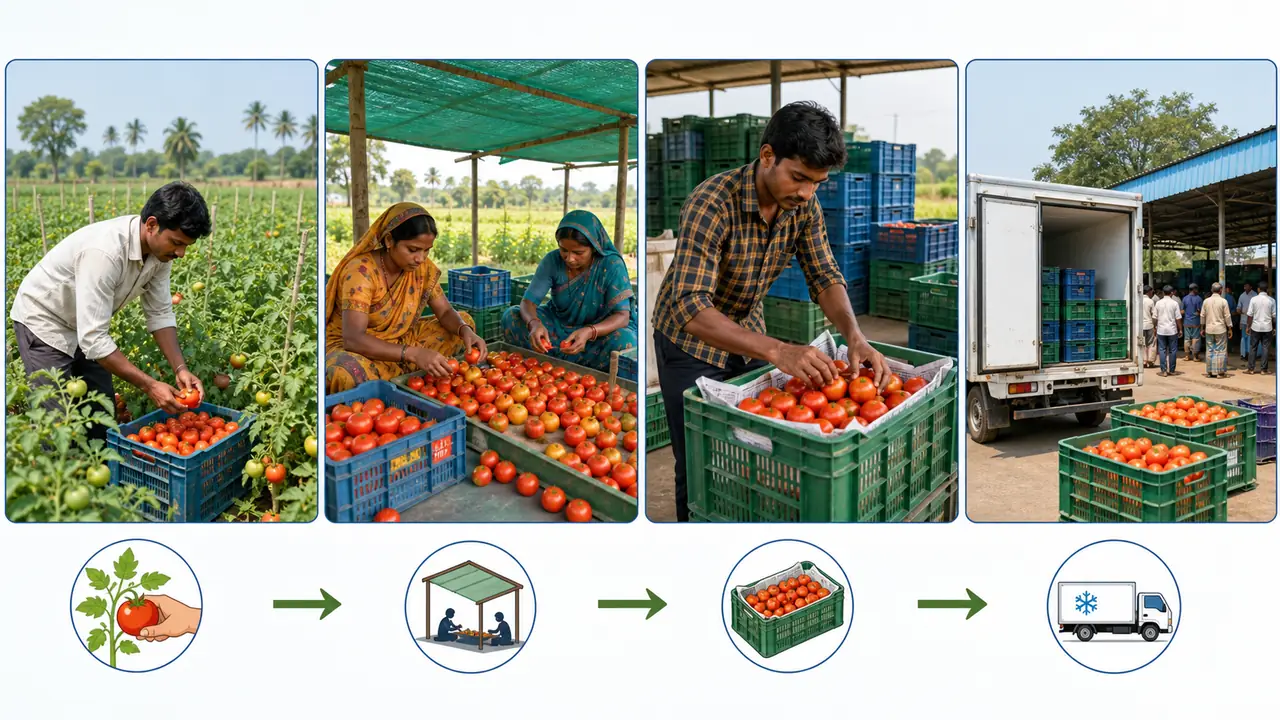
Imagine two farmers harvesting the same tomato crop on the same morning. Farmer A keeps the crates in shade, removes cracked fruits, pre-cools the produce, and sends uniform lots to market. Farmer B piles the tomatoes in the sun, presses heavy sacks over them, and waits until evening transport. By the next day both farmers still have "tomatoes", but only one has a product that buyers trust.
That is the heart of post-harvest management: after harvest, the crop is still alive, but its quality is slowly being spent. Good handling makes that spending slow and controlled. Bad handling makes quality disappear quickly.
What post-harvest management means
Post-harvest management includes all important steps after harvesting:
Pro Content Locked
Upgrade to Pro to access this lesson and all other premium content.
₹99 charged monthly · Cancel anytime
- All Agriculture & Banking Courses
- AI Lesson Questions (100/day)
- AI Doubt Solver (50/day)
- Glows & Grows Feedback (30/day)
- AI Section Quiz (20/day)
- 22-Language Translation (100/day)
- Recall Questions (20/day)
- AI Quiz (15/day)
- AI Quiz Paper Analysis (100/day)
- AI Step-by-Step Explanations (100/day)
- Spaced Repetition Recall (FSRS)
- AI Tutor
- Immersive Text Questions
- Audio Lessons — Hindi & English
- Mock Tests & Previous Year Papers
- Summary & Mind Maps
- XP, Levels, Leaderboard & Badges
- Generate New Classrooms
- Voice AI Teacher (AgriDots Live)
- AI Revision Assistant
- Knowledge Gap Analysis
- Interactive Revision (LangGraph)
🔒 Secure via Razorpay · Cancel anytime · No hidden fees
Post-Harvest Basics for Fruits, Vegetables and Cereals
Harvest is not the end of agricultural production. If produce is bruised, badly stored, poorly packed, or delayed in transport, a large part of its value is lost after it leaves the field.
Start with a market scene
Imagine two farmers harvesting the same tomato crop on the same morning. Farmer A keeps the crates in shade, removes cracked fruits, pre-cools the produce, and sends uniform lots to market. Farmer B piles the tomatoes in the sun, presses heavy sacks over them, and waits until evening transport. By the next day both farmers still have "tomatoes", but only one has a product that buyers trust.
That is the heart of post-harvest management: after harvest, the crop is still alive, but its quality is slowly being spent. Good handling makes that spending slow and controlled. Bad handling makes quality disappear quickly.
What post-harvest management means
Post-harvest management includes all important steps after harvesting:
- cleaning
- sorting and grading
- packing
- storage
- transport
- processing, where needed
It also includes all the scientific treatments used to slow deterioration, prevent sprouting, reduce rotting, and make produce suitable for long-distance sale or processing.
Why this unit matters
| Benefit | Explanation |
|---|---|
| Loss reduction | less spoilage means more usable produce |
| Better quality | freshness, texture, and appearance improve |
| Better price | graded and properly packed produce sells better |
| Longer availability | storage and processing extend supply |
Importance in the Indian context
India is one of the world's major horticultural producers. It grows large quantities of fruits, vegetables, plantation crops, spices, flowers, and aromatic plants. Yet a large share of this production never reaches consumers in the best possible condition.
The biggest reasons are:
- perishability
- inadequate handling infrastructure
- weak transport and storage systems
- insufficient processing
An important national problem is that production may be high, but processing remains low compared with many countries where a much larger share of fruit and vegetable output is preserved or converted into stable products.
That is why post-harvest technology is linked with:
- food safety
- food security
- export growth
- farmer income
- value addition
- better use of seasonal glut production
Losses are amplified by weak transport, inadequate infrastructure, poor handling systems, and limited processing support. So post-harvest management is both a biological and an economic systems topic.
So post-harvest technology is not a small supporting topic. It is one of the main tools for turning production into usable food, stable income, and marketable products.
Think like a produce doctor
Every post-harvest answer becomes easier if you diagnose the produce like a doctor:
| Symptom in produce | Hidden cause | First thinking step |
|---|---|---|
| Shrivelling | water loss through transpiration | raise humidity, cool quickly, avoid delay |
| Softening | ripening and tissue breakdown | harvest at right maturity, reduce temperature |
| Rotting | fungal or bacterial infection | remove injured produce, keep water and containers clean |
| Poor price | uneven size, bruises, poor colour | sort, grade, pack, and present uniform lots |
This table is not only for memorization. It trains you to ask "what is the real problem?" before naming a treatment.
Why losses are so high in horticultural produce
Fruits and vegetables are living materials even after harvest. They breathe, lose water, soften, ripen further, and become vulnerable to microbes. If they are handled roughly, kept in heat, washed in dirty water, packed badly, or delayed in marketing, quality falls rapidly.
The basic pattern of loss is easy to understand:
- physical loss from bruising, cutting, crushing, and shrivelling
- physiological loss from respiration, transpiration, ripening, and senescence
- pathological loss from fungi and bacteria
- market loss when appearance falls and price drops even before the produce is fully spoiled
Crop-wise loss estimates also show that different commodities behave differently. Highly perishable crops lose value faster and more heavily.
The mango truck
A mango lot may look perfect at harvest, but during transport three small mistakes can ruin it:
- overfilled crates press fruits against each other
- field heat remains trapped inside the load
- injured fruits release moisture and become infection points
By the time the truck reaches the city, the loss may appear as black spots, soft patches, poor aroma, or lower auction price. The full chain is injury -> heat -> infection -> price loss.
Processing as a post-harvest answer
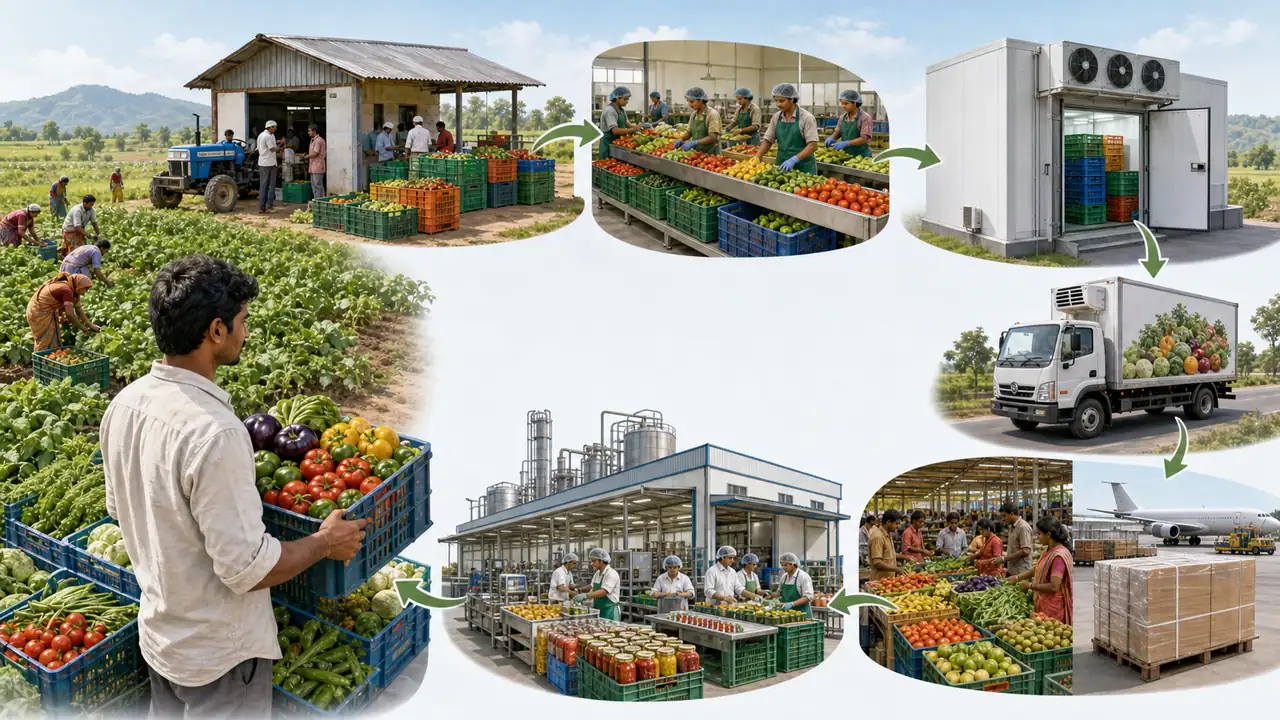
When a crop arrives in huge quantity during a short season, fresh sale alone is often not enough. Processing helps absorb excess produce and convert it into safer, longer-lasting products.
Common processed product groups include:
- pulp and juice
- ready-to-serve beverages
- pickles
- jams and jellies
- syrups and squashes
- tomato puree and ketchup
- canned vegetables
The core logic is:
processing saves surplus produce, cuts avoidable loss, extends availability, and increases value.
This is especially important during seasonal gluts, when fresh sale alone cannot absorb all market arrivals.
Fresh handling vs processing
Two broad post-harvest pathways can be contrasted as follows:
| Pathway | Main aim | Examples |
|---|---|---|
| Fresh-market handling | keep produce attractive and fresh until sale | washing, grading, pre-cooling, packing, cold storage |
| Processing and preservation | convert surplus into stable products | juice, pulp, jam, jelly, pickle, canned products, cereal snacks |
This distinction helps students understand why India needs both pack-houses and food-processing units. Fresh storage alone cannot absorb every seasonal glut, and processing alone cannot replace good fresh handling.
Why one percent loss reduction matters
One powerful idea is this: even a small percentage reduction in post-harvest loss saves a very large quantity of food at national scale. For students, the concept is more important than the arithmetic:
- high production plus high loss is inefficient
- loss reduction is like "producing more" without using more land
- every saved tonne improves farmer income, consumer supply, and food security
Therefore post-harvest technology is not only a farmer-level practice; it is a national food-system strategy.
Scale of food processing units
Food-processing industries can be classified by production capacity as follows.
| Scale | Capacity idea |
|---|---|
| Large scale | above 250 tonnes per year |
| Small scale | 50-250 tonnes per year |
| Cottage scale | 10-50 tonnes per year |
| Home scale | below 10 tonnes per year |
Reference data bank: India, losses and processing
The exact figures show why post-harvest technology matters in India: high production becomes useful only when losses are reduced and value addition improves.
Horticulture area and production status
| Crop group | Area in thousand ha | Production in thousand tonnes | Productivity in tonnes per ha |
|---|---|---|---|
| Fruits | 6,301 | 90,186 | 11.32 |
| Vegetables | 10,106 | 169,064 | 17.22 |
| Plantation crops | 3,680 | 16,658 | 4.54 |
| Spices | 3,474 | 6,988 | 1.87 |
| Loose flowers | 278 | 2,184 | 6.59 |
| Aromatic plants | 634 | 1,022 | 1.19 |
Additional facts:
- horticulture crops occupy about 24.472 million ha
- total horticulture production is around 286.188 million tonnes
- India is described as second after China in fruits and vegetables
- India leads in several crops, including mango, banana, papaya, cashew nut, areca nut, potato, and okra
- cut-flower production was recorded as 74,305 lakh stems
- during 2015-16, fruit and vegetable exports were about Rs 8,391.41 crore
- fruit exports were about Rs 3,524.50 crore
- vegetable exports were about Rs 4,866.91 crore
Export composition of horticulture produce
| Export category | Approximate share by volume |
|---|---|
| Fresh fruits and vegetables | 76% |
| Processed fruits and vegetables | 23% |
| Floriculture and seeds | 1% |
This table explains why fresh handling is so important: most exported volume still moves as fresh produce, so washing, grading, cooling, packaging, and transport quality directly affect export value.
Crop-wise post-harvest loss estimates
| Fruit / vegetable | Percent loss range or estimate |
|---|---|
| Papaya | 40-100 |
| Mandarin | 20-95 |
| Banana | 20-80 |
| Grape | 27 |
| Lemon | 20-85 |
| Cauliflower | 49 |
| Tomato | 5-50 |
| Onion | 16-55 |
| Cabbage | 37 |
| Potato | 5-40 |
Broad national loss estimates are about 20-30% in fruits and 30-40% in vegetables between harvest and consumption. Reasons include perishability, weak post-harvest infrastructure, poor transport, inadequate markets, and low processing support.
Processing comparison: India and other countries
| Country / group | Approximate share of fruits and vegetables processed |
|---|---|
| India | less than 2% |
| Malaysia | 80% |
| Philippines | 78% |
| Brazil | 70% |
| Thailand | 30% |
| Many developed countries | 40-60% |
Exam connection: India's production is high, but processing share is low. Therefore, processing and preservation technologies are needed to absorb seasonal glut, reduce wastage, strengthen food security, and increase export of value-added products.
Indian processed fruit and vegetable product shares
| Product group | Share |
|---|---|
| Fruit pulp and juice | 27% |
| Ready-to-serve beverages | 13% |
| Pickles | 12% |
| Jams and jellies | 10% |
| Synthetic syrups | 8% |
| Squashes | 4% |
| Tomato puree and ketchup | 4% |
| Canned vegetables | 4% |
| Others | 18% |
Indian processing industry profile
| Industry segment | Share |
|---|---|
| Unorganized | 42% |
| Organized | 25% |
| Small scale | 33% |
Export products and destination countries
| Processed product | Countries commonly linked with it |
|---|---|
| Mango pulp | Saudi Arabia, UAE, UK, USA |
| Fruit juice | USSR |
| Canned fruits such as mango and guava | USSR, UAE |
| Canned vegetables such as green pepper | UK, USA, UAE |
| Dehydrated garlic and onion | USSR, Japan, UK |
| Pickles and chutney, especially mango | USA, Japan |
History facts
| Year | Person / institution | Key fact |
|---|---|---|
| 1749 | Needham | first recorded cause of spoilage in stored food |
| 1789 | Lavoisier | fermentation recorded |
| 1800 | Aes / de Heine text in source; Peter Durand | iron/metal container developments are linked with this period |
| 1765 | Spallanzani | challenged ideas around preservation by heating, forming a basis for canning science |
| 1804 | M. Nicolas Appert | successful preservation in glass container; known as Father of Canning |
| 1824 | Fastier | hold-the-cap can |
| 1857 | James Haryson | modern refrigeration |
| 1857 | Organized processing | fruit and vegetable processing started in an organized manner |
| 1861 | Papin | cooking of food by preserved means is recorded for this period |
| 1874 | Shriver | autoclave first used |
| 1920 | Mumbai | first fruit and vegetable processing factory in India |
| 1949 | Lucknow | Fruit Preservation and Canning Institute |
| 1950 | Mysore | Central Food Technological Research Institute |
| 1966 | Burg and Burg | hypobaric storage |
Why this matters beyond fruits
Post-harvest principles are not limited to horticulture. Cereals, pulses, flowers, roots, tubers, bulbs, and processed products all need the same basic discipline:
- harvest at proper stage
- handle gently
- remove field heat or excess moisture
- separate diseased material
- store under suitable conditions
- market or process without unnecessary delay
Fruits and vegetables
These are highly perishable because they contain a lot of water and continue respiring after harvest.
Good management focuses on:
- correct harvest maturity
- avoiding bruises and cuts
- shade and pre-cooling where possible
- fast movement to market, storage, or processing
Why maturity matters
Success in post-harvest handling with correct maturity:
- too early -> poor flavour and incomplete ripening
- too late -> softening, bruising, and shorter storage life
So harvest maturity is one of the first scientific steps in post-harvest management.
Cereals
Cereals are less delicate than fruits and vegetables, but they still need careful management.
Important steps include:
- drying to safe moisture
- cleaning and grading
- protection from insects, rodents, and fungi
- storage in dry, ventilated structures
For cereals, hidden losses are especially important. A grain lot may look acceptable from outside but still lose value through internal heating, mould growth, odour, reduced seed viability, or insect damage caused by excess moisture and poor storage hygiene.
How Unit 3 links all produce groups
These topics may look separate at first, but the same scientific ideas repeat:
| Scientific idea | Fruits and vegetables | Flowers | Cereals |
|---|---|---|---|
| Moisture control | prevent wilting/shrivelling | maintain turgidity without microbial growth | dry grain to safe moisture |
| Temperature control | slow respiration and ripening | slow senescence and ethylene effects | reduce insects and mould risk |
| Cleanliness | safe washing and packing | clean vase/holding solution | clean grain and storage structure |
| Mechanical protection | avoid bruises and cuts | avoid petal/stem injury | reduce breakage during threshing/milling |
| Market timing | avoid glut and distress sale | regulate flowering supply | store grain for later processing/sale |
This is the best mental model for the unit: different commodities, same goal - preserve value after harvest.
Common causes of post-harvest loss
- rough handling
- excess moisture
- high temperature
- poor ventilation
- microbial attack
- storage pests
These causes operate through underlying processes such as respiration, transpiration, ripening, ethylene action, and microbial growth after injury.
Important post-harvest operations
Pre-cooling
Pre-cooling removes field heat and slows respiration, ripening, and deterioration.
Important methods include:
- hydro cooling
- contact icing
- vacuum cooling
- cold-air or room-cooling approaches
Grading
Grading means classifying produce according to size, quality, and appearance.
It improves:
- market trust
- lot uniformity
- packaging efficiency
- price realization
Waxing
Special importance should be given to waxing of fruits and vegetables:
- it replaces some natural wax lost during handling
- it reduces water loss
- it improves appearance
- it can prolong storage life
Ripening management
Ripening can also be delayed or regulated scientifically.
Examples include:
- ethylene absorbents such as potassium permanganate
- growth-regulating treatments for delaying ripening in some fruits
The main lesson is that ripening is managed, not merely watched.
Storage logic
Proper storage extends produce life by controlling:
- respiration
- transpiration
- ripening
- biochemical change
- microbial deterioration
A simple rule is this:
- store only sound produce
- avoid damaged and diseased produce
- avoid very overripe or under-mature lots for long storage
Zero-energy cool chamber idea
One useful Indian post-harvest concept is the zero-energy cool chamber, which offers low-cost short-term storage by lowering temperature and maintaining higher humidity without full conventional refrigeration.
Scope of post-harvest technology
Post-harvest technology helps agriculture by:
- reducing waste
- improving quality and shelf life
- supporting value addition
- strengthening food safety
- boosting processing and export potential
It also supports:
- orderly marketing
- reduced distress sale during glut periods
- better use of infrastructure like cold stores and pack houses
- more stable supply for consumers in off-season periods
History points students should remember
A short history of processing and preservation is useful here. Every year need not be memorized, but a few landmarks are important:
- Nicolas Appert is remembered as the Father of Canning because he reported successful preservation of food in glass containers.
- Peter Durand is associated with the metal container.
- Early heating-based preservation ideas became the basis of canning science.
- Modern refrigeration developed later and transformed storage and transport possibilities.
- In India, organized fruit and vegetable processing began in the nineteenth century and later institutions such as CFTRI, Mysore and the preservation/canning institute at Lucknow strengthened the field.
These history points show how preservation moved from household practice to organized science and infrastructure.
Student way to remember this unit
Think of post-harvest management as a race against four enemies:
- heat
- moisture problems
- physical injury
- delay
Summary Cheat Sheet
| Concept / Topic | Key Details / Explanation |
|---|---|
| Meaning of post-harvest management | Post-harvest management includes all important steps after harvest such as cleaning, sorting, grading, packing, storage, transport, and processing. |
| Why the topic matters | It matters because reducing post-harvest loss improves usable food supply, farmer income, food security, quality, and export readiness without needing more land. |
| Main kinds of loss | Post-harvest losses are broadly physical (bruising, cutting, crushing), physiological (respiration, transpiration, ripening, senescence), pathological (fungi and bacteria), and market loss from poor appearance and reduced price. |
| Why horticultural losses are high | Fruits and vegetables remain living produce after harvest, so they continue to respire, lose water, soften, ripen, and become vulnerable to microbes. |
| Fresh handling versus processing | Fresh-market handling tries to keep produce fresh through washing, grading, pre-cooling, packing, and storage, while processing converts surplus into stable products such as juice, pulp, jam, jelly, pickle, puree, ketchup, and canned goods. |
| Why processing is important | Processing helps absorb seasonal glut, reduces avoidable wastage, extends availability, and adds value to the crop. |
| Important post-harvest operations | High-value operations are harvesting at proper maturity, gentle handling, pre-cooling, grading, waxing, ripening management, safe storage, and quick marketing or processing. |
| Pre-cooling | Pre-cooling removes field heat and slows respiration and deterioration. Important methods include hydro cooling, contact icing, vacuum cooling, and cold-air cooling. |
| Grading and waxing | Grading improves lot uniformity, market trust, and price realization. Waxing reduces water loss, improves appearance, and can extend storage life. |
| Produce-doctor diagnosis line | A good diagnosis line is: shrivelling -> water loss, softening -> ripening/tissue breakdown, rotting -> microbial infection, poor price -> bruising or non-uniform quality. |
| Fruits, vegetables, and cereals | Fruits and vegetables need speed, shade, cooling, and gentle handling; cereals need drying to safe moisture, cleaning, protection from insects and fungi, and proper ventilated storage. |
| Common causes of loss | Major causes are rough handling, excess moisture, high temperature, poor ventilation, microbial attack, storage pests, and marketing delay. |
| Storage logic | Good storage means controlling respiration, transpiration, ripening, biochemical change, and microbial deterioration, and storing only sound produce. |
| Zero-energy cool chamber | A zero-energy cool chamber is a low-cost storage idea that lowers temperature and maintains higher humidity without conventional refrigeration. |
| Indian significance | India has high horticultural production, but a large share is still lost because of weak handling infrastructure, poor storage, weak transport, and low processing support. |
| Important statistical idea | A high-value memory line is that even 1% reduction in post-harvest loss can save a very large quantity of food at national scale. |
| History points | Important names include Nicolas Appert as the Father of Canning, Peter Durand with the metal container, James Haryson with modern refrigeration, and Burg and Burg with hypobaric storage. |
| Best chapter memory line | The strongest chapter line is maturity + pre-cooling + grading + safe storage + quick market or processing. |
Lesson Doubts
Ask questions, get expert answers