🌸 Flower Management and Food-Sector Support
A fuller lesson on flower handling, harvest factors, post-harvest care, and the role of food-sector support.
Flower Management and Food-Sector Support
Flowers are among the most delicate agricultural products. Their value depends strongly on appearance, freshness, colour, stem quality, and vase life.
A flower is sold as a feeling
Unlike grain, a flower is not bought mainly for calories or storage value. It is bought for beauty, freshness, fragrance, colour, and emotion. That is why a flower can lose market value even when it has not technically "spoiled".
Think of a rose stem at a wedding shop. If the petals are bruised, the neck bends, or the leaves yellow, the buyer immediately sees the problem. This makes flower post-harvest management a quality-protection race from the moment of cutting.
Why flowers need special care
Cut flowers continue to lose water and respire after harvest. Their keeping quality is affected by:
- water uptake
- respiration rate
- relative humidity
- temperature
- microbial blockage in the stem
- ethylene sensitivity
Because flowers are sold mainly for beauty and freshness, even a small decline in quality causes a big fall in value. That is why post-harvest losses in flowers are often discussed in terms of farm-value loss, not only physical spoilage.
Pro Content Locked
Upgrade to Pro to access this lesson and all other premium content.
₹99 charged monthly · Cancel anytime
- All Agriculture & Banking Courses
- AI Lesson Questions (100/day)
- AI Doubt Solver (50/day)
- Glows & Grows Feedback (30/day)
- AI Section Quiz (20/day)
- 22-Language Translation (100/day)
- Recall Questions (20/day)
- AI Quiz (15/day)
- AI Quiz Paper Analysis (100/day)
- AI Step-by-Step Explanations (100/day)
- Spaced Repetition Recall (FSRS)
- AI Tutor
- Immersive Text Questions
- Audio Lessons — Hindi & English
- Mock Tests & Previous Year Papers
- Summary & Mind Maps
- XP, Levels, Leaderboard & Badges
- Generate New Classrooms
- Voice AI Teacher (AgriDots Live)
- AI Revision Assistant
- Knowledge Gap Analysis
- Interactive Revision (LangGraph)
🔒 Secure via Razorpay · Cancel anytime · No hidden fees
Flower Management and Food-Sector Support
Flowers are among the most delicate agricultural products. Their value depends strongly on appearance, freshness, colour, stem quality, and vase life.
A flower is sold as a feeling
Unlike grain, a flower is not bought mainly for calories or storage value. It is bought for beauty, freshness, fragrance, colour, and emotion. That is why a flower can lose market value even when it has not technically "spoiled".
Think of a rose stem at a wedding shop. If the petals are bruised, the neck bends, or the leaves yellow, the buyer immediately sees the problem. This makes flower post-harvest management a quality-protection race from the moment of cutting.
Why flowers need special care
Cut flowers continue to lose water and respire after harvest. Their keeping quality is affected by:
- water uptake
- respiration rate
- relative humidity
- temperature
- microbial blockage in the stem
- ethylene sensitivity
Because flowers are sold mainly for beauty and freshness, even a small decline in quality causes a big fall in value. That is why post-harvest losses in flowers are often discussed in terms of farm-value loss, not only physical spoilage.
Flower post-harvest work must also be seen within the larger Indian horticulture economy, where losses after harvest are strongly linked with weak infrastructure, transport gaps, and insufficient processing or support systems.
Easy analogy: cut stem as a drinking straw
After cutting, the stem works like a straw. If the straw is crushed, blocked by microbes, or kept away from water, the flower head wilts. Conditioning, clean water, pulsing, and preservatives are all attempts to keep this straw open and useful.
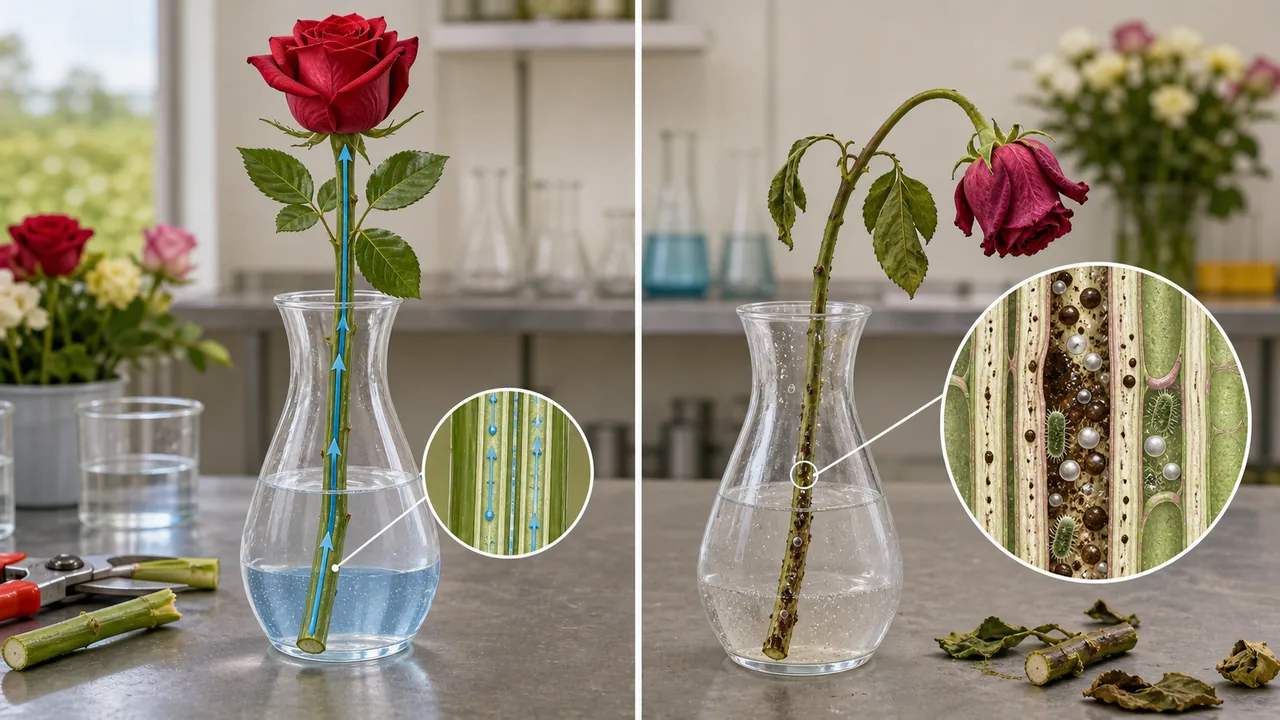
Use this analogy in your mind:
| Handling step | What it protects |
|---|---|
| sharp cut | open water channel |
| clean bucket | fewer microbes in the stem |
| pre-cooling | slower water loss and respiration |
| pulsing | temporary energy reserve before sale |
| upright transport where needed | shape of geotropic stems |
Three major factor groups
The flower chapter is easiest to understand through three layers:
Pre-harvest factors
- varietal or genetic makeup
- growing environment
- proper nutrition
- low disease and pest injury
Varietal and genetic differences are especially important. Some flower species and even different cultivars of the same flower naturally keep better after harvest than others. So post-harvest life begins with crop and cultivar selection.
Growing conditions also shape future vase life:
- flowers need proper light, but too much intense sunlight may scorch tissues
- temperature must suit the crop
- balanced nutrition supports better keeping quality
- excessive nitrogen can make plants softer and more disease-prone
- pollution, toxic gases, pests, and pathogens reduce quality before harvest itself
Post-harvest quality differs not only by species but also by cultivar. So genetic makeup is one of the earliest determinants of future vase life.
Harvest factors
- correct stage of opening
- correct time of day
- clean cutting method
- rapid movement to shade and water
This stage often decides whether a flower can travel well or not. The coolest part of the day is usually best for harvesting, and flowers should not be cut when surface water from rain or dew is still present.
Right cutting method also matters:
- use a sharp knife or secateurs
- avoid crushing the stem
- give slant cuts to many woody stems to expose greater water-absorbing area
- for latex-bearing flowers such as dahlia and poinsettia, special hot-water dipping can help manage latex problems
A useful harvest-stage rule is:
- spike-type flowers are often cut when about one-fourth to one-half of florets are open
- daisy-type flowers are often harvested when blooms are fully open
Post-harvest factors
- conditioning and hydration
- pre-cooling
- storage
- transport
- use of preservative solutions
These factors protect the quality created in the field. A poor post-harvest chain can destroy even a very good crop.
Why post-harvest support matters in India
The larger national context is clear:
- India is one of the biggest producers of fruits and vegetables
- post-harvest losses are still high
- weak infrastructure reduces realizable value
- processing share remains low compared with many countries
This matters in the flower chapter because delicate products like cut flowers suffer rapidly when:
- cooling is delayed
- transport is rough
- market linkage is weak
- bunching, grading, and packing systems are poor
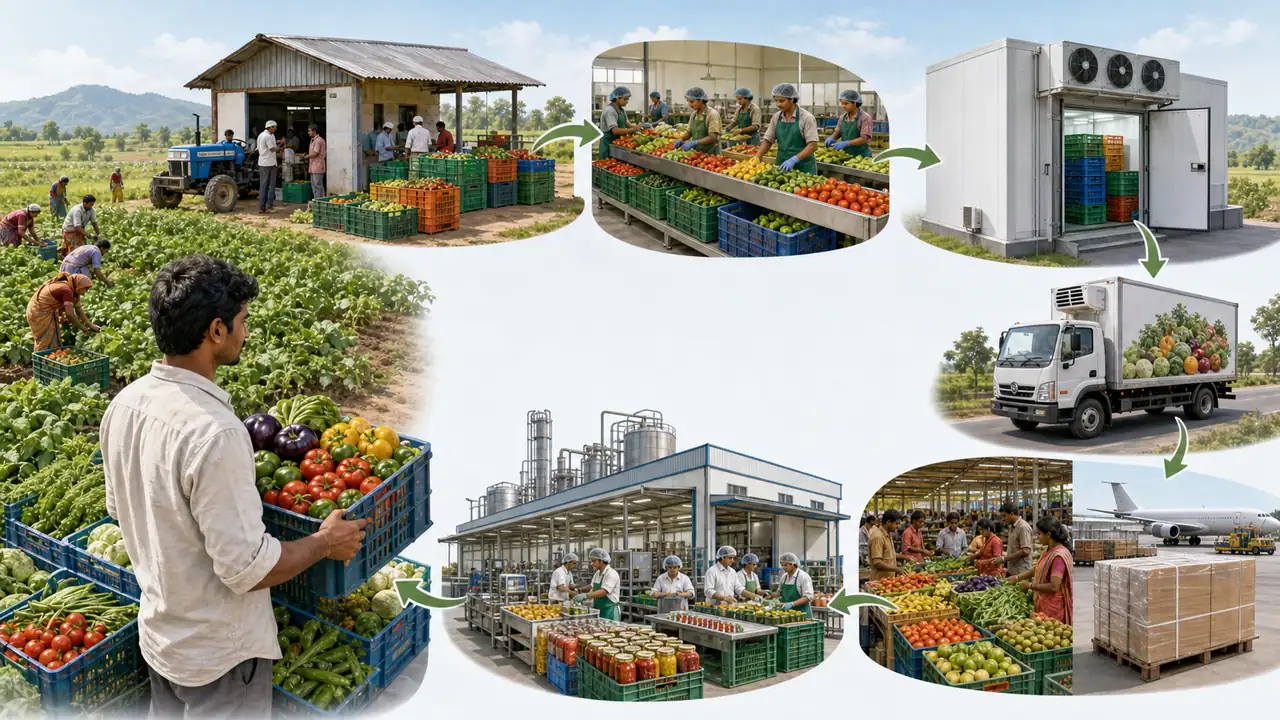
Important post-harvest practices for flowers
| Practice | Why it helps |
|---|---|
| Pre-cooling | removes field heat and slows deterioration |
| Conditioning | restores turgidity after harvest or transport |
| Pulsing | provides sugar and useful chemicals before storage |
| Careful packaging | prevents bending, crushing, and water loss |
| Cold storage | extends shelf life |
Flower handling is also linked with general post-harvest operations such as:
- washing or cleaning where appropriate
- rapid field-heat removal
- hygienic handling water
- curing logic for some commodities
- commodity-specific packing and transport design
Flowers are not treated exactly like roots or fruits, but they benefit from the same principle: remove field stress early and protect quality continuously.
Why a florist rejects a bunch
A grower sends two chrysanthemum bunches to a city florist. One bunch is uniform, firm, cool, clean, and packed without crushing. The other has uneven stem length, warm stems, wet petals, and a few damaged flowers. The florist may reject the second bunch or pay less, even if most flowers are still biologically alive.
The lesson: flower grading is not cosmetic. It is the bridge between farm production and buyer confidence.
Why losses are so serious in flowers
Flower post-harvest losses are often expressed in value terms and may reach about 30-40% of farm value. This is why flower loss is discussed not only as physical spoilage but also as rapid loss of market value.
Even a 1% reduction in post-harvest loss can save a very large quantity of horticultural produce each year. So support systems are not a luxury; they are a productivity and income necessity.
Harvest-stage idea
Many flowers for distant markets are harvested at bud stage or partial opening because:
- they travel better
- they are less damaged in transit
- they often open later in water
- shelf life can improve
This principle is central in floriculture. The exact stage changes from crop to crop, but the general rule is:
- local market -> more open stage
- distant market -> earlier stage, often bud or colour-show stage
Examples of harvest-stage logic
Several crop-wise harvest examples show the same underlying pattern:
- rose for local sale can be cut when outer petals start unfurling; for distant sale it is cut as a tight coloured bud
- standard carnation for local sale is harvested around half-open or paint-brush stage; for distant sale buds are cut when colour is visible and the cross has developed
- gladiolus for local sale is cut when lower florets open; for distant sale when lower florets show colour
- tuberose is cut before full opening, with stage differing between single and double types
- gerbera is cut before outer ray florets shed pollen
- orchids are often sold more open than many other flowers
These examples show one idea clearly: harvest stage is a market decision, not only a biological event.
The general rule is:
- loose flowers are often harvested fully open
- distant-market flowers are usually harvested earlier than local-market flowers
- opening stage depends on both crop type and destination
Transport reminders
- some flowers should be transported upright
- clean water and hygienic handling matter
- packaging should protect stem, bloom, and leaves
- mechanical injury quickly lowers value
Preservatives and vase solutions
Fresh flower preservatives usually contain:
- a food source such as sugar
- a germicide
- a pH-adjusting substance
Their role is to improve water movement, reduce microbial growth, and support longer vase life.
These preservative ideas include several named practices:
- conditioning to restore turgidity after harvest or transport
- pulsing with concentrated sugar plus supportive chemicals before long storage or transport
- holding solutions for longer maintenance after harvest
- anti-ethylene treatment for sensitive flowers
It also notes that cytokinins, gibberellin, and auxin may influence senescence, bud opening, or abscission in selected situations.
The larger post-harvest logic is that preservation and processing technology strengthen both food safety and food security. For flowers, this becomes quality security and market security, because better support extends salability and reduces distress loss.
Water relation and temperature
Vase life mainly can be understood as a balance among:
- water uptake
- water loss
- tissue ability to retain water
- respiration rate
- temperature
Higher temperature increases respiration and shortens the life of flowers. That is why quick hydration and cooling are basic scientific steps.
Packing and transport details
Some practical transport rules are:
- flowers should be dried before packing if surface moisture is present
- corrugated fibreboard boxes are commonly preferred
- geotropically sensitive flowers should move upright
- low temperature and high relative humidity are important during shipment
It also notes that humidity during pre-cooling and shipment may need to remain very high, often around 95-98%.
Food-sector support
In this unit, support means more than just government schemes. It includes the entire post-harvest support system that allows delicate produce to move from farm to buyer without heavy loss.
Post-harvest systems improve when farmers, traders, and processors receive support for:
- storage infrastructure
- processing units
- transport chains
- quality improvement systems
- market linkage
For flowers especially, support may include:
- pack houses
- grading and bunching facilities
- cool-chain handling
- clean packing materials
- links to local, urban, and export markets
Even excellent flower production fails when the post-harvest chain is weak. So support systems are essential for bunching, grading, pre-cooling, packaging, movement, and export handling.
Government or institutional support should be connected with its real purpose: reducing losses, improving value addition, and strengthening market access.
Food-sector support as an institutional chain
This support can be understood at four levels:
- farm level -> harvest timing, shade, hydration, bunching
- pack-house level -> grading, sleeve packing, pre-cooling, carton preparation
- transport level -> cool movement, upright placement for sensitive flowers, humidity management
- market/export level -> quality standards, auction linkage, urban distribution, export readiness
That is why flower management is paired with support systems rather than being treated as an isolated farm skill.
History and processing perspective from the unit
The opening part of Unit 3 also gives a history of post-harvest science and processing development:
- canning science developed gradually through work on spoilage, heat treatment, and containers
- refrigeration and preservation technology changed the handling of perishables
- in India, organized fruit and vegetable processing began early in the twentieth century
This bigger context matters because flower handling also depends on the same scientific mindset:
- prevent spoilage
- slow deterioration
- reduce heat
- preserve quality through the chain
One clear message
If asked why food-sector or post-harvest support is important for flowers, the best answer is:
Flowers are high-value but highly perishable, so without support in cooling, grading, packaging, transport, and market linkage, a large part of their value is lost before sale.
Summary Cheat Sheet
| Concept / Topic | Key Details / Explanation |
|---|---|
| Why flowers need special care | Flowers are highly sensitive because their value depends on freshness, colour, petal condition, stem quality, and vase life, and even small injury causes large market-value loss. |
| Main quality-loss causes | Important causes of quality decline are water loss, respiration, microbial blockage in stems, ethylene sensitivity, high temperature, bruising, and delayed cooling or transport. |
| Straw analogy | A cut flower stem behaves like a drinking straw. If it is crushed, blocked, or kept away from clean water, the flower wilts quickly. |
| Three factor groups | Flower quality should be studied under pre-harvest factors, harvest factors, and post-harvest factors. |
| Pre-harvest factors | Important pre-harvest factors are varietal or genetic makeup, growing environment, balanced nutrition, and low pest or disease injury. |
| Harvest factors | High-value harvest points are correct stage of opening, correct time of day, sharp cutting method, and rapid movement to shade and water. |
| Post-harvest factors | Important post-harvest steps are conditioning, hydration, pre-cooling, storage, transport, packaging, and preservative solutions. |
| Harvest-stage rule | The general harvest rule is more open flowers for local markets and earlier bud or colour-show stage for distant markets so flowers travel better. |
| Crop-wise harvest examples | Examples include rose cut more open for local sale and tighter for distant sale, gladiolus cut at lower-floret opening or colour stage, and tuberose cut before full opening. |
| Important practices | Core practices are pre-cooling, conditioning, pulsing, careful packaging, and cold storage. These help preserve turgidity, reduce heat, and extend vase life. |
| Preservative solutions | Flower preservatives usually contain a food source such as sugar, a germicide, and a pH-adjusting substance to improve water uptake and reduce microbial growth. |
| Water and temperature relation | Vase life depends on the balance between water uptake and water loss, along with respiration and temperature. Higher temperature usually shortens flower life. |
| Transport rules | Flowers should be kept clean, cool, and protected from crushing. Some flowers need upright transport, and shipment often needs high relative humidity plus suitable packaging. |
| Food-sector support | Support systems matter because flower quality can collapse without grading, bunching, pre-cooling, packing, transport, storage, and market linkage. |
| Support-chain levels | The support chain can be read at four levels: farm level, pack-house level, transport level, and market/export level. |
| Best chapter memory line | The strongest answer frame is pre-harvest + harvest + post-harvest, with cooling, clean water, careful cutting, and market-linked handling at every stage. |
Lesson Doubts
Ask questions, get expert answers