🥬 Post-Harvest Management of Fruits and Vegetables
A detailed lesson on washing, pre-cooling, grading, treatment, storage, and loss reduction in fruits and vegetables.
Post-Harvest Management of Fruits and Vegetables
Fruits and vegetables remain biologically active after harvest. They keep respiring, losing water, softening, and becoming vulnerable to microorganisms.
Begin with a kitchen test
Keep one leafy vegetable bunch on a table in a warm room and another inside a cool, moist place. After a few hours, the first one wilts, while the second stays fresher. Nothing magical happened. The warmer bunch lost water faster and kept respiring faster.
This everyday observation is the science of post-harvest management in miniature: control heat, water loss, injury, microbes, and delay.
Why post-harvest care matters
- reduces losses
- extends shelf life
- protects market quality
- improves price realization
- supports food security
Important practices
- harvest at proper maturity
- avoid cuts, bruises, and compression
- sort and grade quickly
- keep produce in shade
- cool and store appropriately
Post-harvest handling can be understood as a sequence. A good answer should show that sequence clearly:
Pro Content Locked
Upgrade to Pro to access this lesson and all other premium content.
₹99 charged monthly · Cancel anytime
- All Agriculture & Banking Courses
- AI Lesson Questions (100/day)
- AI Doubt Solver (50/day)
- Glows & Grows Feedback (30/day)
- AI Section Quiz (20/day)
- 22-Language Translation (100/day)
- Recall Questions (20/day)
- AI Quiz (15/day)
- AI Quiz Paper Analysis (100/day)
- AI Step-by-Step Explanations (100/day)
- Spaced Repetition Recall (FSRS)
- AI Tutor
- Immersive Text Questions
- Audio Lessons — Hindi & English
- Mock Tests & Previous Year Papers
- Summary & Mind Maps
- XP, Levels, Leaderboard & Badges
- Generate New Classrooms
- Voice AI Teacher (AgriDots Live)
- AI Revision Assistant
- Knowledge Gap Analysis
- Interactive Revision (LangGraph)
🔒 Secure via Razorpay · Cancel anytime · No hidden fees
Post-Harvest Management of Fruits and Vegetables
Fruits and vegetables remain biologically active after harvest. They keep respiring, losing water, softening, and becoming vulnerable to microorganisms.
Begin with a kitchen test
Keep one leafy vegetable bunch on a table in a warm room and another inside a cool, moist place. After a few hours, the first one wilts, while the second stays fresher. Nothing magical happened. The warmer bunch lost water faster and kept respiring faster.
This everyday observation is the science of post-harvest management in miniature: control heat, water loss, injury, microbes, and delay.
Why post-harvest care matters
- reduces losses
- extends shelf life
- protects market quality
- improves price realization
- supports food security
Important practices
- harvest at proper maturity
- avoid cuts, bruises, and compression
- sort and grade quickly
- keep produce in shade
- cool and store appropriately
Post-harvest handling can be understood as a sequence. A good answer should show that sequence clearly:
harvest -> washing -> pre-cooling -> sorting/grading -> special treatment -> packing -> storage -> transport -> market or processing
The chain is only as strong as its weakest link
Post-harvest operations work as a chain. If washing is clean but packing crushes the produce, quality still falls. If grading is good but transport is hot, shelf life still shortens. So while studying, do not treat washing, cooling, curing, waxing, and storage as isolated definitions.
Each operation should be understood through four questions:
- What problem does it solve?
- Which crops need it most?
- What mistake can make it harmful?
- What is one clear crop example?
Major post-harvest treatments
| Treatment | Main purpose |
|---|---|
| Washing | remove dirt, sap, and field contamination |
| Pre-cooling | remove field heat quickly |
| Curing | heal wounds in roots, tubers, and bulbs |
| Degreening | improve consumer colour in some crops |
| Waxing | reduce water loss and improve appearance |
| Hot water treatment | reduce some fungal problems |
| Chemical treatment | delay ripening, sprouting, or storage disorders in selected crops |
Washing
Washing removes dirt, debris, dried sap, and other unwanted materials from the surface. It also improves appearance in crops such as mango, papaya, carrot, radish, turnip, sugar beet, sweet potato, and banana.
One caution is especially important:
- water must be clean
- otherwise fungal and bacterial load may build up
- sanitation measures such as disinfectants or clean-water systems help maintain safe washing
Example: washing carrots improves appearance because soil is removed. But washing soft, injured produce in dirty water can spread infection. Therefore, "washing" is not automatically good; clean water and suitable crop choice matter.
Pre-cooling
Pre-cooling means rapid removal of field heat from freshly harvested produce. It is one of the most important operations in perishable crops because it helps:
- slow ripening
- slow senescence
- conserve weight
- reduce deterioration before storage and transport
Main pre-cooling methods
| Method | Simple idea | Typical suitability |
|---|---|---|
| Room cooling | produce is cooled inside a refrigerated room | many fruits and vegetables |
| Forced-air cooling | cold air is pulled through packed produce | fruits, fruit vegetables, tubers, cauliflower |
| Hydro-cooling | produce is cooled with chilled water | stem and leafy vegetables, some fruits |
| Package icing | ice is placed in or on the package | some root, stem, and flower-type vegetables |
| Vacuum cooling | water evaporates rapidly under low pressure and cools the produce | some leafy and flower-type vegetables |
| Transit cooling / mechanical refrigeration | cooling continues during movement | many fruits and vegetables |
| Top icing / channel icing | ice applied to specific package layouts | some roots, leafy produce, cantaloupe-type materials |
Why okra becomes unsellable
Okra may lose quality quickly if harvested late, handled roughly, kept in heat, or packed too tightly. The buyer may see shrivelling, darkening, bruising, and loss of tenderness. A better chain would use tender-stage harvest, shade, quick sorting, suitable packing, and cool humid storage.
This is how to convert a table into understanding: each storage number in the lesson represents a real fight against wilting, heat injury, and market rejection.
Why grading matters
Grading improves:
- uniformity
- market appeal
- packing efficiency
- price realization
Sorting should be understood separately from grading:
- sorting separates produce into categories and removes undesirable material
- grading forms uniform lots on the basis of size, shape, weight, colour, texture, firmness, or defects
Curing
Curing is mainly used in root, tuber, and bulb crops. The produce is held for some time under suitable warm and humid conditions so harvest wounds heal and a protective layer develops.
This helps by:
- reducing water loss
- reducing infection through wounds
- improving storage life
Curing with crops such as:
- potato
- sweet potato
- yam
- taro
- cassava
- onion
- garlic
Degreening
Degreening is the removal or breakdown of green pigment so the fruit develops market-preferred colour. It is commonly associated with citrus and also discussed in relation to crops such as banana, mango, and tomato.
The main idea is simple:
- it is a colour-improvement treatment
- it often uses ethylene under controlled conditions
- its purpose is appearance and market acceptance, not merely storage
Waxing
Waxing replaces some of the natural protective wax removed during handling. Food-grade waxes can:
- reduce water loss
- reduce respiration to some extent
- seal tiny scratches
- improve shine and market appeal
- prolong storage life when used correctly
After coating, wax should dry properly before packing.
Hot-water treatment
Hot-water treatment means dipping produce in water at a carefully controlled temperature for a specific time. It is used mainly to reduce fungal infection and in some cases to help attain more uniform ripening.
Examples from the unit include diseases and crops such as:
- anthracnose control in some fruits
- treatments in apple, grapefruit, lemon, mango, orange, papaya, and peach under different temperature-time combinations
The exact numbers are less important than the principle:
temperature and exposure time must kill pathogens without damaging the fruit.
Radiation treatment
Radiation treatment uses ionizing radiation for three common purposes:
- surface pasteurization
- sprout inhibition
- delay of senescence or control of pests/pathogens
It is sometimes called cold sterilization because it works without raising produce temperature the way ordinary heat treatment does.
Important examples include:
- onion
- potato
- ginger
- garlic
- small onions
- raisins and dried fruits
- mango
The practical idea for students is that irradiation can be used for:
- sprout inhibition
- insect disinfestation
- shelf-life extension
- quarantine treatment
Vapour heat treatment (VHT)
VHT is especially important in fruit-fly management and export handling. Produce is exposed to warm, humid conditions for a carefully set time so all stages of the insect are killed without harming the fruit.
VHT is especially linked with:
- citrus
- mango
- papaya
- pineapple
and notes its importance in mango export handling.
Fumigation
Fumigation exposes produce to a gas in a tight space. In the unit, sulphur dioxide treatment is discussed mainly for:
- control of Botrytis
- reduction of litchi skin discolouration
The emphasis should remain on purpose and caution rather than memorizing every operational detail.
Chemical treatment
Post-harvest life can be influenced before or after harvest with suitable chemicals or growth regulators. The important concepts are:
- sprout control in onion and potato
- ethylene absorption in packaging
- delay of ripening
- extension of shelf life
- reduction of post-harvest disease
- maintenance of green colour in some vegetables
Examples include:
- maleic hydrazide for sprouting or ripening control
- potassium permanganate as an ethylene absorbent
- gibberellic acid for delaying ripening in some produce
- calcium sprays for better storability in fruits like mango and guava
Main causes of deterioration
| Cause | Effect |
|---|---|
| Mechanical injury | bruising and entry of infection |
| Water loss | shrivelling and wilting |
| High temperature | faster respiration and spoilage |
| Microbial attack | rotting |
Storage objectives and precautions
Storage can be understood as a way to balance daily harvest arrivals with sale, extend availability, and prevent distress sale during glut. Storage is therefore both a biological tool and a marketing tool.
Objectives of storage
- slow biological activity
- reduce microorganism growth
- avoid glut and distress sale
- prolong the market period
- make produce available in the off-season
- regulate the market in an orderly manner
- reduce transpiration, respiration, and ethylene production
Tips for high-quality storage
The main storage rules are:
- store only sound, mature, damage-free produce
- avoid overripe or under-mature produce for long storage
- know the recommended temperature and humidity for the commodity
- avoid temperatures below safe limits because chilling or freezing injury can occur
- do not overload storage rooms or stack packages too tightly
- keep ventilation adequate
- keep storage rooms clean and rodent-protected
- use strong, ventilated containers that can withstand stacking
- do not store ethylene-sensitive commodities with high ethylene producers
- do not mix strong-odour commodities with odour-absorbing ones
- inspect stored produce regularly for injury, water loss, disease, and decay
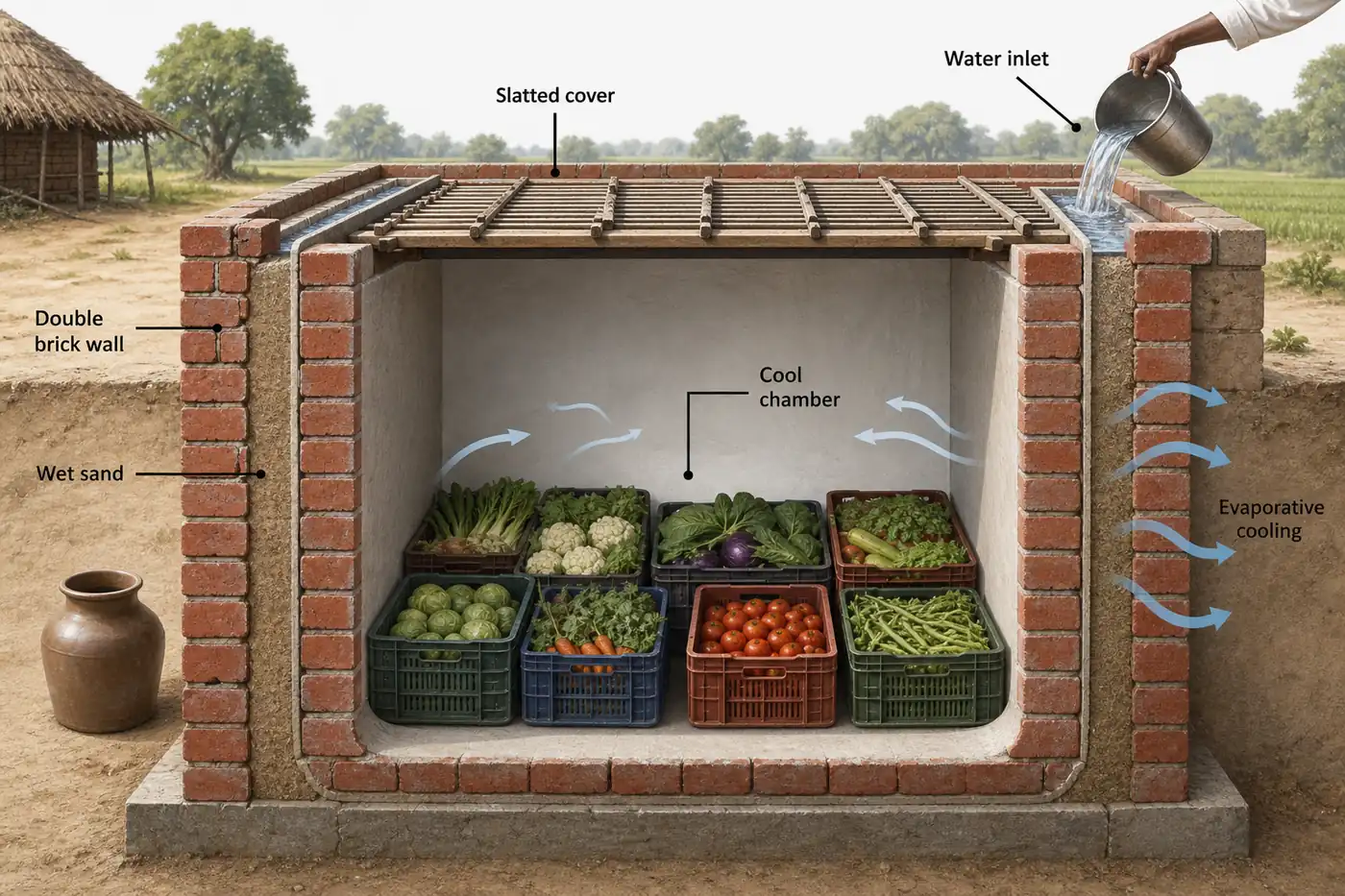
Zero energy cool chamber: construction logic
A practical model of a zero energy cool chamber may vary in exact local dimensions, but the working design is:
- choose a shaded, well-aerated place near water
- build a double brick wall
- fill the cavity between the walls with sand
- keep the sand moist by sprinkling water regularly
- use a bamboo/straw or similar lid and protect the chamber from direct sun and rain
- keep produce in ventilated crates and cover lightly as needed
- monitor temperature and relative humidity with simple instruments
The chamber works by evaporative cooling. As water evaporates from wet sand, heat is removed and the inside environment becomes cooler and more humid. This is especially useful for small farmers handling fresh fruits and vegetables without electricity-based cold storage.
Advanced storage comparison
| Storage system | Main control | Best way to remember |
|---|---|---|
| Cold storage | temperature and relative humidity | slows metabolism but must avoid chilling injury |
| Hypobaric storage | low pressure plus refrigeration | lowers gas pressure and removes volatiles like ethylene |
| Controlled atmosphere storage | accurate control of O2, CO2, N2, ethylene, and volatiles | precise gas management |
| Modified atmosphere storage | atmosphere changed around the produce with less precision | practical gas modification |
Benefits of CA storage
- slows respiration and ethylene production
- delays softening and senescence
- reduces sensitivity to ethylene action
- can reduce selected storage disorders when correctly used
Possible harmful effects of CA storage
- physiological disorders can appear if gases are wrong
- irregular ripening may occur in crops such as banana, mango, pear, or tomato
- off-flavour and off-odour may develop under anaerobic respiration
- very high carbon dioxide can injure some commodities
Benefits of MA storage
- lowers respiration and ethylene production
- reduces water loss
- slows nutrient decomposition
- lowers microbial growth and spoilage
- delays ripening and senescence
The distinction is short:
CA is accurately controlled; MA is modified but less exact.
Storage logic
Storage is used to:
- slow biological activity
- reduce microbial growth
- avoid glut and distress sale
- extend market period
- reduce respiration and transpiration losses
The broader objectives of storage are:
- avoid glut and distress sale
- prolong the market period
- make produce available in the off-season
- regulate the market in an orderly manner
Important storage systems named in this unit
- traditional storage
- cold storage
- controlled atmosphere storage
- modified atmosphere storage
- hypobaric or reduced-pressure storage
At class 12 level, the key idea is simple: the correct combination of temperature, humidity, and atmosphere helps preserve quality, but the correct condition changes from crop to crop.
Summary Cheat Sheet
| Concept / Topic | Key Details / Explanation |
|---|---|
| Core post-harvest sequence | A strong answer should show the chain harvest -> washing -> pre-cooling -> sorting and grading -> special treatment -> packing -> storage -> transport -> market or processing. |
| Why care is needed | Fruits and vegetables remain biologically active after harvest, so they continue to respire, lose water, soften, ripen, and become vulnerable to microbes. |
| Major post-harvest treatments | Important treatments are washing, pre-cooling, curing, degreening, waxing, hot-water treatment, fumigation, vapour heat treatment, irradiation, and selected chemical treatments. |
| Washing | Washing removes dirt, sap, and contamination, but the water must be clean or infection can spread. |
| Pre-cooling | Pre-cooling removes field heat quickly and helps slow ripening, senescence, water loss, and deterioration. |
| Sorting and grading | Sorting removes undesirable produce and separates categories; grading forms uniform lots by size, shape, colour, weight, or quality, improving market appeal and price realization. |
| Curing | Curing is mainly used in roots, tubers, and bulbs such as potato, sweet potato, yam, onion, and garlic so wounds heal and storage life improves. |
| Degreening and waxing | Degreening improves market colour, especially in crops like citrus, banana, mango, and tomato. Waxing reduces water loss, improves shine, and may prolong storage life. |
| Hot-water, VHT, and fumigation | Hot-water treatment reduces some fungal infections if temperature and time are carefully controlled. Vapour heat treatment (VHT) is especially important in export and fruit-fly control. Fumigation is used for selected disease and pest problems, such as SO2-related treatment in litchi. |
| Irradiation and chemical treatment | Irradiation can be used for sprout inhibition, insect disinfestation, and shelf-life extension. Chemical or growth-regulator treatment may help with sprouting control, ripening delay, ethylene absorption, and storage disorders. |
| Main causes of deterioration | The major causes are mechanical injury, water loss, high temperature, and microbial attack. |
| Storage objectives | Storage helps slow biological activity, reduce microbial growth, avoid glut and distress sale, prolong the market period, and make produce available later. |
| Zero-energy cool chamber | A zero-energy cool chamber is a low-cost evaporative-cooling system that keeps produce cooler and more humid without conventional refrigeration. |
| Advanced storage systems | Important named systems are cold storage, controlled atmosphere (CA) storage, modified atmosphere (MA) storage, and hypobaric storage. |
| CA versus MA storage | CA storage means accurate control of gases such as O2 and CO2; MA storage means the atmosphere is changed but less precisely. |
| Best memory line | The strongest recall line is gentle handling + correct maturity + pre-cooling + grading + safe storage, because these steps reduce loss most directly. |
Reference tables: treatments and storage conditions
Commodity-wise pre-cooling methods
| Cooling method | Commodities commonly associated with it |
|---|---|
| Room cooling | all fruits and vegetables |
| Forced-air or pressure cooling | fruits, fruit-type vegetables, tubers, cauliflower |
| Hydro-cooling | stem and leafy vegetables, some fruits, fruit-type vegetables |
| Package icing | roots, stems, some flower-type vegetables, green onion, Brussels sprouts |
| Vacuum cooling | some stem, leafy, and flower-type vegetables |
| Transit cooling / mechanical refrigeration | all fruits and vegetables |
| Top icing and channel icing | some roots, stems, leafy vegetables, and cantaloupes |
Curing conditions for roots, tubers and bulbs
| Commodity | Temperature | Relative humidity | Curing time |
|---|---|---|---|
| Potato | 15-20°C | 90-95% | 5-10 days |
| Sweet potato | 27-33°C | above 90% | 5-7 days |
| Yam | 32-40°C | above 90% | 1-4 days |
| Taro | 30-35°C | above 95% | 4-7 days |
| Cassava | 30-35°C | above 80% | 4-7 days |
| Onion and garlic | 35-45°C | 60-75% | 0.5-1 day |
Degreening memory: ethylene around 10-20 ppm, about 27°C, and 80-90% relative humidity is used to break down green pigment and develop market-preferred colour, especially in citrus and also in banana, mango, and tomato.
Hot-water treatment examples
| Commodity | Pathogen / problem named | Temperature | Time |
|---|---|---|---|
| Apple | Gloeosporium sp., Penicillium expansum | 45°C | 10 min |
| Grapefruit | Phytophthora citrophthora | 48°C | 3 min |
| Lemon | Penicillium digitatum, Phytophthora sp. | 52°C | 5-10 min |
| Mango | Colletotrichum gloeosporioides | 52°C | 5 min |
| Orange | Diplodia, Phomopsis, Phytophthora | 53°C | 5 min |
| Papaya | fungi | 48°C | 20 min |
| Peach | Monilinia fructicola, Rhizopus stolonifer | 52°C | 2.5 min |
The table also reinforces the method principle: temperature and time must be strong enough to suppress the pathogen but not strong enough to injure the fruit.
Government of India irradiation dose requirements
| Commodity | Minimum dose | Maximum dose | Purpose |
|---|---|---|---|
| Onion | 0.03 kGy | 0.09 kGy | sprout inhibition |
| Potato | 0.05 kGy | 0.15 kGy | sprout inhibition |
| Raisins | 0.25 kGy | 0.75 kGy | insect disinfestation |
| Dried fruits | 0.25 kGy | 0.75 kGy | insect disinfestation |
| Mango | 0.25 kGy | 0.75 kGy | shelf-life extension, quarantine treatment, fruit-fly and stone-weevil disinfestation |
| Ginger | 0.03 kGy | 0.15 kGy | sprout inhibition |
| Garlic | 0.03 kGy | 0.15 kGy | sprout inhibition |
| Small onion / shallot | 0.03 kGy | 0.15 kGy | sprout inhibition |
Vapour heat treatment and fumigation exact notes
| Treatment | Key facts |
|---|---|
| VHT | recommended for citrus, mango, papaya, and pineapple; about 43°C saturated air for 8 hours, followed by holding for another 6 hours; mandatory for mango export in the lesson note |
| SO₂ fumigation | fruit boxes are kept in a gas-tight room or treated through slow-release sodium metabisulphite pads |
| Main disease target | Botrytis cinerea, especially in susceptible packed produce |
| Litchi note | 1.2% sulphur dioxide for 10 minutes plus 2 minute HCl dip can reduce skin discoloration; litchi may turn yellow after treatment and red again after 1-2 days |
Chemical treatment examples
| Chemical / growth regulator | Lesson-aligned use |
|---|---|
| Maleic hydrazide at 200 ppm | reduces sprouting of onion and potato during storage |
| Potassium permanganate | ethylene absorbent in fruit packaging; delays ripening |
| Diphenylamine 0.1-0.25% for 30 seconds | controls superficial scald |
| Gibberellic acid | delays ripening in banana and tomato; GA₃ at 100-200 ppm extends guava storability |
| N-benzyladenine 10-20 ppm | prolongs shelf life of vegetables |
| Maleic hydrazide 1000-2000 ppm | delays ripening of mango |
| Calcium chloride 0.6% and calcium nitrate 1% | improve shelf life of mango and guava |
| Calcium compounds 1.7% | delay ripening in ber |
| Cytokinin | extends storage life of leafy vegetables |
| IAA | helps maintain green colour in legume vegetables |
| Difolatan 0.2% | controls post-harvest diseases of tomato and onion |
Zero energy cool chamber exact construction and shelf-life table
| Design detail | Revision value |
|---|---|
| Floor size | 165 cm × 115 cm |
| Wall type | double brick wall |
| Wall height | 67.5 cm |
| Cavity between walls | about 7.5 cm |
| Cavity filling | sand, kept wet |
| Lid | straw or dry grass on bamboo frame, about 165 cm × 115 cm |
| Working principle | direct evaporative cooling without electricity |
| Produce | Season | Outside storage | Zero energy cool chamber |
|---|---|---|---|
| Leaf vegetables | summer | less than 1 day | 3 days |
| Leaf vegetables | winter | 3 days | 8-10 days |
| Potato | spring / summer | 40 days | 97 days |
| Mango | summer | 4 days | 8 days |
| Orange | winter | 8-10 days | 20-30 days |
| Tomato | summer | 7 days | 15 days |
| Pointed gourd | summer | 2 days | 5 days |
| Bitter gourd | summer | 2 days | 6 days |
| Okra | summer | 1 day | 6 days |
| Carrot | spring | 5 days | 12 days |
| Cauliflower | spring | 7 days | 12 days |
| Green chilli | summer | 3 days | 6 days |
Cold storage conditions for selected fruits
| Fruit | Temperature | RH | Approximate shelf life |
|---|---|---|---|
| Acid lime | 8-10°C | 90-95% | 6-8 weeks |
| Apple | -1 to 0°C | 94% | 4-8 months |
| Apricot | 0-1°C | 90-95% | 1-2 weeks |
| Asian pear | 0-1°C | 90-95% | 2 months |
| Avocado | 8-12°C | 85-90% | 1.5 weeks |
| Banana | 13°C | 90-95% | 1-4 weeks |
| Ber | 3°C | 90-95% | 4 weeks |
| Grape | 0-1.7°C | 85-90% | 7 weeks |
| Guava | 6.7°C | 85-90% | 2 weeks |
| Kiwi / Chinese gooseberry | 0-1°C | 90-95% | 2-8 weeks |
| Lemon | 10-13°C | 85-90% | 1-6 months |
| Litchi | 5.7°C | 90-95% | 3-5 weeks |
| Mango | 8-10°C | 90-95% | 2 months |
| Papaya | 8-9°C | 85-90% | 2-4 weeks |
| Peach | -0.5 to 0°C | 90-95% | 2-4 weeks |
| Pineapple | 7-13°C | 85-90% | 2-4 weeks |
| Pomegranate | 5°C | 90-95% | 2 months |
| Strawberry | 0°C | 90-95% | 7-10 weeks |
| Sweet orange | -1 to 0.5°C | 90-95% | 2-3 weeks |
Cold storage conditions for selected vegetables
| Vegetable | Temperature | RH | Approximate shelf life |
|---|---|---|---|
| Asparagus, green | 1-2°C | 95-100% | 2-3 weeks |
| Beans | 4-7°C | 90-95% | 7-10 days |
| Bell pepper | 7-10°C | 90-95% | 2-3 weeks |
| Bitter gourd | 10-12°C | 85-90% | 2-3 weeks |
| Brinjal / eggplant | 10-12°C | 90-95% | 1-4 weeks |
| Broccoli | 0°C | 95-100% | 10-14 days |
| Cabbage | 0°C | 90-95% | 3-6 weeks |
| Carrot | 0.4-4°C | 93-99% | 6-8 months |
| Cauliflower | 0°C | 90-95% | 3-4 weeks |
| Garlic | 0°C | 65-70% | 6-7 months |
| Ginger | 13°C | 65-70% | 6 months |
| Lettuce | 0°C | 90-95% | 2-3 weeks |
| Mushroom | 0°C | 90-95% | 7-14 days |
| Okra | 8.9°C | 90-95% | 7-10 days |
| Onion | 0°C | 65-70% | 20-24 weeks |
| Peas | 0°C | 90-95% | 1-2 weeks |
| Potato | 3-4.4°C | 85% | 34 weeks |
| Radish | 0°C | 90-95% | 1-2 months |
| Tomato, ripe | 7.2°C | 90% | 1 week |
| Tomato, unripe | 8.9-10°C | 85-90% | 4-5 weeks |
| Turnip | 0°C | 90-95% | 4-5 months |
| Watermelon | 10-15°C | 90-95% | 2-3 weeks |
Lesson Doubts
Ask questions, get expert answers