📝 Post-Harvest Management Practice and Revision
A recap lesson bringing together the main post-harvest concepts of Unit 3.
Post-Harvest Management Practice and Revision
This recap chapter brings Unit 3 together after the detailed fruit, vegetable, flower, cereal, and storage topics.
Unit structure
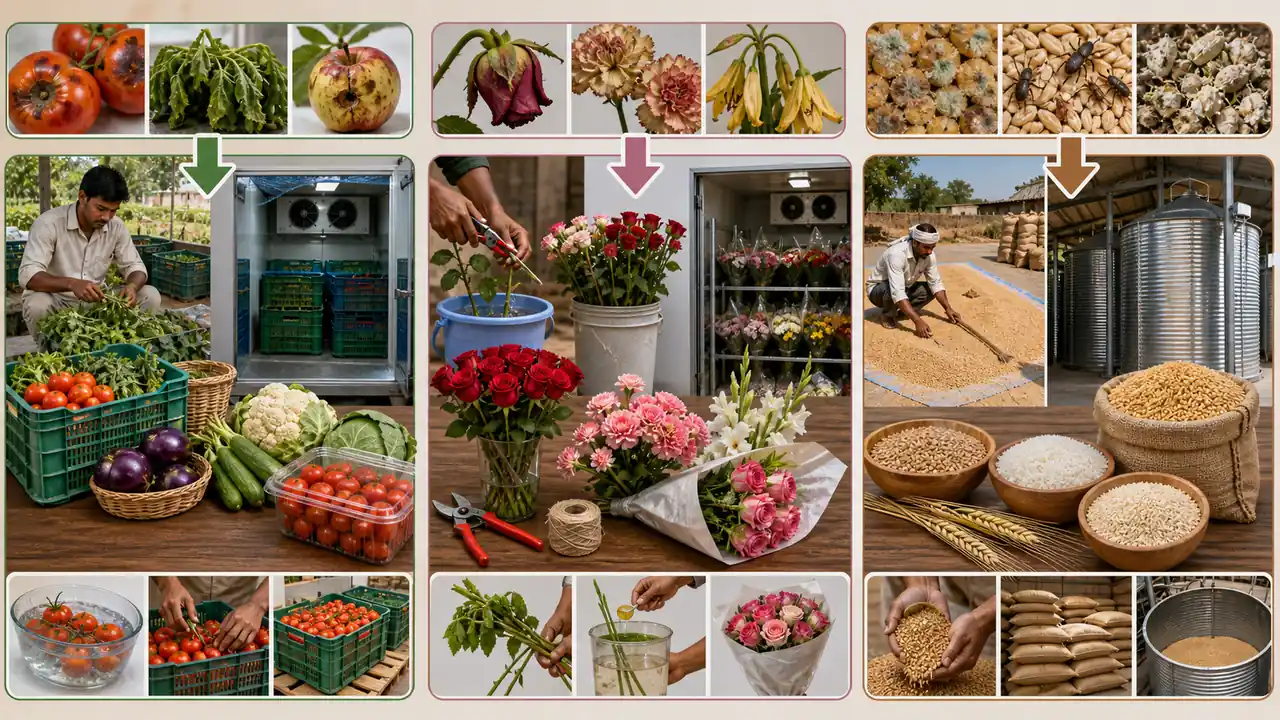
Do not revise Unit 3 as a pile of disconnected tables. Revise it as three stories:
- fresh produce story -> harvest gently, remove heat, prevent water loss, store correctly
- flower story -> preserve beauty, water uptake, vase life, and market grade
- cereal story -> dry safely, process efficiently, protect from hidden storage enemies
This three-part structure helps the unit remain connected instead of becoming a set of disconnected tables.
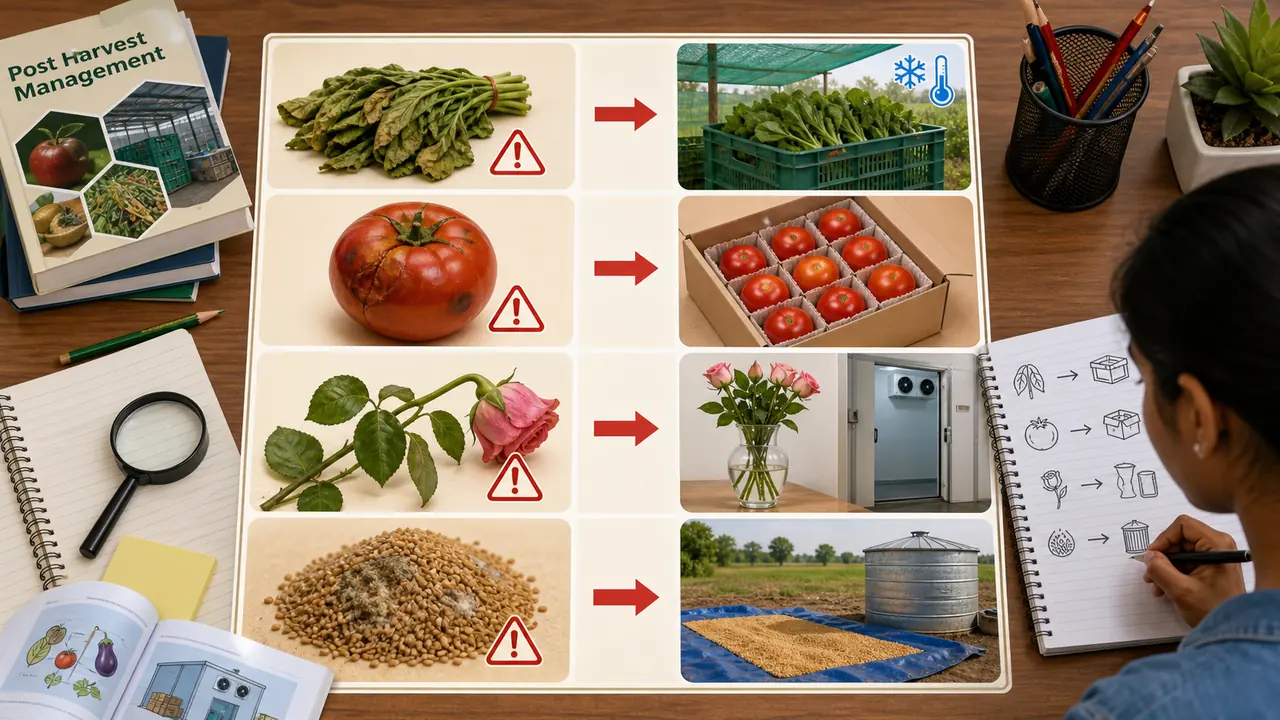
Revision route for this unit
Remember Unit 3 as one connected chain:
harvest stage -> cleaning -> cooling -> grading -> treatment -> packing -> storage -> transport -> market
If you can explain that chain clearly for fruits, vegetables, flowers, and cereals, you are already strong in this unit.
Pro Content Locked
Upgrade to Pro to access this lesson and all other premium content.
₹99 charged monthly · Cancel anytime
- All Agriculture & Banking Courses
- AI Lesson Questions (100/day)
- AI Doubt Solver (50/day)
- Glows & Grows Feedback (30/day)
- AI Section Quiz (20/day)
- 22-Language Translation (100/day)
- Recall Questions (20/day)
- AI Quiz (15/day)
- AI Quiz Paper Analysis (100/day)
- AI Step-by-Step Explanations (100/day)
- Spaced Repetition Recall (FSRS)
- AI Tutor
- Immersive Text Questions
- Audio Lessons — Hindi & English
- Mock Tests & Previous Year Papers
- Summary & Mind Maps
- XP, Levels, Leaderboard & Badges
- Generate New Classrooms
- Voice AI Teacher (AgriDots Live)
- AI Revision Assistant
- Knowledge Gap Analysis
- Interactive Revision (LangGraph)
🔒 Secure via Razorpay · Cancel anytime · No hidden fees
Post-Harvest Management Practice and Revision
This recap chapter brings Unit 3 together after the detailed fruit, vegetable, flower, cereal, and storage topics.
Unit structure
Do not revise Unit 3 as a pile of disconnected tables. Revise it as three stories:
- fresh produce story -> harvest gently, remove heat, prevent water loss, store correctly
- flower story -> preserve beauty, water uptake, vase life, and market grade
- cereal story -> dry safely, process efficiently, protect from hidden storage enemies
This three-part structure helps the unit remain connected instead of becoming a set of disconnected tables.
Revision route for this unit
Remember Unit 3 as one connected chain:
harvest stage -> cleaning -> cooling -> grading -> treatment -> packing -> storage -> transport -> market
If you can explain that chain clearly for fruits, vegetables, flowers, and cereals, you are already strong in this unit.
Commodity diagnosis pattern
Take any commodity and answer these four prompts aloud:
| Prompt | Example using mango |
|---|---|
| What can go wrong? | bruising, field heat, fungal infection, over-ripening |
| What is the first protection? | shade, gentle handling, sorting |
| Which treatment may help? | hot-water treatment, proper packing, cool storage |
| How will I explain it clearly? | explain sequence, purpose, and one crop example |
The same pattern can be applied to rose, okra, potato, wheat, and gladiolus so that the unit remains practical and connected.
Objective check
- Pre-cooling mainly removes:
- field heat
- Curing is especially useful in:
- roots, tubers, and bulbs
- Waxing mainly helps in:
- reducing moisture loss and improving appearance
- VHT is especially linked with:
- quarantine treatment and fruit-fly management in certain fruits
- Controlled atmosphere storage works by:
- regulating oxygen and carbon dioxide more precisely than ordinary cold storage
- Hypobaric storage is associated with:
- low-pressure conditions
- Post-harvest loss in flowers is strongly affected by:
- water loss, ethylene injury, bruising, and microbial blockage
- Grading mainly helps improve:
- uniformity, buyer confidence, and market value
- Washing should be done with clean water because:
- dirty water may spread fungal and bacterial contamination
- Hydro-cooling removes heat mainly by:
- direct contact with cool water
- Room cooling is generally:
- slower than forced-air or hydro-cooling
- The goal of storage is not only preservation but also:
- regulated marketing and reduction of avoidable loss
Fill in the blanks
- The rapid removal of field heat is called __________.
- The process of healing wounds in root, tuber, and bulb crops is called __________.
- Storage under controlled gas composition is called __________ atmosphere storage.
- The process of improving market colour in crops like citrus is called __________.
- Flower shelf life is strongly affected by water balance and __________ sensitivity.
- Removal of surface dirt, sap, and adhering material is done by __________.
- Low-pressure storage is known as __________ storage.
- A treatment used in some fruits for quarantine purposes is __________ heat treatment.
- The scientist known as the Father of Canning is __________.
- A low-cost chamber based on evaporative cooling is the __________ __________ cool chamber.
Commodity and method recall
Know how the logic changes across produce groups:
- Fruits and vegetables need fast heat removal, gentle handling, and moisture-loss control.
- Roots, tubers, and bulbs often benefit from curing.
- Flowers demand precision because appearance and vase life matter as much as freshness.
- Cereals depend heavily on drying and safe storage rather than delicate cooling treatments.
Full Unit 3 concept checklist
Use this checklist to verify that the main ideas of the unit are covered.
Scope and importance
- India produces large quantities of horticultural crops, but low processing and weak handling increase post-harvest losses.
- Reducing post-harvest loss increases usable food without increasing cultivated area.
- Processing absorbs glut-season produce and converts it into stable products.
- Better storage and processing support food security, export, farmer income, and consumer availability.
- Food-processing units can exist at large, small, cottage, and home scale.
History and institutions
- preservation by heating led toward canning science
- Nicolas Appert is remembered as the Father of Canning
- modern refrigeration made long-distance storage and transport easier
- CFTRI, preservation/canning institutes, IICPT, NIFTEM, boards, and food-processing schemes support the sector
Fruits and vegetables
- remain living after harvest
- continue respiration and transpiration
- lose quality through mechanical, physiological, pathological, and market losses
- need washing, pre-cooling, grading, treatments, packing, storage, and transport
- storage reduces respiration, transpiration, ripening, biochemical changes, and microbial deterioration
Flowers
- are highly perishable and appearance-sensitive
- vase life depends on water uptake, water transport, water loss, carbohydrates, temperature, humidity, ethylene, and microbes
- pre-harvest, harvest, and post-harvest factors all decide quality
- conditioning, pulsing, preservatives, pre-cooling, storage, packaging, and transport are core operations
Cereals
- require harvest at proper maturity
- must be threshed, winnowed, dried, cleaned, graded, stored, and processed
- safe moisture and rodent/insect protection are central
- primary processing prepares grain; secondary processing converts grain into food products
- paddy, maize, sorghum, millet, and wheat each have different processing needs
Big comparison table
| Produce group | Main risk | First protection step | Important later steps | Central idea |
|---|---|---|---|---|
| Fruits | respiration, ripening, bruising, rot | shade and pre-cooling | washing, grading, waxing, storage | living tissue after harvest |
| Vegetables | water loss, wilting, decay | quick cooling and gentle handling | curing where needed, clean packing | quality falls rapidly in heat |
| Roots/tubers/bulbs | wound infection and sprouting | curing | storage humidity/temperature control | wound healing improves storage |
| Flowers | wilting, ethylene injury, bent neck | hydration and pre-cooling | conditioning, pulsing, preservatives | vase life is the key quality |
| Cereals | moisture, insects, rodents, mould | drying | winnowing, storage, milling | dry grain is safe grain |
Operations map
| Operation | Meaning | Main crop group | Why it is used |
|---|---|---|---|
| Washing | removing dirt and surface contamination | fruits and vegetables | improves appearance and sanitation |
| Pre-cooling | removing field heat rapidly | perishables and flowers | slows respiration and senescence |
| Curing | healing harvest wounds | roots, tubers, bulbs | reduces infection and water loss |
| Degreening | breaking down green pigment | citrus, banana, mango, tomato | improves consumer colour |
| Waxing | applying edible protective coating | fruits and some vegetables | reduces moisture loss and improves shine |
| Hot-water treatment | controlled warm-water dipping | selected fruits | reduces fungal problems |
| Irradiation | ionizing-radiation treatment | approved commodities | sprout inhibition, insect control, shelf-life extension |
| VHT | vapour heat treatment | export fruits | kills fruit-fly stages |
| Fumigation | gas treatment in a tight space | selected fruits/produce | controls pests or specific disorders |
| CA storage | accurate gas control | high-value produce | lowers respiration and ethylene action |
| MA storage | modified atmosphere around produce | packaged/stored produce | slows ripening and spoilage |
| Hypobaric storage | low-pressure refrigerated storage | selected produce | removes gases and volatiles |
| Pulsing | short high-strength treatment | cut flowers | supports bud opening and travel |
| Holding solution | lower-strength vase solution | cut flowers | maintains quality during display |
| Threshing | removing grain from plant | cereals | separates grain after harvest |
| Winnowing | separating grain from chaff | cereals | cleans grain using air movement |
| Parboiling | soaking and steaming paddy | rice | reduces breakage and improves hulling |
Concept recap
Make sure you can also connect these exact Unit 3 concepts:
- post-harvest losses rise when production is high but infrastructure is weak
- processing is a national answer to glut-season waste
- food processing units may be large, small, cottage, or home scale
- washing water must itself be hygienic
- irradiation may be used for sprout inhibition, insect control, or shelf-life extension
- VHT is strongly linked with fruit-fly and export handling
- sulphur dioxide fumigation is associated with selected fruit-protection uses
- CA and MA storage are related but not identical
- zero energy cool chamber works without electricity on an evaporative-cooling principle
Very short answer drill
- What is pre-cooling?
- What is curing?
- What is waxing?
- What is VHT?
- What is fumigation?
- What is CA storage?
- What is hypobaric storage?
- What is grading?
- Why are flowers harvested carefully for distant markets?
- Why should washing water be sanitary?
- What is the difference between primary and secondary processing of cereals?
- Why does maize meal have shorter shelf life than many cereal flours?
- Why does parboiling reduce breakage in rice?
- What are the main components of a flower preservative?
- Why should sucrose not be used alone in vase water?
- What is the role of Codex standards in food processing?
One-line answer bank
Use these to quickly check yourself:
| Question | One-line answer |
|---|---|
| Why is pre-cooling important? | It removes field heat and slows respiration, ripening, water loss, and senescence. |
| Why is curing done? | It heals wounds in roots, tubers, and bulbs so infection and water loss are reduced. |
| Why is clean washing water necessary? | Contaminated water can spread bacteria and fungi instead of reducing them. |
| Why is waxing useful? | It reduces water loss, seals small scratches, improves appearance, and can extend storage life. |
| Why is VHT used? | It is a quarantine heat treatment for killing fruit-fly stages in selected fruits. |
| Why do flowers need preservatives? | They need sugar, microbial control, pH adjustment, and sometimes anti-ethylene support. |
| Why is cereal drying essential? | Moist grain invites mould, insects, heating, odour, and poor keeping quality. |
| Why is brown rice more nutritious than polished rice? | It retains more bran, which contains nutrients such as protein and thiamine. |
| Why are schemes needed? | Storage, cold chain, testing, processing, and training infrastructure are costly. |
Short-answer practice
- Explain the difference between curing, pre-cooling, and waxing.
- Why is gentle handling as important as cold storage in fruits and vegetables?
- Why are flowers often harvested at bud or partial-opening stage for distant markets?
- Write a short note on the objectives of storage.
- How do temperature and humidity affect post-harvest life?
- Why do cut flowers need special attention to water balance?
- Explain why grading helps both the seller and the consumer.
- Distinguish between controlled atmosphere and modified atmosphere storage.
- Explain the function of germicide, sucrose, and acidifier in floral preservatives.
- Write short notes on conditioning, pulsing, and holding solution in cut flowers.
- Explain harvesting, threshing, winnowing, drying, and storage in cereals.
- Write a short note on parboiling of paddy.
- Explain why food-processing schemes are linked with post-harvest loss reduction.
Long-answer style prompts
- Explain the importance and scope of post-harvest technology in horticultural produce.
- Describe the major post-harvest treatments used for fruits and vegetables.
- Write a detailed note on flower post-harvest care and factors affecting vase life.
- Explain different storage methods used for horticultural produce.
- Discuss how post-harvest management reduces physical, physiological, and pathological losses.
- Describe the total post-harvest system of cereals, including preparation for storage, primary processing, and secondary processing.
- Discuss important government schemes and institutions supporting food processing and post-harvest infrastructure.
- Explain how storage works as both a biological control system and a marketing tool.
- Compare post-harvest management of flowers and cereal crops.
Applied questions
- A mango consignment reaches the market with shriveling and sap marks. Which post-harvest steps were probably weak?
- A potato lot stores poorly even though the yield was good. Explain how curing and storage conditions could make the difference.
- Why is pre-cooling often described as the "first protection step" after harvest?
- A flower grower harvests blooms fully open for distant sale. What likely problem will appear and why?
- Compare normal cold storage with CA storage from the point of view of produce physiology.
- A farmer stores paddy without proper drying after a humid harvest. Predict the likely storage problems.
- A florist uses sugar water without germicide. Explain why flowers may wilt even though food was supplied.
- A rice mill reports too many broken grains. Explain how parboiling and proper drying can help.
- A cold chain breaks midway between farm gate and retail store. Which quality losses can appear in fruits and flowers?
- A food entrepreneur wants to make maize snacks. Which post-harvest and processing factors should be checked first?
Diagram-style concept maps
Fruit and vegetable map
maturity -> careful harvest -> washing -> pre-cooling -> sorting/grading -> crop-specific treatment -> packaging -> storage -> transport
Flower map
right stage -> sharp cut -> hydration -> conditioning -> pre-cooling -> pulsing -> bunching -> cold storage -> transport -> holding solution
Cereal map
maturity -> harvest -> threshing -> winnowing -> drying to safe moisture -> cleaning/grading -> storage -> milling/hulling/parboiling -> secondary processing
Match the following
| Column A | Column B |
|---|---|
| Nicolas Appert | canning history |
| Zero energy cool chamber | evaporative cooling |
| Potassium permanganate | ethylene absorption |
| STS | anti-ethylene support in sensitive flowers |
| 8-HQC | floral preservative germicide |
| Parboiling | paddy quality improvement before hulling |
| Hammer mill | cereal grinding |
| Codex | international food standards |
| Mega Food Park | integrated food-processing infrastructure |
| NIFTEM | food technology, entrepreneurship, and management |
True or false practice
- Fruits and vegetables stop respiring immediately after harvest.
- Curing is most useful for delicate leafy vegetables.
- Waxing can reduce water loss and improve appearance.
- Controlled atmosphere storage is more precise than modified atmosphere storage.
- Flowers for distant markets are often harvested earlier than flowers for local sale.
- Sucrose should always be used alone in floral preservatives.
- Cereal grains with high moisture are safer for storage.
- Parboiling can reduce breakage during rice hulling.
- Ground maize meal can become rancid because maize has relatively higher fat.
- Food-processing infrastructure helps reduce wastage and improve value addition.
True or false answers
- False
- False
- True
- True
- True
- False
- False
- True
- True
- True
Fill-in practice: advanced set
- Storage under low pressure is called __________ storage.
- Storage with accurately managed oxygen, carbon dioxide, nitrogen, and ethylene is called __________ storage.
- Flower preservatives usually contain sugar, germicide, and a __________ adjuster.
- The microbial blockage of flower xylem reduces __________ uptake.
- Rice treatment involving soaking, steaming, and drying is called __________.
- Separating grain from chaff using air movement is called __________.
- A mill that uses fast beaters in a circular chamber is a __________ mill.
- Wheat bread quality depends strongly on __________ formation.
- Codex standards are linked with food safety and __________.
- Food-processing training centres support human resource __________.
Advanced fill-in answers
- hypobaric
- controlled atmosphere
- pH
- water
- parboiling
- winnowing
- hammer
- gluten
- quality
- development
Common mistakes to avoid
- Do not write that washing is always safe; dirty water can spread disease.
- Do not treat pre-cooling and cold storage as identical; pre-cooling removes field heat quickly, while storage maintains conditions later.
- Do not say curing is for all vegetables; it is mainly for root, tuber, and bulb crops.
- Do not confuse degreening with ripening in every crop; it is mainly a colour-management treatment.
- Do not say CA and MA are the same; CA is more accurately controlled.
- Do not say flowers only need cold temperature; they also need water uptake, germicide, pH control, anti-ethylene care, and correct harvest stage.
- Do not say cereals only need storage; they also need threshing, winnowing, drying, cleaning, grading, and processing.
- Do not ignore schemes and institutions; post-harvest science is closely linked with infrastructure and training.
Important points to remember
- Washing improves appearance but must not become a source of contamination.
- Pre-cooling slows respiration, ripening, and deterioration.
- Curing helps heal harvest injuries in certain crops and reduces later storage problems.
- Waxing is mainly a moisture-loss control step, not a substitute for refrigeration.
- Flowers fail quickly when the stem cannot absorb water properly.
- Storage is a management decision as much as a biological process.
Oral recall drill
Speak these without notes:
- the meaning of field heat and why it must be removed
- why roots and tubers are cured but leafy produce is not
- how flower handling differs from cereal handling
- why grading, packing, and storage influence market price
Answer key
Fill in the blanks answers
- pre-cooling
- curing
- controlled
- degreening
- ethylene
- washing
- hypobaric
- vapour / vapor
- Nicolas Appert
- zero energy
Key anchors
- Pre-cooling = remove field heat.
- Curing = heal and harden harvested surfaces.
- Waxing = reduce water loss.
- CA storage = controlled gases.
- Flower quality = freshness + stem water uptake + vase life.
Summary Cheat Sheet
| Concept / Topic | Key Details / Explanation |
|---|---|
| Fresh-produce story | Fruits and vegetables lose value through heat, water loss, rough handling, respiration, and microbial attack, so cooling and careful handling are central. |
| Cereal story | Cereals mainly need proper drying, safe moisture, storage hygiene, and pest protection. |
| Flower story | Flowers need gentle handling, cooling, clean solutions, and correct harvest stage because appearance and vase life determine value. |
| Storage concept | Storage works both as a biological control system and as a marketing tool by slowing deterioration and regulating supply. |
| Best unit takeaway | Unit 3 becomes easy when each commodity is linked with its main post-harvest enemy and the correct protection step. |
Lesson Doubts
Ask questions, get expert answers