🌾 Post-Harvest Management of Cereal Crops and Schemes
A deeper lesson on cereal drying, storage protection, storage systems, and support schemes.
Post-Harvest Management of Cereal Crops and Schemes
Cereal crops may not spoil as visibly as fruits or flowers, but they suffer major losses if drying and storage are poor.
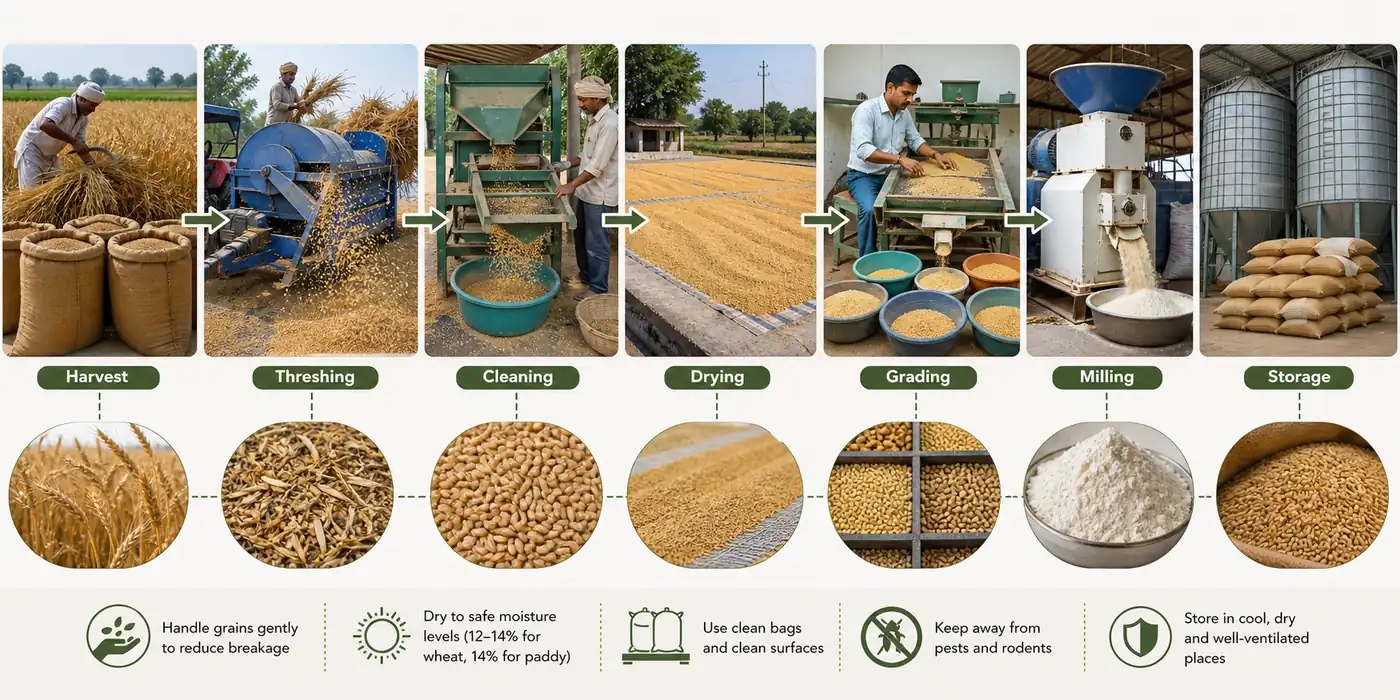
Start with the grain-store story
A grain bag may look safe from outside, but inside it can be losing quality silently. If moisture is high, mould may grow. If insects enter, weight and germination fall. If rodents attack, both quantity and hygiene suffer. Unlike a bruised tomato, cereal damage may stay hidden until the bag is opened.
So cereal post-harvest management is a lesson in invisible protection: moisture, pests, aeration, containers, and processing efficiency.
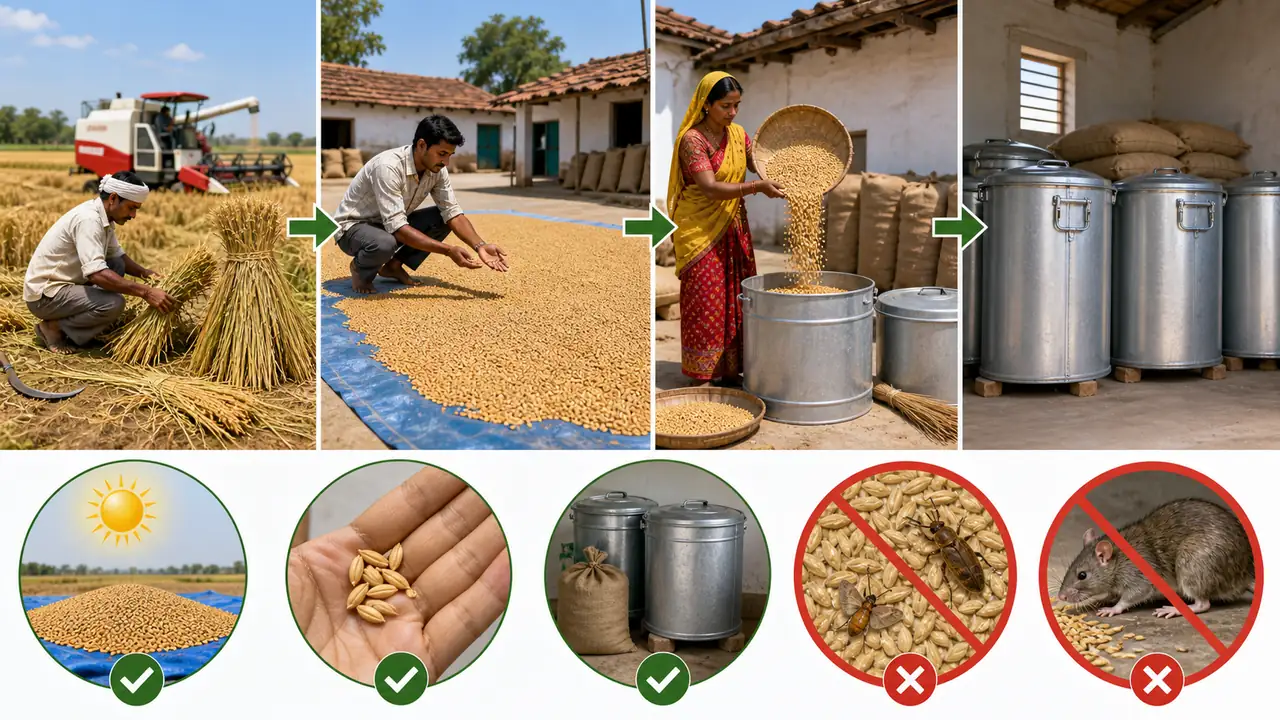
Main cereal post-harvest steps
- threshing
- cleaning
- drying
- grading
- storage
- pest protection
Total post-harvest system in cereals
Cereal handling can be understood as a complete system between harvest and consumption. This system has three large stages:
Pro Content Locked
Upgrade to Pro to access this lesson and all other premium content.
₹99 charged monthly · Cancel anytime
- All Agriculture & Banking Courses
- AI Lesson Questions (100/day)
- AI Doubt Solver (50/day)
- Glows & Grows Feedback (30/day)
- AI Section Quiz (20/day)
- 22-Language Translation (100/day)
- Recall Questions (20/day)
- AI Quiz (15/day)
- AI Quiz Paper Analysis (100/day)
- AI Step-by-Step Explanations (100/day)
- Spaced Repetition Recall (FSRS)
- AI Tutor
- Immersive Text Questions
- Audio Lessons — Hindi & English
- Mock Tests & Previous Year Papers
- Summary & Mind Maps
- XP, Levels, Leaderboard & Badges
- Generate New Classrooms
- Voice AI Teacher (AgriDots Live)
- AI Revision Assistant
- Knowledge Gap Analysis
- Interactive Revision (LangGraph)
🔒 Secure via Razorpay · Cancel anytime · No hidden fees
Post-Harvest Management of Cereal Crops and Schemes
Cereal crops may not spoil as visibly as fruits or flowers, but they suffer major losses if drying and storage are poor.
Start with the grain-store story
A grain bag may look safe from outside, but inside it can be losing quality silently. If moisture is high, mould may grow. If insects enter, weight and germination fall. If rodents attack, both quantity and hygiene suffer. Unlike a bruised tomato, cereal damage may stay hidden until the bag is opened.
So cereal post-harvest management is a lesson in invisible protection: moisture, pests, aeration, containers, and processing efficiency.
Main cereal post-harvest steps
- threshing
- cleaning
- drying
- grading
- storage
- pest protection
Total post-harvest system in cereals
Cereal handling can be understood as a complete system between harvest and consumption. This system has three large stages:
| Stage | What happens | Why it matters |
|---|---|---|
| Preparation for storage | harvest, thresh, winnow, dry, inspect, store | protects grain before long holding |
| Primary processing | clean, grade, hull, mill, pound, grind, temper, parboil, soak, dry, sieve | removes inedible parts and prepares grain or flour |
| Secondary processing | ferment, bake, puff, flake, fry, extrude | turns grain/flour into edible, attractive products |
This is an important difference from flowers. Flowers are usually marketed for appearance. Cereals are usually transformed through several operations before final eating.
One analogy: grain is like a sleeping seed
Stored grain looks inactive, but it is not dead. It can respire slowly, absorb moisture from the environment, support insect life, and lose viability. Treat grain as a sleeping seed that must be kept dry, cool, clean, and protected.
This analogy makes the difference clear:
| Produce type | Main fear | First protection idea |
|---|---|---|
| leafy vegetables | wilting | high humidity and cooling |
| flowers | vase-life loss | water uptake and low temperature |
| cereals | hidden storage loss | safe moisture and pest control |
Primary and secondary processing
Primary processing does not necessarily make the product ready to eat. It makes the grain cleaner, smaller, dehulled, or more usable for the next step. Secondary processing adds value by making foods people can directly cook or eat.
| Primary processing examples | Secondary processing examples |
|---|---|
| cleaning | fermentation |
| grading | baking |
| hulling | puffing |
| milling | flaking |
| pounding and grinding | frying |
| tempering and soaking | extrusion |
| parboiling and drying | snack or breakfast product formation |
Quick memory line
Primary processing prepares grain; secondary processing converts it into useful foods.
Wheat kept a little too moist
A farmer stores wheat without drying it properly because the grain "looks dry enough". After a few weeks, the bag smells musty and some grains show mould. The error was not visible at first, but unsafe moisture created a storage ecosystem for fungi and insects.
This is why cereal storage should always begin with drying and safe moisture before moving to milling or value addition.
Secondary processing methods
Puffing
Puffing exposes grain to very high pressure or heat so the grain expands and opens. Puffed grains can be eaten as snacks, used in breakfast cereals, toasted, coated, or mixed with other ingredients. The science behind puffing is rapid expansion of internal moisture into steam.
Flaking
Flaking partially cooks or softens grain, presses it into thin flakes, and dries it. Flakes are useful for quick-cooking or ready-to-eat products. The lesson notes that crisp flakes need low final moisture, around below 7%, to maintain texture.
Fermentation
Cereal flour doughs can be fermented to make different foods. Fermentation improves flavour, texture, digestibility, and gas production in some products.
Baking
Doughs and batters from cereal flours are baked to make breads, biscuits, cakes, rolls, and similar products. In wheat-based products, gluten strength becomes very important.
Extrusion
Extrusion heats and forces dough-like material through a small opening to form strands or shapes. These shapes may then be fried, boiled, dried, or seasoned. Pasta, noodles, breakfast cereals, and many snack foods are examples.
Why cereals need special post-harvest care
Grain may look normal at first, yet gradually lose quality because of:
- high moisture
- insect attack
- fungal growth
- heating
- rodent damage
- poor storage hygiene
Seed grain has an additional concern: viability. So in cereals, poor storage affects not only food quality but also planting value.
Why drying matters most
Grain with unsafe moisture may develop:
- fungal infection
- internal heating
- bad smell
- poor keeping quality
- insect infestation
Drying is therefore the first storage-protection step in cereals, just as pre-cooling is the first protection step in many fresh fruits and vegetables.
Post-harvest treatment for storage
Harvesting
Cereals must be harvested at the right maturity. If harvested too early, grain has more moisture and active enzymes, so deterioration is faster. If the crop remains in the field too long after maturity, morning dew and rain can wet it and increase mould and insect risk.
Three broad harvesting power levels can be identified:
- manual
- animal powered
- engine powered
Small-scale farmers may use a range of mechanized harvesters, but the choice depends on cost, efficiency, and local suitability. After cutting, crops may be left in the field briefly to dry before later operations.
Threshing
Threshing removes grain from the rest of the plant and can be understood through three linked tasks:
- separate grain from the panicle or ear
- separate grain from straw
- winnow chaff away from grain
The most energy-demanding part is separating grain from the panicle/ear. That is why this part was mechanized earlier. Manual systems may use sticks or flails; powered threshers speed up work and reduce drudgery.
Winnowing
Winnowing separates heavier grain from lighter chaff and straw. Traditional winnowing uses natural wind by tossing threshed material so chaff blows aside and heavier grains fall vertically. Hand baskets are effective but slow. Fan-based machines create artificial wind and often combine winnowing with screens or sieves for grading.
Drying
Sun drying is the cheapest method where weather allows. In humid climates or during cloudy harvest periods, artificial drying may be needed. A simple artificial dryer can use a perforated tray or box, a fan, and heat from diesel/electric/kerosene/gas/biomass sources.
The target for safe cereal storage is broadly 10-15% moisture. Exact safe moisture varies with cereal, climate, storage duration, and structure.
Storage after drying
Dried grain is stored in bulk until processing. It must be inspected regularly for:
- moisture gain
- heating
- mould
- insects
- rodent damage
- bad smell
If grain picks up moisture, it should be re-dried. Storage structures should be rodent-proof, dry, ventilated, and hygienic.
Objectives of cereal storage
- maintain quantity
- maintain market quality
- preserve seed viability where needed
- reduce insect and fungal damage
- make grain available beyond harvest time
The wider storage objectives also apply here:
- slow biological activity
- reduce growth of microorganisms
- avoid glut and distress sale
- prolong the market period
- regulate availability more evenly
Factors affecting storage
Important examples include:
- temperature
- relative humidity
- ventilation
- air velocity
- atmospheric gas composition
- light
- nature of the commodity
- post-harvest treatment already given to the commodity
Important storage factors
| Factor | Why it matters |
|---|---|
| Temperature | affects biological activity |
| Moisture | high moisture invites spoilage |
| Ventilation | reduces heating and bad storage atmosphere |
| Hygiene | lowers infestation risk |
| Structure strength | helps safe long-term storage |
Primary processing in detail
Cleaning and grading
Before milling or hulling, grain is cleaned to remove chaff, soil, stones, dust, straw pieces, and other foreign matter. Grading separates grain according to size or quality. Some winnowers include sieves so cleaning and grading happen together.
Hulling
Many cereals have outer husk or shell layers that are not pleasant to eat. These are removed by decorticators or hullers. Rice hullers may be manual or powered. The lesson notes an important rice principle: parboiled rice breaks less during hulling. Polishing can remove bran after hulling, but too much polishing lowers nutrition.
Pounding, milling, and grinding
Important examples include:
| Mill type | Working idea | Lesson-aligned notes |
|---|---|---|
| Plate mill | grain is ground between two plates | pressure controls fineness; manual versions exist but are hard work |
| Hammer mill | fast beaters break grain in a circular chamber | common at small scale; screen hole size controls particle size |
| Roller mill | rollers crush grain | costly and high-maintenance at small scale; often used for animal feed |
Hammer mills are widely used because they are versatile. Particle size is commonly distinguished by use: finer grinding for human food and coarser grinding for animal feed.
Moisture conditioning before milling
Moisture is critical during milling:
- too dry and hard -> higher energy demand and difficult breakdown
- too moist -> grain sticks to the mill
- dry grain may be conditioned by soaking
- moist grain may need drying before grinding
This is why cereal post-harvest management is not just about "dry grain"; it is about correct moisture for the next operation.
Parboiling of paddy
Parboiling is an optional rice treatment but highly important. It involves soaking and heating paddy so starch partly gelatinizes. This toughens grain, loosens the hull, sterilizes the grain, and reduces breakage during hulling.
Lesson-aligned sequence:
- soak or steep paddy in cold or hot water to raise moisture
- steam to gelatinize starch in the kernel
- dry carefully before husking or storage
Brown rice retains bran and is nutritionally richer than fully polished white rice because bran contains protein and vitamin B1. This is a useful nutrition connection for Class 12 students.
Raw materials and flour quality
Good cereal products require good raw material. Small bakers may not have laboratory equipment, so they depend on miller/wholesaler information and simple flour checks.
Wheat flour and gluten
Wheat flour contains gluten-forming proteins. During mixing, gluten creates an elastic network. Yeast produces gas, gluten traps it, dough volume increases, and bread becomes light. If flour is weak in gluten, gas escapes and bread becomes flat and heavy.
Wheat flour extraction grades
Extraction-based categories include:
| Flour type | Extraction idea |
|---|---|
| Wholemeal flour | 100% extraction |
| Wheatmeal flour | about 90-95% extraction |
| Straight-run flour | about 70-72% extraction |
| Patent flour | about 20-40% extraction |
Extraction tells us how much of the original grain is represented in the flour. Higher extraction usually means more bran and fibre; lower extraction gives whiter flour but less bran-associated nutrition.
Common wheat flour types
- atta: suitable for chapati; may be available as wheatmeal flour
- special baker's flour: strong flour for bread, rolls, and pastry
- biscuit flour: blended for mechanical biscuit manufacture
- self-raising flour: soft flour with aerating additive, used for chemically aerated breads
- soft flour: useful in cake making
Non-wheat and composite flours
Wheat can also be blended with other flours:
- cassava flour is fine, white, and useful in fried/baked products
- maize and sorghum flours are used for breads, snacks, porridge, tortillas, cornflour, and thickeners
- soy/composite flour improves protein content and amino-acid balance when blended with cereal flours
Composite flour is especially important nutritionally because cereals may be energy-rich but limited in some protein-quality aspects.
Composition of cereal grains: how to read the table
The cereal-comparison table covers crude protein, fat, ash, fibre, and available carbohydrate. Instead of rote memorization, use these patterns:
| Cereal | Main learning pattern |
|---|---|
| Brown rice | moderate carbohydrate, lower protein than many millets/wheat |
| Oats | comparatively high fat and fibre among listed cereals |
| Maize | higher fat than wheat or rice, so meal can become rancid faster |
| Wheat | valued for gluten quality and bread-making |
| Barley | notable fibre compared with several cereals |
| Pearl millet | comparatively high protein among listed examples |
Nutritional composition affects processing choice, product quality, storage stability, and value addition.
Crop-wise processing notes
Maize
Maize may be dry milled or wet milled. Dry milling grinds grain with stones, plate mills, or hammer mills. Wet milling soaks grain and may allow slight fermentation before milling, improving flavour. Alkaline soaking can help remove bran. Because maize has relatively high fat, ground maize meal has shorter shelf life and may turn rancid faster.
Paddy rice
Paddy may be parboiled before husk removal. Parboiling toughens grain, reduces shattering during husking, and can reduce moisture absorption during storage. Brown rice is dehusked but not fully polished; white rice is polished and loses more bran. Brown rice is nutritionally superior because bran contributes protein and thiamine.
Sorghum and millet
Some sorghum seed coats, especially red types, contain tannins that taste bitter and can interfere with protein digestion. Therefore, hulling is important before flour preparation. Traditional processing uses winnowing, wetting, pounding, repeated winnowing, washing, soaking/conditioning, drying, and regrinding.
Traditional and improved storage logic
Grain may be stored in simple or advanced systems, but the scientific aim remains the same: keep the produce dry, protected, and stable.
Traditional storage methods named in the unit
- pit storage
- clamp storage
- barns storage
- cellars storage
- sand and coir storage
- high-altitude storage
- zero energy cool chamber
These systems differ in design and crop suitability, but they all try to reduce exposure to excess heat, moisture, and pests.
Zero Energy Cool Chamber
A zero energy cool chamber works on the principle of evaporative cooling, so it does not require electricity for its basic cooling effect.
Main features
- usually made from locally available materials such as brick, sand, bamboo, and straw or grass cover
- double brick wall with sand-filled cavity
- water is sprinkled regularly so evaporation lowers temperature and raises humidity inside
- chamber is placed in a well-aerated shaded place near water supply
Why it matters
- low-cost
- useful for fresh fruits and vegetables
- improves shelf life in summer and winter without conventional refrigeration
- especially valuable for farmers and small-scale handlers
Examples of improved storage life inside such chambers include leafy vegetables, mango, tomato, okra, chilli, carrot, and cauliflower. The exact numbers are less important than the principle: cooler and more humid conditions slow deterioration.
Advanced storage methods
Cold storage
Cold storage maintains suitably low temperature and appropriate humidity so metabolic activity slows down without causing chilling or freezing injury.
Recommended temperature and relative-humidity ranges are listed for many fruits and vegetables such as:
- apple
- banana
- citrus fruits
- mango
- papaya
- pineapple
- strawberry
- beans
- cabbage
- carrot
- cauliflower
- onion
- peas
- potato
- tomato
- watermelon
The key idea is not every figure, but the following points:
- each commodity has its own safe temperature range
- humidity needs also differ
- too low a temperature may create chilling or freezing injury
Hypobaric storage
In hypobaric storage, produce is kept under:
- low pressure
- refrigerated condition
- controlled gas environment
Lower pressure reduces the partial pressure of gases, helps remove carbon dioxide and volatiles like ethylene, and can prolong storage life. Flavour may sometimes be affected.
Controlled atmosphere (CA) storage
CA storage means the gaseous composition is controlled accurately. Oxygen, carbon dioxide, nitrogen, ethylene, and other volatiles are managed more precisely than in ordinary storage.
Main benefits of CA storage
- slows respiration
- lowers ethylene production
- delays softening and senescence
- reduces sensitivity to ethylene action
- can reduce some storage disorders in selected produce
Possible harmful effects
- some physiological disorders may appear or worsen
- very low oxygen or very high carbon dioxide may cause irregular ripening
- off-flavour and off-odour may develop because of anaerobic respiration
Modified atmosphere (MA) storage
MA storage also changes the internal atmosphere around produce, but with less exact control than CA storage.
The main advantages are:
- reduced respiration and ethylene production
- lower water loss
- lower nutrient breakdown
- reduced microbial growth and spoilage
- slower ripening and senescence
So the difference is simple:
- CA = more accurate gas control
- MA = atmosphere modified, but less precisely controlled
Typical support infrastructure includes
- storage godowns
- drying floors and drying equipment
- cleaning and grading units
- processing facilities
- transport and handling systems
Role of schemes and public support
Post-harvest infrastructure is costly. Government schemes and institutional support help by improving:
- storage systems
- processing units
- transport and supply chains
- farmer-level adoption of safer post-harvest practices
Important government schemes and institutions
Cereal and post-harvest processing should also be seen within a larger food-sector support system. These details belong to an earlier policy period, so they are best studied as syllabus facts and institutional concepts rather than as current rules.
1. Infrastructure development for food processing
The Ministry of Food Processing Industries supported integrated infrastructure for food processing during the Eleventh Five Year Plan period. Three major initiatives are grouped under this infrastructure push:
- Mega Food Parks
- Cold Chain, Value Addition and Preservation Infrastructure
- Modernization of Abattoirs
The common goal was to create enabling infrastructure so farm produce could move into processing, storage, preservation, and value addition with less waste.
2. Mega Food Parks Scheme
Mega Food Parks were designed to accelerate food-processing growth by creating strong processing infrastructure linked to efficient supply chains. The model includes common facilities at a central processing centre and primary processing centres closer to production areas.
Lesson-aligned points to remember:
- capital grant support was linked with project cost
- difficult and ITDP-notified areas had higher assistance ceilings in the lesson note
- each project required a long completion period, roughly 30-36 months
- the aim was common infrastructure that supports processing units inside the park
3. Cold Chain, Value Addition and Preservation Infrastructure
A very large cold storage gap was identified by a Task Force on Cold Chain. This scheme aimed to provide an integrated cold chain from farm gate to consumer without breaks. Its assistance supported plant, machinery, and technical civil works.
Why this matters for Unit 3:
- perishable commodities need continuous temperature control
- cold chain failure means post-harvest loss even after good production
- value addition and preservation convert perishables into more stable products
- farmers benefit when wastage reduces and marketable life improves
4. Technology upgradation, establishment, and modernization
This scheme provided grant-in-aid for new food-processing units and for modernization or expansion of existing units. Important features included decentralization through banks and financial institutions, faster sanctioning, e-portal-based processing, and public tracking of applications.
Conceptually, this teaches students that post-harvest modernization is not only a science issue; it is also a finance, transparency, and institutional-delivery issue.
5. Quality assurance, Codex standards, and R&D
Food processing becomes globally competitive only when safety and quality are reliable. This area is linked with:
- food testing laboratories
- HACCP, ISO, GMP, GHP, and safety management systems
- research and development in food processing
- promotional activities and public awareness
Codex standards matter because they are internationally accepted food safety and quality reference points.
6. Human resource development
The food-processing industry needs trained entrepreneurs, managers, technologists, and skilled workers. Support is listed for:
- degree and diploma infrastructure
- entrepreneurship development programmes
- food-processing training centres
- training at recognized national and state institutes
This is a key Class 12 idea: technology cannot spread unless people are trained to use it.
Strengthening institutions
Indian Institute of Crop Processing Technology
IICPT at Thanjavur can be understood as an R&D, education, and outreach institution under the Ministry of Food Processing Industries. Its work areas include:
- crop processing
- preservation
- value addition of agricultural and horticultural produce
- food-process engineering education
- incubation and training for entrepreneurs
Important research themes include energy saving in parboiling, better milling of cereals, pulses, oilseeds, and millets, ready-to-use dry mixes, fermented batter, grain-based products, fortification, new equipment for puffing and yard drying, storage-loss reduction, biomass use, and by-product utilization.
National Meat and Poultry Processing Board
Although this is not a cereal institution, it is part of the wider food-sector support system. It was created to address meat and poultry processing issues, support producers, manufacturers, and exporters, improve testing and training, encourage modern meat-shop models, and strengthen sector development.
Indian Grape Processing Board
The Indian Grape Processing Board at Pune supported research, extension, quality upgradation, market information, and domestic or international promotion of Indian wine. It is an example of commodity-specific processing support.
NIFTEM
NIFTEM is presented as a sector-promotion and business-promotion institution for food processing. Lesson-aligned mandate areas include:
- one-stop solution support for sector problems
- skill and entrepreneurship development
- business incubation with pilot plants
- frontier research
- managerial talent development
- intellectual support for food safety and quality regulations
- knowledge repository for technology, markets, standards, and management
- SME cluster upgradation
- national and international networking
How schemes connect back to cereals
For cereals, schemes and institutions matter because they support:
- drying yards and dryers
- storage-loss reduction
- parboiling technology
- milling improvement
- cereal-based product development
- fortified and composite grain foods
- entrepreneur training
- testing and quality assurance
- market-ready value-added products
So a complete answer on cereal post-harvest management should not stop at drying and storage. It should also include processing, value addition, infrastructure, standards, training, and institutions.
Why this matters for national food security
Producing grain is only half the story. If storage losses remain high, national food availability and farmer income both suffer. Good cereal post-harvest management therefore supports:
- farm profitability
- market stability
- food availability
- quality preservation after harvest
Cereal Processing Revision Notes
Cereal equipment, milling and composition
Manual, animal, and engine-powered operations all belong to cereal handling. Winnowing baskets, threshers, rodent-proof containers, grain protectants, and safe drying are part of the full chain. Hammer mills are remembered with particle-size targets: about 1 mm for human food and about 3 mm for animal feed. About 50% of rice grown globally is remembered as parboiled.
Flour extraction terms include straight run and patents. Composition tables should include brown rice, sorghum, rye, oats, maize, wheat, barley, and pearl millet. Traditional processing terms for sorghum and millets include querns, pestle and mortar, pounding, winnowing, washing, conditioning, drying, and regrinding.
Food-sector schemes and institutions
| Scheme / institution | Reference-depth memory |
|---|---|
| Mega Food Park | grant 50%, ceiling Rs 50 crore, 30 parks / 15 projects / 8 final approvals with state names |
| Cold chain | gap 9-10 million tonnes, assistance 50%/75%, cap Rs 10 crore, second phase 39 projects, 1.60 lakh MT |
| Technology upgradation | grant limits Rs 50 lakh and Rs 75 lakh, with 2532 units memory |
| IICPT | 11 patents, 4 approved, mobile tomato processing unit, 320 outreach programmes |
| Meat Board | date 19 Feb 2009, 19 members, meat-testing lab |
| NIFTEM | cost Rs 244.60 crore revised to Rs 479.94 crore, society dates 19.05.2010 and 11.11.2010 |
Reference tables: cereal processing
Post-harvest cereal system
| Stage | Operations | Output logic |
|---|---|---|
| Preparation for storage | harvesting, threshing, winnowing, drying, storage inspection | grain is made safer for holding |
| Primary processing | cleaning, grading, hulling, milling, pounding, grinding, tempering, parboiling, soaking, drying, sieving | inedible parts are removed or grain size is reduced |
| Secondary processing | fermentation, baking, puffing, flaking, frying, extrusion | grain or flour becomes more interesting, edible, or value-added food |
Storage-preparation operations
| Operation | Reference-depth points |
|---|---|
| Harvesting | harvest at optimum maturity; early harvest gives wetter grain and active enzymes; delayed harvest risks dew, rain, mould, and insects |
| Harvesting power | manual, animal-powered, and engine-powered systems are named |
| Field drying | harvested crops may be left in field for a few days to dry |
| Threshing | separates grain from panicle, separates grain from straw, and supports winnowing of chaff |
| Manual threshing | stick or hinged flail may beat crop spread on the floor |
| Winnowing | threshed material is lifted/tossed so light chaff moves aside and heavy grain falls vertically |
| Winnowing basket | hand-held baskets are effective but slow |
| Machine winnowing | fan creates artificial wind; some machines contain sieves and screens for grading |
| Drying | sun drying is lowest cost; artificial dryers are needed in humid climates |
| Simple dryer | perforated-base tray or box with fan-forced hot air from lower chamber |
| Dryer power / heat | fan may use diesel or electricity; heat may use kerosene, electricity, gas, or biomass |
| Safe moisture | cereal grains should be dried to about 10-15% before storage |
| Storage | inspect regularly; re-dry if moisture is picked up; protect with insecticides where appropriate; use rodent-proof containers |
Mill types and particle-size targets
| Mill / equipment | Revision detail |
|---|---|
| Plate mill | derived from stone mill or quern; two chilled iron plates on horizontal axis; hand screw adjusts pressure and fineness |
| Hammer mill | 2-20 kW at small scale; high-speed beaters in circular chamber; perforated plate controls particle size |
| Roller mill | crushes grain rather than milling into small particles; costly and high-maintenance at small scale; often used for animal feed |
| Human food flour | hammer-mill particle size about 1 mm |
| Animal feed | hammer-mill particle size about 3 mm |
| Wet milling caution | hammer mills cannot be used for wet milling |
Flour extraction grades
| Wheat flour extraction type | Extraction |
|---|---|
| Wholemeal flour | 100% |
| Wheatmeal flour | 90-95% |
| Straight-run flour | 70-72% |
| Patent flour | 20-40% |
Common flour types
| Flour type | Use |
|---|---|
| Wholemeal flour | brown bread, rolls, high-fibre products |
| Atta | chapati flour; also available as wheatmeal flour |
| Special baker's flour | strong flour for bread, rolls, and pastry; needs good gluten |
| Biscuit flour | special blend for mechanical biscuit plants |
| Self-raising flour | soft flour fortified with chemical aerating additive, used in chemically aerated breads such as soda bread |
| Soft flour | cake making |
| Cassava flour | fine white powder; shelf life up to about one year; used in fried and baked foods |
| Maize and sorghum flour | breads, snacks, porridge, tortillas, cornflour, thickeners |
| Soy / composite flour | raises protein content and improves amino-acid balance in composite foods |
Cereal composition table
| Cereal | Crude protein | Crude fat | Ash | Crude fibre | Available carbohydrate |
|---|---|---|---|---|---|
| Brown rice | 7.3 | 2.2 | 1.4 | 0.8 | 64.3 |
| Sorghum | 8.3 | 3.9 | 2.6 | 4.1 | 62.9 |
| Rye | 8.7 | 1.5 | 1.8 | 2.2 | 71.8 |
| Oats | 9.3 | 5.9 | 2.3 | 2.3 | 62.9 |
| Maize | 9.8 | 4.9 | 1.4 | 2.0 | 63.6 |
| Wheat | 10.6 | 1.9 | 1.4 | 1.0 | 69.7 |
| Barley | 11.0 | 3.4 | 1.9 | 3.7 | 55.8 |
| Pearl millet | 11.5 | 4.7 | 1.5 | 1.5 | 63.4 |
Crop-wise cereal processing notes
| Crop | Processing points |
|---|---|
| Maize | dry milling uses stones, hand-powered plate mill, hammer mill, or powered plate mill; wet milling involves soaking and slight fermentation; alkaline water helps bran removal; bran may feed chickens; high fat causes quicker rancidity in ground meal |
| Paddy rice | parboiling gelatinizes starch, toughens grain, reduces insect attack and shattering, and helps reduce moisture absorption; stages are soaking/steeping, steaming, and careful drying |
| Brown rice vs white rice | brown rice is husked but not fully polished; it retains bran with protein and vitamin B1 / thiamine |
| Sorghum and millet | red sorghum seed coats may contain tannins; traditional processing uses querns or hand plate mills, winnowing, wetting, mortar pounding, repeated winnowing, washing, soaking for about 24 hours, drying, and pestle-and-mortar regrinding |
Reference tables: schemes, institutions and support data
Scheme for Infrastructure Development
| Component | Objective |
|---|---|
| Mega Food Parks Scheme | modern infrastructure and supply-chain support for food processing |
| Cold Chain, Value Addition and Preservation Infrastructure | integrated cold chain from farm gate to consumer |
| Modernization of Abattoirs | improved meat-processing infrastructure |
Mega Food Parks Scheme
| Detail | Revision value |
|---|---|
| Planning period | 11th Five Year Plan |
| Grant in difficult and ITDP-notified areas | 50% of project cost |
| Grant ceiling | Rs 50 crore |
| Time for each park | about 30-36 months |
| Proposed parks | 30 |
| Projects taken up at that point | 15 |
| Final approvals | 8 |
| States named for final approvals | Andhra Pradesh, Punjab, Jharkhand, Assam, West Bengal, Uttarakhand, Tamil Nadu, Karnataka |
| Cumulative project cost of 8 parks | Rs 930 crore |
| Total grant assistance for 8 parks | Rs 500 crore |
| In-principle approvals | remaining 7 projects |
| Additional new parks under approval | 15 |
Cold Chain, Value Addition and Preservation Infrastructure
| Detail | Revision value |
|---|---|
| Cold storage gap identified | 9-10 million tonnes |
| Scheme approval year | 2008 |
| Assistance in general areas | 50% of plant, machinery, and technical civil works |
| Assistance in NE / difficult areas | 75% |
| Maximum assistance | Rs 10 crore |
| First phase projects | 10 |
| First phase commercial operation | 8 had started |
| Second phase projects | 39 approved |
| Second phase investment | about Rs 850 crore |
| Cold-chain capacity expected | about 1.60 lakh MT |
Technology upgradation / establishment / modernization scheme
| Detail | Revision value |
|---|---|
| General areas assistance | 25% of plant, machinery, and technical civil works |
| General areas ceiling | Rs 50 lakh |
| Difficult areas assistance | 33.33% |
| Difficult areas ceiling | Rs 75 lakh |
| Decentralized process | from 2007 onward through banks / financial institutions |
| XI Plan allocation | Rs 600 crore |
| Amount received so far in lesson note | Rs 488.51 crore, including Rs 98 crore BE of 2011-12 |
| Units assisted | 2,532 food-processing units |
| E-portal idea | bank/FI recommendation and grant flow through Ministry e-portal |
Quality assurance, Codex and R&D
| Component | Revision value |
|---|---|
| Food testing laboratories | maximum grant Rs 2.50 crore per project; 22 XI Plan projects assisted |
| HACCP / ISO / GMP / GHP / safety systems | maximum grant Rs 15 lakh in general area and Rs 20 lakh in difficult area; 18 XI Plan projects assisted |
| R&D in food processing | 40 XI Plan projects assisted |
| Promotional activities | Rs 46.78 crore spent in XI Plan |
Human resource development
| HRD support | Revision value |
|---|---|
| Degree / diploma infrastructure | maximum grant Rs 75 lakh per project; 33 projects approved |
| Entrepreneurship Development Programmes | maximum grant Rs 2 lakh per programme; 846 EDPs assisted |
| Food Processing Training Centres | Rs 6 lakh for single-line and Rs 15 lakh for multi-line products; 140 centres assisted |
| XI Plan expectation | about 270 FPTCs, 750 EDPs, and support to about 55 universities / colleges / institutions |
IICPT, Thanjavur
| Detail | Revision value |
|---|---|
| Full role | teaching, research, outreach in post-harvest processing, preservation, and value addition |
| Campus | Thanjavur |
| Formal degree courses | began from 2009-10 academic year |
| Patents | 11 filed, 4 approved |
| Mobile unit | mobile processing unit for tomatoes |
| Outreach | about 320 one-day programmes for farmers |
| Products | 10 new products developed and commercially tested |
| Testing lab | international-standard food testing laboratory at Thanjavur |
National Meat and Poultry Processing Board
| Detail | Revision value |
|---|---|
| Establishment date | 19 February 2009 |
| Status | autonomous body, initially government-funded for 3 years |
| Members | 19 members including CEO |
| Chairperson | from industry |
| Purpose | national hub and single-window support for meat and poultry processing |
| Achievements | world-class meat-products testing lab, about 40 one-day butcher-training programmes per year, model modern meat shop, national conferences and expert meets |
Indian Grape Processing Board
| Detail | Revision value |
|---|---|
| Approval year | 2009 |
| Location | Pune, Maharashtra |
| Registration | Societies Registration Act, 1860 |
| Board size | 15 members |
| Focus | R&D, extension, quality upgradation, market information, domestic and international promotion of Indian wine |
| Activity | promotion of Wines of India, exhibitions, consumer awareness, training, and advocacy with governments |
NIFTEM
| Detail | Revision value |
|---|---|
| Approval year | 2006 |
| Original estimated cost | Rs 244.60 crore plus foreign exchange component of US $8.1 million |
| Revised cost | Rs 479.94 crore, approved in April 2011 |
| Society incorporation | 19.05.2010 |
| Asset and liability transfer date | 11.11.2010 |
| Main role | sector-promotion and business-promotion organization for food processing |
| Mandate | one-stop solution, skill development, entrepreneurship, incubation, frontier research, managerial talent, regulation support, knowledge repository, SME cluster upgradation, networking |
| Short-term training | started 20-22 July 2011 and 19-21 September 2011 |
| Outreach | nearly 20 outreach programmes every year with knowledge partners |
Summary Cheat Sheet
| Concept / Topic | Key Details / Explanation |
|---|---|
| First rule of cereal storage | Safe moisture is the first rule because excess moisture encourages mould, insects, bad odour, heating, and poor keeping quality. |
| Nature of cereal losses | Cereal losses are often hidden storage losses, so damage may build up before it becomes obvious from outside the bag or bin. |
| Main cereal post-harvest chain | The major steps are harvesting, threshing, winnowing, drying, cleaning, grading, storage, and processing. |
| Three-stage cereal system | The full system includes preparation for storage, primary processing, and secondary processing. |
| Primary vs secondary processing | Primary processing prepares grain by cleaning, grading, hulling, milling, pounding, grinding, soaking, tempering, drying, or parboiling; secondary processing converts grain or flour into foods by fermentation, baking, puffing, flaking, frying, or extrusion. |
| Grain-storage logic | Grain should be treated like a sleeping seed that must be kept dry, clean, protected from insects and rodents, and checked regularly. |
| Drying importance | Drying is the cereal equivalent of first protection because unsafe moisture promotes fungi, insects, heating, poor shelf life, and seed-quality loss. |
| Storage systems | Traditional, cold, hypobaric, CA, and MA storage systems all try to control the storage environment in different ways. |
| Support systems | Important support names are Mega Food Park, cold-chain assistance, IICPT, NIFTEM, the Meat Board, and related technology-upgradation support. |
| Best lesson takeaway | Storage science is as important as production science in cereals because drying, hygiene, and pest protection decide how much harvest remains usable. |
Lesson Doubts
Ask questions, get expert answers