❄️ Flower Shelf Life, Preservatives and Storage
A deeper lesson on pre-cooling, pulsing, preservatives, storage, and the main causes of cut-flower deterioration.
Flower Shelf Life, Preservatives and Storage
Improving flower shelf life means slowing the processes that cause wilting, yellowing, stem bending, microbial blockage, poor opening, and early senescence.
The vase-life mystery
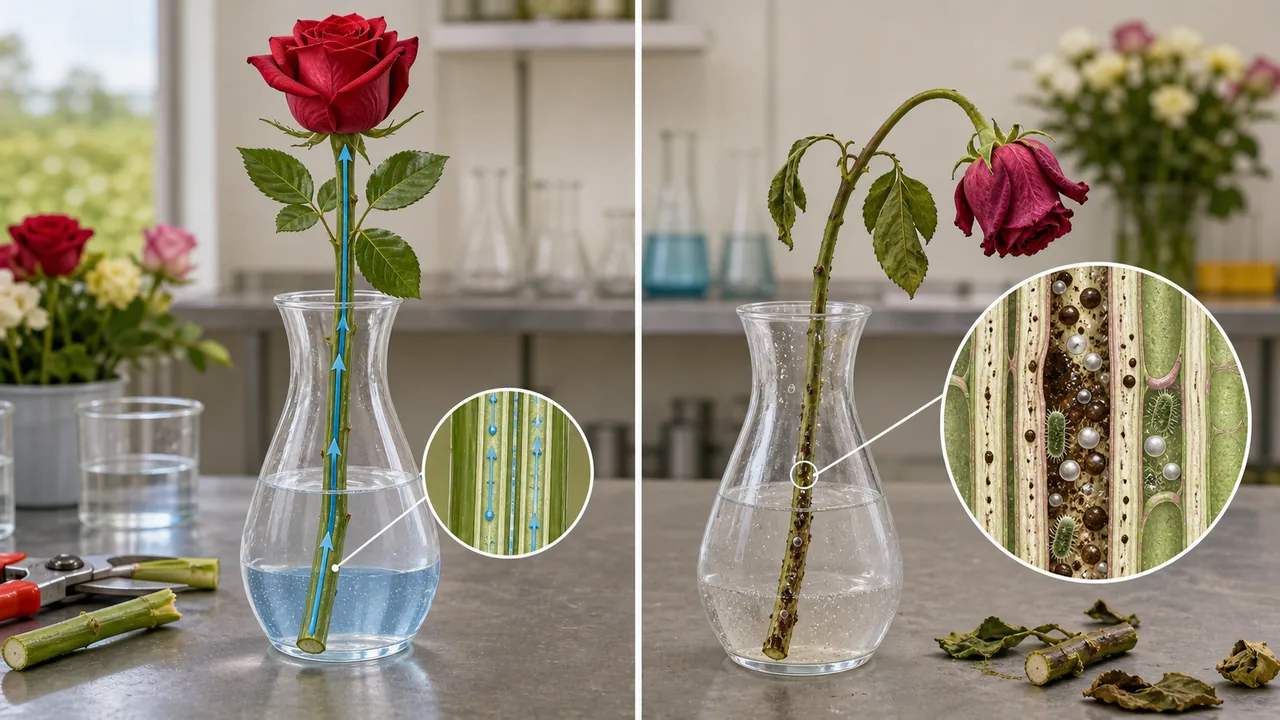
Two identical-looking flower bunches may behave very differently in a vase. One remains fresh for several days; the other bends, wilts, or drops petals quickly. The difference often comes from invisible post-harvest details: blocked xylem, low carbohydrate reserve, high ethylene exposure, warm storage, or dirty vase solution.
The explanation that follows focuses on those invisible details. The flower head is the part we admire, but the stem base, water, temperature, and microbes often decide the final result.
Major factors affecting shelf life
- water uptake
- respiration
- relative humidity
- temperature
- microbial blockage
- ethylene sensitivity
Post-harvest behaviour is not identical across all flowers. The nature and extent of damage differ by species and even by cultivar, which is why no single storage rule fits every flower crop.
Pro Content Locked
Upgrade to Pro to access this lesson and all other premium content.
₹99 charged monthly · Cancel anytime
- All Agriculture & Banking Courses
- AI Lesson Questions (100/day)
- AI Doubt Solver (50/day)
- Glows & Grows Feedback (30/day)
- AI Section Quiz (20/day)
- 22-Language Translation (100/day)
- Recall Questions (20/day)
- AI Quiz (15/day)
- AI Quiz Paper Analysis (100/day)
- AI Step-by-Step Explanations (100/day)
- Spaced Repetition Recall (FSRS)
- AI Tutor
- Immersive Text Questions
- Audio Lessons — Hindi & English
- Mock Tests & Previous Year Papers
- Summary & Mind Maps
- XP, Levels, Leaderboard & Badges
- Generate New Classrooms
- Voice AI Teacher (AgriDots Live)
- AI Revision Assistant
- Knowledge Gap Analysis
- Interactive Revision (LangGraph)
🔒 Secure via Razorpay · Cancel anytime · No hidden fees
Flower Shelf Life, Preservatives and Storage
Improving flower shelf life means slowing the processes that cause wilting, yellowing, stem bending, microbial blockage, poor opening, and early senescence.
The vase-life mystery
Two identical-looking flower bunches may behave very differently in a vase. One remains fresh for several days; the other bends, wilts, or drops petals quickly. The difference often comes from invisible post-harvest details: blocked xylem, low carbohydrate reserve, high ethylene exposure, warm storage, or dirty vase solution.
The explanation that follows focuses on those invisible details. The flower head is the part we admire, but the stem base, water, temperature, and microbes often decide the final result.
Major factors affecting shelf life
- water uptake
- respiration
- relative humidity
- temperature
- microbial blockage
- ethylene sensitivity
Post-harvest behaviour is not identical across all flowers. The nature and extent of damage differ by species and even by cultivar, which is why no single storage rule fits every flower crop.
Why flowers lose quality so quickly
Cut flowers continue to respire after harvest. At the same time, they may lose water faster than they absorb it. When water balance breaks down, petals lose freshness, stems bend, and market value declines rapidly.
Flower losses become especially important for distant and export markets, where travel time and repeated handling make shelf-life technology even more essential.
Key treatments
| Treatment | Main goal |
|---|---|
| Pre-cooling | remove field heat |
| Pulsing | supply sugars and useful chemicals before storage or sale |
| Holding solution | maintain quality after pulsing |
| Cold storage | extend life and regulate marketing |
Complete shelf-life chain for cut flowers
A cut flower is a living stem without roots. The grower has removed it from its water supply, but the flower still needs water, food reserves, oxygen balance, and protection from microbes. That is why shelf-life management is a chain, not a single chemical treatment.
harvest stage -> clean cut -> rapid hydration -> conditioning -> pre-cooling -> pulsing -> grading -> bunching -> cold storage -> protected transport -> holding solution
If any one link is weak, vase life falls. For example, a rose harvested at the right bud stage can still bend at the neck if the stem is blocked by microbes. A gladiolus spike can still lose value if it is laid horizontally and bends geotropically during transport. A chrysanthemum can still yellow if temperature is high and the transport period is long.
Think of preservatives as a support team
A preservative solution is not one magic chemical. It is more like a support team:
| Team member | What it does for the flower |
|---|---|
| sugar | gives energy for opening and respiration |
| germicide | keeps the stem water pathway cleaner |
| acidifier | improves water uptake and discourages microbes |
| anti-ethylene compound | protects sensitive flowers from premature ageing |
The important point is to explain function, not only list chemical names.
Pre-harvest base for long vase life
Shelf life begins before harvest. Flower keeping quality is closely connected with the crop's genetic character and growing conditions. The following factors are especially important:
| Factor | How it influences shelf life |
|---|---|
| Species and cultivar | some types naturally keep longer than others |
| Light | poor light weakens growth; very high light can scorch leaves and petals |
| Temperature | each flower has a preferred growing range; stress reduces keeping quality |
| Nutrition | balanced nutrition supports stem strength and flower quality |
| Nitrogen excess | can increase disease susceptibility and reduce vase performance |
| Micronutrient balance | iron deficiency in gladiolus is a typical quality problem in north India |
| Pollution and toxic gases | damage foliage and flowers before harvest |
| Insect and disease attack | damaged flowers often produce more ethylene and senesce faster |
This is why a preservative cannot "rescue" badly grown flowers completely. Post-harvest handling protects quality; it cannot create quality that was absent in the field.
Harvest decisions that decide later shelf life
The harvest decision has three questions:
- at what developmental stage?
- at what time of day?
- with what cutting method?
Flowers for distant markets are usually harvested earlier than flowers for local markets. Earlier harvest lowers damage risk, reduces ethylene sensitivity in some crops, and gives buds time to open after transport. But the stage cannot be too immature, or the bud may fail to open properly.
Useful stage patterns
| Flower type | Better harvest logic |
|---|---|
| Spike-type flowers | harvest when a fraction of lower florets or individual florets show opening/colour |
| Daisy-type flowers | harvest closer to full opening |
| Rose, carnation, gladiolus, lily, freesia, tulip | bud or colour-showing stage works for distance because buds continue opening in water |
| Loose flowers like marigold and some chrysanthemum trade | fully open flowers are accepted because the product is used differently |
Use this sentence in answers:
Local sale can tolerate a more open flower; distant sale needs a stronger, tighter, transport-safe flower.
Water relations: the central physiology
Flower senescence is strongly controlled by water balance. After harvest, three events compete with one another:
- water enters through the cut stem
- water moves through xylem vessels
- water is lost from petals and leaves by transpiration
Wilting begins when water loss becomes faster than water uptake. This may happen because the room is hot and dry, because the stem cut is poor, because air has entered xylem vessels, or because bacteria and yeasts block the conducting tissue.
Why acidified clean water helps
Water uptake improves when the holding solution is acidified and when wetting agents or flower food are used properly. In simple terms:
- slightly acidic water discourages many microbes
- clean water keeps xylem clearer
- surfactants reduce surface tension and help water enter the stem
- sugar supports respiration and bud opening
The dirty vase problem
A student buys two carnation stems and places one in clean preservative solution and another in ordinary dirty water. The second stem may wilt faster because microbes multiply near the cut end and block water uptake. This simple case explains why germicides, clean containers, recutting, and acidic solution are repeatedly mentioned in flower storage.
The concept is: microbial blockage -> reduced water uptake -> wilting -> shorter vase life.
Respiration, carbohydrate reserves, and temperature
Flowers continue respiration after cutting. Respiration uses stored carbohydrates. If temperature is high, the flower burns reserves faster, petals age earlier, and vase life shortens. This is why pre-cooling and cold storage are repeated again and again in flower handling.
Think of carbohydrate reserves as the flower's lunch box for travel. Higher temperature makes the flower eat that lunch box quickly; lower safe temperature makes it last longer.
Relative humidity and water loss
Relative humidity affects transpiration. In dry air, flowers lose water quickly. In high humidity, water loss is slower. However, humidity must be managed with cleanliness and ventilation because very wet, dirty conditions can promote disease. The best storage environment therefore combines:
- suitable low temperature
- high but safe relative humidity
- clean containers and water
- crop-specific ventilation and packaging
Growth regulators in flower shelf life
Several hormone-related points are best understood conceptually:
- cytokinins can delay senescence in some cut flowers
- gibberellic acid may improve longevity or help bud opening in selected cases
- indole acetic acid can increase ethylene in isolated carnation petals
- auxin can delay abscission in poinsettia-type material
No one growth regulator should be treated as universal. The correct effect depends on flower crop, tissue, concentration, and objective.
Preservative solutions as "three-part medicine"
Most preservative solutions are built around three jobs:
| Component | Main job | Student warning |
|---|---|---|
| Sugar, usually sucrose | gives energy and supports bud opening | sugar alone feeds microbes too |
| Germicide or biocide | controls bacteria, yeasts, and moulds | should match crop and concentration |
| Acidifier / pH adjuster | improves water uptake and reduces microbial multiplication | too strong a solution can injure stems |
Salts, growth regulators, anti-ethylene compounds, wetting agents, and conditioners may also act as supporting components. A strong answer should show that preservatives are not "one chemical"; they are carefully balanced mixtures.
Anti-ethylene protection
Ethylene-sensitive flowers age, drop petals, or fail faster when exposed to ethylene. Silver thiosulphate-responsive flowers include carnation, orchid, gypsophila, gladiolus, gerbera, snapdragon, alstroemeria, agapanthus, anemone, and sweet pea.
For students, the logic is:
ethylene-sensitive flower + long transport = anti-ethylene treatment becomes important
Some transport boxes may also carry ethylene scrubbers such as potassium permanganate-based material. This is especially useful when mixed consignments, long routes, or enclosed packaging increase the risk of ethylene accumulation.
The storage-science background also supports flower handling:
- storage helps balance daily fluctuation between harvest and sale
- long-term storage can make produce available in the off-season
- different storage systems act by reducing microbial growth, slowing respiration, and controlling the atmosphere around the produce
All of these treatments connect to one core question:
How do we keep the cut stem alive, hydrated, and attractive for as long as possible?
Floral preservatives usually contain
- sugar source
- germicide
- pH adjuster
Preservative logic in simple words
Preservatives can be understood as functional combinations:
- sugar supplies energy and helps bud opening
- germicide reduces microbial blockage
- acidifier or pH adjuster helps water uptake conditions
These improve water movement and reduce microbial growth.
Important points include that chemicals such as fungicides, growth regulators, and specialized floral chemicals may be used in certain crops to extend shelf life or reduce storage disorders.
Why sugar is used
Sugar helps supply energy to cut flowers after harvest, especially when natural reserves are low or when buds still need to open.
Why germicides are used
Water in stems and containers can support microbial growth. Germicides help keep the conducting tissues clearer so flowers absorb water more effectively.
Why low temperature is critical
Lower temperature generally:
- slows respiration
- slows wilting
- slows microbial activity
- helps delay senescence
But the correct temperature still depends on flower type, because very unsuitable conditions can create injury in sensitive materials.
Why pre-cooling matters before storage
Flowers often carry field heat after harvest. If that heat is not removed quickly:
- respiration stays high
- water loss stays rapid
- senescence speeds up
- storage life falls
The larger post-harvest chapter also describes several cooling approaches that help students see pre-cooling as part of a scientific chain:
- hydro cooling
- contact icing
- vacuum cooling
- air cooling
Not all of these are used for every flower, but the lesson is important: rapid field-heat removal is one of the basic tools of post-harvest life extension.
Pre-cooling temperatures: how to study the table
The crop-wise pre-cooling temperatures are easier to learn when they are grouped by cooling need:
| Flower | Lesson-aligned pre-cooling idea |
|---|---|
| Chrysanthemum and rose | very low cooling range around 0.5-4°C |
| Carnation | low cooling, about 1-3°C |
| Alstroemeria | cool handling around 4°C |
| Anthurium | warmer than many temperate flowers, around 5-7°C |
| Dendrobium | still warmer, around 10°C |
| Gladiolus | comparatively higher pre-cooling range around 13°C |
This grouping also teaches the principle: tropical and subtropical flowers may be injured by temperatures that are safe for temperate flowers.
Conditioning or hardening
Conditioning restores turgidity in flowers that have wilted after harvest, storage, or transport. In practice it means giving stems a clean rehydration opportunity before the next step of marketing.
Lesson-aligned details to retain:
- clean or demineralized water is preferred
- germicides may be added
- citric acid may adjust pH around 4.0-5.0
- wetting agents such as Tween 20 can support water uptake at suitable low concentration
- STS, 8-HQC, and sucrose may also be used in conditioning systems where appropriate
Impregnation
Impregnation is a short treatment in which stems are loaded with selected metallic salts such as silver nitrate, nickel chloride, or cobalt chloride at high concentration. The purpose is to reduce water-vessel blockage, microbial decay, and ethylene-related deterioration.
This approach is linked with cut flowers such as:
- gerbera
- carnation
- chrysanthemum
- gladiolus
In simple terms, impregnation is not normal vase water. It is a brief, targeted pre-treatment.
Pulsing in detail
Pulsing is a short-duration treatment with higher concentration of sucrose and germicide before storage or long-distance movement. It is especially useful for flowers that must remain fresh after a long marketing chain.
Lesson-aligned pulsing points
- sucrose is the major energy source in pulse solutions
- concentration may vary widely by crop, roughly from low single digits to much higher values
- a biocide should accompany sugar because sugar alone encourages microbes
- ethylene-sensitive flowers may receive STS pulses
- alstroemeria and lilies may benefit from gibberellic-acid-containing pulses to reduce leaf yellowing
- some crops respond to very short silver nitrate pulses, but high concentration can injure sensitive flowers
- rose and carnation usually need lower sucrose than multi-floret spikes such as gladiolus and tuberose
Pulse concentration memory table
| Crop group | Teaching memory |
|---|---|
| Rose and carnation | moderate sucrose pulse, often around 5-8% in standard notes |
| Gladiolus and tuberose | higher sucrose need, often around 10-20% because many florets must open |
| Ethylene-sensitive flowers | add anti-ethylene support where suitable |
| Leaf-yellowing-prone crops | gibberellic acid may support leaf quality |
Bud opening solutions
Bud opening treatments use germicide, sucrose, and sometimes hormonal support to help immature buds open after harvest. Typical crops include chrysanthemum, rose, carnation, gladiolus, and snapdragon.
This topic is easy to confuse with pulsing:
- pulsing prepares flowers for storage or travel
- bud opening helps immature buds reach display stage
- both may use sugar and germicide, but their practical objective differs
Grading, bunching, and packaging
After harvest, flowers are graded according to market specifications and then arranged into bunches. Trade bunch sizes such as 5, 10, 20, 50, or 100 stems or flowers depend on crop and market.
Packaging must protect flowers from:
- petal bruising
- stem breakage
- water loss
- crushing in stacked loads
- unsuitable heat or humidity
Corrugated fibreboard boxes, sleeves, cushioning with paper or cotton-like material, and crop-specific orientation are all part of good packaging logic.
Wet storage, dry storage, CA, MA, and hypobaric storage
Storage approaches can be distinguished as follows:
| Storage type | Meaning in simple words | Usefulness |
|---|---|---|
| Wet cold storage | stems remain in water or solution | short-term holding and retail-type use |
| Dry cold storage | flowers are stored dry after packing | longer transport/storage but more labour and care |
| CA storage | gases are accurately controlled | slows respiration and ethylene-linked ageing |
| MA storage | package or room atmosphere is modified less precisely | practical life extension in some systems |
| Hypobaric storage | low pressure plus refrigeration | reduces gas pressure and helps remove volatiles |
All these systems serve the same biological goal: lowering respiration, conserving stored carbohydrates, limiting ethylene build-up, and delaying senescence.
Recommended flower storage: pattern table
The study table below includes many crops. Use it to remember the pattern without memorizing every row mechanically:
| Flower group | Approximate storage message |
|---|---|
| Alstroemeria, asparagus, aster, lilies, daffodil, freesia, iris, snapdragon, statice, stock, sunflower, sweet pea | many store near 0-1°C with high humidity |
| Carnation | stores near 1°C and can keep for weeks under good conditions |
| Rose | very cool storage around 0.5-2°C with high humidity |
| Gerbera | slightly warmer, around 2-4°C |
| Gladiolus | around 7°C in the table |
| Anthurium, crossandra, orchid, torch ginger, tuberose | warmer storage than temperate flowers |
| Marigold | moderate cool storage, roughly 8-12°C |
The principle is stronger than the figures: storage temperature is crop-specific.
Transport rules
Flower transport must reduce transpiration, respiration, and mechanical injury. Practical points include:
- dry flowers before final packing so free moisture does not encourage damage
- use corrugated cardboard boxes or suitable sleeves
- maintain high relative humidity during pre-cooling and shipment
- transport at an optimum low temperature for that crop
- keep geotropic-bending-sensitive flowers such as gladiolus and snapdragon upright
- use ethylene scrubbers in boxes for sensitive flowers where needed
- provide light or avoid long dark hot transport for crops prone to leaf yellowing
- road, air, and sea shipment are possible, but air shipment may still need pretreatment because temperature control can be weak during flight
Fresh-flower preservative chemistry
Important examples include:
| Chemical group | Examples in the lesson | Main role |
|---|---|---|
| Quinoline germicides | 8-HQS, 8-HQC | control microbes and improve solution uptake |
| Silver compounds | silver nitrate, silver thiosulphate | germicidal and anti-ethylene support in selected flowers |
| Fungicidal support | thiobendazole-type material | reduces fungal problems |
| Quaternary ammonium salts | QAS | microbial control |
| Chlorine release compounds | slow-release chlorine sources | sanitation in solution |
| Aluminium salts | aluminium sulphate | acidifying and antimicrobial support |
8-HQC is a common commercial preservative component and sucrose is the common food source. Standard holding-preservative sucrose is much lower than pulsing sucrose and is often placed around 1-2% in many floral preservative contexts.
Commercial preservative names
Examples include:
- Floralife
- Rogard/Silgard
- Chrystal
- Prolong
- Oasis
- Vita Flora
Do not write an answer as if the brand itself is the concept. The concept is: commercial preservatives combine food, germicide, pH adjustment, and sometimes hormonal or surfactant support.
Holding or vase solution
Holding solution is used after pulsing and storage, at wholesaler, retailer, or consumer level. It usually contains lower concentration of chemicals than the pulse solution.
Useful components include:
- sucrose
- 8-HQC or 8-HQS
- aluminium sulphate
- citric acid
- anti-ethylene agents such as STS or silver nitrate in appropriate systems
- growth regulators such as gibberellic acid or benzyl adenine for selected crops
- ethylene biosynthesis/action inhibitors such as AVG, MVG, AOA, 1-MCP-type agents in relevant cases
This gives students a complete answer: holding solution is not just "water"; it is a low-strength maintenance environment for the cut flower.
Storage and handling logic
Good flower storage is not just "keep it cold." It also means:
- harvest at the proper stage
- place stems quickly in water or conditioning solution
- remove field heat rapidly
- maintain cleanliness of containers and solutions
- pack in a way that prevents bending and crushing
- avoid delay between harvest and sale
General storage objectives
Storage has a few very simple objectives:
- reduce deterioration
- maintain quality
- balance harvest with sale timing
- extend availability beyond immediate harvest
These same objectives apply strongly to flowers, even though flowers are marketed for beauty rather than eating quality.
Main causes of deterioration
The major causes of flower deterioration include:
- water stress
- respiration and reserve depletion
- microbial blockage
- ethylene injury
- bruising and mechanical damage
- wrong harvest stage
- unsuitable storage environment
The wider post-harvest framework also supports these points through storage tips such as:
- store only sound, high-quality produce
- avoid temperatures lower than recommended for the commodity
- avoid overloading rooms or stacking containers too closely
- provide adequate ventilation
- keep storage areas clean
These rules are general, but they are highly relevant to flower storage as well.
What makes export flowers difficult
Flower losses become especially serious in distant and foreign markets because export flowers must survive:
- longer transport time
- repeated handling
- temperature fluctuation
- temporary dry periods
- microbial problems in stem or solution
So when writing an answer on shelf life, connect technology with distance:
the longer the marketing chain, the greater the need for precise cooling, hydration, grading, and packaging.
Flowers are highly perishable compared with many other horticultural commodities, which is why patient, soft, and expert handling is emphasized so strongly.
Pulsing vs holding solution
Students often mix these up.
| Term | Simple idea |
|---|---|
| Pulsing | short-term treatment before storage/marketing |
| Holding solution | solution used to maintain quality during holding or display |
Conditioning or rapid rehydration should also be understood as part of the same practical chain, because freshly cut stems need water balance restored before long transport or storage.
Main storage goals
- maintain freshness
- reduce water loss
- regulate opening
- extend vase life
- allow flexible marketing and transport
Shelf-life support from storage science
The wider post-harvest chapter describes storage systems such as:
- cold storage
- controlled atmosphere storage
- modified atmosphere storage
- hypobaric storage
For flowers, the practical lesson is not that every farm will use all of these systems, but that shelf life improves when:
- temperature is controlled
- humidity is suitable
- harmful gases such as excess ethylene are limited
- respiration is slowed
Shelf-life improvement sequence
Shelf-life improvement includes:
- proper variety and pre-harvest care
- correct harvest stage
- clean cutting and rapid hydration
- pre-cooling
- pulsing or preservative treatment
- cold storage
- careful grading, packaging, and transport
One strong summary
Cut-flower shelf life depends on the entire chain: good pre-harvest growth, correct harvest stage, clean cutting, water uptake, low safe temperature, microbial control, ethylene management, suitable preservatives, crop-specific storage, and protected transport. The physiology behind these practices is also important: flowers age because they lose water, consume carbohydrates, suffer xylem blockage, respond to ethylene, and respire faster at high temperature.
A complete explanation connects:
- pre-harvest quality
- right harvest stage
- coolest-time harvesting
- conditioning and hydration
- pulsing and preservatives
- cold storage
- soft handling and safe transport
- support infrastructure for distant markets
Main reasons for short vase life
The major reasons are:
- poor variety choice
- weak pre-harvest growing conditions
- incorrect harvest stage
- delayed hydration
- microbial clogging
- high temperature
- excessive ethylene exposure
- rough transport and storage injury
What a good practical answer should mention
When writing about flower shelf life, include:
- correct harvest stage
- clean cutting and handling
- rapid pre-cooling
- preservative use
- cold storage
- soft handling during packing and transport
Visual reinforcement
These BioRender templates are useful references for building stronger diagrams around flower handling and post-harvest care:
- Methods used for applying probiotics to vegetables post-harvest.
- Postharvest metabolic mechanism in the presence of active edible coating film
- Angiosperm - Flower Anatomy
They are not cut-flower trade templates word for word, but they are strong visual bases for explaining water loss, storage, and flower structure.
Summary Cheat Sheet
| Concept / Topic | Key Details / Explanation |
|---|---|
| Main shelf-life factors | Flower shelf life is controlled by water uptake, respiration, relative humidity, temperature, microbial blockage, and ethylene sensitivity. |
| Why flowers lose quality quickly | Cut flowers may lose water faster than they absorb it, consume stored carbohydrates through respiration, and suffer xylem blockage or ethylene injury, which shortens vase life rapidly. |
| Shelf-life chain | A strong answer should follow this chain: harvest stage -> clean cut -> rapid hydration -> conditioning -> pre-cooling -> pulsing -> grading -> bunching -> cold storage -> protected transport -> holding solution. |
| Preservatives as a support team | Floral preservatives usually combine sugar for energy, germicide for microbial control, acidifier for better water uptake, and sometimes anti-ethylene support. |
| Pre-harvest base for vase life | Shelf life begins with species/cultivar choice, good light, suitable temperature, balanced nutrition, and low disease or insect damage. |
| Harvest-stage logic | Flowers for distant markets are usually harvested earlier or tighter than flowers for local markets, but the stage must still allow proper opening later. |
| Water-balance idea | Wilting begins when transpiration losses become greater than water uptake through the cut stem, especially when xylem is blocked by microbes or air. |
| Conditioning | Conditioning restores turgidity by giving stems a clean rehydration opportunity, often with clean water, germicide, and suitable pH adjustment. |
| Pulsing | Pulsing is a short-duration treatment with higher-concentration sugar and supportive chemicals before storage or long transport. It prepares flowers for the later marketing chain. |
| Holding solution | A holding solution is used after storage or during display and usually contains lower chemical concentration than a pulse solution. |
| Pre-cooling and storage | Pre-cooling removes field heat and helps slow respiration, water loss, and senescence. Good cold storage then extends marketable life, but the correct temperature is crop-specific. |
| Storage-system names | Important storage approaches are wet cold storage, dry cold storage, controlled atmosphere (CA), modified atmosphere (MA), and hypobaric storage. |
| CA, MA, and hypobaric logic | All these systems aim to slow respiration, limit ethylene effects, conserve carbohydrates, and delay senescence, though their precision and cost differ. |
| Germicide and preservative names | High-value names include 8-HQS, 8-HQC, silver nitrate, STS, thiabendazole, quaternary ammonium salts, aluminium sulphate, and citric acid. |
| Ethylene management | STS, silver nitrate, and related anti-ethylene tools help protect sensitive flowers, while KMnO4-based ethylene scrubbers may be used in transport boxes. |
| Transport rules | Flowers should be packed to avoid bruising, crushing, bending, and water loss. Gladiolus and snapdragon are classic examples needing upright transport because of geotropic bending. |
| Best chapter memory line | The strongest recall line is: clean cutting + rapid hydration + pre-cooling + pulsing + cold storage + soft transport, with water balance as the central physiological idea. |
Lesson Doubts
Ask questions, get expert answers