🥫 Preservation and Value-Added Products
A deeper lesson on why foods are preserved, the principles of preservation, and major preservation methods.
Preservation and Value-Added Products
Preservation means protecting food from spoilage so it stays safe, nutritious, attractive, and saleable for a longer time. It is the science of controlling the physical, chemical, and microbial changes that make food unfit for use.
Start with a student-friendly scene
Imagine three mangoes on a summer kitchen table. One is eaten fresh, one is cut and kept open, and one is turned into jam or pickle. The fresh mango may spoil quickly, the open mango darkens and attracts microbes, but the processed mango can travel to another city and still earn money for the farmer. That simple scene is the heart of preservation: control water, air, heat, microbes, enzymes, and handling so food keeps its value for longer.
When studying any preservation method, ask one question first: What spoilage force is this method controlling?
- Drying controls available water.
- Blanching controls enzymes.
- Pasteurization controls microbes by heat.
- KMS and sodium benzoate control microbial growth chemically.
- Canning controls microbes by sealing plus heat.
- Refrigeration slows respiration and microbial multiplication.
This single question makes the long list easier to remember.
Pro Content Locked
Upgrade to Pro to access this lesson and all other premium content.
₹99 charged monthly · Cancel anytime
- All Agriculture & Banking Courses
- AI Lesson Questions (100/day)
- AI Doubt Solver (50/day)
- Glows & Grows Feedback (30/day)
- AI Section Quiz (20/day)
- 22-Language Translation (100/day)
- Recall Questions (20/day)
- AI Quiz (15/day)
- AI Quiz Paper Analysis (100/day)
- AI Step-by-Step Explanations (100/day)
- Spaced Repetition Recall (FSRS)
- AI Tutor
- Immersive Text Questions
- Audio Lessons — Hindi & English
- Mock Tests & Previous Year Papers
- Summary & Mind Maps
- XP, Levels, Leaderboard & Badges
- Generate New Classrooms
- Voice AI Teacher (AgriDots Live)
- AI Revision Assistant
- Knowledge Gap Analysis
- Interactive Revision (LangGraph)
🔒 Secure via Razorpay · Cancel anytime · No hidden fees
Preservation and Value-Added Products
Preservation means protecting food from spoilage so it stays safe, nutritious, attractive, and saleable for a longer time. It is the science of controlling the physical, chemical, and microbial changes that make food unfit for use.
Start with a student-friendly scene
Imagine three mangoes on a summer kitchen table. One is eaten fresh, one is cut and kept open, and one is turned into jam or pickle. The fresh mango may spoil quickly, the open mango darkens and attracts microbes, but the processed mango can travel to another city and still earn money for the farmer. That simple scene is the heart of preservation: control water, air, heat, microbes, enzymes, and handling so food keeps its value for longer.
When studying any preservation method, ask one question first: What spoilage force is this method controlling?
- Drying controls available water.
- Blanching controls enzymes.
- Pasteurization controls microbes by heat.
- KMS and sodium benzoate control microbial growth chemically.
- Canning controls microbes by sealing plus heat.
- Refrigeration slows respiration and microbial multiplication.
This single question makes the long list easier to remember.
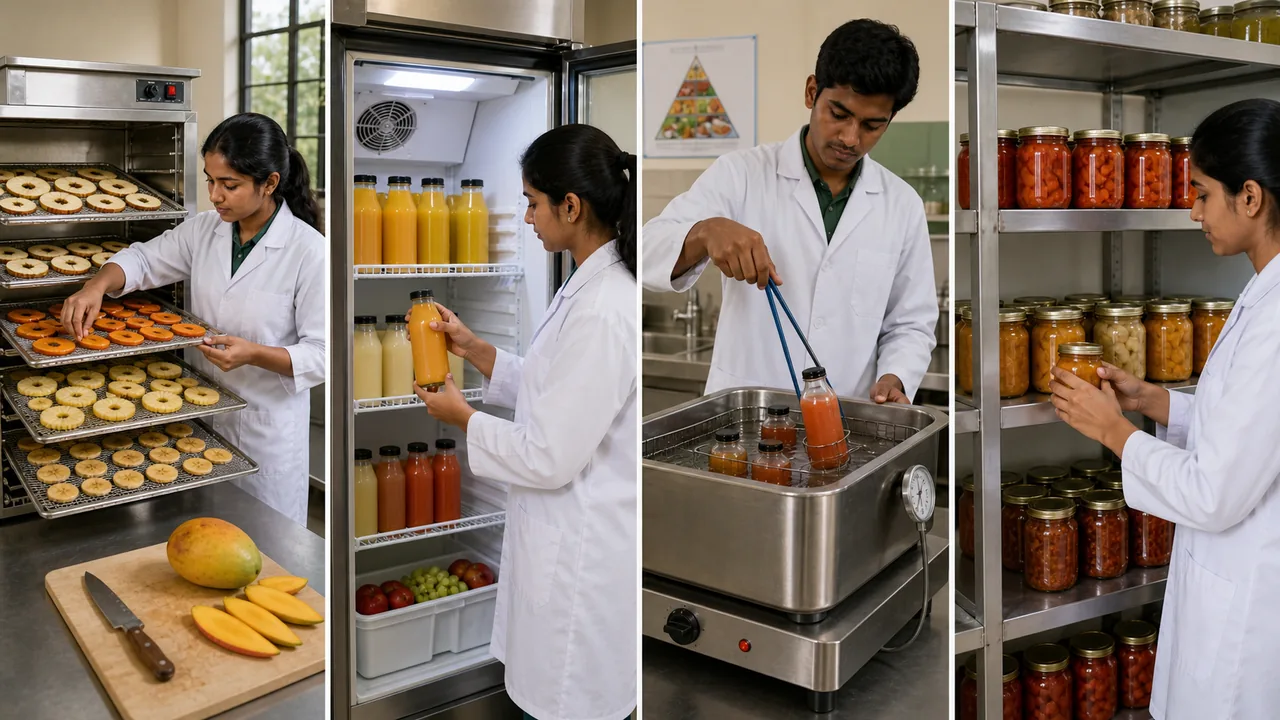
Why preservation is needed
This unit links preservation with both household need and national horticulture economics.
- it extends shelf life
- it makes seasonal produce available beyond harvest time
- it reduces waste in glut periods
- it adds variety to the diet
- it saves labour, fuel, and repeated preparation time
- it helps stabilize market prices
- it improves nutrition access
- it creates value-added products from perishable crops
What kinds of spoilage we try to control
| Type of change | What it affects |
|---|---|
| Physical changes | colour, flavour, texture, taste, appearance |
| Chemical changes | carbohydrate, fat, protein, vitamin, and mineral stability |
| Microbial changes | moulds, yeasts, bacteria |
Why apple slices turn brown
If you cut an apple and leave it open, the exposed surface turns brown because enzymes and oxygen react with plant compounds. A little lemon juice slows this because acidity and antioxidants disturb that reaction. The same logic works in food processing: processors do not only fight bacteria; they also fight enzyme action, oxidation, moisture loss, and texture damage.
Main principles of preservation
The whole chapter is built around three large principles:
- prevention or delay of microbial decomposition
- prevention or delay of self-decomposition in food
- prevention of damage from insects, animals, and mechanical causes
Preventing or delaying microbial decomposition
Asepsis
Asepsis means keeping microorganisms out. In practice, this means cleanliness during harvesting, grading, transport, washing, cutting, packing, and storage.
Filtration
Filtration is mainly used for liquids such as juices and beverages. Special filters hold back microorganisms while allowing the liquid to pass through.
Anaerobic condition
Some products are protected when oxygen is reduced or replaced. This can be done by:
- replacing oxygen with carbon dioxide
- evacuating sealed containers
- covering products like pickles with oil
High temperature
Microorganisms can be destroyed or greatly reduced by heating methods such as:
- canning
- pasteurization
- boiling or cooking
- irradiation-related sterilizing approaches in special cases
Preventing or delaying self-decomposition
Food can spoil even without obvious outside contamination because enzymes and oxidation continue acting inside it.
Blanching
Blanching is a short heat treatment, especially important for vegetables. It helps:
- soften tissues before packing
- preserve original colour and flavour
- destroy undesirable enzymes
- remove trapped air
- lower microbial load
- reduce astringency or unwanted taste factors
Antioxidants
Antioxidants protect foods from deterioration caused by air and oxidation. Common examples that should be recognized include:
- BHA
- BHT
- tocopherols
- ascorbic acid
- lactic acid
- phosphoric acid
Two broad classes of preservation methods
| Class | Main logic |
|---|---|
| Bacteriostatic methods | make conditions unfavourable for microbial growth |
| Bactericidal methods | use stronger action to destroy microorganisms |
Bacteriostatic methods
1) Drying of foods
Drying means reducing moisture to a level at which microorganisms cannot grow properly.
Drying by application of heat
- Sun drying is simple and cheap but usually gives lower product quality because exposure is less controlled.
- Mechanical drying uses controlled temperature, airflow, and humidity.
- Vacuum drying removes water under controlled vacuum and heat.
- Freeze drying removes water by sublimation after freezing.
Drying by binding moisture
Instead of physically removing water, we can make it unavailable for microbes by using:
- sugar
- salt
2) Chemical preservatives
Chemical preservatives are added to retard, inhibit, or stop microbial activity.
Class I preservatives
- salt
- sugar
- dextrose
- spices
- vinegar
- ascorbic acid
Class II preservatives
- benzoic acid and its salts
- sulphur dioxide and sulphite salts
- nitrates
- sorbic acid and its salts
- propionic acid and its salts
- lactic acid and its salts
KMS
Potassium metabisulphite (KMS) is especially important in fruit processing.
- it releases sulphur dioxide
- it is better suited to products where anthocyanin colour is not the key pigment
- it should not be used in naturally anthocyanin-rich juices like jamun or phalsa because colour can be affected
- it is unsuitable for tin containers because sulphur compounds can react and create blackening and bad odour
- it is very effective against moulds
- many fruit juice products use it around 350 ppm
Sodium benzoate
- it is water soluble
- it delays fermentation in juices
- it is suitable for naturally coloured products
- it is especially effective against yeasts
- the textbook repeatedly links it with juices, squashes, and cordials around 750 ppm
3) Food additives used in preservation
The following can be understood as common preservation-oriented additives:
- sugar
- salt
- acids
- spices
Sugar
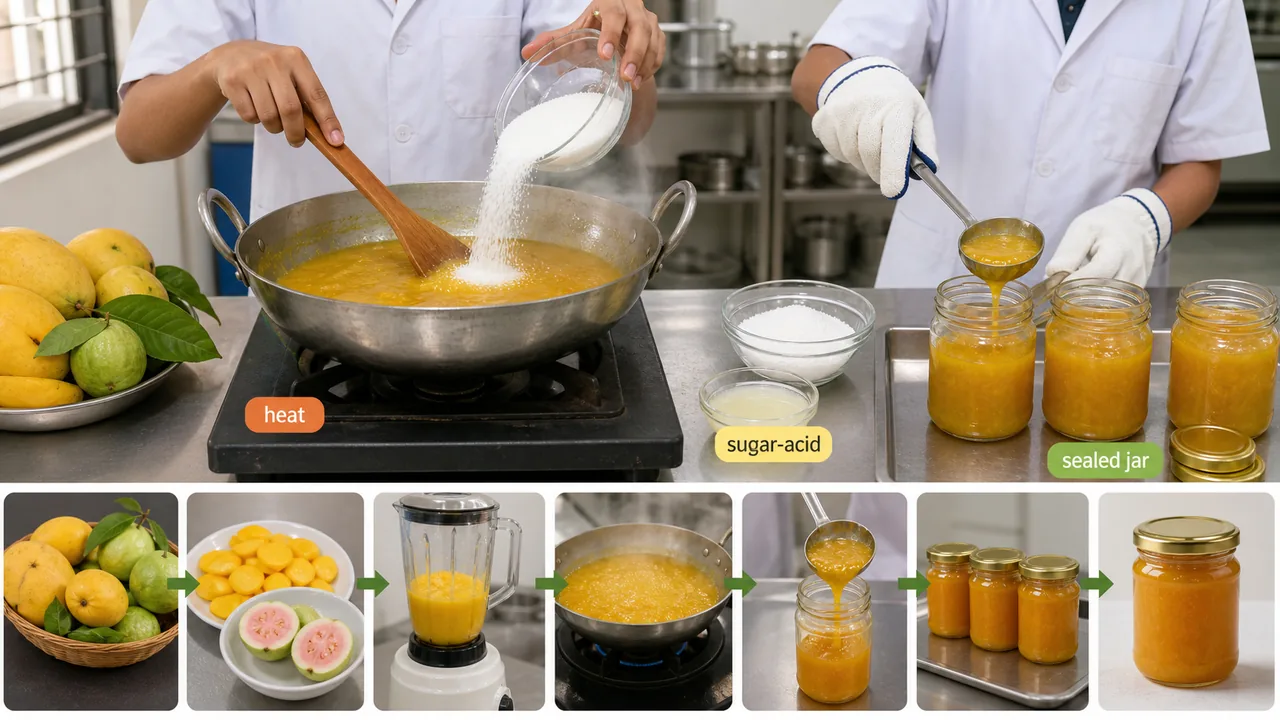
Sugar helps by tying up available water through osmotic action. High sugar concentration is central in jam, jelly, and marmalade.
Why jam feels safer than fresh pulp
Fresh fruit pulp has water, sugar, acids, enzymes, and microbes. If it is just stored in a bowl, microbes can multiply. During jam making, the processor adds sugar, heats the mixture, adjusts acid, removes water through boiling, and fills hot into a clean jar. So jam is not preserved by one magic ingredient; it is preserved by a combined hurdle system.
One strong summary line is: Good preservation usually works by combining hurdles such as heat, low available water, acidity, preservatives, hygienic filling, and safe packaging.
Salt
Salt preserves by:
- creating high osmotic pressure
- dehydrating microbes and food surface
- reducing oxygen solubility in water
- slowing enzymatic browning and deterioration
Acids
Acids give flavour and also help preservation, pectin behaviour, and product balance.
Important named acids:
- acetic acid for pickles, sauces, chutneys, ketchup
- citric acid for jam, jelly, squash, nectar
- lactic acid for fermented products and pickle character
Spices
Spices do more than improve taste. They:
- enhance flavour and palatability
- sometimes add colour
- contribute antibacterial and antifungal effects
4) Low temperature
Low temperature slows microbial growth, enzyme activity, and chemical changes, though it is not equally permanent for all products.
| Storage system | Typical temperature idea | Use |
|---|---|---|
| Cellar storage | above 15°C | short storage of roots and bulbs |
| Refrigerated storage | around 0–5°C | short to medium storage of perishables |
| Freezing storage | around -18°C to -40°C | long storage where frozen preservation is suitable |
Important point: vegetables are often blanched before freezing because enzymes may remain active even below 0°C.
Bactericidal methods
These methods destroy microorganisms mainly through heat or radiation.
Pasteurization
Pasteurization is a controlled heat treatment, usually below 100°C.
Three named methods
- Bottle or holding pasteurization
- Overflow method
- Flash pasteurization
Two broad heating styles are especially important:
- LTHT = low temperature, high time
- HTST = high temperature, short time
Boiling or cooking
Cooking improves:
- microbial safety
- enzyme inactivation
- colour, flavour, and texture
- digestibility
Canning
Canning uses sealed containers plus heating at or above 100°C.
- acidic fruits usually need less severe treatment
- non-acid vegetables need stronger treatment, often above 100°C under pressure
- the sealed container also creates an anaerobic condition that helps stability
Acid-based food groups to remember
| Food class | pH idea | Examples |
|---|---|---|
| Low-acid foods | 5.3 and above | peas, corn, beans, milk, meat |
| Medium-acid foods | 5.3–4.5 | spinach, asparagus, beet, pumpkin |
| Acid foods | 4.5–3.7 | tomato, pear, pineapple, sauces |
| High-acid foods | below 3.7 | berries, sauerkraut, pickles |
Other preservation methods named in the unit
Filtration
Used especially for clarified liquids where bacteria and yeasts must be held back.
Carbonation
Carbon dioxide dissolved in beverages improves keeping quality and creates characteristic effervescence. Fruit beverages may carry about 1–8 g/litre of CO₂.
Fermentation
Fermentation is one of the oldest preservation methods. Foods are preserved because microorganisms produce:
- alcohol
- lactic acid
- acetic acid
Preservation by antibiotics
Important names include:
- Nisin
- Subtilin
- Pimaricin
Irradiation
Irradiation is sometimes described as a kind of cold sterilization because it reduces spoilage organisms and helps prevent sprouting in products such as onion and potato without relying on conventional heating.
Importance and scope of preservation in India
- India grows a large diversity of fruits and vegetables because of varied climate and soils.
- Most fruits and vegetables are seasonal and highly perishable.
- Surplus often appears in one season, but transport, roads, packaging, and cold storage are not always adequate.
- Growers may not get a good price at harvest time.
- Post-harvest losses continue even when production is high.
Two major solutions emphasized in the unit
- expand cold storage and distribution infrastructure
- process fruits and vegetables into value-added products for longer storage and better returns
Why India has major opportunity
- the middle class increasingly demands processed products
- processing can increase farmer income
- value addition can support horticulture in remote and hill regions
- export of processed products can improve foreign exchange earnings
- India still processes a much smaller share of horticultural produce than advanced processing economies
Summary Cheat Sheet
| Concept / Topic | Key Details / Explanation |
|---|---|
| Meaning of preservation | Preservation means protecting food from spoilage so it remains safe, nutritious, attractive, and saleable for a longer time. |
| Main spoilage forces controlled | Preservation controls physical, chemical, and microbial spoilage by acting on water, air, heat, enzymes, microbes, and handling conditions. |
| Main principles of preservation | The chapter is built on three broad principles: prevent or delay microbial decomposition, prevent or delay self-decomposition, and prevent damage from insects, animals, and mechanical causes. |
| Key principle words | High-value core words are asepsis, filtration, anaerobic condition, and high temperature. |
| Bacteriostatic vs bactericidal methods | Bacteriostatic methods make conditions unfavourable for microbial growth, while bactericidal methods destroy microorganisms more directly. |
| Drying and moisture control | Drying reduces available moisture, while sugar and salt may preserve by binding water and creating conditions unsuitable for microbes. |
| Blanching and self-decomposition control | Blanching is a short heat treatment that destroys undesirable enzymes, helps preserve colour and flavour, removes trapped air, and reduces microbial load. |
| Preservatives and antioxidants | Important preservation-oriented additives include BHA, BHT, gallates, tocopherols, ascorbic acid, and support acids such as lactic acid and phosphoric acid. |
| KMS | Potassium metabisulphite (KMS) releases SO₂, is highly effective against moulds, and is commonly used in fruit products, but it is unsuitable for some naturally coloured anthocyanin-rich juices and tin containers. Pure KMS is remembered with about 57.7% SO₂. |
| Sodium benzoate | Sodium benzoate is water soluble and especially effective against yeasts, making it useful in juices, squashes, and cordials. |
| Low-temperature preservation | Cellar storage, refrigerated storage, and freezing storage slow microbial growth, enzyme action, and chemical changes, though crop suitability differs. |
| Pasteurization and canning | Pasteurization is controlled heating usually below 100°C, while canning combines sealing and stronger heat treatment. Useful facts include HTST milk at 72°C for 15 sec and juice pasteurization around 85°C for 25-30 min. |
| Acid-food logic | Acidic foods need less severe canning than low-acid vegetables, which usually require treatment above 100°C under pressure. |
| Industry importance | Preservation extends shelf life, reduces glut-season waste, supports value addition, and helps make fruits and vegetables available beyond the harvest period. India still needs stronger cold chain and processing expansion. |
Lesson Doubts
Ask questions, get expert answers