🛡️ Packaging, Marketing, Export and Safe Food
A deeper lesson on packaging functions, market presentation, export expectations, and safe-food logic.
Packaging, Marketing, Export and Safe Food
Product preparation is linked with the business side of food processing. A good product is not truly market-ready until it can be packed, stored, transported, displayed, and sold safely.
The marketplace question
Think of two bottles of the same mango squash in a shop. One has a clean label, tight cap, clear batch details, attractive colour, and no leakage. The other has a faded label, sticky bottle, and no date. Even before tasting, the buyer trusts the first one more. That is why packaging is not decoration only; it is the first conversation between the product and the customer.
For Class 12 answers, write packaging as a 4-in-1 system: it contains, protects, communicates, and markets.
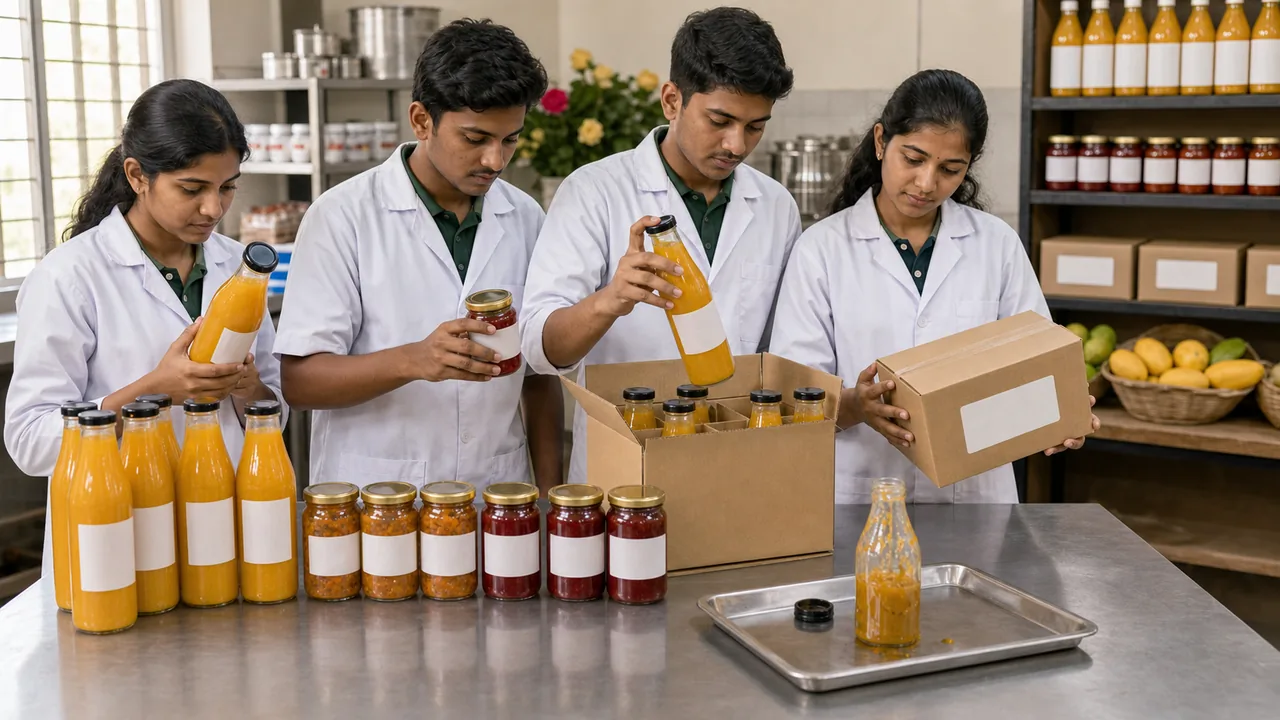
Why packaging matters in marketing
Packaging is not just a wrapper. In this unit, packaging is a marketing tool, a protective tool, and a shelf-life tool at the same time.
Pro Content Locked
Upgrade to Pro to access this lesson and all other premium content.
₹99 charged monthly · Cancel anytime
- All Agriculture & Banking Courses
- AI Lesson Questions (100/day)
- AI Doubt Solver (50/day)
- Glows & Grows Feedback (30/day)
- AI Section Quiz (20/day)
- 22-Language Translation (100/day)
- Recall Questions (20/day)
- AI Quiz (15/day)
- AI Quiz Paper Analysis (100/day)
- AI Step-by-Step Explanations (100/day)
- Spaced Repetition Recall (FSRS)
- AI Tutor
- Immersive Text Questions
- Audio Lessons — Hindi & English
- Mock Tests & Previous Year Papers
- Summary & Mind Maps
- XP, Levels, Leaderboard & Badges
- Generate New Classrooms
- Voice AI Teacher (AgriDots Live)
- AI Revision Assistant
- Knowledge Gap Analysis
- Interactive Revision (LangGraph)
🔒 Secure via Razorpay · Cancel anytime · No hidden fees
Packaging, Marketing, Export and Safe Food
Product preparation is linked with the business side of food processing. A good product is not truly market-ready until it can be packed, stored, transported, displayed, and sold safely.
The marketplace question
Think of two bottles of the same mango squash in a shop. One has a clean label, tight cap, clear batch details, attractive colour, and no leakage. The other has a faded label, sticky bottle, and no date. Even before tasting, the buyer trusts the first one more. That is why packaging is not decoration only; it is the first conversation between the product and the customer.
For Class 12 answers, write packaging as a 4-in-1 system: it contains, protects, communicates, and markets.
Why packaging matters in marketing
Packaging is not just a wrapper. In this unit, packaging is a marketing tool, a protective tool, and a shelf-life tool at the same time.
It helps:
- reduce transport and handling losses
- protect produce from mechanical damage
- reduce undesirable physiological change
- reduce moisture loss
- keep appearance attractive
- improve market presentation
- standardize quantity for sale
- support inspection, stacking, and transport efficiency
Packaging is linked with cleanliness during picking, grading, packing, and transport. So packaging is part of the whole safe-handling chain, not just the final wrap.
Core functions of packaging
1) To contain produce
A good package should act as:
- an efficient handling unit
- a saleable unit of standard quantity and weight
2) To protect produce
A package should protect against:
- rough loading and unloading
- pressure during stacking
- moisture loss
- heat stress
- physiological injury
- pathological deterioration
3) To communicate
Good packaging communicates through labels and package appearance:
- product name
- variety
- country or place of origin
- quantity or volume
- date details
- branding and trademark identity
4) To market the product
Good packaging:
- improves appearance
- lowers handling losses
- supports standard unit sale
- reduces transport cost when stacking is efficient
- helps the seller present the product professionally
These are the four classic characteristics of packaging:
- to contain
- to protect
- to communicate
- to market
Important value-added fruit and vegetable products
Strong emphasis should be placed on traditional processing products. These are core school-level products you are expected to know.
This topic therefore acts as a bridge between processing and business readiness. A jam, jelly, pickle, or ketchup is not fully market-ready until it is packed properly, labelled correctly, and kept safe during storage and sale.
How to think like a small food entrepreneur
Suppose a student group wants to sell guava jelly at a school exhibition. The recipe may be correct, but the product will fail if:
- the jar is not sterilized
- the label does not mention product name and quantity
- the lid leaks during transport
- the jelly crystallizes because the sugar balance was wrong
- the display looks unhygienic
Every product can be studied through three questions: How is it made?, How can it fail?, and How will a buyer trust it?
Jam
Jam is made by boiling fruit pulp with sugar to a reasonably thick consistency that holds the fruit tissue in place.
Important textbook points
- finished soluble solids are usually around 68%
- acidity is around 0.5–0.6%
- fruit pulp is often taken around 45%
- invert sugar should not be too low or too high because both cause defects
| Jam component / standard | Revision value |
|---|---|
| Fruit pulp | about 45% |
| TSS | at least 68%, often judged in the 68-70% range |
| Acidity | 0.5-0.6% |
| Water | 33-38% |
| Invert sugar | 30-50%, because both very low and very high levels can create defects |
| Common fruits | apple, strawberry, banana, pineapple, carrot, peach, pear and mixed-fruit options |
Major processing steps
- select fully ripe fruit
- wash and clean
- peel and prepare pulp
- blanch if needed
- cook pulp with sugar
- add citric acid near final cooking stage
- judge end point by sheet test, temperature, TSS, or weight logic
- fill into jars
- store in a cool, dry place
| Jam flow-sheet stage | Exam detail |
|---|---|
| Fruit selection | ripe, firm fruits are preferred |
| Preparation | wash, peel, pulp, and remove seed/core |
| Sugar addition | start cooking with part of the sugar, then add the remaining sugar |
| Citric acid | added near 103°C for taste and gel balance |
| End point | 105°C, 68-70% TSS, sheet/flake test, or final weight about 1.5 times sugar weight |
| Filling | hot filling into sterilized glass jars or bottles |
| Finishing | cooling, waxing where used, capping, and ambient cool-dry storage |
| Jam defect | Likely cause | Prevention / correction |
|---|---|---|
| Crystallization | invert sugar less than about 30% | add glucose or corn syrup with cane sugar |
| Sticky or gummy jam | too high TSS or excess sugar concentration | adjust with pectin, citric acid, or both |
| Premature setting | low TSS and high pectin | add more sugar and control cooking |
| Surface graining / shrinkage | moisture evaporation during storage | store in a cool place with good closure |
| Mould risk | poor storage humidity / contamination | hygienic filling and storage around 80% relative humidity |
Jelly
Jelly is a semi-solid product prepared from a clear strained pectin-rich extract plus sugar and acid.
Key facts to remember
- guava is one of the best fruits for jelly
- pectin and acid balance are critical
- tartaric acid is often mentioned as suitable for jelly
- jelly commonly targets around 65% TSS and about pH 3.2
| Jelly component / standard | Revision value |
|---|---|
| Fruit juice / extract | about 45% |
| TSS | about 65% |
| Pectin | 0.5-1.0% |
| Acid | about 0.75% |
| Water | 33-38% |
| pH | about 3.2 |
| Pasteurization | 82-85°C for 30 min |
Important process ideas
- fruit is often selected at the half-ripe stage because pectin is highest then
- juice is extracted after heating or blanching
- pectin is tested by jelmeter or alcohol test
- end point can be judged by drop test, temperature, or TSS
| Fruit group for jelly | Examples in the lesson |
|---|---|
| Rich in pectin and acid | sour apple, grape, lemon, orange, jamun, gooseberry, cranberry |
| Rich in pectin but low in acid | apple, unripe banana, guava, sour cherry, fig, pear, loquat |
| Low pectin but rich in acid | sweet cherry, pineapple, rhubarb |
| Low pectin and low acid | apricot, peach, pomegranate, raspberry, strawberry, overripe fruits |
| Jelmeter reading | Alcohol test clue | Sugar quantity cue |
|---|---|---|
| 1.25 | one large clot | 1.250 kg sugar |
| 1.0 | 2-3 clots | 1.000 kg sugar |
| 0.75 | 3-5 clots | 0.750 kg sugar |
| 0.50 | several small clots | do not make jelly directly or add pectin |
| Jelly defect | Likely cause |
|---|---|
| Failure to set | too much sugar, lack of acid, undercooking, overcooking, or prolonged cooking |
| Cloudy / foggy jelly | unclarified extract, immature fruit, overcooking, scum not removed, faulty pouring, premature gelation |
| Crystals | excess sugar or over-concentration |
| Syneresis / weeping | excess acid, low sugar concentration, insufficient pectin, premature gelation, or fermentation |
Jelly intuition: the three-legged stool
Jelly stands on three legs: pectin, acid, and sugar. If one leg is weak, the jelly cannot set properly. Too little pectin gives a weak set, wrong acid balance causes poor gel or weeping, and excess sugar may crystallize. This analogy helps convert defect questions into logical answers instead of rote memorization.
Marmalade
Marmalade is a fruit jelly containing suspended shreds or slices of citrus peel.
Important ideas:
- generally made from citrus fruits like orange and lemon
- peel shreds are softened before mixing
- bitterness has to be controlled
- browning in storage must be checked
| Marmalade flow-sheet point | Revision detail |
|---|---|
| Raw material | ripe citrus fruits |
| Peel part | outer yellow flavedo is cut thinly |
| Shred size | about 1.9-2.5 cm long and 0.08-0.12 cm thick |
| Extract boiling | peel/extract handling uses about 2-3 times water and 40-60 min boiling |
| Pectin test | alcohol test is used before sugar calculation |
| Cooking | cook to about 103-105°C, then to gel point |
| Shred treatment | shredded peel is boiled 10-15 min in several water changes to soften and remove bitterness |
| Shred rate | about 62 g prepared shred per kg extract |
| Browning prevention | about 0.09 g KMS/kg marmalade and avoid tin containers |
| Finishing | flavouring such as orange oil, hot filling, sealing, ambient storage |
Preserves, candy, crystallized, and glazed products
Preserves
Preserves or murabba are prepared from whole fruits, vegetable pieces, or segments cooked in sugar syrup until spoilage is prevented.
- final solids are usually around 70%
- products can be made by rapid, slow, or vacuum process
- vacuum process better retains colour and flavour
| Preserve / candy source flow | Preserve path | Candy path |
|---|---|---|
| Start | mature fruit, washed and prepared | mature fruit, washed and prepared |
| First sugar contact | alternate layers of 1 kg fruit : 1 kg sugar or syrup at 40% TSS for one day | same start |
| Syrup raising | raise syrup to 60% TSS, steep one day | same start |
| Further raising | increase by 5% TSS on alternate days up to 70% TSS | increase by 5% TSS on alternate days up to 75% TSS |
| Final steeping | keep in 70% TSS for about a week | keep in 75% TSS for about a week |
| Finish | fill fruit with fresh syrup around 68% TSS, seal and store | drain, shade dry, pack, and store |
Candied products
Candied fruits or vegetables are impregnated with concentrated sugar or glucose syrup and then drained and dried.
Crystallized products
These are candied products coated with sugar crystals.
Glazed products
These are candied products covered with a thin transparent sugar coating that gives gloss.
Pickles
Pickling is preservation in salt, vinegar, oil, or their combination with spices.
Four major pickling approaches
- preservation with salt
- preservation with vinegar
- preservation with oil
- preservation with a mixture of salt, oil, spices, and vinegar
| Pickling route | Standard memory point |
|---|---|
| Salt | 15% salt or above prevents microbial spoilage and hardens tissue |
| Vinegar | finished pickle should contain at least 2% acetic acid |
| Oil | pieces should remain completely immersed under edible oil |
| Mixed route | salt, oil, spices, and vinegar act together for cauliflower, carrot, turnip, chilli, jackfruit, tomato and similar products |
Sauce and ketchup
Sauce
Sauce is made from pulp of tomato or other fruit or vegetable with sugar, salt, spice, and vinegar.
- minimum TSS is around 15%
- acidity is about 1.2%
Ketchup
Ketchup is prepared only from tomato and is more concentrated.
- tomato solids are higher
- TSS is higher than sauce
- consistency is thicker
Quick sauce-vs-ketchup difference
| Feature | Ketchup | Sauce |
|---|---|---|
| Raw material | tomato only | tomato plus other fruits or vegetables possible |
| TSS | minimum 25% as per FPO cue; total solids usually 28% or more | minimum 15% |
| Acidity | minimum about 1.0% | minimum about 1.2% |
| Consistency | thicker | thinner |
| Cost | generally costlier | cheaper in source comparison |
| Colour range | usually red | may be red, green, or another colour |
| Tomato ketchup / sauce flow | Revision detail |
|---|---|
| Raw material | fully ripe red tomatoes |
| Preparation | wash, sort, cut, and chop |
| Softening | heat at 70-90°C for 3-5 min |
| Pulping | strain and pulp to remove seed, skin, and coarse matter |
| First concentration | cook pulp with one-third sugar and a spice bag |
| Concentration target | cook to about one-third original pulp or juice volume |
| Seasoning | remove and squeeze spice bag, then add remaining sugar and salt |
| End point | judge by tomato solids and product body |
| Acid / preservative | add vinegar or acetic acid and permitted preservative |
| Finishing | fill, cool, pasteurize if needed, crown-cork, and store cool and dry |
Marketing and export perspective
Export buyers usually demand:
- good grade consistency
- clean packaging
- label clarity
- product stability
- compliance with food-safety systems
Students should pay special attention to a wider export logic:
- value-added products strengthen horticulture development
- export becomes easier when raw produce is converted into more stable products
- cleanliness, grading, packaging, and legal compliance all affect exportability
For some commodities, special post-harvest protocols may become mandatory. Export markets usually demand more scientific handling than local markets.
In simple words, export value comes when processing, packaging, quality control, and legal compliance all work together.
Export-readiness checklist
Packaging, quality standards, marketing, and export form one practical chain. A product is export-ready only when several things are true together.
| Requirement | Why it matters for export |
|---|---|
| Uniform raw material | reduces variation in colour, flavour, texture, and processing yield |
| Correct processing | keeps TSS, acidity, heating, filling, and preservation within expected limits |
| Hygienic handling | reduces microbial and physical contamination risk |
| Suitable packaging | protects the product during long movement and storage |
| Accurate label | communicates product name, quantity, origin, dates, and brand identity |
| Standard compliance | helps meet buyer, national, and international expectations |
| Inspection readiness | supports pre-shipment checking and buyer confidence |
Why export quality starts before export
Export failure is rarely caused only at the port. It may begin much earlier: wrong raw material, poor washing, weak heating, unsuitable preservative, faulty closure, incomplete label, or poor storage. Therefore, the safe answer in exams is that quality is built throughout the value chain, from harvesting to distribution.
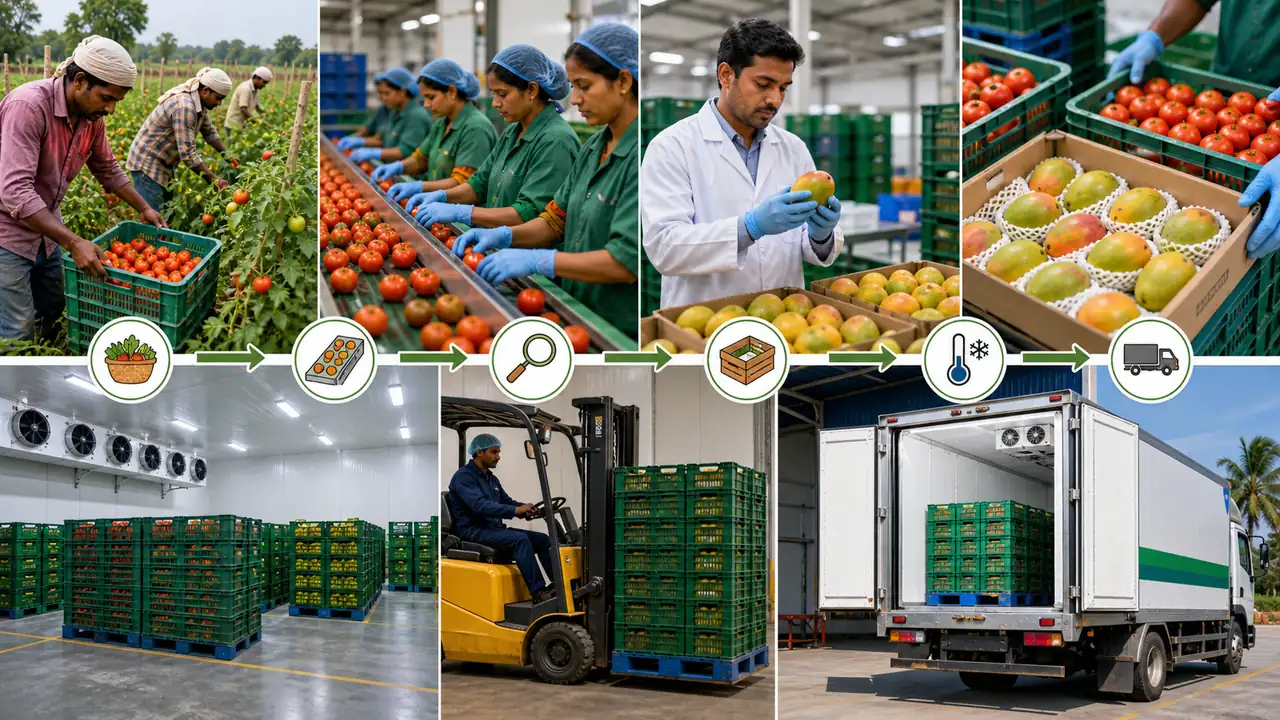
Marketing labels: what they should communicate
A good package should identify the product clearly. Depending on product type and rules, labels commonly communicate:
- product name
- variety or type
- place or country of origin
- net quantity or volume
- batch or lot identity
- manufacturing or packing date
- expiry or best-before date
- ingredients where applicable
- trademark or brand name
- storage instruction
This communication function protects both the seller and the buyer. It also helps inspection because standard packages with clear labels can be checked faster.
Packaging and marketing are directly linked
Packaging is not separate from marketing. The connection becomes clear through:
- better packaging reduces injuries
- lower losses reduce marketing cost
- standard packs help trade
- better appearance improves saleability
So the business logic is:
good packaging -> lower loss -> better presentation -> stronger marketing
Safe-food idea in simple language
Safe food means the product is prepared, packed, stored, and sold in a way that does not harm the consumer.
This includes attention to:
- clean raw material
- hygienic preparation
- proper additive use
- suitable acidity and solids where required
- appropriate packaging material
- protection from contamination
Quality assurance and quality control
A useful distinction should also be made between maintaining quality through the chain and checking the final product before marketing.
Quality assurance
Quality assurance is the broader system that helps ensure final products remain within legal and market standards by controlling:
- raw materials
- ingredients
- packaging supplies
- processing steps
- storage and handling
Quality control
Quality control is the evaluation of the final product before or during marketing to confirm that it meets standards.
So a good answer should not reduce quality to taste alone. Quality begins from input selection and process control.
What safe-food systems try to prevent
- microbial contamination
- physical contamination
- chemical hazards
- misleading labelling
- poor packaging that shortens stability
- product failure during storage or transport
Bridge to safe food
A product can fail in the market even if flavour is good, because:
- the package fails
- the product separates in storage
- microbial safety is poor
- the label is incomplete
- acidity or solids are outside standard range
Market success depends on both processing quality and market readiness.
Summary Cheat Sheet
| Concept / Topic | Key Details / Explanation |
|---|---|
| Core value-added products | Main Unit 4 processed products are jam, jelly, marmalade, preserves, pickles, sauce, and ketchup. |
| Product-success logic | Product success depends on correct balance of pectin, sugar, acid, total solids, heating, filling, and storage condition. |
| Jam | Jam is commonly remembered with about 45% pulp, about 68% TSS, acidity around 0.5-0.6%, water about 33-38%, and invert sugar around 30-50%. |
| Jelly | Jelly is remembered with pectin about 0.5-1.0%, acid about 0.75%, pH around 3.2, and pasteurization about 82-85°C for 30 min. |
| Jelly-setting logic | A good jelly needs the correct balance of pectin, acid, sugar, and heating; common checks include the alcohol test, clot interpretation, and jelmeter reading. |
| Packaging importance | Packaging strongly affects shelf life, price realization, consumer confidence, and safe market movement. |
| Four classic packaging functions | The four classic functions are contain, protect, communicate, and market. |
| Marketing and safe-food link | A processed product succeeds only when both processing quality and market readiness are strong, including proper packaging, labelling, and stability in storage. |
Lesson Doubts
Ask questions, get expert answers