📮 Packaging Materials and Modern Packaging Systems
A detailed lesson on packaging functions, materials, MAP, vacuum packaging, and tetra-pack systems.
Packaging Materials and Modern Packaging Systems
Packaging is a technical decision, not just a decorative one. Different commodities need different levels of rigidity, ventilation, moisture protection, gas exchange, cost control, and market presentation.
How to read the packaging images
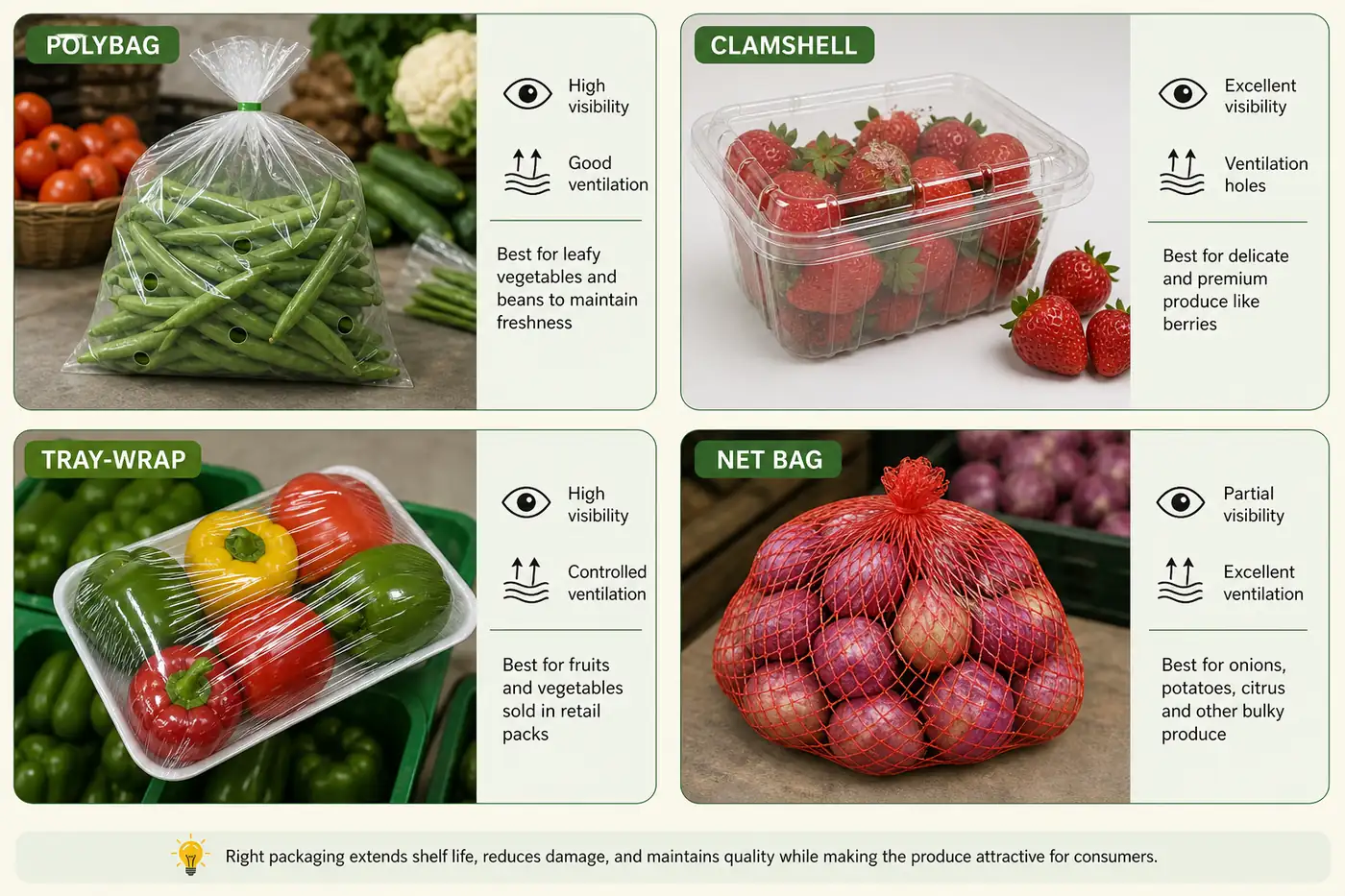
Before memorizing package names, look at the photos like a produce seller. Ask: Is this product soft or hard? Does it need air? Will it lose water? Will the buyer want to see it? Is it travelling nearby or far away? These questions explain why a net bag suits onion or citrus, a clamshell protects delicate produce, a tray-wrap improves retail display, and a corrugated box helps long-distance stacking.
The package is therefore a small engineering solution around a living product.
Packaging functions students must know
All detailed packaging systems in this unit grow out of the same four needs:
Pro Content Locked
Upgrade to Pro to access this lesson and all other premium content.
₹99 charged monthly · Cancel anytime
- All Agriculture & Banking Courses
- AI Lesson Questions (100/day)
- AI Doubt Solver (50/day)
- Glows & Grows Feedback (30/day)
- AI Section Quiz (20/day)
- 22-Language Translation (100/day)
- Recall Questions (20/day)
- AI Quiz (15/day)
- AI Quiz Paper Analysis (100/day)
- AI Step-by-Step Explanations (100/day)
- Spaced Repetition Recall (FSRS)
- AI Tutor
- Immersive Text Questions
- Audio Lessons — Hindi & English
- Mock Tests & Previous Year Papers
- Summary & Mind Maps
- XP, Levels, Leaderboard & Badges
- Generate New Classrooms
- Voice AI Teacher (AgriDots Live)
- AI Revision Assistant
- Knowledge Gap Analysis
- Interactive Revision (LangGraph)
🔒 Secure via Razorpay · Cancel anytime · No hidden fees
Packaging Materials and Modern Packaging Systems
Packaging is a technical decision, not just a decorative one. Different commodities need different levels of rigidity, ventilation, moisture protection, gas exchange, cost control, and market presentation.
How to read the packaging images
Before memorizing package names, look at the photos like a produce seller. Ask: Is this product soft or hard? Does it need air? Will it lose water? Will the buyer want to see it? Is it travelling nearby or far away? These questions explain why a net bag suits onion or citrus, a clamshell protects delicate produce, a tray-wrap improves retail display, and a corrugated box helps long-distance stacking.
The package is therefore a small engineering solution around a living product.
Packaging functions students must know
All detailed packaging systems in this unit grow out of the same four needs:
- containing the product
- protecting the product
- communicating information
- helping marketability
Packaging also helps with unitization, handling, storage, transport, and consumer convenience. So it is not just a wrapper; it is part of the post-harvest and marketing system.
Class 12 decision trick
Packaging materials are easiest to understand in this order:
- name the material
- state the commodity situation
- give one advantage
- give one limitation
Example: Wooden crates are strong and reusable for larger fruits, but rough wood can bruise soft fruits and may carry fungi if untreated.
Common packaging materials and systems
This section first contrasts improved packaging with older market movement. Many vegetables are moved in gunny bags and bamboo baskets, while better systems use polythene films, paperboard boxes lined with polythene, plastic containers, corrugated fibreboard, and modern polymer-film systems. The teaching point is that the package must reduce losses while keeping freshness, succulence, and quality for a longer period.
Plastic film bags
- widely used for consumer-size fruit and vegetable packs
- light and convenient
- useful where direct visual display matters
They are especially relevant where retail visibility and small pack size matter.
Simple polythene-type packaging is linked with modified atmosphere effects in some produce situations, showing that even basic films may change storage behaviour.
Plastic boxes
- rigid containers
- suitable for soft and delicate commodities
- reduce crushing and bruising
Net or mesh bags
- often used for fruits such as apple, citrus, guava, and sapota
- good visibility and ventilation
This type becomes useful where ventilation is important and the commodity does not require a tight moisture barrier.
Sleeve packs
- help immobilize fruits
- improve appearance and sales appeal
Cling film
- useful where low water-vapour loss and high gas permeability are desired
- common in retail presentation
Shrink film and stretch film
Shrink wrapping
- uses shrink film
- requires heat
- usually involves wrapping, sealing, shrinking, and cooling
Stretch wrapping
- uses stretch film
- usually does not require heat
- mainly involves wrapping and sealing
These are often grouped together in school material because both are specialized plastic-packaging systems, but students should remember the simple difference: shrink depends on heat, stretch mainly depends on film tension.
Antimicrobial packaging
This system includes antimicrobial agents in coatings or package surfaces so that microbial growth is further reduced.
This shows that modern packaging may actively participate in shelf-life protection rather than merely enclosing the product.
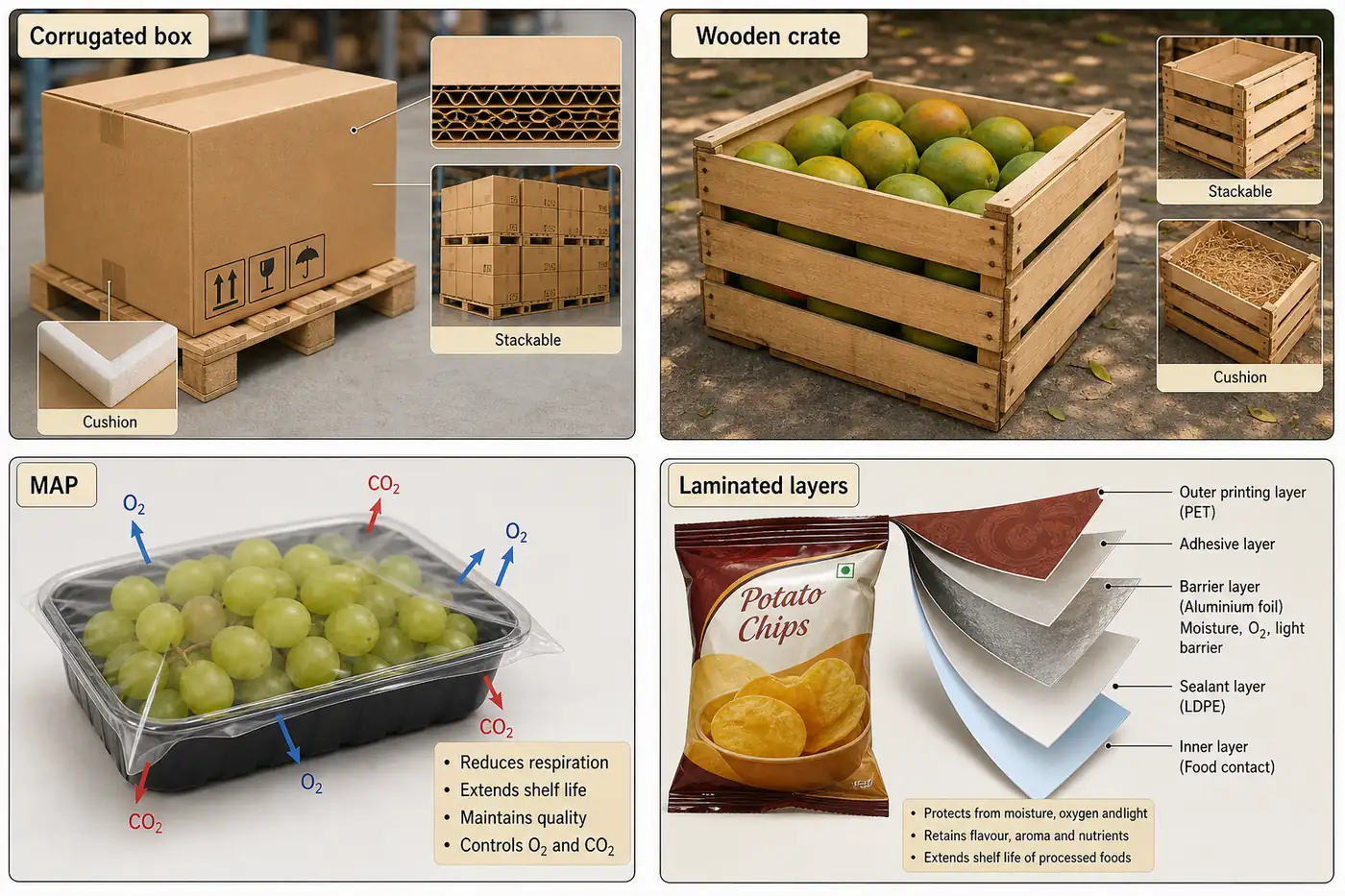
Wooden packaging
Advantages of wooden crates
- can be made and repaired locally
- resist varied weather reasonably well
- often reusable for multiple trips
- ventilation can be good
- useful for larger fruits
Disadvantages of wooden crates
- untreated wood may carry fungi and bacteria
- rough surfaces may injure delicate produce
- painted or chemically treated wood may harm quality
- disposal is difficult
- large-scale use increases pressure on forest resources
Bamboo mat holed boxes
These are suitable for transporting apple.
Polypropylene boxes
- suitable for long-distance markets
- reusable and durable
Corrugated fibreboard boxes
- economical
- widely suited for fruit and vegetable packing
- common in organized market chains
They are popular because they balance cost, printability, stacking value, and transport convenience.
Modified atmosphere packaging
MAP works by modifying the oxygen and carbon dioxide levels around fresh produce sealed in polymeric film.
Why MAP works
Respiring produce naturally consumes oxygen and releases carbon dioxide. If the film properties and crop respiration are well matched, an internal atmosphere develops that:
- lowers oxygen
- increases carbon dioxide
- slows respiration
- reduces decay
- reduces some physiological and biochemical deterioration
The success of MAP depends on correct matching between commodity respiration and film permeability. If the balance is wrong, quality may decline instead of improving.
The same idea can be explained simply: the package atmosphere changes because of the natural interaction between product respiration and film barrier properties.
MAP as a breathing-room analogy
Fresh produce keeps breathing after harvest. MAP is like designing a room where the crop breathes slowly but does not suffocate. If the film allows too much gas exchange, the atmosphere does not change enough. If the film blocks too much exchange, off-odour and injury can occur. This is why film permeability and commodity respiration must be matched.
Passive MAP
In passive MAP, the atmosphere changes naturally because:
- the commodity is respiring
- the film has selective permeability
In passive MAP, the plant material and sealed package interact naturally. Respiration consumes O₂ and releases CO₂, while the polymer film restricts gas exchange according to its permeability. A good passive MAP reaches an equilibrium atmosphere with lower O₂ and higher CO₂ than normal air.
Active MAP
In active MAP, the desired gas balance is created intentionally.
This may involve:
- flushing the package with a gas mixture
- using absorbers or scavengers
- adjusting headspace quickly before sealing
Active MAP can also use packaging additives such as oxygen scavengers when the film is a good moisture barrier but not a perfect oxygen barrier. Its advantage is speed: the desired atmosphere is reached almost immediately instead of slowly developing through respiration alone.
Active systems become useful when passive film behaviour alone is not enough to create the desired gas balance.
Vacuum packaging
Vacuum packaging removes air before sealing, reducing free space and lowering oxygen availability.
This method is especially useful where oxidation control and compact packing are important.
Vacuum packaging can be understood in contrast with MAP and CAP because products are sealed after air removal in low-oxygen conditions. The basic idea is: vacuum packaging reduces oxygen by directly removing air.
Exact reference cue: MAP and CAP usually operate near ambient pressure around 101 kPa, while vacuum packaging works under reduced atmosphere. Products are packed in film of low oxygen permeability and sealed after air evacuation. Apple storage is given as an example below 10 kPa.
Tetra-packaging
Tetra-pack is an important example of layered packaging.
Layer logic
- polyethylene protects against moisture
- paper gives strength and stiffness
- polyethylene layers help adhesion and sealing
- aluminium acts as a barrier to oxygen, light, and flavour loss
Important examples include:
| Layer cue | Function |
|---|---|
| Polyethylene | protects against moisture |
| Paper | gives stability and strength |
| Polyethylene | adhesion |
| Aluminium | barrier to oxygen, flavour and light |
| Polyethylene | adhesion |
| Polyethylene | seals in the liquid |
Main advantages
- high hygiene
- nutrient retention
- good flavour protection
- long storage without refrigeration in suitable products
- low package weight relative to product weight
Reference proportions:
| Tetra-pack material / filled-pack fact | Key value |
|---|---|
| Paper | about 80% for strength and stiffness |
| Polyethylene | about 15% for liquid tightness and microbial barrier support |
| Aluminium foil | about 5% for air, light, and off-flavour barrier |
| Filled package efficiency | about 97% product and only 3% packaging material |
| Common use | fruit beverages and RTS beverages |
Tetra-pack is also efficient because most of the filled package is product, while packaging material forms only a small fraction.
Type of packaging materials
Packaging materials are selected according to:
- rigidity or flexibility
- gas permeability
- water-vapour resistance
- communication or print value
- transport suitability
- cost and reusability
So the real lesson is not a random list of materials, but why one material suits one commodity better than another.
Characteristics of a good package
A good package should:
- hold produce in a standard saleable unit
- protect against damage in storage and transport
- reduce physiological and pathological loss
- provide useful information
- support efficient marketing
Why packaging lowers marketing cost
Packaging also lowers marketing cost because:
- reduced injury means less wastage
- uniform packs are easier to stack and handle
- transport loss decreases
- sale becomes more standardized
Lesson-aligned packaging selection table
Use this table as a practical decision guide. It is important to connect each package with the reason it is chosen.
| Packaging type | Best use | Main advantage | Main caution |
|---|---|---|---|
| Plastic film bags | small consumer packs of fruits and vegetables | light, visible, convenient for retail sale | film thickness and permeability must suit the commodity |
| Plastic boxes | soft and delicate produce | rigid support reduces crushing | higher cost than simple bags |
| Net or mesh bags | apple, citrus, guava, sapota, onion-like produce where ventilation is useful | good visibility and air movement | not suitable when moisture loss must be strongly restricted |
| Sleeve packs | fruits needing immobilization and display appeal | fruit movement is reduced, appearance improves | poor fit can still allow bruising |
| Cling film | tray-packed produce and retail display | reduces water loss while allowing useful gas exchange | overheating or condensation can reduce quality |
| Shrink film | tight consumer packs | neat appearance and firm holding after heat shrinking | heat step must not injure produce |
| Stretch film | retail wrapping without heat shrinking | simple operation and good display | weaker shelf-life control than a properly designed MAP pack |
| Antimicrobial packaging | packs where surface contamination control is important | antimicrobial agents in coating or attachment help suppress microbes | it supports hygiene; it does not replace clean handling |
| Wooden crates | robust transport, larger fruits, local market chains | locally repairable, reusable, ventilated | rough surfaces and contamination risk for soft produce |
| Bamboo mat holed boxes | apple transport in traditional chains | ventilation and low local cost | variable strength and hygiene |
| Polypropylene boxes | long-distance marketing | durable and reusable | initial investment is higher |
| Corrugated fibreboard boxes | organized fruit and vegetable marketing | economical, printable, stackable | weakens if exposed to excess moisture |
| Sacks and bags | flexible bulk handling | cheap and easy to move | poor protection for delicate produce |
| Pallet boxes and shipping containers | large-scale transport | efficient stacking and movement | needs organized logistics |
| Baskets | local movement using bamboo, leaves, or plastic strips | easily available in many areas | shape and roughness may cause injury |
The “match package to produce” rule
A package should not be selected only because it is cheap. A cheap package becomes costly if it increases bruising, moisture loss, decay, rejection, or complaints. For example, a rigid crate may be better for delicate fruits, while a ventilated mesh pack may suit commodities that need air movement. For long-distance movement, reusability and stack strength become more important than short-term price.
Film permeability and produce respiration
Fresh fruits and vegetables are alive after harvest. They continue respiration, consume oxygen, release carbon dioxide, and lose water. That is why a polymer film cannot be chosen randomly.
| Film property | Why it matters |
|---|---|
| Oxygen permeability | controls how fast oxygen enters the pack |
| Carbon dioxide permeability | controls how fast carbon dioxide escapes |
| Water-vapour transmission | controls moisture loss and condensation risk |
| Film thickness | affects strength and gas movement |
| Seal integrity | decides whether the designed atmosphere is maintained |
If the film is too tight for a fast-respiring commodity, oxygen may become too low and off-flavour can develop. If the film is too open, moisture loss and decay control may be poor. Film thickness and permeability should therefore be standardized commodity-wise.
Passive MAP: step-by-step understanding
Passive modified atmosphere packaging is created by the natural interaction between a respiring product and a sealed polymer film.
- Fresh produce is packed in a polymeric film.
- The package is sealed.
- The commodity continues respiration.
- Oxygen inside the package gradually falls.
- Carbon dioxide gradually rises.
- Gas movement through the film slows extreme changes.
- If film permeability matches respiration rate, a beneficial equilibrium develops.
The success of passive MAP therefore depends on two matching factors: respiration rate of produce and gas permeability of film. This is why the same film cannot be blindly used for every vegetable.
Active MAP: step-by-step understanding
Active MAP is used when we do not want to wait for the package atmosphere to develop slowly.
| Active method | What it does | Why it helps |
|---|---|---|
| Gas flushing | desired gas mixture is introduced before sealing | target atmosphere is reached quickly |
| Oxygen scavenger | removes oxygen left in the pack | useful when oxygen exclusion is needed |
| Carbon dioxide adjustment | creates a higher carbon dioxide condition where suitable | can reduce decay organisms |
| Headspace control | adjusts the free air space inside the pack | improves atmosphere management |
| Partial vacuum support | removes part of the air before sealing | speeds the move toward a low-oxygen environment |
Active MAP usually costs more than passive MAP, but it gives faster and more controlled atmosphere formation.
MAP, CAP and vacuum packaging
Important points include MAP, CAP, and vacuum packaging together because all three manage the air around the commodity.
| System | Pressure condition | Atmosphere logic | Best memory line |
|---|---|---|---|
| MAP | usually ambient pressure | gas composition inside pack is modified | modify the gas |
| CAP | usually controlled storage atmosphere | gas composition is actively maintained in storage | control the storage air |
| Vacuum packaging | reduced pressure | air is removed before sealing | remove the air |
Vacuum packaging uses a film with low oxygen permeability and seals the product after evacuating air. The lesson notes that apple storage has been tested under pressure lower than normal atmospheric pressure, which shows the principle: lower oxygen availability slows many deterioration processes.
Tetra-pack layer-by-layer logic
Tetra-pack is not just “a carton.” It is a layered aseptic package in which each layer performs a job.
| Layer material | Function for the student to remember |
|---|---|
| Polyethylene outer layer | moisture protection |
| Paperboard | strength and stiffness |
| Polyethylene bonding layer | adhesion between layers |
| Aluminium foil | barrier to oxygen, light, flavour loss, and off-flavour entry |
| Polyethylene inner layers | liquid-tight sealing and microbial barrier support |
The approximate material idea is mostly paper, some polyethylene, and a small aluminium layer. The teaching point is that the package becomes strong, light, hygienic, liquid-tight, and protective only because the layers work together.
Why fruit beverages and RTS drinks use tetra-pack
- It protects flavour and colour from air and light.
- It keeps the product hygienic when aseptic processing is done correctly.
- It supports storage for months in suitable products without refrigeration.
- It uses low packaging weight compared with product weight.
- It is easier to transport than heavy glass bottles in many supply chains.
Packaging failure situations
Case 1: Guava packed in a loose sack
The sack is cheap, but soft fruits can rub, bruise, and develop decay. A rigid plastic box or corrugated fibreboard pack with cushioning would better protect the produce.
Case 2: Leafy vegetable sealed in an unsuitable film
If the film does not match respiration, oxygen may fall too low or condensation may rise. The result can be off-odour, yellowing, decay, and poor consumer acceptance.
Case 3: Long-distance apple transport in weak cartons
A weak carton may collapse in stacking. Even if the fruit was good at harvest, compression injury can reduce sale value. Long-distance marketing needs stack strength, ventilation, and handling efficiency.
Case 4: Fruit beverage in a transparent weak pack
Light and oxygen can damage colour, flavour, and vitamins. A layered pack with aluminium barrier or a suitable bottle with correct closure is safer for shelf stability.
Choosing the right package
Packaging choice depends on:
- commodity type
- delicacy of produce
- market distance
- need for ventilation
- need for moisture barrier
- cost
- display value
- whether shelf-life extension is required
It may also depend on whether the commodity needs:
- free ventilation
- higher humidity retention
- modified atmosphere support
- bruising protection
- long-distance transport safety
Exam memory line
If asked why packaging matters, the best one-line answer is:
Packaging protects, preserves, presents, and helps the product move safely through storage and market channels.
Additional notes
Traditional and modern packaging facts
Older or common market systems include gunny bags, bamboo baskets, and paperboard boxes lined with polythene. Improved packaging is needed because these older systems may not control bruising, moisture, ventilation, stack strength, and appearance well enough for modern markets.
| Package type | Specific reference cue |
|---|---|
| Plastic film bags | consumer-size packs for fruit and vegetable marketing |
| Plastic boxes | rigid containers for soft and delicate commodities |
| Net / mesh bags | apple, citrus, guava, sapota and similar fruits |
| Sleeve packs | immobilize fruits and improve sales appeal |
| Cling film | low water-vapour transmission and high gas permeability |
| Shrink film | wrapping, sealing, heat shrinking, cooling |
| Stretch film | wrapping and sealing without heat shrinking |
| Antimicrobial packaging | antimicrobial agents in polymer coatings or surface attachments |
| Wooden crates | local manufacture, repair, reuse, ventilation, but contamination and roughness risk |
| Bamboo mat holed boxes | apple transport |
| Polypropylene boxes | long-distance markets and reuse |
| Corrugated fibreboard | economical fruit and vegetable packaging |
| Sacks, bags, nets, crates, cartons, baskets | broader material classification for market movement |
Exact MAP, vacuum and tetra-pack facts
- Vacuum packaging may reduce pressure below 10 kPa in the apple example.
- Tetra-pack material memory: paper 80%, polyethylene 15%, aluminium foil 5%.
- Filled pack memory: about 97% product and 3% package.
- Passive MAP develops the atmosphere through commodity respiration and film permeability.
- Active MAP creates the desired gas mixture intentionally before sealing or during packaging.
Summary Cheat Sheet
| Concept / Topic | Key Details / Explanation |
|---|---|
| Why packaging matters | Packaging is a technical decision based on rigidity, ventilation, moisture protection, gas exchange, stacking, transport, cost, and market presentation. |
| Main packaging materials | Important material groups include plastic, wood, board, polymer films, and composite packs, each with different uses. |
| Good-package functions | A good package should contain, protect, communicate, and help marketability. |
| Common package examples | Useful examples are plastic film bags, plastic boxes, net or mesh bags, sleeve packs, cling film, wooden crates, polypropylene boxes, and corrugated fibreboard boxes. |
| MAP | In modified atmosphere packaging (MAP), oxygen and carbon dioxide around the produce are modified to slow respiration and decay. |
| Passive vs active MAP | Passive MAP develops atmosphere naturally through commodity respiration and film permeability, while active MAP creates the desired atmosphere intentionally by gas adjustment or related support. |
| Vacuum packaging | Vacuum packaging reduces oxygen by removing air before sealing, which helps lower oxidation and compact the pack. |
| Shrink vs stretch wrapping | Shrink wrapping uses heat after wrapping, while stretch wrapping usually works by film tension and generally does not need heat. |
| Tetra-pack | Tetra-pack is a layered package in which paper gives strength, polyethylene helps sealing and moisture protection, and aluminium blocks oxygen, light, and flavour loss. |
| Best chapter takeaway | Packaging must be matched to the commodity, because the wrong material can increase bruising, water loss, off-odour, or market rejection even if the pack looks attractive. |
Lesson Doubts
Ask questions, get expert answers