🌺 Processed Flower Products, Storage and Marketing
A deeper lesson on flower value addition, handling, packaging, storage, and the market logic of processed flower products.
Processed Flower Products, Storage and Marketing
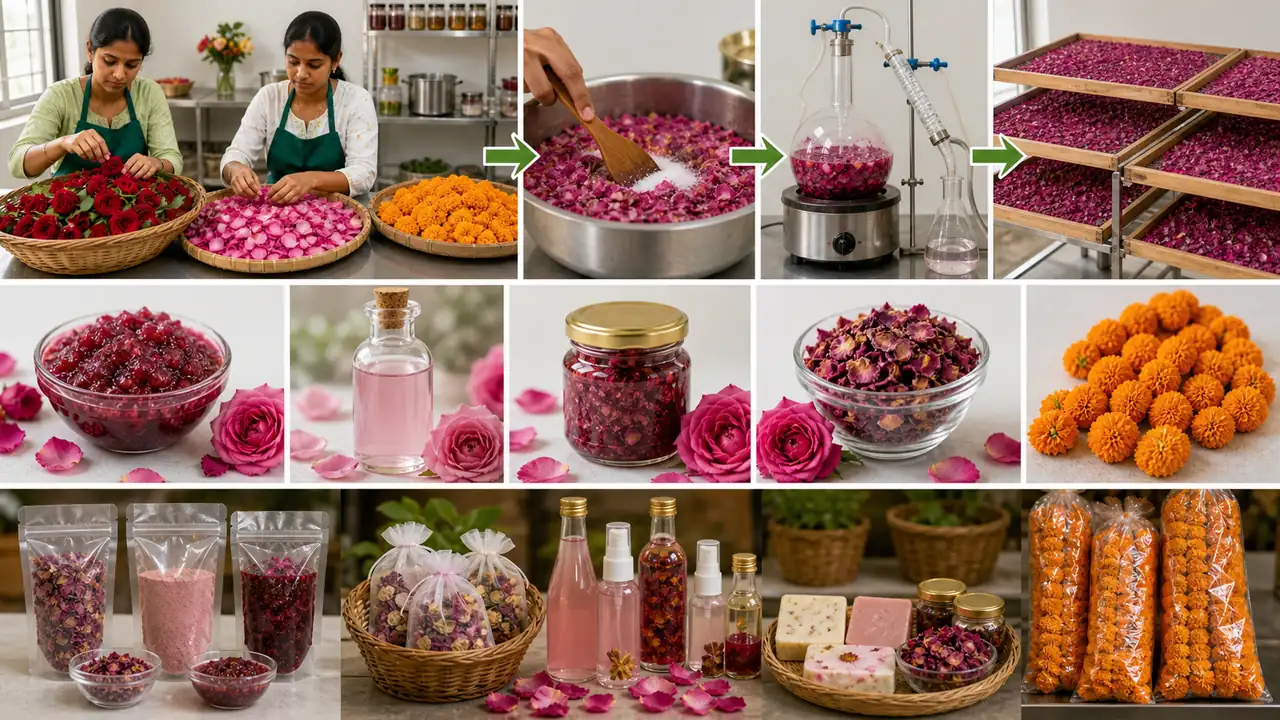
Processed horticultural products move from kitchen science or factory processing into saleable products. This includes visually sensitive products like flowers, along with the fruit and vegetable products commonly studied in Unit 4.
The value-addition lens
A raw fruit, vegetable, or flower is often valuable for only a short time. Processing asks a clever question: Can we protect the useful quality and sell it in another form? Guava can become jelly, mango can become pickle, tomato can become ketchup, citrus peel can become marmalade, and rose petals can become gulkand or rose water. The student should see each product as a way of converting perishability into enterprise value.
Use this memory line: processing changes form, storage protects quality, packaging creates trust, and marketing captures value.
Pro Content Locked
Upgrade to Pro to access this lesson and all other premium content.
₹99 charged monthly · Cancel anytime
- All Agriculture & Banking Courses
- AI Lesson Questions (100/day)
- AI Doubt Solver (50/day)
- Glows & Grows Feedback (30/day)
- AI Section Quiz (20/day)
- 22-Language Translation (100/day)
- Recall Questions (20/day)
- AI Quiz (15/day)
- AI Quiz Paper Analysis (100/day)
- AI Step-by-Step Explanations (100/day)
- Spaced Repetition Recall (FSRS)
- AI Tutor
- Immersive Text Questions
- Audio Lessons — Hindi & English
- Mock Tests & Previous Year Papers
- Summary & Mind Maps
- XP, Levels, Leaderboard & Badges
- Generate New Classrooms
- Voice AI Teacher (AgriDots Live)
- AI Revision Assistant
- Knowledge Gap Analysis
- Interactive Revision (LangGraph)
🔒 Secure via Razorpay · Cancel anytime · No hidden fees
Processed Flower Products, Storage and Marketing
Processed horticultural products move from kitchen science or factory processing into saleable products. This includes visually sensitive products like flowers, along with the fruit and vegetable products commonly studied in Unit 4.
The value-addition lens
A raw fruit, vegetable, or flower is often valuable for only a short time. Processing asks a clever question: Can we protect the useful quality and sell it in another form? Guava can become jelly, mango can become pickle, tomato can become ketchup, citrus peel can become marmalade, and rose petals can become gulkand or rose water. The student should see each product as a way of converting perishability into enterprise value.
Use this memory line: processing changes form, storage protects quality, packaging creates trust, and marketing captures value.
Processed horticultural products covered in this unit
- jam
- jelly
- marmalade
- preserves or murabba
- candied products
- crystallized products
- glazed products
- pickles
- sauce
- ketchup
The core logic of this chapter is broader than a simple product list. It is really about quality after processing. A product becomes valuable only when it stays attractive, stable, and saleable through storage and marketing.
Jam as a market product
A good jam should:
- have proper body and spreadability
- hold fruit tissue in place
- show balanced sweetness and acidity
- remain free from crystallization and separation
Jam process logic
Jam preparation is usually understood as:
- selection of sound fruit
- pulp preparation
- addition of sugar and acid in suitable balance
- cooking to the correct end point
- hot filling into clean containers
- cooling, sealing, and storage
Jam analogy
Jam is like a fruit paste that has been trained to stay stable. Sugar pulls down available water, acid helps flavour and gel behaviour, heat reduces microbes and concentrates solids, and the jar protects the final product. When you explain jam defects, connect each defect to one broken control point rather than memorizing the list blindly.
Jam end-point ideas
Traditional ways of judging jam readiness are also worth remembering. For student answers, it is enough to note that the end point may be judged by:
- sheet or flake type observation
- drop or cold-surface observation
- boiling-point or soluble-solids logic
- final-weight judgement in small-scale processing
Important jam defects
- crystallization from poor sugar balance
- sticky or gummy body from too much concentration
- mould growth in poor storage
- darkening during prolonged warm storage
- shrinkage or drying under poor closure conditions
Storage and sale points
- hot filling into clean jars improves keeping quality
- storage should be cool and dry
- excess moisture loss during storage can cause shrinkage and surface graining
- high humidity raises mould risk
Jelly as a market product
Market quality signs of jelly
- clear and bright appearance
- proper set
- no cloudiness
- no sugar crystals
- no syneresis or weeping
Ideal jelly characteristics
An ideal jelly should be:
- clear and attractive
- properly set but not tough
- pleasant in flavour
- free from suspended impurities
- free from weeping and crystals
Fruits suited for jelly
The textbook tradition emphasizes pectin- and acid-rich fruits such as:
- guava
- sour apple
- grape
- citrus fruits
- gooseberry
- plum
- karonda
Common jelly defects
- cloudy jelly from poorly clarified juice
- crystallization from excess sugar or over-concentration
- syneresis from imbalance of pectin, acid, or solids
- weak set from poor pectin-acid balance
Marmalade
Marmalade is highly sensitive to:
- peel shred quality
- bitterness control
- colour retention
- correct gel formation
Because peel shreds are suspended in the product, marmalade quality depends on both gel quality and peel quality. Browning during storage is a known problem, so storage and container choice matter strongly.
Marmalade source flow-sheet table
| Stage | Main action |
|---|---|
| Fruit selection | use ripe citrus fruits |
| Washing and peeling | wash, then remove the outer yellow flavedo thinly |
| Shredding | cut yellow peel into shreds about 1.9-2.5 cm long and 0.08-0.12 cm thick |
| Extract preparation | boil in 2-3 times water for 40-60 min and strain extract |
| Pectin check | use alcohol test to decide sugar addition |
| Cooking | add sugar and cook to 103-105°C with continuous stirring |
| Peel preparation | boil shreds 10-15 min in several changes of water to soften and remove bitterness |
| Peel addition | add prepared shreds at about 62 g/kg extract |
| Gel point | boil to jellying point and confirm by sheet, drop, or temperature test |
| Final heating | cook around 82-88°C, add flavouring such as orange oil |
| Filling | fill sterilized bottles, seal, and store at ambient condition |
| Browning control | reference cue: about 0.09 g KMS/kg marmalade; avoid tin container |
Preserves, candied, crystallized, and glazed products
Preserves
- based on whole fruits or large pieces
- generally brought to high soluble solids
- sold as premium sweet preserved products
Preserves or murabba differ from jam because the fruit piece remains more intact. Fruit firmness, sugar penetration, and appearance therefore matter more.
Candied products
- higher sugar impregnation than preserves
- syrup is drained and the product is dried
Crystallized products
- sugar crystals are intentionally formed on the outer surface
Glazed products
- coated with a thin transparent sugar layer
- glossy appearance is part of the value
These processed products are important because they extend seasonality, create premium market value, and support small processing enterprises.
Pickles as value-added market products
Market strengths of pickles
- strong flavour profile
- long shelf life
- use of local raw materials
- good small-scale enterprise potential
Main pickle types
Pickles can also be grouped by preservation medium:
- salt pickles
- vinegar pickles
- oil pickles
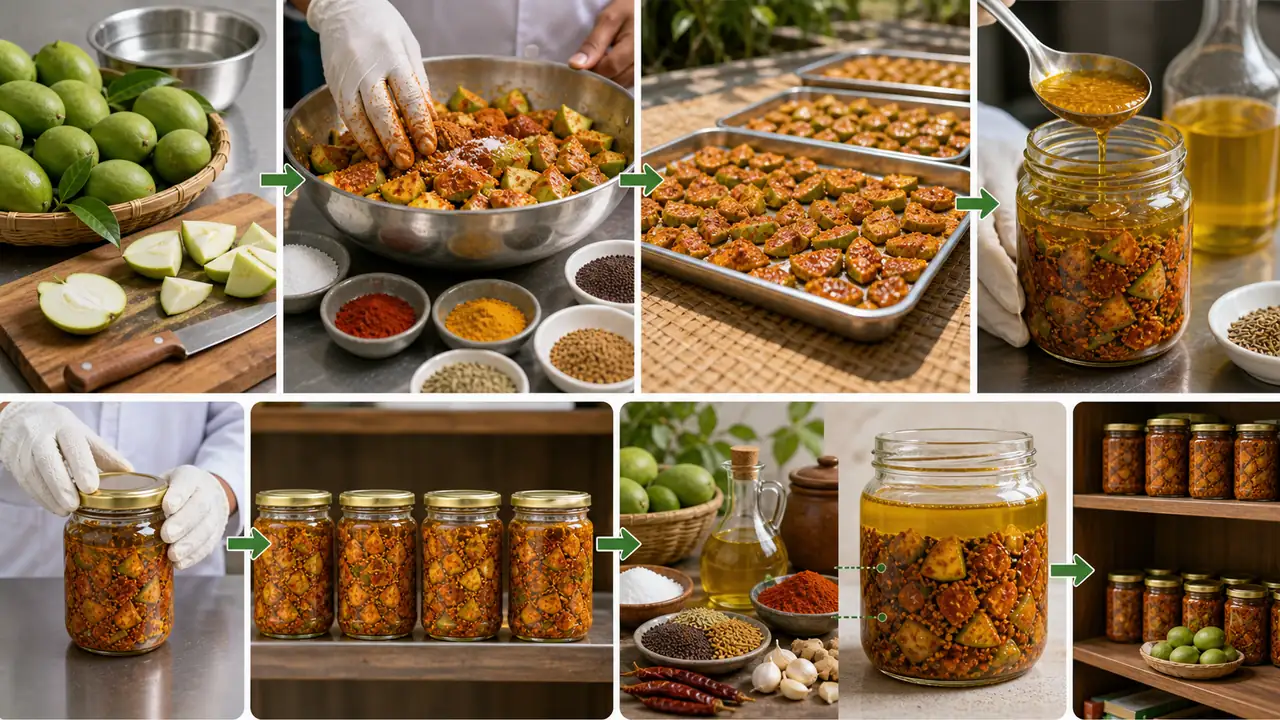
General pickle process logic
- select sound raw material
- wash and cut
- use salt, brine, vinegar, or oil according to method
- add spice mixture
- fill into suitable container
- store under safe conditions
Pickle as a preservation puzzle
A good pickle usually combines more than one hurdle: salt draws out water, acid lowers pH, oil limits oxygen contact, spices add flavour and some antimicrobial value, and sun-curing reduces moisture. If a pickle becomes soft, cloudy, bitter, or scummy, ask which hurdle failed.
Important pickle faults
- blackening
- bitterness
- cloudiness
- scum formation
- softening
- off-flavour
Defects that damage market acceptability
- blackening
- cloudiness
- bitterness
- scum formation
- softness and slipperiness
Sauce and ketchup in the market
What determines their sale value
- proper consistency
- correct TSS and acidity
- balanced spice profile
- smooth texture
- attractive colour
- safe filling and storage
Sauce and ketchup are judged by smoothness, body, acidity, spice balance, and keeping quality. So processing success depends not only on recipe but on pulping, concentration, filling, and storage.
Product-wise defects and prevention
Many product defects are listed here. Instead of memorising them as a list, connect each defect with its cause and correction.
| Product | Defect | Likely cause | Prevention or correction |
|---|---|---|---|
| Preserve | fermentation | low sugar concentration during preparation or storage | raise syrup strength gradually and store in a cool, dry place |
| Preserve | fruit floating | filling before the fruit has cooled and settled | cool the preserve before filling |
| Preserve | fruit shrinkage | pieces placed directly into heavy syrup | increase syrup strength step-wise so sugar enters the fruit slowly |
| Preserve | stickiness | insufficient final consistency or storage moisture | dry and concentrate properly before storage |
| Pickle | bitter taste | strong vinegar, excess spice, or overcooked spices | use balanced vinegar and spice quantity |
| Pickle | blackening | iron from brine or equipment reacting with product constituents | avoid iron contamination and use suitable utensils |
| Pickle | cloudiness | poor vinegar quality or chemical reaction in brine | use good vinegar and clean ingredients |
| Pickle | dull colour | poor raw material or insufficient curing | use sound raw material and correct curing |
| Pickle | shrivelling | direct exposure to very strong salt or vinegar solution | increase concentration gradually where needed |
| Pickle | softness and slipperiness | inadequate brine/oil coverage or microbial growth | keep pieces below brine/oil and maintain hygiene |
| Jam or jelly | crystallization | excessive sugar or wrong final concentration | control soluble solids and acid balance |
| Jelly | cloudy appearance | unclarified juice or poor filtration | clarify juice before cooking |
| Jelly | weak set | poor pectin-acid-sugar balance | test pectin and adjust acid/sugar correctly |
| Sauce/ketchup | thin body | insufficient concentration or weak pulp | concentrate to required body and TSS |
Exam memory line
Most defects can be traced to one of four mistakes: wrong concentration, poor hygiene, unsuitable container, or poor storage.
Preserve, candy, crystallized and glazed flow
These products are close relatives, but their market identity differs.
| Product | Processing idea | Final appearance | Student memory |
|---|---|---|---|
| Preserve or murabba | fruit pieces are impregnated with syrup | juicy pieces in heavy syrup | fruit plus syrup |
| Candy | syrup-impregnated pieces are drained and dried | sweet dried pieces | fruit plus sugar plus drying |
| Crystallized fruit | dried candied fruit is encouraged to form sugar crystals | sugary crystal coating | visible crystals |
| Glazed fruit | candied fruit gets a thin transparent sugar coating | glossy attractive surface | shine and gloss |
The gradual increase of syrup strength is important because fruit cells need time to absorb sugar. Sudden heavy syrup pulls water out rapidly and can shrink the fruit.
Pickle preparation map
Pickles are commonly understood through four preservation routes.
| Pickle route | Preservation force | Examples or use logic |
|---|---|---|
| Salt pickle | salt draws water and suppresses microbes | many vegetable pickles begin with salting or brining |
| Vinegar pickle | acetic acid lowers pH | useful where sharp acidic taste is acceptable |
| Oil pickle | oil excludes air and protects surface | mango, lime, cauliflower, turnip-type pickles |
| Mixed pickle | salt, oil, spices, and vinegar act together | cauliflower, carrot, turnip, chilli, jackfruit, tomato combinations |
Spices are not only flavouring materials. In many traditional pickles they also improve palatability, colour, and microbial resistance. However, excess spice or prolonged cooking can create bitterness and dark colour.
Source pickle recipe and flow-sheet tables
| Pickle | Source ingredient memory |
|---|---|
| Mango pickle | mango 1 kg, salt 200 g, red chilli powder 10 g, asafoetida 5 g, fenugreek, black pepper, large cardamom, cumin and cinnamon powder 10 g each, headless clove 6 |
| Cucumber pickle | cucumber 1 kg, salt 200 g, red chilli powder 15 g, large cardamom, cumin, black pepper 10 g each, headless clove 6, vinegar 750 ml |
| Green chilli pickle | green chilli 1 kg, salt 150 g, ground mustard 100 g, lime juice 200 ml or amchur 200 g, fenugreek, large cardamom, turmeric, cumin 15 g each, mustard oil 400 ml |
| Pickle | Flow-sheet logic from source |
|---|---|
| Mango | mature green mango -> washing -> peeling -> slicing -> jar filling -> salt sprinkling -> sun exposure for one week with shaking at least twice daily -> spice mixing -> cool, dry storage |
| Lime | ripe but not overripe healthy lime -> washing -> hot-water dip at 60-65°C for about 5 min -> cutting into four or smaller uniform pieces -> brining/juice coverage -> sun drying for 2-3 days -> spice mixing -> packaging -> cool storage away from sunlight |
| Cucumber | washing -> peeling -> cutting into about 5 cm pieces -> salt mixing -> jar filling -> standing 6-8 h -> water draining -> spice and vinegar addition -> sun for one week -> cool storage away from sunlight |
| Green chilli | washing -> drying -> making incision -> mixing spices with lime juice -> mixing with chillies -> jar filling -> adding lime juice and oil -> sun for one week -> cool storage away from sunlight |
Pickle defects with exact prevention logic
| Defect | Likely cause | Prevention idea |
|---|---|---|
| Bitter taste | strong vinegar, excess spice, or prolonged cooking of spices | keep vinegar and spice balanced |
| Blackening | iron in brine or equipment, or some microorganisms | avoid iron utensils and use clean equipment |
| Cloudiness | inferior vinegar or vinegar-mineral reaction | use good vinegar and clean ingredients |
| Dull / faded product | inferior raw material or insufficient curing | use good raw material and proper curing |
| Shrivelling | direct placement in very strong salt, sugar, or vinegar | avoid sudden high concentration |
| Scum formation | wild yeast on brine surface delaying lactic acid formation | add about 1% acetic acid and keep good brine control |
| Softness / slipperiness | inadequate brine cover or weak brine | proper-strength brine and keep pieces below brine surface |
Sauce and ketchup process map
The whole topic can be understood as a quality chain.
- Select ripe and sound tomatoes or suitable pulp material.
- Wash and trim diseased or damaged portions.
- Cook or soften the material to help pulping.
- Extract pulp and remove seeds, peel, and coarse fibre.
- Concentrate with sugar, salt, spices, and acid.
- Judge the end point by body, tomato solids, and soluble solids.
- Add vinegar or acetic acid and permitted preservative where required.
- Fill hot into clean containers.
- Cool, crown-cork or seal, pasteurize if needed, and store in a cool, dry place.
Sauce and ketchup specifications
| Feature | Sauce | Ketchup |
|---|---|---|
| Raw material | tomato or other fruit/vegetable pulp | tomato juice or pulp without seed and skin |
| TSS | not less than 15% | not less than 25% as per FPO cue |
| Acidity | about 1.2% minimum | about 1.0% minimum |
| Solids | product cooked to suitable consistency | at least 12% tomato solids and generally 28% or more total solids |
| Consistency | thinner than ketchup | thicker than sauce |
| Colour | can be red, green, or product-specific | only tomato red |
| Cost | usually cheaper | usually costlier |
| Ketchup flow-stage | Exact reference cue |
|---|---|
| Tomato preparation | fully ripe red tomatoes, washed, sorted, cut, and chopped |
| Softening | heat at 70-90°C for 3-5 min |
| Pulp extraction | strain and pulp the softened tomato |
| First cooking | cook pulp with one-third sugar and a spice bag |
| Concentration | cook to about one-third of original volume |
| Spice removal | remove spice bag after squeezing in pulp |
| Final additions | add remaining sugar, salt, vinegar/acetic acid, and preservative |
| Closure | fill, cool, pasteurize where needed, and crown-cork |
Sauce vs ketchup comparison
| Feature | Ketchup | Sauce |
|---|---|---|
| Raw material | tomato only | tomato or other fruit/vegetable pulp |
| Body | thicker | thinner |
| TSS | higher than sauce | minimum around 15% in lesson context |
| Acidity | balanced for tomato product | around 1.2% minimum in lesson context |
| Cost | generally costlier | cheaper than ketchup |
| Colour | usually tomato red | may be red, green, or other product colour |
Flower value addition as an AgriDots extension
Most examples here come from fruit and vegetable processing, but the same market logic also helps explain flower-based value addition in floriculture enterprises. It should be read as an applied extension of the same preservation and marketing principles.
| Flower product | Raw material | Value-addition idea | Packaging and marketing point |
|---|---|---|---|
| Rose water | fragrant rose petals | distillation or extraction of aroma-rich water | clean bottles, fragrance retention, attractive labelling |
| Gulkand | rose petals and sugar | sweet preserve-like floral product | glass jar, hygiene, sugar balance, cool storage |
| Essential oil | aromatic flowers | concentrated volatile oil extraction | dark bottles, airtight closure, premium branding |
| Dried flowers | flowers dried while retaining shape/colour | craft, decoration, bouquet material | moisture-proof packs, colour protection |
| Potpourri | dried petals plus aromatic material | fragrance and decorative product | transparent or premium pouch with aroma barrier |
| Garlands | fresh flowers | immediate religious or ceremonial use | ventilation, moisture management, quick sale |
| Bouquets | fresh flowers with foliage and wrapping | gifting and decoration | sleeve, paper, film, hydration support |
The same processing principle applies: a product becomes marketable only when appearance, shelf life, cleanliness, and presentation are maintained together.
Storage decisions for flower products
| Product type | Main risk | Better storage approach |
|---|---|---|
| Fresh garland | wilting and browning | cool handling, humidity support, quick marketing |
| Bouquet | wilting, stem blockage, petal injury | hydration, gentle wrapping, shade, cool chain |
| Dried flower | moisture absorption and mould | dry pack, desiccant where suitable, sealed storage |
| Rose water | aroma loss and contamination | clean bottle, tight cap, cool dark place |
| Essential oil | oxidation and light damage | small airtight dark bottle |
| Gulkand | fermentation or mould if sugar balance is poor | clean jar, adequate sugar, cool dry storage |
This extension helps students see why value addition is broader than cooking. It includes drying, extraction, preservation, grading, packaging, and branding.
How storage links with value
Processing alone does not guarantee profit. Value is maintained only when storage protects the prepared product from:
- fermentation
- moisture gain or loss
- browning
- microbial spoilage
- package failure
- flavour deterioration
Storage principles across processed products
Across jam, jelly, marmalade, pickles, sauce, and ketchup, the storage rules are similar:
- protect from contamination
- avoid excess heat
- control moisture and closure
- protect flavour and colour
- use proper containers
Role of packaging in processed-product marketing
Processed horticultural products need packages that:
- prevent leakage
- prevent contamination
- maintain appearance
- improve shelf display
- allow easy transport
- build consumer trust
Consumers also judge processed products by cleanliness, leakage, uniformity, and overall visual appeal. That is why packaging is both protective and commercial.
Where flowers fit in this chapter
Flowers, preserves, candies, pickles, and bottled products all earn more when appearance, packaging, and presentation are improved. In all of them, value addition is not complete until the product is market-ready.
Flower-enterprise checklist
- Is the raw material fresh, clean, and sorted?
- Is the product meant for immediate use, short storage, or long storage?
- Does it need low temperature, dry storage, or light protection?
- Is the package protecting aroma, colour, moisture balance, and shape?
- Is the label clear about product name, quantity, date, and safe use?
- Can the product survive transport without leakage, crushing, wilting, or contamination?
Summary Cheat Sheet
| Concept / Topic | Key Details / Explanation |
|---|---|
| Value-addition principle | Processed horticultural and flower products gain value only when they remain stable in storage and attractive in sale. |
| Core processed products | Important products include jam, jelly, marmalade, preserves, candied products, pickles, sauce, and ketchup, along with flower-based value-added products. |
| Marmalade | Marmalade is linked with citrus pulp and peel, with useful memory points such as flavedo, peel-shred dimensions, bitterness reduction by boiling, flavouring, KMS use, and hot filling. |
| Pickling routes | Pickles may use salt, oil, brine, vinegar, spices, and sun-curing, with examples such as mango, lime, cucumber, and green chilli. |
| Tomato ketchup | High-value ketchup facts include tomato solids around 12%, total solids 28% or more, FPO TSS around 25%, heating around 70-90°C for 3-5 min, cooking to about one-third volume, and hot filling with crown corking. |
| Packaging and storage | Correct packaging and storage are essential because processing alone is not enough; leakage, browning, fermentation, crystallization, and cloudiness can still cause market failure. |
| Flower value addition | Flower-based products follow the same logic as food products: processing is incomplete until storage, packaging, aroma/colour protection, and market presentation are solved. |
| Best chapter takeaway | A processed product succeeds only when processing + packaging + storage + presentation work together. |
Lesson Doubts
Ask questions, get expert answers