✅ Safe Food, Quality Control and Standards
A deeper lesson on food quality dimensions, quality systems, food laws, GMP, ISO, Codex, and HACCP.
Safe Food, Quality Control and Standards
Food should not only look attractive or taste pleasant. It must be safe, legally acceptable, nutritionally suitable, and properly controlled from raw material stage to the consumer stage.
Why this topic matters
Imagine a perfectly coloured bottle of juice with a loose cap, wrong preservative dose, and no batch record. It may look marketable, but it is not dependable food. Safe-food systems exist because consumers cannot see microbes, chemical residues, poor sanitation, or process mistakes with their eyes. Standards, GMP, QA, QC, ISO, Codex, and HACCP are society’s way of making invisible safety visible through rules and records.
For students, the core idea is simple: quality is designed before processing, controlled during processing, checked after processing, and protected during storage and sale.
What quality means in food
Quality is defined here in a wide sense. A product is considered good when it satisfies customer needs in terms of:
Pro Content Locked
Upgrade to Pro to access this lesson and all other premium content.
₹99 charged monthly · Cancel anytime
- All Agriculture & Banking Courses
- AI Lesson Questions (100/day)
- AI Doubt Solver (50/day)
- Glows & Grows Feedback (30/day)
- AI Section Quiz (20/day)
- 22-Language Translation (100/day)
- Recall Questions (20/day)
- AI Quiz (15/day)
- AI Quiz Paper Analysis (100/day)
- AI Step-by-Step Explanations (100/day)
- Spaced Repetition Recall (FSRS)
- AI Tutor
- Immersive Text Questions
- Audio Lessons — Hindi & English
- Mock Tests & Previous Year Papers
- Summary & Mind Maps
- XP, Levels, Leaderboard & Badges
- Generate New Classrooms
- Voice AI Teacher (AgriDots Live)
- AI Revision Assistant
- Knowledge Gap Analysis
- Interactive Revision (LangGraph)
🔒 Secure via Razorpay · Cancel anytime · No hidden fees
Safe Food, Quality Control and Standards
Food should not only look attractive or taste pleasant. It must be safe, legally acceptable, nutritionally suitable, and properly controlled from raw material stage to the consumer stage.
Why this topic matters
Imagine a perfectly coloured bottle of juice with a loose cap, wrong preservative dose, and no batch record. It may look marketable, but it is not dependable food. Safe-food systems exist because consumers cannot see microbes, chemical residues, poor sanitation, or process mistakes with their eyes. Standards, GMP, QA, QC, ISO, Codex, and HACCP are society’s way of making invisible safety visible through rules and records.
For students, the core idea is simple: quality is designed before processing, controlled during processing, checked after processing, and protected during storage and sale.
What quality means in food
Quality is defined here in a wide sense. A product is considered good when it satisfies customer needs in terms of:
- safety
- quality specifications
- delivery
- price
- appearance
- consistency
Quality is not interpreted in only one way. It may be explained as:
- conformance to standards
- meeting customer preference
- degree of excellence
- fitness for intended use
- zero-defect thinking in modern production systems
Overall food quality profile
Broad quality dimensions
| Dimension | Examples |
|---|---|
| Physical | size, shape, thickness, viscosity, appearance |
| Chemical | composition, deterioration parameters |
| Sensory | colour, smell, flavour, texture |
| Nutritive | vitamins, minerals, fibre, energy, antioxidants |
| Microbial | total load, yeasts, moulds, pathogens |
| Convenience or process value | processing suitability, shelf life, packaging utility |
If safety fails badly, the food may become not fit for human consumption, even if some sensory traits still look normal.
How the quality profile should be understood
Food quality can be understood almost like a pyramid of judgement. A product may look good, but if the hazardous profile is poor, then public-health safety fails and the food cannot be accepted. The order should therefore be thought of like this:
- is the food safe?
- is the food legally and hygienically acceptable?
- does it meet physical, sensory, nutritive, and convenience expectations?
- can it survive marketing and storage without losing value?
This is why quality food is not just attractive food. It is food that remains safe, acceptable, and useful from processing to consumption.
Elements of food quality and safety
A proper quality-control programme should include:
- physical and chemical evaluation of raw materials
- in-process control of ingredients and packaging materials
- monitoring of processing parameters
- checking finished product quality
- microbiological analysis and control
- storage and handling control
- sanitation and waste control
- confirmation that legal and market standards are met
Why each control point matters
- Raw-material control prevents poor-quality produce from entering the chain.
- In-process control avoids mistakes in heating, filling, sealing, drying, fermenting, or cooling.
- Microbiological control checks whether harmful organisms, spoilage microbes, yeasts, or moulds are increasing.
- Storage and handling control prevents otherwise good products from becoming unsafe after processing.
- Sanitation control protects the plant, equipment, water, workers, and environment around the food.
Quality control and quality assurance
| Term | Main focus |
|---|---|
| Quality control (QC) | evaluation of product, often near final stage |
| Quality assurance (QA) | prevention of failure during the process itself |
Simple memory line
QC checks the product. QA builds the product correctly.
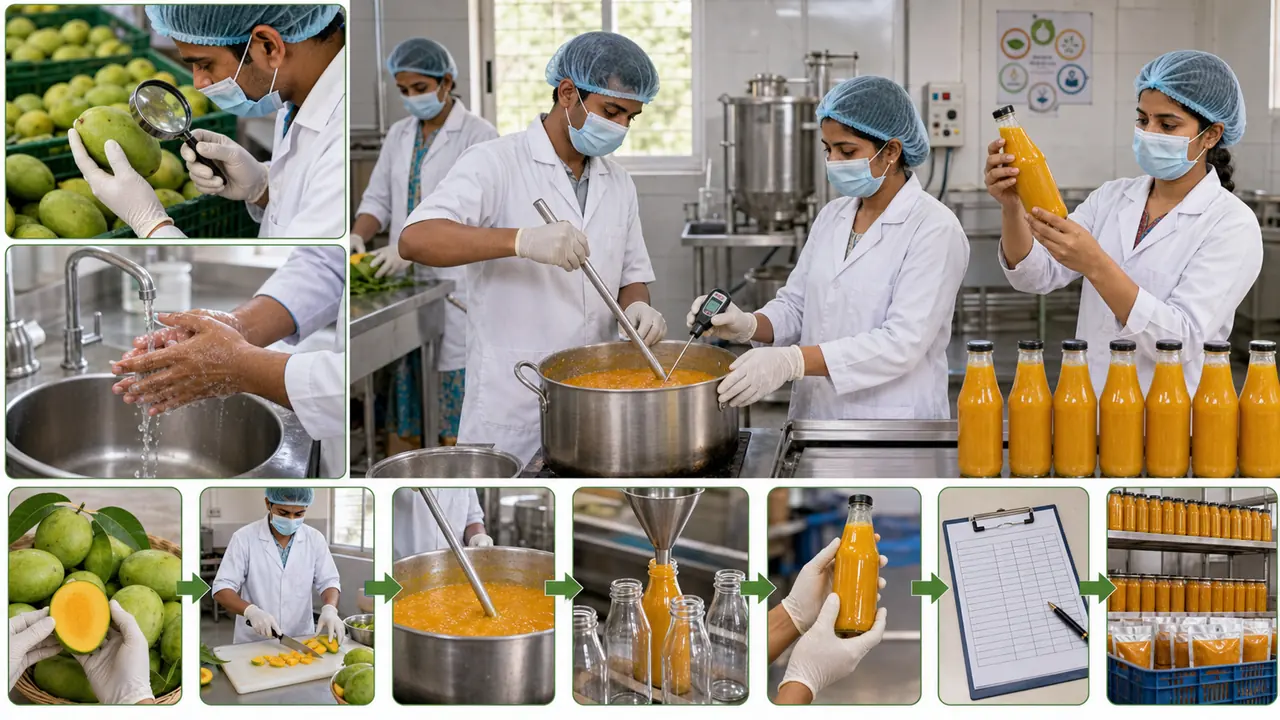
A simple factory example
Suppose a fruit-squash factory is operating:
- QC might test the finished bottle for °Brix, acidity, colour, seal quality, and microbial safety.
- QA makes sure that washing, pulp extraction, filtration, sugar mixing, bottling, and sealing are all done correctly so that defects do not appear in the first place.
This is why QA is broader and more preventive, while QC is more inspection oriented.
School-canteen analogy
If a canteen tastes one samosa at the end, that is like QC. If it also checks oil quality, worker handwashing, raw material freshness, cooking temperature, clean utensils, and covered storage throughout the process, that is QA thinking. HACCP goes one step further and asks, At which point can a serious hazard enter, and how do we control it before it reaches students?
Systems used to ensure quality
SOP
Standard Operating Procedures are fixed step-by-step methods used to keep each stage uniform and reliable.
GMP
Good Manufacturing Practices are sanitation and operational guidelines that help ensure food is prepared, packed, and held safely.
GMP can be understood as one of the basic discipline systems behind safe food. It affects layout, sanitation, worker practice, equipment cleanliness, and process hygiene.
What GMP usually covers
- hygienic building design
- adequate ventilation and drainage
- cleanable equipment surfaces
- worker hygiene and protective clothing
- clean water supply
- waste disposal
- pest control
- prevention of cross-contamination
In simple terms, GMP creates the hygienic environment in which safe food can actually be produced.
TQM
Total Quality Management is the broader management philosophy where every part of the organization participates in maintaining and improving quality.
Food laws
Food laws are rules set by authorities to regulate food quality, safety, hygiene, quantity, value, labeling, and standardization.
Why food laws are needed
They help:
- prevent adulteration
- standardize trade
- protect consumers
- support fair marketing
- help processors and traders maintain accepted quality
- create confidence in domestic and export markets
This means food law is not only punitive. It is also a framework for trust in trade and public health.
Exam framing: how to write a strong answer on food laws
Do not write food laws as a list of names only. A strong Class 12 answer should connect each law to a purpose:
- PFA type laws protect consumers from adulteration and unsafe sale.
- FPO type rules standardize fruit and vegetable processing.
- Weights and Measures type rules protect quantity and label honesty.
- Export inspection rules protect international trade confidence.
- Environment and Insecticide rules connect food factories and farm chemicals with public health.
Food laws also help many groups at once:
- farmers and producers
- processors and manufacturers
- traders and marketers
- consumers
- government and inspection agencies
So the food-law system is a link between agriculture, industry, and public health.
Indian quality and legal framework
India has both compulsory and voluntary systems.
Compulsory systems
Important names to recognize:
- PFA Act
- Atomic Energy Rules
- Essential Commodities Act
- Fruit Products Order (FPO)
These are remembered as compulsory because they are backed by legal enforcement rather than only advisory use.
| Compulsory Act / Order | Mode of operation | Regulation / special reference cue |
|---|---|---|
| Prevention of Food Adulteration Act, 1954 | Ministry of Health and Family Welfare; Directorate General of Health Services; Central Committee for Food Standards | prevents adulteration, misbranding, and sale outside licence conditions; gives minimum quality standards; non-compliance can lead to fine and imprisonment |
| Atomic Energy Rules, 1991 | Department of Atomic Energy | controls irradiation of food; certificate should mention dose and purpose |
| Essential Commodities Act, 1954 | Ministry of Food | regulates manufacture, commerce, and distribution of essential commodities and supports sub-orders |
| Fruit Products Order, 1955 | Ministry of Food Processing Industry and Central Food Products Advisory Committee | regulates fruit and vegetable products; FPO mark and licence after sanitation, personnel hygiene, machinery, equipment and work-area requirements are checked |
| Vegetable Oil Products Regulation Order, 1998 | Ministry of Food and Consumer Affairs | regulates edible-oil product production and distribution; supersedes older vegetable-oil product orders |
| Sugar Control Order, 1966 | Ministry of Agriculture and Irrigation, Department of Sugar | regulates manufacture, quality, and sale of sugar |
| Export Quality Control and Inspection Act, 1963 | Ministry of Commerce, Export Inspection Council, regional export inspection agencies | compulsory pre-shipment inspection; AGMARK recognized for inspection and quality control of selected items |
| Standards of Weights and Measures Act, 1976 | Ministry of Food and Civil Supplies, Directorate of Weights and Measures | quantity declaration, manufacturing date, and sale-price requirements on packed products |
| Consumer Protection Act, 1986 | Ministry of Food and Civil Supplies | consumer councils and authorities for consumer-dispute settlement |
| Environment Protection Act, 1986 | Ministry of Environment and Forestry | controls hazardous microorganisms, substances, and cells; food plants discharging waste need NOC from State Pollution Board |
| Insecticide Act, 1968 | Directorate of Plant Protection, Quarantine and Storage, Ministry of Agriculture | safe insecticide use so residues do not create health hazards |
Voluntary and support-oriented systems
Examples commonly associated with the broader Indian system:
- AGMARK
- BIS
- export inspection and commodity-board support
An important point is a wider support network around food quality in India, including bodies such as:
- Spices Board
- Tea Board
- Coffee Board
- National Horticulture Board
These bodies do more than inspection. They also support research, development, quality improvement, and trade confidence in their respective commodity sectors.
| Voluntary standard | Operating body | Key feature |
|---|---|---|
| Agricultural Produce Grading and Marking Act, 1937 | Directorate of Marketing and Inspection | grade standards for agricultural and allied commodities; AGMARK certificate system; grading, sorting and inspection by quality attributes |
| Bureau of Indian Standards | Indian Standards Institution / BIS system | standards and specifications for foods, limits of toxic compounds, packaging and labelling requirements, voluntary third-party certification |
| Certification Marks Scheme under BIS Act, 1986 | Bureau of Indian Standards | certification for processed foods, ingredients, and packaging containers; assures quality to consumers through certification mark |
AGMARK in simple words
AGMARK is strongly associated with graded agricultural produce. It represents standardization and quality marking in the agricultural sector and helps buyers trust commodity quality.
BIS in simple words
BIS supports standard setting and quality assurance for products, processes, and systems. It is an example of organized standardization that helps industry and consumers follow accepted benchmarks.
International organizations governing food safety
Key organizations to remember are:
- WHO
- WTO
- FAO
- Codex Alimentarius Commission (CAC)
- ISO
- IAMFES
- ICMSF
- NACMCF
- IDF
- HMSO
These names may look large, but the underlying logic is simple:
- FAO and WHO are strongly linked to food standards and health protection
- WTO matters because international trade expects compliance and quality discipline
- Codex provides standards and codes of practice
- ISO gives system-oriented standards
- microbial advisory bodies help define safe criteria for food handling
ISO
The International Organization for Standardization develops globally recognized management standards.
Why ISO matters in food systems
- it supports consistency
- it improves system discipline
- it helps organizations meet customer requirements
- it supports reliable delivery and process management
This discussion also mentions:
- ISO 9000 series for quality management
- ISO 14000 series for environmental management
ISO facts
| ISO fact | Revision value |
|---|---|
| Headquarters | Geneva, Switzerland |
| Founded | 1947 |
| Membership cue | more than 130 member countries in lesson context |
| ISO/TC 176 | convened in 1979 for quality management standards |
| ISO 9000 family | ISO 9001, ISO 9002, ISO 9003, ISO 9004 |
| Main ISO 9000 purpose | consistent production and timely delivery of goods and services |
| ISO/TC 207 | convened in 1993 for environmental management |
| ISO 14000 family | controls and minimizes environmental impact of operations, goods, and services |
The textbook also notes that ISO standards do not tell every organization exactly how to run itself. Instead, they provide a recognized framework so that the organization can consistently satisfy requirements and demonstrate reliability.
These show that food quality systems are linked not only to the product itself but also to the organization and process environment.
Codex Alimentarius Commission
CAC was created jointly by FAO and WHO to develop food standards, guidelines, and codes of practice.
Main purposes of Codex
- protect consumer health
- ensure fair practices in food trade
- coordinate food-standard work internationally
Codex should be connected with two powerful ideas:
- food safety and trade are linked
- international harmonization reduces confusion between countries
HACCP
Hazard Analysis and Critical Control Point is one of the most important concepts in this unit.
HACCP is linked with the NASA space programme. It was developed to ensure the safety of foods used by astronauts, so its spirit is preventive: hazards are identified and controlled before the food reaches the consumer.
Types of hazards considered
- biological hazards
- chemical hazards
- physical hazards
Seven principles of HACCP
- analyze hazards
- identify critical control points
- establish critical limits
- establish monitoring procedures
- establish corrective actions
- establish verification procedures
- establish record keeping
| HACCP principle | Key meaning |
|---|---|
| Analyze hazards | identify biological, chemical, and physical contaminants and ways to control them |
| Identify critical control points | find points in production where hazards can be controlled or eliminated |
| Establish critical limits | set minimum safe standards for each control point |
| Establish monitoring procedures | decide how and by whom processing standards will be watched |
| Establish corrective actions | reprocess or dispose of unsafe food when limits are not met |
| Establish verification procedures | test and calibrate equipment and confirm the system works |
| Establish record keeping | document hazards, controls, monitoring, safety requirements, and corrective actions |
Why HACCP is especially powerful
HACCP is preventive. Instead of waiting for the final product to fail, it identifies where danger can arise and controls those points in advance.
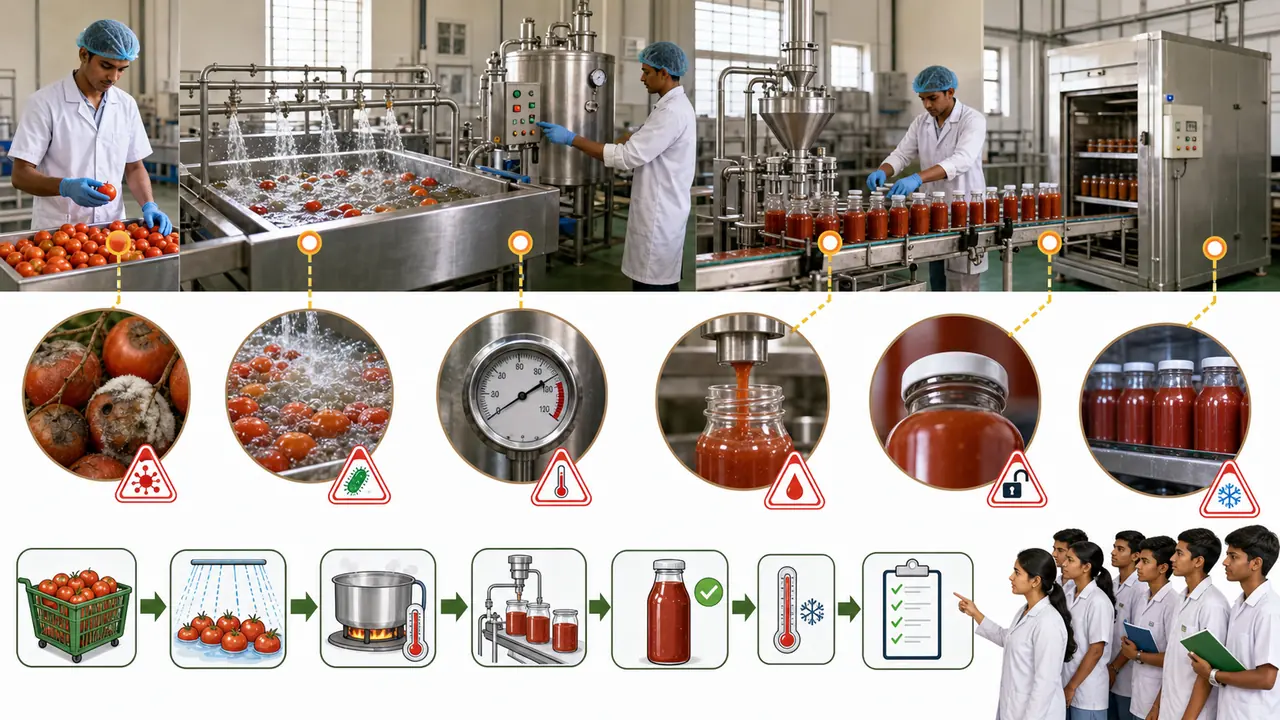
A simple HACCP example
In a tomato-sauce unit, possible critical points may include:
- washing quality of raw tomatoes
- heating temperature during cooking
- bottle sterilization
- sealing of the bottle
- storage after filling
If any one of these points fails, a safe product can become unsafe even if the recipe itself is correct. That is why HACCP focuses on critical control points, not only on the finished sample.
Why HACCP is important
- reduction in contamination
- fewer recalls and product destruction events
- better market protection
- improved supplier status
- compliance with regulations and buyer requirements
- easier international acceptance
Quality attributes to remember
Food quality can be judged by a cluster of attributes:
| Attribute group | Student memory line |
|---|---|
| Physical | size, thickness, viscosity, visible uniformity |
| Chemical | composition and deterioration status |
| Sensory | colour, smell, texture, flavour |
| Nutritive | vitamins, minerals, fibre, antioxidants, energy |
| Convenience | processing suitability, shelf life, packaging ease |
| Microbial | total load, moulds, yeasts, pathogens |
This list is important because food quality is often described through these attributes.
Why safe food starts before the factory gate
One of the most important textbook messages is that food quality must be built throughout the value chain:
- harvesting
- handling
- manufacturing
- processing
- packaging
- storage
- marketing
- distribution
So if a student is asked, “At what stage should quality control begin?”, the best answer is: from the very beginning of the value-added chain, not only at the final packaging stage.
Summary Cheat Sheet
| Concept / Topic | Key Details / Explanation |
|---|---|
| Food quality dimensions | Food quality includes physical, chemical, sensory, nutritive, convenience, and microbial dimensions. |
| QC vs QA | Quality control (QC) checks the product, while quality assurance (QA) is preventive and process-oriented. |
| GMP, SOP, and TQM | GMP, SOP, and TQM support organized food-quality systems by improving sanitary conditions, consistency, and process discipline. |
| Indian standardization and laws | Important systems and laws include Vegetable Oil Products Order, Sugar Control Order, Export Quality Control and Inspection Act, Weights and Measures Act, Consumer Protection Act, Environment Protection Act, Insecticide Act, AGMARK Act, BIS, and the Certification Marks Scheme. |
| AGMARK and BIS | AGMARK is linked with graded agricultural produce and official quality marking, while BIS provides standards, specifications, safety limits, packaging, and labelling requirements. |
| ISO | ISO is based in Geneva and was founded in 1947. Useful memory points include ISO/TC 176, ISO 9001-9004, ISO/TC 207, and ISO 14000. |
| HACCP | HACCP focuses on identifying hazards and controlling them at critical points before unsafe food reaches the consumer; its origin is often linked with NASA and astronaut food safety. |
| International quality words | The core international quality terms for this unit are ISO, Codex, and HACCP, with HMSO also appearing as a useful abbreviation in revision. |
| Best chapter takeaway | Safe food depends on combining legal compliance, quality systems, process control, and hazard prevention, not just final-product checking. |
Lesson Doubts
Ask questions, get expert answers