📝 Food Processing and Value Addition Practice and Revision
A recap lesson bringing together the main food-processing and value-addition concepts of Unit 4.
Food Processing and Value Addition Practice and Revision
This recap chapter follows the value chain of Unit 4 so that the topic remains connected:
preservation -> product preparation -> packaging -> storage -> standards -> safe food
Unit sequence
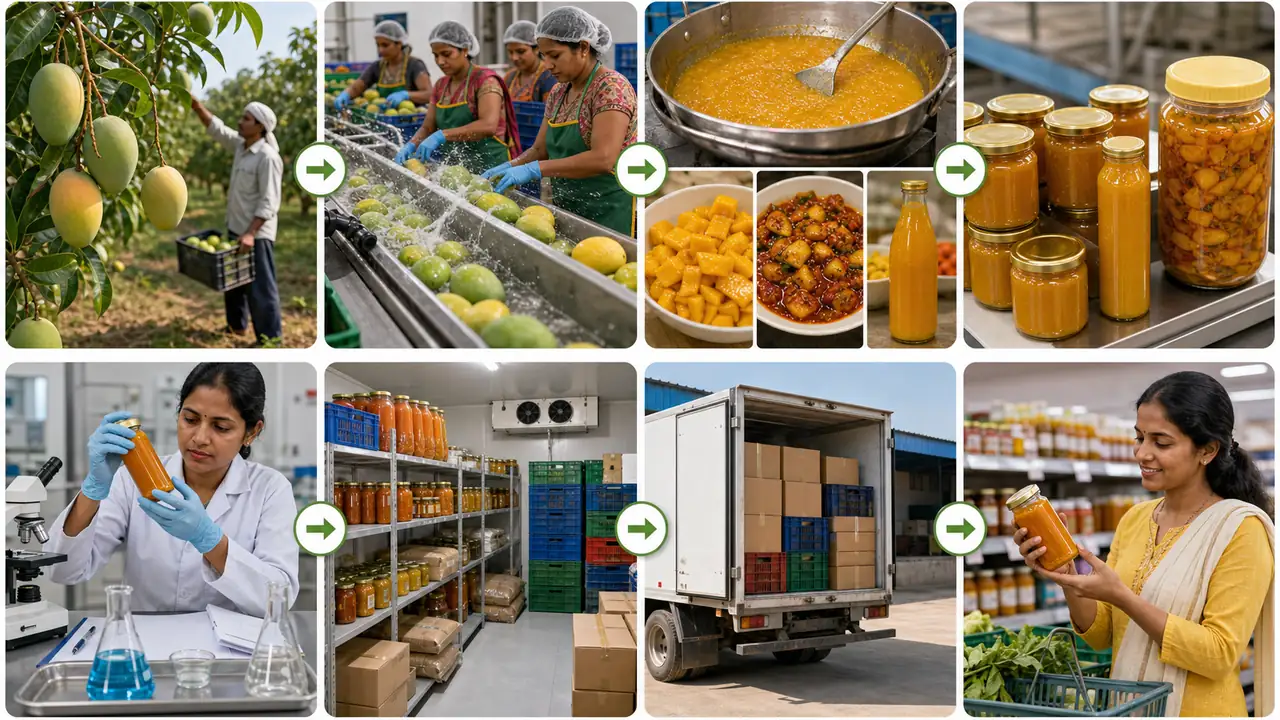
Do not revise Unit 4 as disconnected facts. Build a mental movie of a product moving from farm to consumer:
- a perishable crop is harvested
- spoilage forces begin acting
- preservation methods control those forces
- processing converts it into jam, jelly, pickle, ketchup, or flower product
- packaging protects and presents it
- standards and HACCP make it trustworthy
If you can explain that movie for mango pickle, guava jelly, tomato ketchup, and a packed fruit tray, most Unit 4 answers become easier.
Three short processing situations
| Situation | Main point to diagnose |
|---|---|
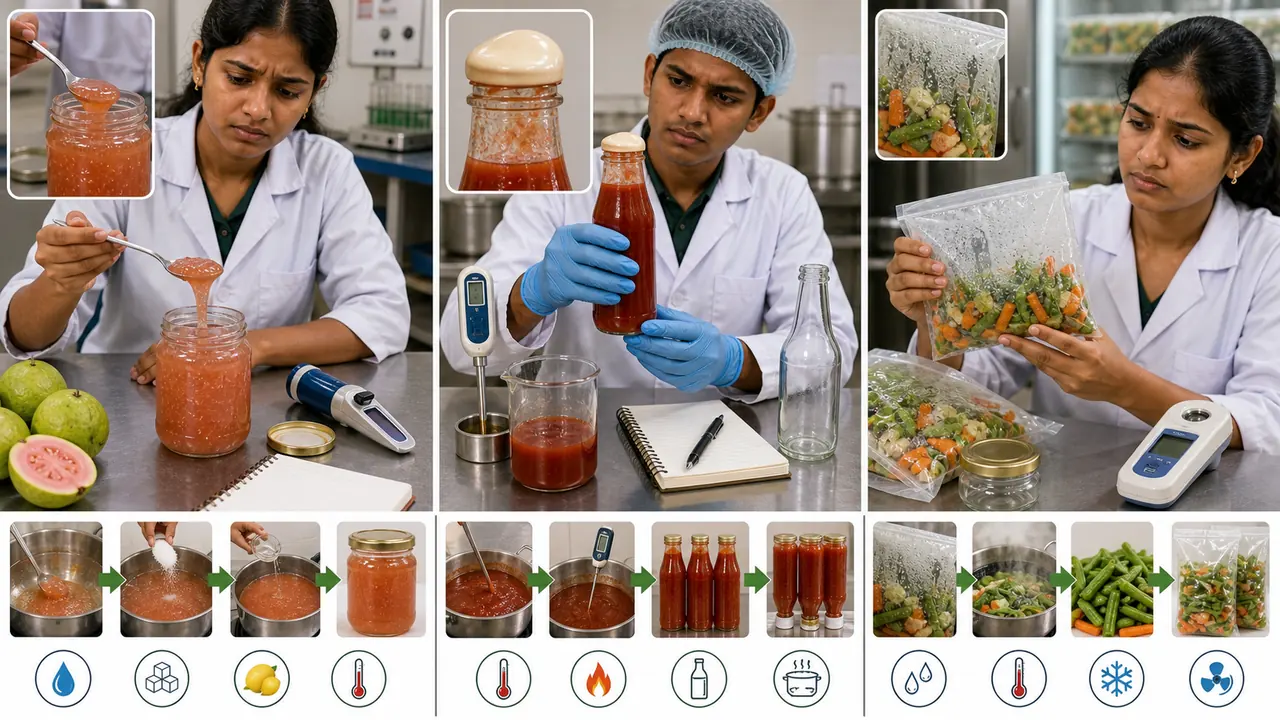
| Guava jelly did not set even after cooling | check pectin, acid, sugar, cooking endpoint, and over/undercooking |
| Tomato ketchup bottle fermented during storage | check heating, TSS/acidity, preservative use, filling hygiene, seal, and storage |
| Packed vegetables developed off-odour in film | check respiration rate, film permeability, temperature, and unsuitable MAP balance |
Objective questions
- Preservation of food mainly means:
- protecting food from spoilage and undesirable change
- Asepsis refers to:
- preventing entry of microorganisms
- Filtration is especially useful for:
- liquids such as juices and beverages
- Anaerobic condition in pickles is commonly supported by:
- oil covering the product surface
- Blanching is mainly done to:
- inactivate enzymes and prepare tissues for processing
- BHA and BHT are examples of:
- antioxidants
- Drying by sublimation after freezing is:
- freeze drying
- KMS is mainly valued because it releases:
- sulphur dioxide
- Sodium benzoate is especially effective against:
- yeast
- Refrigerated storage generally works around:
- 0–5°C
- Pasteurization is generally carried out:
- below 100°C
- Non-acid vegetables usually require canning:
- above 100°C under pressure
- Carbonation improves beverage keeping quality mainly through:
- dissolved carbon dioxide
- Nisin is associated with:
- antibiotic-based preservation support
- Jelly is prepared from:
- clear pectin-containing fruit extract, sugar, and acid
- Marmalade is most commonly associated with:
- citrus fruit and peel shreds
- Pickling may use:
- salt, vinegar, oil, or a mixture with spices
- Ketchup differs from sauce because ketchup is:
- made only from tomato and is more concentrated
- MAP stands for:
- modified atmosphere packaging
- Tetra-pack uses aluminium mainly to:
- block oxygen, light, and flavour loss
- QA differs from QC because QA:
- is process-oriented and preventive
- HACCP is mainly concerned with:
- hazard identification and control at critical points
- Food laws are broadly meant to regulate:
- specifications and hygienic manufacturing conditions
- AGMARK is mainly associated with:
- graded agricultural produce and quality marking
- ISO 14000 is associated mainly with:
- environmental management systems
- Codex Alimentarius was created jointly by:
- FAO and WHO
- The most important reason for standardizing polymer film thickness in vegetable packaging is:
- different vegetables respire at different rates
- In passive MAP, the modified atmosphere is mainly produced by:
- commodity respiration and film permeability
- Active MAP differs from passive MAP because active MAP:
- intentionally introduces or adjusts gases before sealing
- A preserve may show fruit shrinkage when:
- fruit pieces are put directly into very heavy syrup
- Cloudiness in pickle is commonly linked with:
- inferior vinegar or chemical reaction in brine
- The aluminium layer in tetra-pack mainly protects against:
- oxygen, light, and flavour loss
- Vacuum packaging works mainly by:
- removing air before sealing
- In a HACCP plan, corrective action is needed when:
- monitoring shows that a critical limit has not been met
- Gulkand is best understood as:
- a rose-petal sugar-based value-added product
Fill in the blanks
- Preservation methods are broadly classified into __________ and bactericidal methods.
- Sugar and salt preserve food mainly by reducing __________ water.
- The short heat treatment used before freezing vegetables is called __________.
- Juice heated rapidly for a short time is an example of __________ pasteurization.
- The jelly test based on clot formation after spirit addition is the __________ test.
- Murabba is another common name for __________.
- Packaging should contain, protect, communicate, and __________ the product.
- The two forms of MAP are passive and __________ MAP.
- GMP stands for Good Manufacturing __________.
- CAC stands for Codex Alimentarius __________.
- HACCP includes identification of critical control __________.
- Food that is unsafe becomes unfit for human __________.
- GMP helps ensure food is prepared and held under __________ conditions.
- The seven HACCP principles include monitoring and corrective __________.
- Food quality includes physical, chemical, sensory, nutritive, convenience, and __________ attributes.
- ISO stands for International Organization for __________.
- Passive MAP depends on commodity respiration and film __________.
- In active MAP, the desired gas mixture may be introduced before __________.
- Vacuum packaging removes __________ before sealing.
- Wooden crates may need soft liners for __________ fruits.
- Corrugated fibreboard boxes are economical but should be protected from excess __________.
- Fruit shrinkage in preserve can occur when fruit is cooked directly in heavy __________.
- A pickle should remain below the brine or oil to avoid softness, slipperiness, and __________ growth.
- Tetra-pack cartons combine paper, polyethylene, and __________ foil.
- Rose water and essential oils need packaging that protects __________.
- HACCP records document hazards, monitoring, corrective actions, and __________.
Match the pairs
| Column A | Column B |
|---|---|
| Asepsis | keeping microbes out |
| Freeze drying | sublimation-based drying |
| KMS | sulphite-type preservative |
| Sodium benzoate | common preservative for coloured juices |
| Jelly | clear pectin-rich gel product |
| Marmalade | citrus jelly with peel shreds |
| MAP | modified gas atmosphere in a package |
| GMP | sanitary manufacturing guideline |
| ISO | international standardization framework |
| HACCP | hazard-based preventive food-safety system |
| AGMARK | agricultural quality marking |
| Codex | international food standards system |
| Passive MAP | atmosphere formed by respiration and film permeability |
| Active MAP | atmosphere created intentionally by gas adjustment |
| Vacuum packaging | air removal before sealing |
| Tetra-pack | layered aseptic beverage carton |
| Gulkand | rose-petal value-added product |
| Fruit shrinkage | defect from sudden heavy syrup exposure |
Very short answer practice
- What is preservation?
- What is asepsis?
- What is blanching?
- What is pasteurization?
- What is canning?
- What is jelly?
- What is marmalade?
- What is pickling?
- What is MAP?
- What is vacuum packaging?
- What is QC?
- What is QA?
- What is AGMARK?
- What is Codex?
- What is GMP?
- What is TQM?
- What is passive MAP?
- What is active MAP?
- What is the purpose of an oxygen scavenger?
- What is vacuum packaging?
- Why are ventilation holes useful in crates?
- What is gulkand?
- What is a glazed fruit product?
- Name two common pickle defects.
- Name two compulsory Indian food legislations.
Short-answer practice
- Differentiate between physical, chemical, and microbial spoilage.
- Explain bacteriostatic and bactericidal methods with examples.
- Why are sugar and salt both effective preservatives?
- Write a short note on KMS.
- Write a short note on sodium benzoate.
- Why is blanching important before freezing vegetables?
- Explain the role of pectin in jelly making.
- Differentiate between jam and jelly.
- Differentiate between sauce and ketchup.
- State four functions of packaging.
- Explain passive and active MAP.
- Why is Tetra-pack suitable for beverages?
- Differentiate between quality control and quality assurance.
- State the importance of GMP in food industry.
- Why are food laws important for farmers, processors, consumers, and government agencies?
- Differentiate between compulsory and voluntary standardization systems.
- Why is HACCP considered preventive rather than merely corrective?
- What is the role of Codex in international food trade?
- Explain why film permeability must be matched with produce respiration.
- Differentiate between shrink wrapping and stretch wrapping.
- Write the layer functions of tetra-pack in brief.
- Why are wooden crates useful but risky for soft fruits?
- Explain why gradual syrup concentration is important in preserve and candy making.
- Describe the four main pickle preservation routes.
- Differentiate between preserve, candy, crystallized fruit, and glazed fruit.
- State the causes and prevention of two pickle defects.
- Explain how flower products such as rose water, gulkand, dried flowers, and essential oils show value addition.
- Why do export-oriented food products need both legal compliance and good packaging?
Long-answer practice
- Explain the principles of food preservation in detail.
- Describe bacteriostatic methods of preservation.
- Describe bactericidal methods of preservation.
- Explain the importance and scope of fruit and vegetable preservation in India.
- Write a detailed note on jam preparation and common defects.
- Explain jelly preparation, pectin testing, and problems of jelly making.
- Write a note on marmalade, preserves, candied fruits, and glazed products.
- Explain methods of pickle preparation and common pickle defects.
- Write a detailed note on packaging materials and modern packaging systems.
- Explain food quality dimensions, food laws, and systems used for food safety.
- Describe HACCP and explain its seven principles.
- Explain the role of AGMARK, BIS, ISO, and Codex in food quality assurance.
- Write a note on Indian compulsory and voluntary food-legislation systems.
- Explain why quality must be built from harvest to distribution rather than checked only at the final stage.
- Describe packaging materials used for fruits and vegetables, including plastic films, boxes, mesh bags, wooden crates, polypropylene boxes, corrugated fibreboard boxes, baskets, sacks, and pallet containers.
- Explain MAP in detail, including passive MAP, active MAP, gas balance, film permeability, and effect on respiration and decay.
- Explain vacuum packaging and tetra-packaging with suitable examples.
- Discuss common defects in preserves, pickles, jam, jelly, sauce, and ketchup, with causes and prevention.
- Explain processed flower products as an enterprise opportunity, including storage and packaging needs.
- Prepare a complete answer on standardization systems for food quality control in India.
Practical reasoning questions
- Why are naturally coloured anthocyanin juices less suitable for KMS use?
- Why does non-acid food require harsher canning than acidic fruit?
- Why can a beautiful package still hold unsafe food?
- Why must export-oriented processed foods focus on standards from the beginning?
- Why is pectin testing necessary before making jelly?
- Why is heavy syrup at the wrong stage harmful in preserve making?
- Why can a product meet taste expectations but still fail as “quality food”?
- Why do international buyers care about ISO, Codex, and HACCP compliance from the start of processing?
- Why can an unsuitable MAP film create off-odour even when the raw produce was fresh?
- Why does a low-cost sack become expensive if it increases bruising and rejection?
- Why can a tetra-pack beverage remain acceptable longer than the same beverage in a poorly sealed transparent pack?
- Why should gulkand be stored in a clean, well-closed jar?
- Why are flower products sensitive to both moisture and light?
- Why is the package a part of marketing and not only a part of storage?
Answer-building templates
Template 1: preservation method answer
Use this pattern:
Pro Content Locked
Upgrade to Pro to access this lesson and all other premium content.
₹99 charged monthly · Cancel anytime
- All Agriculture & Banking Courses
- AI Lesson Questions (100/day)
- AI Doubt Solver (50/day)
- Glows & Grows Feedback (30/day)
- AI Section Quiz (20/day)
- 22-Language Translation (100/day)
- Recall Questions (20/day)
- AI Quiz (15/day)
- AI Quiz Paper Analysis (100/day)
- AI Step-by-Step Explanations (100/day)
- Spaced Repetition Recall (FSRS)
- AI Tutor
- Immersive Text Questions
- Audio Lessons — Hindi & English
- Mock Tests & Previous Year Papers
- Summary & Mind Maps
- XP, Levels, Leaderboard & Badges
- Generate New Classrooms
- Voice AI Teacher (AgriDots Live)
- AI Revision Assistant
- Knowledge Gap Analysis
- Interactive Revision (LangGraph)
🔒 Secure via Razorpay · Cancel anytime · No hidden fees
Food Processing and Value Addition Practice and Revision
This recap chapter follows the value chain of Unit 4 so that the topic remains connected:
preservation -> product preparation -> packaging -> storage -> standards -> safe food
Unit sequence
Do not revise Unit 4 as disconnected facts. Build a mental movie of a product moving from farm to consumer:
- a perishable crop is harvested
- spoilage forces begin acting
- preservation methods control those forces
- processing converts it into jam, jelly, pickle, ketchup, or flower product
- packaging protects and presents it
- standards and HACCP make it trustworthy
If you can explain that movie for mango pickle, guava jelly, tomato ketchup, and a packed fruit tray, most Unit 4 answers become easier.
Three short processing situations
| Situation | Main point to diagnose |
|---|---|
| Guava jelly did not set even after cooling | check pectin, acid, sugar, cooking endpoint, and over/undercooking |
| Tomato ketchup bottle fermented during storage | check heating, TSS/acidity, preservative use, filling hygiene, seal, and storage |
| Packed vegetables developed off-odour in film | check respiration rate, film permeability, temperature, and unsuitable MAP balance |
Objective questions
- Preservation of food mainly means:
- protecting food from spoilage and undesirable change
- Asepsis refers to:
- preventing entry of microorganisms
- Filtration is especially useful for:
- liquids such as juices and beverages
- Anaerobic condition in pickles is commonly supported by:
- oil covering the product surface
- Blanching is mainly done to:
- inactivate enzymes and prepare tissues for processing
- BHA and BHT are examples of:
- antioxidants
- Drying by sublimation after freezing is:
- freeze drying
- KMS is mainly valued because it releases:
- sulphur dioxide
- Sodium benzoate is especially effective against:
- yeast
- Refrigerated storage generally works around:
- 0–5°C
- Pasteurization is generally carried out:
- below 100°C
- Non-acid vegetables usually require canning:
- above 100°C under pressure
- Carbonation improves beverage keeping quality mainly through:
- dissolved carbon dioxide
- Nisin is associated with:
- antibiotic-based preservation support
- Jelly is prepared from:
- clear pectin-containing fruit extract, sugar, and acid
- Marmalade is most commonly associated with:
- citrus fruit and peel shreds
- Pickling may use:
- salt, vinegar, oil, or a mixture with spices
- Ketchup differs from sauce because ketchup is:
- made only from tomato and is more concentrated
- MAP stands for:
- modified atmosphere packaging
- Tetra-pack uses aluminium mainly to:
- block oxygen, light, and flavour loss
- QA differs from QC because QA:
- is process-oriented and preventive
- HACCP is mainly concerned with:
- hazard identification and control at critical points
- Food laws are broadly meant to regulate:
- specifications and hygienic manufacturing conditions
- AGMARK is mainly associated with:
- graded agricultural produce and quality marking
- ISO 14000 is associated mainly with:
- environmental management systems
- Codex Alimentarius was created jointly by:
- FAO and WHO
- The most important reason for standardizing polymer film thickness in vegetable packaging is:
- different vegetables respire at different rates
- In passive MAP, the modified atmosphere is mainly produced by:
- commodity respiration and film permeability
- Active MAP differs from passive MAP because active MAP:
- intentionally introduces or adjusts gases before sealing
- A preserve may show fruit shrinkage when:
- fruit pieces are put directly into very heavy syrup
- Cloudiness in pickle is commonly linked with:
- inferior vinegar or chemical reaction in brine
- The aluminium layer in tetra-pack mainly protects against:
- oxygen, light, and flavour loss
- Vacuum packaging works mainly by:
- removing air before sealing
- In a HACCP plan, corrective action is needed when:
- monitoring shows that a critical limit has not been met
- Gulkand is best understood as:
- a rose-petal sugar-based value-added product
Fill in the blanks
- Preservation methods are broadly classified into __________ and bactericidal methods.
- Sugar and salt preserve food mainly by reducing __________ water.
- The short heat treatment used before freezing vegetables is called __________.
- Juice heated rapidly for a short time is an example of __________ pasteurization.
- The jelly test based on clot formation after spirit addition is the __________ test.
- Murabba is another common name for __________.
- Packaging should contain, protect, communicate, and __________ the product.
- The two forms of MAP are passive and __________ MAP.
- GMP stands for Good Manufacturing __________.
- CAC stands for Codex Alimentarius __________.
- HACCP includes identification of critical control __________.
- Food that is unsafe becomes unfit for human __________.
- GMP helps ensure food is prepared and held under __________ conditions.
- The seven HACCP principles include monitoring and corrective __________.
- Food quality includes physical, chemical, sensory, nutritive, convenience, and __________ attributes.
- ISO stands for International Organization for __________.
- Passive MAP depends on commodity respiration and film __________.
- In active MAP, the desired gas mixture may be introduced before __________.
- Vacuum packaging removes __________ before sealing.
- Wooden crates may need soft liners for __________ fruits.
- Corrugated fibreboard boxes are economical but should be protected from excess __________.
- Fruit shrinkage in preserve can occur when fruit is cooked directly in heavy __________.
- A pickle should remain below the brine or oil to avoid softness, slipperiness, and __________ growth.
- Tetra-pack cartons combine paper, polyethylene, and __________ foil.
- Rose water and essential oils need packaging that protects __________.
- HACCP records document hazards, monitoring, corrective actions, and __________.
Match the pairs
| Column A | Column B |
|---|---|
| Asepsis | keeping microbes out |
| Freeze drying | sublimation-based drying |
| KMS | sulphite-type preservative |
| Sodium benzoate | common preservative for coloured juices |
| Jelly | clear pectin-rich gel product |
| Marmalade | citrus jelly with peel shreds |
| MAP | modified gas atmosphere in a package |
| GMP | sanitary manufacturing guideline |
| ISO | international standardization framework |
| HACCP | hazard-based preventive food-safety system |
| AGMARK | agricultural quality marking |
| Codex | international food standards system |
| Passive MAP | atmosphere formed by respiration and film permeability |
| Active MAP | atmosphere created intentionally by gas adjustment |
| Vacuum packaging | air removal before sealing |
| Tetra-pack | layered aseptic beverage carton |
| Gulkand | rose-petal value-added product |
| Fruit shrinkage | defect from sudden heavy syrup exposure |
Very short answer practice
- What is preservation?
- What is asepsis?
- What is blanching?
- What is pasteurization?
- What is canning?
- What is jelly?
- What is marmalade?
- What is pickling?
- What is MAP?
- What is vacuum packaging?
- What is QC?
- What is QA?
- What is AGMARK?
- What is Codex?
- What is GMP?
- What is TQM?
- What is passive MAP?
- What is active MAP?
- What is the purpose of an oxygen scavenger?
- What is vacuum packaging?
- Why are ventilation holes useful in crates?
- What is gulkand?
- What is a glazed fruit product?
- Name two common pickle defects.
- Name two compulsory Indian food legislations.
Short-answer practice
- Differentiate between physical, chemical, and microbial spoilage.
- Explain bacteriostatic and bactericidal methods with examples.
- Why are sugar and salt both effective preservatives?
- Write a short note on KMS.
- Write a short note on sodium benzoate.
- Why is blanching important before freezing vegetables?
- Explain the role of pectin in jelly making.
- Differentiate between jam and jelly.
- Differentiate between sauce and ketchup.
- State four functions of packaging.
- Explain passive and active MAP.
- Why is Tetra-pack suitable for beverages?
- Differentiate between quality control and quality assurance.
- State the importance of GMP in food industry.
- Why are food laws important for farmers, processors, consumers, and government agencies?
- Differentiate between compulsory and voluntary standardization systems.
- Why is HACCP considered preventive rather than merely corrective?
- What is the role of Codex in international food trade?
- Explain why film permeability must be matched with produce respiration.
- Differentiate between shrink wrapping and stretch wrapping.
- Write the layer functions of tetra-pack in brief.
- Why are wooden crates useful but risky for soft fruits?
- Explain why gradual syrup concentration is important in preserve and candy making.
- Describe the four main pickle preservation routes.
- Differentiate between preserve, candy, crystallized fruit, and glazed fruit.
- State the causes and prevention of two pickle defects.
- Explain how flower products such as rose water, gulkand, dried flowers, and essential oils show value addition.
- Why do export-oriented food products need both legal compliance and good packaging?
Long-answer practice
- Explain the principles of food preservation in detail.
- Describe bacteriostatic methods of preservation.
- Describe bactericidal methods of preservation.
- Explain the importance and scope of fruit and vegetable preservation in India.
- Write a detailed note on jam preparation and common defects.
- Explain jelly preparation, pectin testing, and problems of jelly making.
- Write a note on marmalade, preserves, candied fruits, and glazed products.
- Explain methods of pickle preparation and common pickle defects.
- Write a detailed note on packaging materials and modern packaging systems.
- Explain food quality dimensions, food laws, and systems used for food safety.
- Describe HACCP and explain its seven principles.
- Explain the role of AGMARK, BIS, ISO, and Codex in food quality assurance.
- Write a note on Indian compulsory and voluntary food-legislation systems.
- Explain why quality must be built from harvest to distribution rather than checked only at the final stage.
- Describe packaging materials used for fruits and vegetables, including plastic films, boxes, mesh bags, wooden crates, polypropylene boxes, corrugated fibreboard boxes, baskets, sacks, and pallet containers.
- Explain MAP in detail, including passive MAP, active MAP, gas balance, film permeability, and effect on respiration and decay.
- Explain vacuum packaging and tetra-packaging with suitable examples.
- Discuss common defects in preserves, pickles, jam, jelly, sauce, and ketchup, with causes and prevention.
- Explain processed flower products as an enterprise opportunity, including storage and packaging needs.
- Prepare a complete answer on standardization systems for food quality control in India.
Practical reasoning questions
- Why are naturally coloured anthocyanin juices less suitable for KMS use?
- Why does non-acid food require harsher canning than acidic fruit?
- Why can a beautiful package still hold unsafe food?
- Why must export-oriented processed foods focus on standards from the beginning?
- Why is pectin testing necessary before making jelly?
- Why is heavy syrup at the wrong stage harmful in preserve making?
- Why can a product meet taste expectations but still fail as “quality food”?
- Why do international buyers care about ISO, Codex, and HACCP compliance from the start of processing?
- Why can an unsuitable MAP film create off-odour even when the raw produce was fresh?
- Why does a low-cost sack become expensive if it increases bruising and rejection?
- Why can a tetra-pack beverage remain acceptable longer than the same beverage in a poorly sealed transparent pack?
- Why should gulkand be stored in a clean, well-closed jar?
- Why are flower products sensitive to both moisture and light?
- Why is the package a part of marketing and not only a part of storage?
Answer-building templates
Template 1: preservation method answer
Use this pattern:
Definition -> principle controlled -> method steps -> examples -> advantages/limitations
Example: for blanching, define it as short heat treatment, say it inactivates enzymes and reduces microbial load, mention vegetables before freezing or canning, then add that it helps retain colour, flavour, and texture.
Template 2: product preparation answer
Use this pattern:
Raw material -> preparation -> key ingredients -> endpoint -> filling/storage -> defects
This works for jam, jelly, marmalade, pickle, sauce, and ketchup.
Template 3: food-safety answer
Use this pattern:
Hazard -> control point -> monitoring -> corrective action -> record/verification
This turns HACCP from a memorized list into a practical safety story.
Answer key
Fill in the blanks answers
- bacteriostatic
- available
- blanching
- flash
- alcohol
- preserve
- market
- active
- Practices
- Commission
- points
- consumption
- sanitary
- actions
- microbial
- Standardization
- permeability
- sealing
- air
- soft
- moisture
- syrup
- microbial
- aluminium
- aroma
- verification
Objective answer hints
- different vegetables respire at different rates
- commodity respiration and film permeability
- intentionally introduces or adjusts gases before sealing
- fruit pieces are put directly into very heavy syrup
- inferior vinegar or chemical reaction in brine
- oxygen, light, and flavour loss
- removing air before sealing
- monitoring shows that a critical limit has not been met
- a rose-petal sugar-based value-added product
Key anchors
- Asepsis = entry blocked.
- Blanching = enzyme control.
- KMS = sulphite preservative.
- Jelly = clear pectin gel.
- MAP = gas balance in a pack.
- QC = check product.
- QA = prevent failure.
- HACCP = control hazards where they arise.
- AGMARK = graded agri quality mark.
- Codex = global food-standard reference.
- ISO = organized quality-system discipline.
- GMP = safe manufacturing environment.
- Passive MAP = product plus film creates atmosphere.
- Active MAP = processor adjusts gas atmosphere.
- Vacuum packaging = air removed before sealing.
- Tetra-pack = paper strength, polyethylene seal, aluminium barrier.
- Preserve defect logic = sugar balance and storage control.
- Flower value addition = aroma, colour, shape, and presentation protected for market.
Summary Cheat Sheet
| Concept / Topic | Key Details / Explanation |
|---|---|
| Unit 4 value-chain logic | Revise Unit 4 as preservation -> product preparation -> packaging -> storage -> standards -> safe food. |
| Food-law role | Food laws help regulate both product specifications and hygienic processing conditions. |
| Quality-building chain | Quality should be built from harvesting -> handling -> manufacturing -> processing -> packaging -> storage -> marketing -> distribution, not checked only at the end. |
| QC vs QA | QC checks the product, while QA controls and improves the process so failure is prevented earlier. |
| HACCP | HACCP was developed for very high-assurance food safety and works through seven linked principles based on hazard identification, monitoring, and corrective action. |
| Best unit takeaway | Strong Unit 4 answers connect spoilage control, processing, packaging, legal compliance, and preventive food safety as one continuous value chain. |
Lesson Doubts
Ask questions, get expert answers