🐝 Apiculture, Lac Culture and Sericulture
A fuller bridge lesson introducing bee keeping, lac production, and silk production as farm-linked enterprises.
Apiculture, Lac Culture and Sericulture
Subsidiary enterprises increase farm income and reduce dependence on a single field crop. Three classic examples are apiculture, lac culture, and sericulture.
Why these enterprises matter
All three are:
- biologically driven
- skill-based
- value-adding rural enterprises
- useful for diversification of farm income
They do not depend on the same land-use pattern as ordinary field crops, which is why they can strengthen the farm economy in different ways.
They should also be viewed as agro-based rural industries, not merely hobby activities. They combine biological production, careful management, harvesting, and some level of processing or marketing.
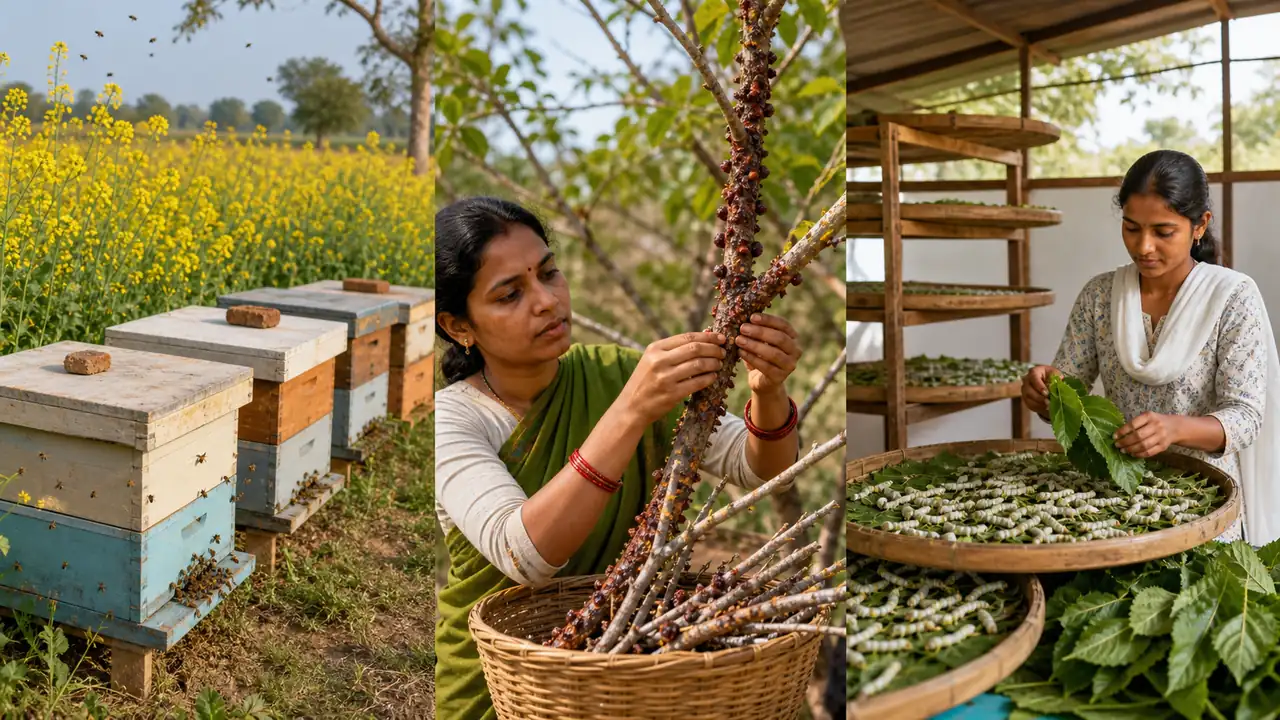
Apiculture
Apiculture means bee keeping. It is important for:
- honey production
- beeswax production
- pollination support in crops
Why bees matter beyond honey
Pollination is often the biggest economic benefit of bee keeping because it improves fruit set and yield in many crops.
Pro Content Locked
Upgrade to Pro to access this lesson and all other premium content.
₹99 charged monthly · Cancel anytime
- All Agriculture & Banking Courses
- AI Lesson Questions (100/day)
- AI Doubt Solver (50/day)
- Glows & Grows Feedback (30/day)
- AI Section Quiz (20/day)
- 22-Language Translation (100/day)
- Recall Questions (20/day)
- AI Quiz (15/day)
- AI Quiz Paper Analysis (100/day)
- AI Step-by-Step Explanations (100/day)
- Spaced Repetition Recall (FSRS)
- AI Tutor
- Immersive Text Questions
- Audio Lessons — Hindi & English
- Mock Tests & Previous Year Papers
- Summary & Mind Maps
- XP, Levels, Leaderboard & Badges
- Generate New Classrooms
- Voice AI Teacher (AgriDots Live)
- AI Revision Assistant
- Knowledge Gap Analysis
- Interactive Revision (LangGraph)
🔒 Secure via Razorpay · Cancel anytime · No hidden fees
Apiculture, Lac Culture and Sericulture
Subsidiary enterprises increase farm income and reduce dependence on a single field crop. Three classic examples are apiculture, lac culture, and sericulture.
Why these enterprises matter
All three are:
- biologically driven
- skill-based
- value-adding rural enterprises
- useful for diversification of farm income
They do not depend on the same land-use pattern as ordinary field crops, which is why they can strengthen the farm economy in different ways.
They should also be viewed as agro-based rural industries, not merely hobby activities. They combine biological production, careful management, harvesting, and some level of processing or marketing.
Apiculture
Apiculture means bee keeping. It is important for:
- honey production
- beeswax production
- pollination support in crops
Why bees matter beyond honey
Pollination is often the biggest economic benefit of bee keeping because it improves fruit set and yield in many crops.
Main colony castes
| Caste | Role |
|---|---|
| Queen | reproduction |
| Workers | foraging, cleaning, nursing, defence |
| Drones | mating |
Important honey-bee species
The common honey-bee species differ in size, behaviour, and suitability for management:
- Apis dorsata is a large wild bee and is difficult to domesticate
- Apis florea is small and gives less honey
- Apis indica is more suitable for Indian domestication
- Apis mellifera is widely used in organized modern bee keeping
Bee products and bee pasturage
Bee pasturage means the plants that provide nectar and pollen.
Students should connect this with:
- nectar as raw material for honey
- pollen as brood food
- flower availability as the foundation of the enterprise
The practical message is simple: without good bee pasturage, colony strength and honey yield both decline.
Lac culture
Lac culture is the rearing of lac insects for the production of resinous lac. Lac is used in polish, varnish, handicrafts, and several industrial applications.
Basic idea
- it is an insect-based enterprise
- it is carried out on suitable host plants
- it produces a non-field commercial product
Important host trees
The detailed lesson expands this further, but even this bridge chapter should anchor three host names in memory:
- kusum
- palas
- ber
Why lac is a true subsidiary enterprise
Lac converts insect activity on host plants into a valuable commercial material. This makes it a special enterprise where the farmer manages:
- host plants
- insect colonization
- timing of harvest
- primary processing into commercial forms
The basic chain is:
host plant -> lac insect secretion -> stick lac -> seed lac -> shellac
Two useful memory points are:
- the lac insect is commonly named Laccifer lacca
- enormous numbers of insects are needed for commercial lac output, showing how biologically intensive the enterprise is
Millions of people in India are directly or indirectly connected with the lac industry, so lac culture has both biological and socio-economic importance.
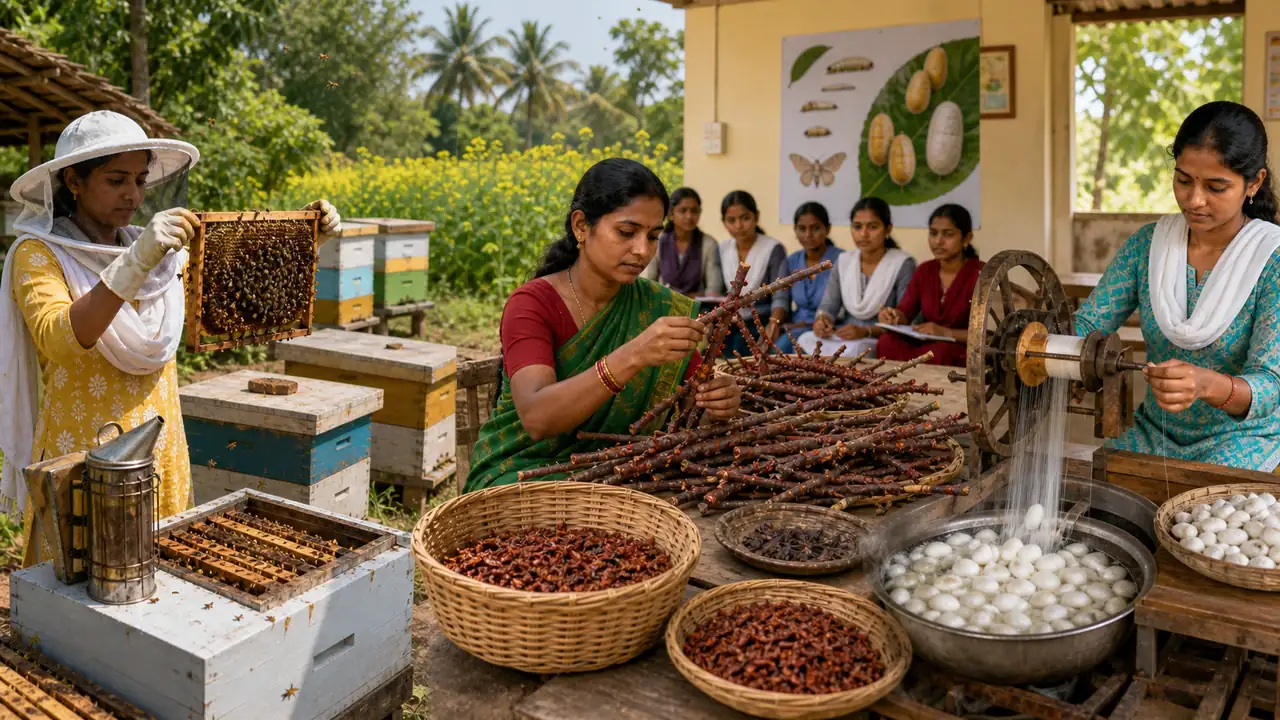
Sericulture
Sericulture is the rearing of silkworms for silk production. It combines agriculture and cottage or rural industry because it depends on:
- host plant cultivation, especially mulberry in common systems
- silkworm rearing
- cocoon production
- reeling and further processing
Why sericulture is more than worm rearing
Sericulture is a complete bio-industrial chain. It includes:
- host-plant support
- silkworm management
- cocoon production
- cocoon processing
- silk reeling
This is why it is grouped with farm enterprises rather than only zoology.
Historical background
Sericulture can be traced to very old Chinese records, and silk knowledge later spread to other countries. It became a strong agro-based industry in India because it connects rural households with a valuable commercial fibre.
Sericulture should be connected with:
- Bombyx mori
- mulberry feeding
- cocoon formation
- raw silk obtained by reeling
It also teaches the basic idea that the popular silk moth Bombyx mori is now fully domesticated and practically absent in the wild state. That makes sericulture a very special example of long-term human management of an insect species.
Common enterprise pattern
The logic is not random. These three are grouped because each one:
- depends on biological management
- creates value from a non-grain source
- supports enterprise-based agriculture
- can improve rural livelihood without depending only on ordinary crop harvest
Main products of the three enterprises
| Enterprise | Main output |
|---|---|
| Apiculture | honey, wax, pollination service |
| Lac culture | resinous lac |
| Sericulture | cocoons and silk |
Why the trio matters to farm families
These three enterprises strengthen agriculture in different ways:
| Enterprise | Main farm value |
|---|---|
| Apiculture | honey, wax, and pollination support |
| Lac culture | value from host trees and insect secretion |
| Sericulture | silk income through host plants, worms, cocoons, and reeling |
This table can also be remembered as a diversification map:
- apiculture supports crop productivity directly through pollination
- lac culture converts host-tree surfaces into an industrial resin product
- sericulture converts host leaves and silkworm care into cocoons and silk
Common management logic
Although bees, lac insects, and silkworms are biologically different, their enterprise pattern is similar:
- select suitable biological material
- maintain the host or habitat properly
- protect the organism from enemies and stress
- harvest at the correct stage
- process the product without losing quality
This one logic links all three enterprises:
- in apiculture, poor colony care or weak bee pasturage reduces honey and pollination value
- in lac culture, poor host-plant or insect management reduces stick lac quality
- in sericulture, poor hygiene or feeding reduces cocoon and silk quality
The bridge idea is very important here: all three enterprises show that management skill can be as important as land size in farm income generation.
Shared logic across the three enterprises
All three topics show the same big agricultural lesson:
- biology must be understood
- timing matters
- quality falls quickly under poor handling
- enterprise value comes from careful management, not from land area alone
Link with the next lessons
This bridge lesson prepares you for the detailed lessons that follow:
- 05-03 deepens bee species, colony life, hives, honey, and bee dances
- 05-04 explains host trees, lac insect life, and conversion of stick lac to shellac
- 05-05 covers silkworm history, life stages, cocoon formation, rearing, and reeling
A simple farm situation
Imagine a small farmer with one acre of crops, a few boundary trees, and family labour available after regular field work. Apiculture, lac culture, and sericulture show how such a farm can earn more without expanding its cultivated area.
| Enterprise | What the organism does | What the family manages | Main income idea |
|---|---|---|---|
| Apiculture | bees collect nectar, make honey, and pollinate crops | hive, bee pasturage, honey extraction | honey, wax, better crop set |
| Lac culture | lac insects produce resin on host twigs | host pruning, brood lac, harvesting, processing | stick lac, seed lac, shellac |
| Sericulture | silkworms convert mulberry leaves into cocoons | leaf supply, rearing hygiene, cocoon marketing | cocoons and silk chain |
How to study the cluster
Each enterprise can be understood through the same sequence: organism -> host or feed -> management -> product -> income. This makes the topics easier to connect and remember.
Small household situation
Riya's family grows mustard and vegetables. They add two bee boxes near the field during flowering. The direct product is honey, but the hidden benefit is better pollination. Her cousin, who has kusum and palas trees, may not keep bees but can use those trees for lac. A third family with mulberry leaves and a clean rearing room may choose sericulture. The right enterprise depends on local resources, not on fashion.
Summary Cheat Sheet
| Concept / Topic | Key Details / Explanation |
|---|---|
| Why these enterprises matter | Apiculture, lac culture, and sericulture are subsidiary enterprises that add income and diversification without needing more cropped area. |
| Apiculture | Apiculture depends on bees, bee pasturage, colony care, and the production of honey, beeswax, and pollination benefits. |
| Lac culture | Lac culture depends on host trees, brood-lac management, insect growth, and resin harvest from insect secretion on twigs. |
| Sericulture | Sericulture depends on host-plant support, especially mulberry in common systems, silkworm rearing, cocoon formation, and silk processing. |
| Shared enterprise logic | All three should be studied through the same sequence: organism -> host or feed -> management -> product -> income/ecological value. |
| Best unit takeaway | These enterprises show how biological skill and careful management can generate value beyond ordinary field-crop harvest. |
Lesson Doubts
Ask questions, get expert answers