🍄 Mushrooms, Landscaping, Biopesticides, Vermicompost and Nursery
A compact but complete lesson on mushroom cultivation, landscape basics, biopesticides, vermicompost, and nursery layout.
Mushrooms, Landscaping, Biopesticides, Vermicompost and Nursery
Several practical enterprises connect agriculture with skill, design, recycling, and input production.
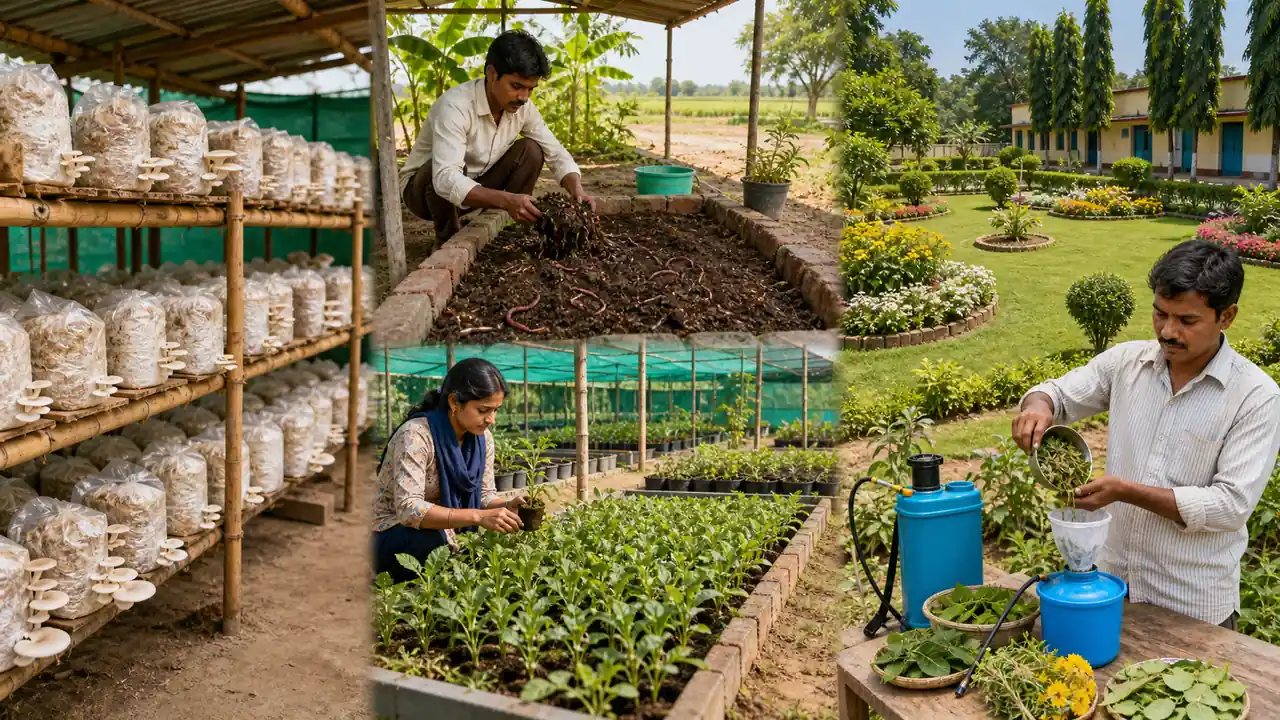
Mushroom cultivation
Mushroom cultivation is a useful enterprise because it:
- uses limited space
- converts agricultural waste into a useful product
- gives quick returns when managed well
Mushroom cultivation shows how low-value residues can be converted into a higher-value food product through proper substrate preparation, hygiene, and environmental control.
Mushroom production can be understood as a knowledge-based enterprise because mushrooms are saprophytic fungi. They do not make food through chlorophyll. Instead, they depend on prepared substrate, spawn, sanitation, and controlled environmental conditions.
It also links mushroom production with:
- use of agro-waste
- indoor or protected cultivation systems
- quick turnover compared with many field enterprises
- strong dependence on hygiene and environmental control
Useful terms in mushroom production include master spawn, commercial spawn, spawn run, and casing. Together they show that mushroom cultivation is a staged biological production system.
Pro Content Locked
Upgrade to Pro to access this lesson and all other premium content.
₹99 charged monthly · Cancel anytime
- All Agriculture & Banking Courses
- AI Lesson Questions (100/day)
- AI Doubt Solver (50/day)
- Glows & Grows Feedback (30/day)
- AI Section Quiz (20/day)
- 22-Language Translation (100/day)
- Recall Questions (20/day)
- AI Quiz (15/day)
- AI Quiz Paper Analysis (100/day)
- AI Step-by-Step Explanations (100/day)
- Spaced Repetition Recall (FSRS)
- AI Tutor
- Immersive Text Questions
- Audio Lessons — Hindi & English
- Mock Tests & Previous Year Papers
- Summary & Mind Maps
- XP, Levels, Leaderboard & Badges
- Generate New Classrooms
- Voice AI Teacher (AgriDots Live)
- AI Revision Assistant
- Knowledge Gap Analysis
- Interactive Revision (LangGraph)
🔒 Secure via Razorpay · Cancel anytime · No hidden fees
Mushrooms, Landscaping, Biopesticides, Vermicompost and Nursery
Several practical enterprises connect agriculture with skill, design, recycling, and input production.
Mushroom cultivation
Mushroom cultivation is a useful enterprise because it:
- uses limited space
- converts agricultural waste into a useful product
- gives quick returns when managed well
Mushroom cultivation shows how low-value residues can be converted into a higher-value food product through proper substrate preparation, hygiene, and environmental control.
Mushroom production can be understood as a knowledge-based enterprise because mushrooms are saprophytic fungi. They do not make food through chlorophyll. Instead, they depend on prepared substrate, spawn, sanitation, and controlled environmental conditions.
It also links mushroom production with:
- use of agro-waste
- indoor or protected cultivation systems
- quick turnover compared with many field enterprises
- strong dependence on hygiene and environmental control
Useful terms in mushroom production include master spawn, commercial spawn, spawn run, and casing. Together they show that mushroom cultivation is a staged biological production system.
The enterprise can operate at:
- marginal scale
- small scale
- industrial scale
This is useful because it teaches students that mushroom production is flexible in scale but strict in management.
Principles of landscape design
Landscape design brings beauty, utility, and order to open spaces. Basic principles include:
- balance
- unity
- proportion
- rhythm
- simplicity
In agriculture education, landscaping is linked to ornamental horticulture, nurseries, and public or home gardens.
Landscaping includes lawns, avenues, and garden styles. It should be understood as planned outdoor design, not mere decoration.
This means the enterprise combines:
- horticultural knowledge
- visual planning
- site preparation
- maintenance skill
Harmony is the essence of landscape gardening, and lawns, avenues, and style selection are all part of real landscape planning.
Biopesticides
Biopesticides are pest-control agents derived from living organisms or their products. They are important because they reduce chemical load and support eco-friendlier crop protection.
Examples may include microbial and botanical sources.
Biopesticides matter because they convert biological knowledge into safer crop protection. They are closely linked with IPM and with the idea of reducing chemical pressure in the farm ecosystem.
The unit groups biopesticides here because they are not only a science topic. They are also an enterprise and input-supply topic within agriculture.
Biopesticides belong in this cluster because they are not only a pest-control topic. They also support local input production and sustainable agriculture.
Vermicompost
Vermicompost is compost prepared with the help of earthworms. It is valued because:
- it improves soil structure
- it adds nutrients
- it supports microbial activity
- it turns waste into a useful farm input
Vermicompost is special because earthworms actively help convert waste into a finer, biologically richer manure. So this enterprise is both a recycling system and a soil-health system.
Its role includes:
- improving physical condition of soil
- enhancing soil biological life
- supporting nurseries, gardens, and organic farming systems
This means vermicompost works as both a manure product and a waste-management enterprise.
The connection between mushrooms and vermicompost is strong because both are residue-based enterprises in which biological agents transform low-value organic material into useful farm outputs.
Nursery and nursery layout
A nursery is a place where seedlings, saplings, or planting materials are raised before field planting.
A good nursery needs
- a suitable site
- irrigation access
- drainage
- shade or protection where needed
- paths, beds, and working space
A nursery looks small in area, but it is a high-value foundation enterprise because the quality of nursery stock strongly affects later field performance.
Nursery work includes propagation, hardening, and preparation of future orchard, garden, or vegetable crops. So nursery is not only a seedling place, but a quality-control stage for later production.
The cluster logic becomes stronger here: mushrooms, vermicompost, and nursery all depend heavily on controlled conditions and careful routine management.
The text also reminds students that nursery care is easier and more economical on a small protected site during the delicate early stage than in a full permanent field.
One way to connect all five topics
These enterprises are different in output, but similar in logic:
- they use skill more intelligently than brute scale
- they convert knowledge into value
- they help diversify farm and horticulture systems
They also share one more common point: each one can be started on limited area when management skill is strong enough.
These enterprises are especially suitable where land is limited but management attention, technical skill, and value addition can still raise income.
This is the real unifying lesson of the cluster: small area + good management + biological skill = high-value support enterprise.
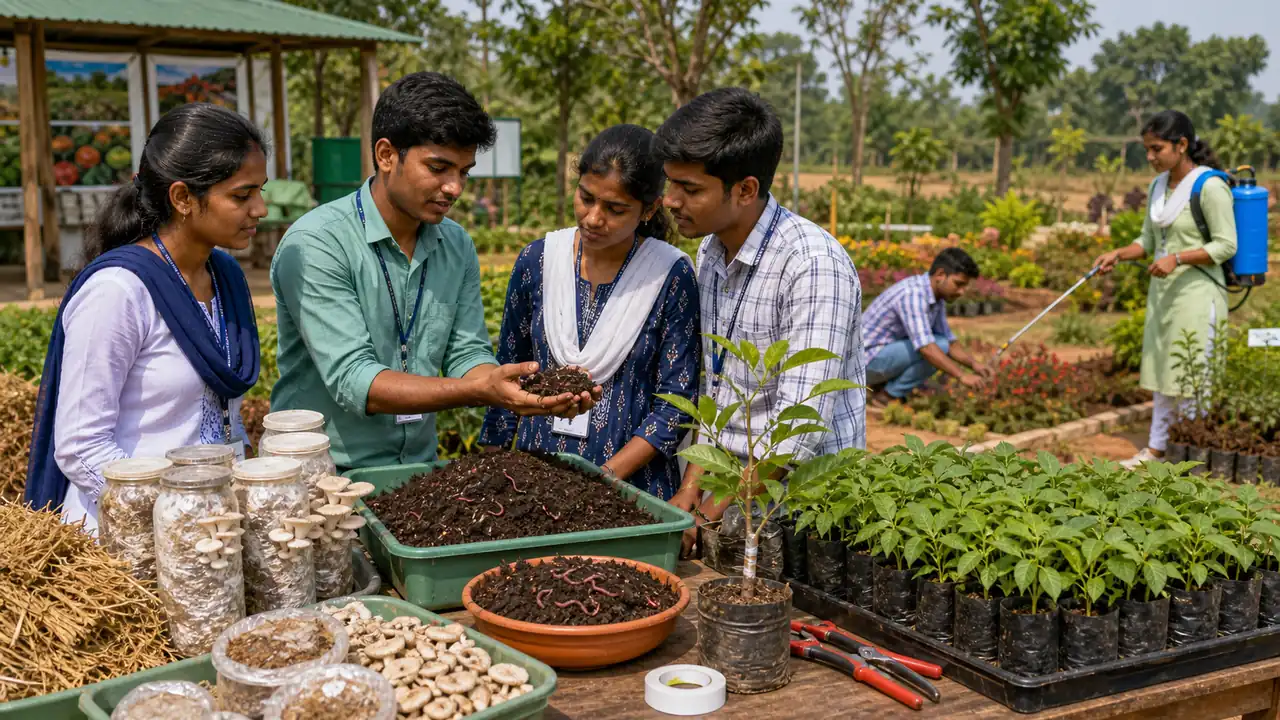
Common logic of the second cluster
This cluster teaches that specialized skill can create value even without very large land area:
- mushrooms turn residues into food
- landscape work turns open space into utility plus beauty
- biopesticides turn biology into crop protection
- vermicompost turns waste into soil fertility
- nurseries turn early care into future crop success
Why these topics are grouped together
The second half of Unit 5 trains students to think in terms of specialised support enterprises:
- mushrooms convert residues into food
- landscape design converts open land into planned utility and beauty
- biopesticides convert biology into safer crop protection
- vermicompost converts waste into a soil-building input
- nurseries convert careful early management into better future crops
So this section is really about support enterprises that strengthen the main farm and horticulture system instead of replacing it.
How the remaining lessons connect
| Lesson | Main deep topic |
|---|---|
| 05-06 | mushroom biology, substrate, spawn, compost, and production systems |
| 05-07 | landscape elements, principles, lawns, avenues, and garden styles |
| 05-08 | biopesticides, formulations, microbial examples, botanicals, and natural enemies |
| 05-09 | vermicompost value, worms, bed preparation, harvesting, and precautions |
| 05-10 | nursery importance, structures, bed types, soil mix, and hi-tech nurseries |
One unifying idea
All five topics reward careful observation and routine management:
- mushrooms fail when hygiene fails
- landscapes fail when proportion and harmony are ignored
- biopesticides fail when timing and targeting are poor
- vermicompost fails when moisture, shade, or waste quality is wrong
- nurseries fail when site, drainage, and aftercare are weak
Farm-skills connection
This cluster works like a farm-skills toolkit. Some enterprises create food, some improve appearance, some protect crops, some improve soil, and some produce healthy planting material.
| Topic | Farmer's problem | Enterprise answer | Simple analogy |
|---|---|---|---|
| Mushroom | crop residues are underused | convert straw or compost into edible fungi | turning leftovers into a new dish |
| Landscaping | plant arrangement lacks purpose | use design principles for beauty and function | arranging a room so movement feels natural |
| Biopesticides | pests need control with less chemical load | use microbes, botanicals, semiochemicals, and natural enemies | calling the ecosystem's own security team |
| Vermicompost | organic waste is wasted | earthworms convert it into stable manure | a biological recycling factory |
| Nursery | field planting needs uniform seedlings | raise strong planting material first | training students before the final exam |
Village enterprise example
A village youth group can combine several of these activities: mushrooms from straw, vermicompost from residues, nursery seedlings in the same shaded area, biopesticide support for vegetable growers, and landscaping services for schools or panchayat buildings.
Summary Cheat Sheet
| Concept / Topic | Key Details / Explanation |
|---|---|
| Mushroom cultivation | Mushroom cultivation is a controlled, high-value enterprise based on prepared substrate, hygiene, and environmental control. |
| Landscaping | Landscaping combines horticulture with aesthetics, planning, and practical use of space. |
| Biopesticides | Biopesticides support safer crop protection through biological sources and fit well with IPM and organic approaches. |
| Vermicompost | Vermicompost improves soil through biological recycling of organic waste by earthworms. |
| Nursery | Nurseries prepare healthy planting material and form the starting point of many horticultural systems. |
| Shared enterprise value | These enterprises strengthen the whole farm system, often suit small areas, and depend more on management skill than on large land area. |
Lesson Doubts
Ask questions, get expert answers