🍯 Apiculture: Colony, Hives and Honey Production
A deeper lesson on bee species, colony structure, swarming, hives, and honey production.
Apiculture: Colony, Hives and Honey Production
Bee keeping becomes productive when we understand both bee biology and hive management.
Why apiculture matters
- provides honey
- provides beeswax
- improves pollination and crop yield
In practical agriculture, pollination is often the biggest long-term benefit.
History in one glance
Beekeeping can be understood as an old human enterprise:
- rock paintings suggest early human association with honey
- ancient Egyptians knew organised bee keeping
- Indian tradition also preserves references to bee and honey
- commercial apiculture expanded greatly after scientific work in the nineteenth century
Important honey bee species
The school-level chapter commonly names four bees:
- Apis dorsata
- Apis indica
- Apis florea
- Apis mellifera
Students mainly need to remember that some are wild and difficult to domesticate, while managed beekeeping relies on more suitable hive-forming species.
Managed and wild tendency
At a simple level:
Pro Content Locked
Upgrade to Pro to access this lesson and all other premium content.
₹99 charged monthly · Cancel anytime
- All Agriculture & Banking Courses
- AI Lesson Questions (100/day)
- AI Doubt Solver (50/day)
- Glows & Grows Feedback (30/day)
- AI Section Quiz (20/day)
- 22-Language Translation (100/day)
- Recall Questions (20/day)
- AI Quiz (15/day)
- AI Quiz Paper Analysis (100/day)
- AI Step-by-Step Explanations (100/day)
- Spaced Repetition Recall (FSRS)
- AI Tutor
- Immersive Text Questions
- Audio Lessons — Hindi & English
- Mock Tests & Previous Year Papers
- Summary & Mind Maps
- XP, Levels, Leaderboard & Badges
- Generate New Classrooms
- Voice AI Teacher (AgriDots Live)
- AI Revision Assistant
- Knowledge Gap Analysis
- Interactive Revision (LangGraph)
🔒 Secure via Razorpay · Cancel anytime · No hidden fees
Apiculture: Colony, Hives and Honey Production
Bee keeping becomes productive when we understand both bee biology and hive management.
Why apiculture matters
- provides honey
- provides beeswax
- improves pollination and crop yield
In practical agriculture, pollination is often the biggest long-term benefit.
History in one glance
Beekeeping can be understood as an old human enterprise:
- rock paintings suggest early human association with honey
- ancient Egyptians knew organised bee keeping
- Indian tradition also preserves references to bee and honey
- commercial apiculture expanded greatly after scientific work in the nineteenth century
Important honey bee species
The school-level chapter commonly names four bees:
- Apis dorsata
- Apis indica
- Apis florea
- Apis mellifera
Students mainly need to remember that some are wild and difficult to domesticate, while managed beekeeping relies on more suitable hive-forming species.
Managed and wild tendency
At a simple level:
- some bee species are largely wild and difficult to manage scientifically
- some adapt better to hive-based beekeeping
This is why species choice matters in commercial apiculture.
Species comparison table
| Species | Common name | Key feature |
|---|---|---|
| Apis dorsata | rock bee | large, open-comb, high honey potential, difficult to domesticate, aggressive |
| Apis indica | Indian bee | medium-sized, several parallel combs, comparatively manageable |
| Apis florea | little bee | small/open comb habit, low honey yield |
| Apis mellifera | European bee | widely introduced and suitable for modern hive management |
Species should always be connected with management possibility. Honey yield alone is not enough; domestication behaviour and temperament decide commercial usefulness.
The honey bee colony
| Member | Main role |
|---|---|
| Queen | egg laying |
| Workers | foraging, nursing, cleaning, defence |
| Drones | mating |
Understanding queen, workers, and drones
- Queen: only fully developed fertile female; can lay large numbers of eggs.
- Workers: sterile females that do almost all work in the hive.
- Drones: male bees whose main role is mating.
Queen
- she is the largest member of the colony
- she may live for about 3-4 years
- she may lay about 800-1500 eggs per day
- sperm stored after the nuptial flight can last for her whole life
Workers
Workers are sterile females with:
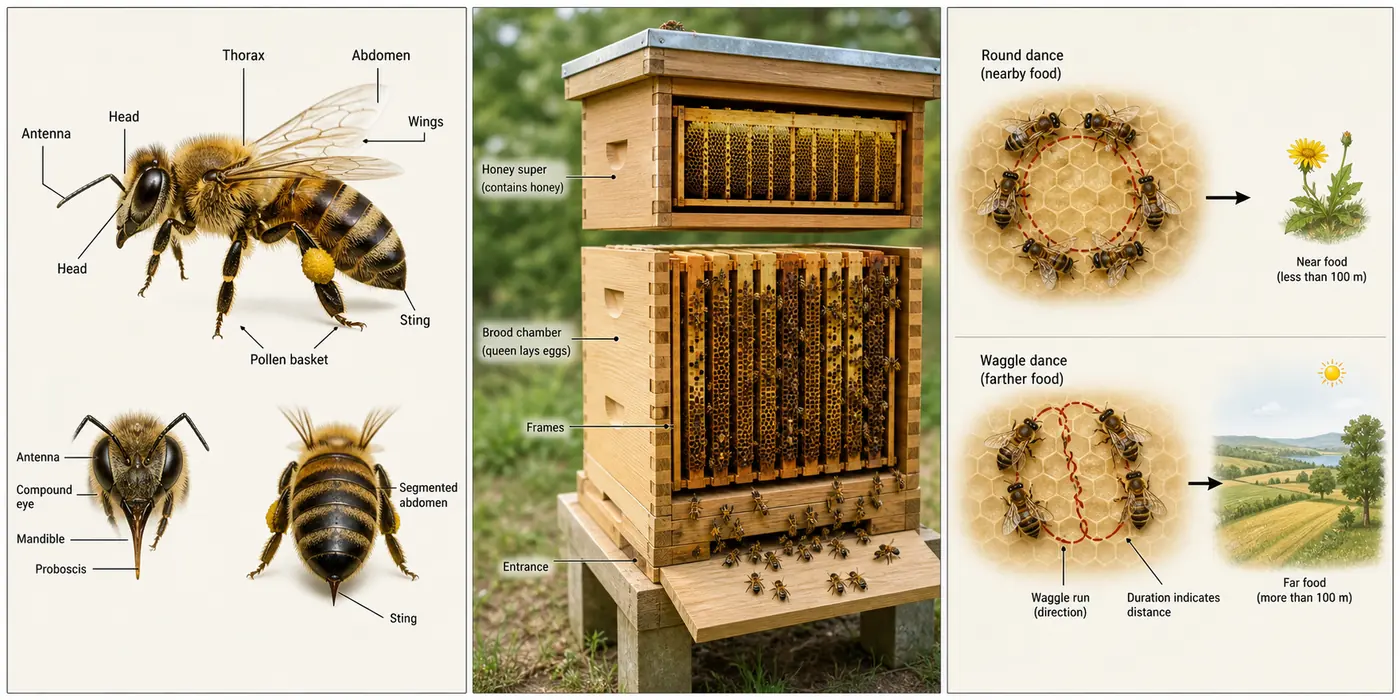
- an efficient sucking proboscis
- wax glands
- a sting
They also live much shorter lives than queens and pass through changing duties as they age.
Age-wise duties of workers
This is an important conceptual point:
- early life: cleaning and caring for brood
- middle stage: guarding
- later stage: foraging for nectar and pollen
Worker duty schedule
| Worker age | Main duty idea |
|---|---|
| 1-14 days | cleaning hive and feeding larvae |
| 14-20 days | guard duty near entrance |
| 21-35 days | foraging for nectar and pollen |
This age-based division of labour makes the colony efficient. A hive is not a crowd of identical insects; it is an organized living factory.
Bee dances and food finding
Worker bees communicate food location through bee dances. This is how the colony recruits more foragers when a good nectar source is found.
These dances can be understood as an important behavioral adaptation because they convert individual discovery into colony-level productivity.
Fertilized and unfertilized eggs
The queen can lay:
- fertilized eggs -> females
- unfertilized eggs -> drones
This is the simplest way to understand caste formation in the colony.
Royal jelly and caste differentiation
At school level, the important idea is:
- larvae from fertilized eggs can become workers or queens
- continued feeding on royal jelly supports queen development
- ordinary worker feeding leads to worker development
Swarming and new queen formation
When colonies become crowded or when the old queen ages, workers prepare new queen cells. A new queen emerges, and the old queen may leave with many workers to form another colony. This movement is called swarming.
Swarming is therefore both a biological event and a management issue. For the beekeeper, it means colony division, possible loss of field force, and the need for proper hiving of swarms.
Hive systems
Traditional and modern hives differ in manageability. Modern hives make inspection and honey extraction easier.
Indigenous methods
Important examples include:
- fixed wall hives
- wooden boxes
- earthen pitchers
These systems can produce honey, but they are less scientific and often more destructive to the comb and colony than modern movable-frame methods.
Important parts of a modern hive
- brood chamber
- supers
- frames with wax foundation
- roof and floor
- queen excluder
The queen excluder keeps the queen out of honey-storage sections while allowing workers to pass.
The broader lesson is that the modern hive is designed for inspection, comb protection, and non-destructive honey extraction.
Hiving a swarm
Two broad approaches are described here:
- a traditional method using a sloping board so bees move upward into the hive
- a quick method in which the swarm is transferred from above into the brood chamber
In both cases, the queen must enter safely and sugar syrup feeding helps the swarm settle.
This reinforces an important enterprise point: bee keeping is not passive. Colony transfer and settling require technique.
Bee pasturage
Plants that provide nectar and pollen are called bee pasturage. Good bee pasturage directly improves honey yield and pollination service.
Raw materials from flowers
- nectar is the sweet secretion that becomes the raw material of honey
- pollen is an essential brood food
Together, nectar and pollen connect apiculture directly with flowering crops and natural vegetation.
How honey is formed
Bees collect nectar, process it, and store it in comb cells. Water is gradually reduced, and honey becomes concentrated enough for storage.
Composition and processing logic
Honey is mainly a concentrated sugar solution containing:
- water
- fructose
- glucose
- traces of minerals
- minute quantities of vitamins
Workers collect nectar, mix it with salivary secretions, carry it in the honey stomach, regurgitate it into storage cells, and fan away excess moisture.
Honey composition memory table
| Component | Lesson-aligned range/idea |
|---|---|
| Water | about 13-20% |
| Fructose | major sugar fraction |
| Glucose | another simple sugar fraction |
| Minerals | traces |
| Vitamins | minute quantities such as B-group and C references |
The exact flavour and composition of honey changes with flower source, which is why bee pasturage decides both quantity and character of honey.
Honey extraction
In scientific beekeeping, extraction is commonly done by centrifugation.
This matters because modern extraction allows honey collection without destroying the entire comb structure.
Uses of honey and beeswax
Honey
- food
- medicinal and traditional uses
- religious uses
- ingredient in value-added products
Beeswax
- candles
- cosmetics and pharmaceuticals
- varnishes and related products
- comb foundation in apiaries
Wax should also be treated as a valuable product in its own right, not just a by-product.
Indigenous versus modern hive management
| Point | Indigenous methods | Modern hive methods |
|---|---|---|
| Structure | wall spaces, boxes, pitchers, local containers | stacked boxes with frames |
| Comb handling | comb may be cut and squeezed | frames can be removed and reused |
| Colony protection | often disturbed heavily | less destructive inspection/extraction |
| Honey extraction | smoking and squeezing common | centrifugation possible |
| Queen control | limited | queen excluder helps keep brood and honey areas separate |
This comparison is useful for long answers because it explains why modern apiculture became more scientific and commercially reliable.
Swarm catching and hiving checklist
When a swarm is collected, the beekeeper must:
- collect the cluster gently in a suitable container
- transfer it into a prepared hive
- ensure the queen enters
- provide frames or foundation for comb building
- feed sugar syrup initially if needed
- allow the colony to settle without repeated disturbance
Both traditional and quick hiving methods are given here. The central point is the same: successful hiving depends on guiding the whole swarm, especially the queen, into the new hive.
Bee dances in more detail
Round dance
Used for nearby food sources. It mainly tells other bees that food is available close to the hive, but it does not give precise directional information.
Waggle dance
Used for more distant food sources. It carries information about:
- direction in relation to the sun
- distance or effort needed to reach the hive
Main points for a full answer
A full answer on apiculture generally includes:
- three uses of bee keeping
- main bee castes and their roles
- swarming
- bee pasturage
- hive parts such as queen excluder
- honey and wax uses
Additional notes
Honey uses, purity and formation facts
| Source point | Main idea |
|---|---|
| Honey is energy-rich and vitamin-containing | Write it as a nutritious bee product, not only a sweetener |
| Ayurvedic and Unani medicine carrier | Also linked with laxative action and relief from cold, cough and fever |
| Religious and household use | Used in ceremonies, alcoholic drinks, and beauty lotions |
| Scientific research use | Honey may be used for preparing bacterial cultures |
| Pest-management use | It may be used in poison baits for some insect pests |
| Purity clue | Homogeneous granulation is a probable sign of purity |
| Laboratory test | Monosaccharide tests help detect honey quality |
In honey formation, nectar is mainly sucrose-rich. The bee stores it in the honey stomach, where salivary amylase helps hydrolyse sucrose into the monosaccharides fructose and glucose. Inside the hive, workers regurgitate the processed nectar and fan their wings to remove excess water. This is why mature honey is thick, concentrated, and storable.
Dance language source table
| Dance type | Distance clue | What is communicated |
|---|---|---|
| Round dance | about 25-100 m or nearby | food is close; no precise direction is given |
| Sickle dance / figure-eight transition | intermediate distance | transition between round and waggle patterns |
| Waggle dance | distant source | direction relative to sun and energy or distance needed |
Quality of the nectar source affects the dance. Rich, abundant nectar produces longer and more vigorous dances, while poorer sources produce fewer and weaker dances.
Waggle dance numeric memory
| Food-source distance | Approximate dance clue from source |
|---|---|
| 200 m | about 8-9 circuits in 15 seconds |
| 1000 m | about 4-5 circuits in 15 seconds |
| 2000 m | about 3 circuits in 15 seconds |
Direction is shown by the angle of the waggle run. If the bee waggles straight upward on the comb, recruits fly toward the sun. If the waggle run is 60° left of upward, food lies 60° left of the sun. If the waggle run is 120° right of upward, recruits use that solar angle. Sounds during the waggle run help recruits interpret the signal in the dark hive.
The colony as a working unit
Think of a bee colony as a village with one reproductive mother, thousands of workers, and a few seasonal males. The hive is not just a wooden box; it is a living workplace where temperature, food storage, childcare, cleaning, defence, and communication happen at the same time.
A simple analogy
| Hive part or bee role | Everyday analogy | What to remember |
|---|---|---|
| Queen | principal of heredity, not daily manager | lays eggs and maintains colony continuity |
| Workers | all-round staff | nurse, clean, guard, forage, build, and process honey |
| Drones | seasonal male role | mate with queen, do not collect food |
| Brood chamber | nursery-like section | eggs, larvae, and pupae develop here |
| Super | storage room | surplus honey is stored here |
Small farm situation
A mustard grower keeps bee boxes near the field during flowering. The student may first notice honey, but the farmer watches pod set. If pollination improves, the crop may give better yield and the beekeeper also earns from honey. This is why apiculture is both a production enterprise and a crop-support enterprise.
Summary Cheat Sheet
| Concept / Topic | Key Details / Explanation |
|---|---|
| Main value of apiculture | One of the biggest agricultural advantages of apiculture is pollination, along with honey and beeswax production. |
| Colony structure | A bee colony should be studied as a working unit of queen, workers, drones, brood, food storage, and communication. |
| Worker bees | Workers perform most routine hive duties such as nursing, cleaning, guarding, foraging, and general colony maintenance. |
| Key management terms | Queen excluder, swarming, and bee pasturage are high-value exam and management terms. |
| Bee communication | Round dance and waggle dance are important bee-communication terms used to indicate food-source information. |
| Best lesson takeaway | Productive bee keeping depends on both colony biology and movable-frame hive management. |
Lesson Doubts
Ask questions, get expert answers